
navigation

Most of B2B has gone digital. Buyers browse online catalogs, build carts, request quotes—and expect to complete the transaction without switching channels.
But that’s not what happens.
Invoices are emailed. POs get uploaded manually. Payments are made on rails chosen more for habit than fit. And the finance team is left to piece it all together on the back end.
This guide walks through the state of B2B payments in 2025: the rails most companies rely on, the challenges finance teams are still wrestling with, and the practical patterns, like self-service invoicing portals, that reduce DSO and keep both buyers and sellers happy.
The State of B2B Payments in 2025-2026
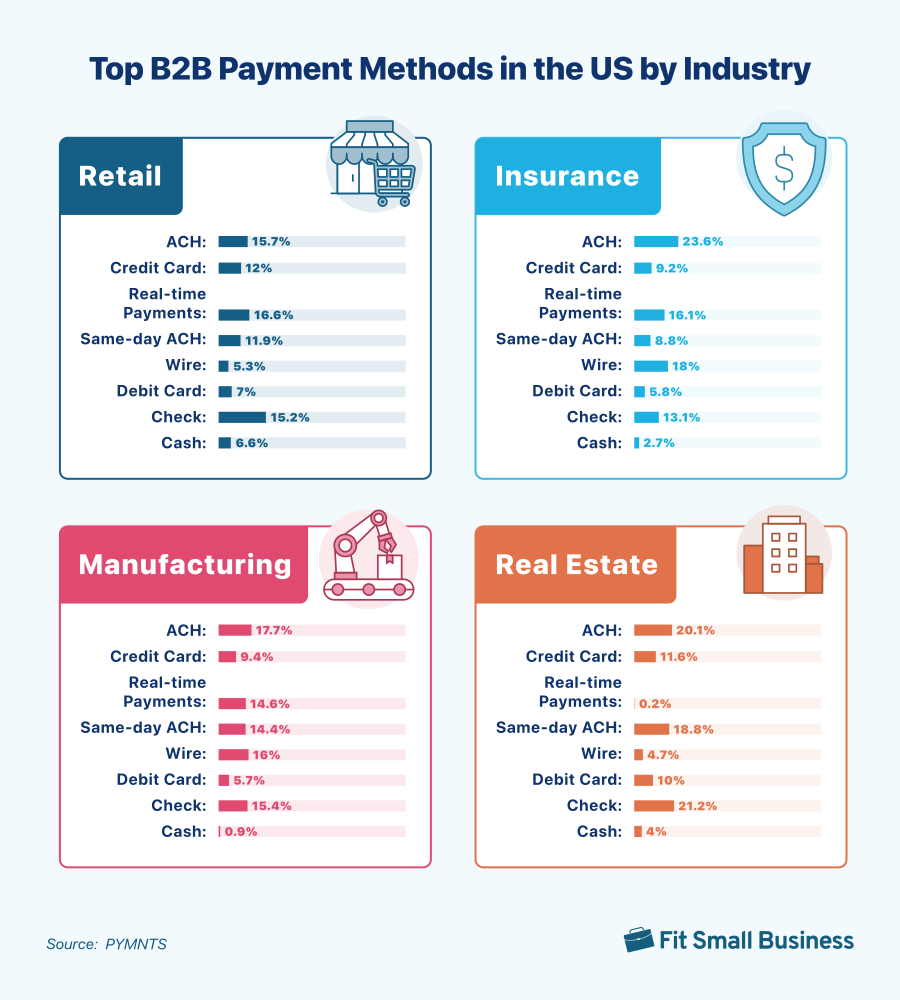 Every part of B2B commerce has moved faster, except payments.
Most sales now start online. Buyers browse digital catalogs, build carts, request quotes. But when it’s time to pay, too many are still pushed back into manual workflows: email for the invoice, PDF for the PO, and a reminder to call accounts receivable if something looks off.
Checks continue to show up, not because anyone prefers them, but because no one’s replaced them. They’re expensive to process, slow to clear, and vulnerable: 63% of U.S. businesses reported check fraud in 2024. Finance teams know it’s inefficient. But in B2B, modernizing payments takes more than plugging in Stripe.
ACH still carries most of the volume — 7.3 billion B2B ACH payments in 2024, with Same Day ACH passing one billion transactions. These rails are stable and cheap, which is why they’ve held their ground. But speed expectations are rising. Real-time networks like RTP® and FedNow are now live and growing. Distributors use them to release shipments the moment funds arrive. But adoption on the buyer side is still limited, and not every use case justifies the speed premium.
Faster rails help, but they don’t fix broken processes. Nearly half of B2B invoices are paid late, and 8% are written off. That gap creates tension across sales, ops, and finance. When buyers can’t view terms, payment status, or credit limits in real time, they open a ticket or abandon the order. Either way, someone pays for the delay.
None of this points to a single broken tool. It points to payment infrastructure being used without a plan. Without rules, routing, or reconciliation logic, payment operations lag behind the rest of the business.
Choosing the Right B2B Payment Methods for eCommerce
Not all payments carry the same weight. An ACH transfer that clears in two days is fine for a standing reorder but disastrous if a shipment is waiting on release. A wire is reliable across borders but too expensive for routine invoices. Checks still appear, but only because habits die hard.
To design a payment stack that works, you need a clear view of settlement speed, processing cost, and operational fit. The table below lays out the current rails through that lens.
Rail |
Settlement |
Cost |
Typical Use Case |
Tradeoffs |
| ACH | 1–3 days | Low | Invoice payments, recurring orders | Delays if remittance is sent separately |
| Same Day ACH | Same day (cutoff) | Low–Moderate | Month-end invoicing, urgent account releases | Cutoff windows limit flexibility |
| RTP® / FedNow | Seconds, 24/7 | Varies | Release-on-receipt shipments, supplier payouts | Adoption gaps on buyer side |
| Corporate Cards | Real-time auth | High (fees) | Spot buys, field teams, small branches | Requires Level 2/3 data to control fees |
| Wire Transfers | Same day | High | High-value or cross-border transactions | Manual, costly, buyer friction |
| Checks | Days to weeks | High + fraud risk | Legacy accounts, industries slow to digitize | Error-prone, incompatible with automation |
Where B2B Payment Projects Break
Adding more rails doesn’t automatically fix payments. The problems show up in how those methods are controlled, applied, and tied back to the rest of the transaction.
No routing logic
When every customer sees every rail, cost creeps in. Interchange fees rise, instant payments go unused, and card data isn’t detailed enough to qualify for better rates. The answer is discipline in routing. Decide which buyers should use which rail, and when, instead of leaving everything open.
No enforcement of terms
Most rails don’t know anything about account terms. They don’t enforce credit limits or respect purchase orders. If approvals aren’t built into the process, orders stop moving until finance or sales gets involved. That creates delays that have nothing to do with settlement speed.
Manual reconciliation
Cash can hit the account without a clear path to the right invoice. Missing addenda on ACH, incomplete wire instructions, or generic card settlements all force AR to match by hand. Without reliable mapping into ERP, every payment turns into detective work.
Compliance gaps
PCI DSS v4.0 changed the baseline for handling card data. Tokenization, authentication, and role-based controls are now expected in production systems, not just listed in policy documents. Companies that lag here don’t just face audit findings; they leave gaps fraudsters can exploit.
Designing a Payment Flow That Doesn’t Stall
The challenge with B2B payments isn’t choosing rails. It’s creating a flow where buyers know what to expect and finance knows where the money belongs. The pattern that works starts with checkout, runs through invoicing, and ends with cash application.
Checkout sets the tone. If it mirrors the buyer’s actual terms — whether that’s invoice on delivery, credit line, or card settlement — the order moves forward without intervention. When it doesn’t, carts stall, and the deal goes back into email.
Invoices need to live where buyers can find them. A portal that shows open balances, credit status, and past transactions removes the uncertainty that drives late payments. Instead of waiting for a statement, buyers can log in and clear what they owe.
On the back end, reconciliation has to be automatic. When payments are matched to invoices and posted to ERP without manual effort, cash closes faster and finance can focus on exceptions, not detective work.
Put together, that’s a payment flow that supports buyers, speeds settlement, and keeps AR under control.
How OroCommerce Handles Payments — and Why It Works Better
In most systems, payments are bolted on. Checkout happens in one tool, invoicing in another, and reconciliation in a third. That leaves finance cleaning up what the platform can’t connect.
OroCommerce takes a different approach. We built payments into our B2B eCommerce platform to support the full order-to-cash cycle, not just the front end.
Here’s what that looks like in practice:
Procurement
When Maria logs in to place an order, she sees her negotiated prices and net-30 terms reflected at checkout. Her account’s Payment Rules require a PO number, so she adds it. No need to email her rep or wait for someone to match paperwork.
AR
When payment comes in, David doesn’t need to hunt for context. If it’s through OroPay, he sees enriched metadata — tokenized card info, wire references, or ACH addenda — already mapped to the right invoice. If the customer used another gateway, the platform still supports ERP sync and reconciliation rules to minimize manual steps.
Sales
Michael’s large accounts use the Invoice Portal. They log in, check open balances, download statements, and pay when it suits their process. She’s no longer stuck answering billing questions and can focus on growing the account.
Under the hood:
- Payment Rules tailor which methods and terms appear for each account, whether it’s card, invoice, instant, or deferred.
- The Invoice Portal gives buyers and finance teams visibility into billing without relying on inboxes.
- OroPay, OroCommerce’s built-in payment service, is available for teams that want more control over how payments are processed and settled. It offers native tokenization, PCI DSS v4.0 alignment, and support for metadata-rich payments that speed up matching and settlement. For businesses using other gateways, OroCommerce supports integrations with processors like Authorize.net, Cybersource, PayPal, and others.
 No one system solves payments alone but when checkout, invoicing, and finance tools share one platform, teams stop working against each other. That’s why OroCommerce made payments part of the core experience: so the people placing orders, approving credit, and closing the books can finally work from the same playbook.
Where to Focus From Here
You don’t need to redesign your entire payment stack tomorrow. But you do need a plan that connects how buyers pay with how your teams operate.
If your current platform can’t enforce terms at checkout, surface invoices to customers, or apply payments without AR intervention, you’re working around the system, not with it.
Start by mapping the flow:
- Where do buyers hit blockers?
- Where does finance pick up manual work?
- What’s missing between checkout and the ledger?
Once you can answer those, it becomes easier to spot where tools like Payment Rules, Invoice Portals, and integrated settlement would make the biggest difference. And whether your current system is built to support them, or built to resist them.
We’ll walk you through how your current flow compares — and what you could simplify, automate, or stop doing entirely.
Frequently Asked Questions
How to choose a global payments platform?
Choosing a global payments platform can be a daunting task, but there are several key factors that businesses should consider to ensure they choose the right platform for their needs.
- Coverage: Businesses should choose a platform that supports the currencies and payment methods they need to operate in their target markets.
- Security: A platform should provide robust security features such as encryption, fraud detection, and compliance with industry standards and regulations.
- Integration: The platform should be easy to integrate with the business’s existing systems and processes.
- Cost: The cost of the platform is another important consideration. Businesses should choose a platform that offers transparent pricing, with no hidden fees or charges.
- Support: Finally, businesses should choose a platform that provides reliable support and customer service. This can help to ensure that any issues or concerns are addressed promptly and efficiently.
What payment method is most commonly used in B2B eCommerce?
ACH (Automated Clearing House) transfers remain the most commonly used payment method in B2B eCommerce. They’re favored for their low cost, reliability, and compatibility with recurring invoicing.
Which is the best B2B payment platform?
The market most trusted B2B online payment platforms are:
- PayPal
- Authorize.net
- Stripe
- Amazon Pay
- 2Checkout
Or you can use OroCommerce’s native payment service, OroPay to help you seamlessly connect your commerce to your cash flow.