
navigation

The construction industry runs near 20% online-order adoption, behind almost every other distribution sector. The demand is there. What’s missing is a cart that fits how these accounts buy.
So orders keep arriving by email and phone, and someone on your team rekeys them.
Both of the obvious fixes cost you something. Move these accounts onto a standard checkout and the pricing and approvals they buy under have nowhere to live, so they call the rep anyway. Leave them on manual entry and you’re paying for the rekeying while a competitor picks up the reorders.
So the digital platform decision is less about the shopping experience and more about what sits behind it.
In this guide you’ll learn what to look for in the best construction B2B eCommerce platform, and how the top five compare in 2026.
What to Look for in a Construction B2B eCommerce Platform
Every vendor demo looks good. The differences show up in how a platform handles the way building materials get sold. Eight things to check before you shortlist an e commerce platform for your construction business:
- Job account hierarchies. You need corporate accounts with sub-accounts underneath, where every site gets its own spending limit, delivery rules, and approval path. Superintendents on different jobs should be able to keep separate carts open at the same time.
- Contract pricing. Every account pays a different price, and those price lists change. The platform has to show each buyer their account specific rates the moment they log in, straight from whatever system owns them.
- AI order capture. Plenty of your orders will keep arriving as emailed PDFs and spreadsheet material lists, whatever the portal offers. Ask how each platform reads those, extracts the line items, prices them against the account, and turns them into a draft order your team approves.
- Unit-of-measure conversion. Buyers order in board feet, pieces, bundles, and pallets, sometimes for the same product. Conversion has to happen in the cart across your full product range, or your team catches the mistake after the truck is loaded.
- Credit controls. Checkout here is a credit decision, not a card swipe. The platform should check the account against its limit and payment terms before the order goes through, and stop orders on held accounts.
- Delivery options. One order can split between branch pickup, direct ship from the mill, and a job-site drop with a time window. Buyers should choose per line and see freight priced accordingly.
- Two-way ERP integration. Stock, pricing, and order status live in ERP systems like BisTrack, Prophet 21, or Eclipse. Buyers need real time inventory across multiple branches, because one wrong number and they stop trusting the site.
- Sales rep account access. Buyers handle routine reorders themselves, then want a rep for the large or unusual ones. Sales reps should be able to open the buyer’s cart, adjust a quote, and place the order in a single system, so the buyer isn’t repeating what they already entered online.
Get a Free eCommerce RFP Template for B2B Sales
Top 5 Construction B2B eCommerce Platforms at a Glance
The right eCommerce platform for construction suppliers depends on what you already run in the back office, how many branches you operate, and how much developer time you have. Here’s how the five compare for construction e commerce and building materials distribution.
| Platform | Target Market and Fit | Standout Construction Capability | ERP Integration Approach | Licensing Model |
|---|---|---|---|---|
| OroCommerce | Mid-market to enterprise building materials distributors, manufacturers, and multi-branch networks running one platform across brands and regions. | Native account hierarchies with separate carts per job site, matrix pricing across large catalogs, and AI order capture that removes the manual processes behind emailed POs and material lists. | Prebuilt connectors for Epicor P21, Microsoft Dynamics, and Sage X3. Other ERPs, including LBM-specific systems, connect through APIs or middleware. | GMV-tiered single license covering commerce, CRM, and workflow. No per-transaction, per-user, or API fees. |
| Adobe Commerce | Enterprise distributors with in-house development teams that want full control over the codebase and multiple branded sites. | Deep catalog customization for technical product data, safety documentation, and installation guides, plus a large third-party extension marketplace. | No prebuilt connectors for LBM ERPs. Integration is custom API development or middleware. | Quote-based license tied to annual GMV and average order value. Three deployment models in 2026: cloud PaaS, ACCS SaaS, and Commerce Optimizer. |
| Agentforce Commerce (formerly Commerce Cloud) | Enterprise organizations already standardized on Salesforce CRM and MuleSoft. | Customer relationships and commerce activity live on the same account record, with Agentforce Revenue Management for contract pricing and approvals. | Middleware-driven through MuleSoft or another integration platform. No native LBM ERP connectors. | Subscription priced per order or as a percentage of GMV, plus separate licensing for ecosystem modules. |
| Sana Commerce | Mid-market distributors running SAP or Microsoft Dynamics that want commerce driven from ERP data. | Contract price lists, credit holds, and stock levels read directly from ERP records rather than a synced copy. | Runs inside the ERP itself. Covers SAP ECC, S/4HANA, and Business One, plus Dynamics 365 Finance and Supply Chain, NAV, and Business Central. | Annual subscription with the ERP connector included. Your ERP determines whether the platform is an option at all. |
| BigCommerce B2B Edition | Smaller regional distributors in the construction sector that want to start selling online with limited internal IT. | Prebuilt buyer portal with account price lists, purchasing roles, spending limits, and quote management. | Multi-tenant SaaS connected through third-party integration middleware. | Custom-quoted enterprise tier based on annual GMV, with B2B Edition as an add-on. |
5 Best B2B eCommerce Platforms for Construction Companies in 2026
1. OroCommerce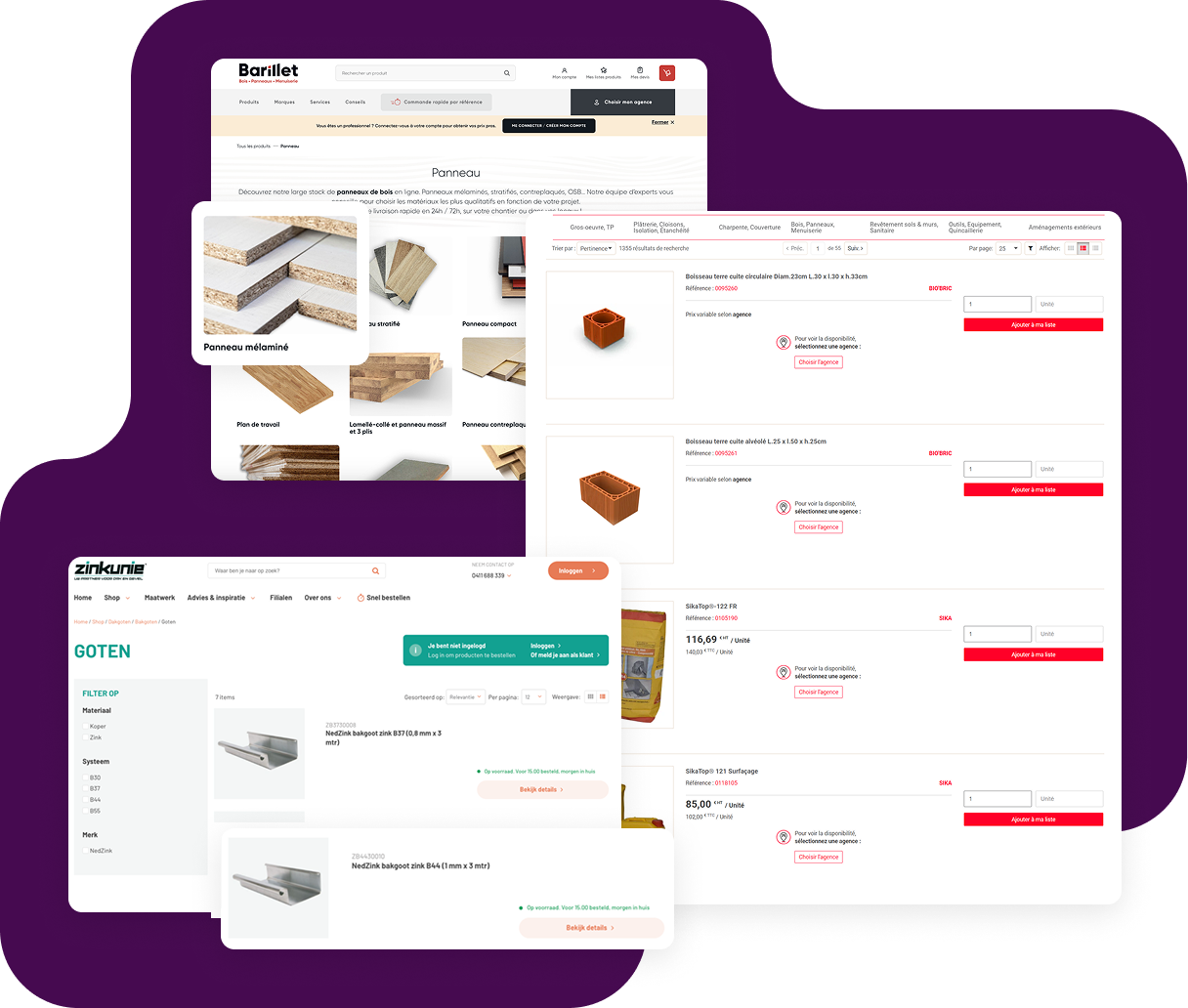
OroCommerce was built for B2B rather than adapted from retail, so contract pricing, account hierarchies, quoting, and the CRM behind your customer relationships come in the box and work off the same records. Few platforms in this comparison start from that position. It’s aimed at mid-market and enterprise distributors running several brands, regions, or branches from one instance.
Best Fit
Distributors connecting one or more ERP systems, managing job-site account structures, and putting reps and buyers in the same single system, all under one license.
Key Capabilities
- AI order capture. SmartOrder reads POs arriving as email, PDF, or Word, matches the line items to your SKUs, checks them against contract pricing, and builds a draft order your team approves. That takes the manual data entry out of orders that never touch the cart.
- Account hierarchies. Procurement teams and large contractors set a separate spending limit, delivery address, and approval path for each site superintendent.
- Self-service portals. Buyers buy online, check order status, pull invoices, and submit RFQs themselves, which takes routine calls off the counter team and lets it improve customer service on the ones that matter.
- Matrix pricing. Contract rates, the special pricing agreements that come out of your supplier relationships, and price lists updates apply across large catalogs and resolve by customer type.
- Credit controls. Orders check against the account’s credit limit and payment terms before they go through, and accounts on hold stop at checkout.
- Delivery options. One order splits across branch pickup, direct ship, and job-site delivery, with freight priced per line.
- Built-in CRM. Sales teams work from one set of records, so digital channels and offline channels run off the same account history. Field reps drop into a buyer’s session through account impersonation.
- Unit-of-measure conversion. Board feet, linear feet, square feet, pallets, and bundles convert during the ordering process.
- Branch stock visibility. Buyers check inventory levels and product availability branch by branch, which matters when material shortages send them hunting for a substitute.
- Multi-brand and multi-region. One instance runs separate sites for each brand, region, or branch network, which is how distributors open new markets and new sales channels on infrastructure they already run.
Pricing
One GMV-tiered license covers everything OroCommerce ships for construction supply eCommerce. No per-transaction charges and no API fees, so costs stay predictable as online sales grow and you reduce costs that scale with volume elsewhere.
Bring your messiest account and contract pricing setup and see how we handle it. Book a demo
2. Adobe Commerce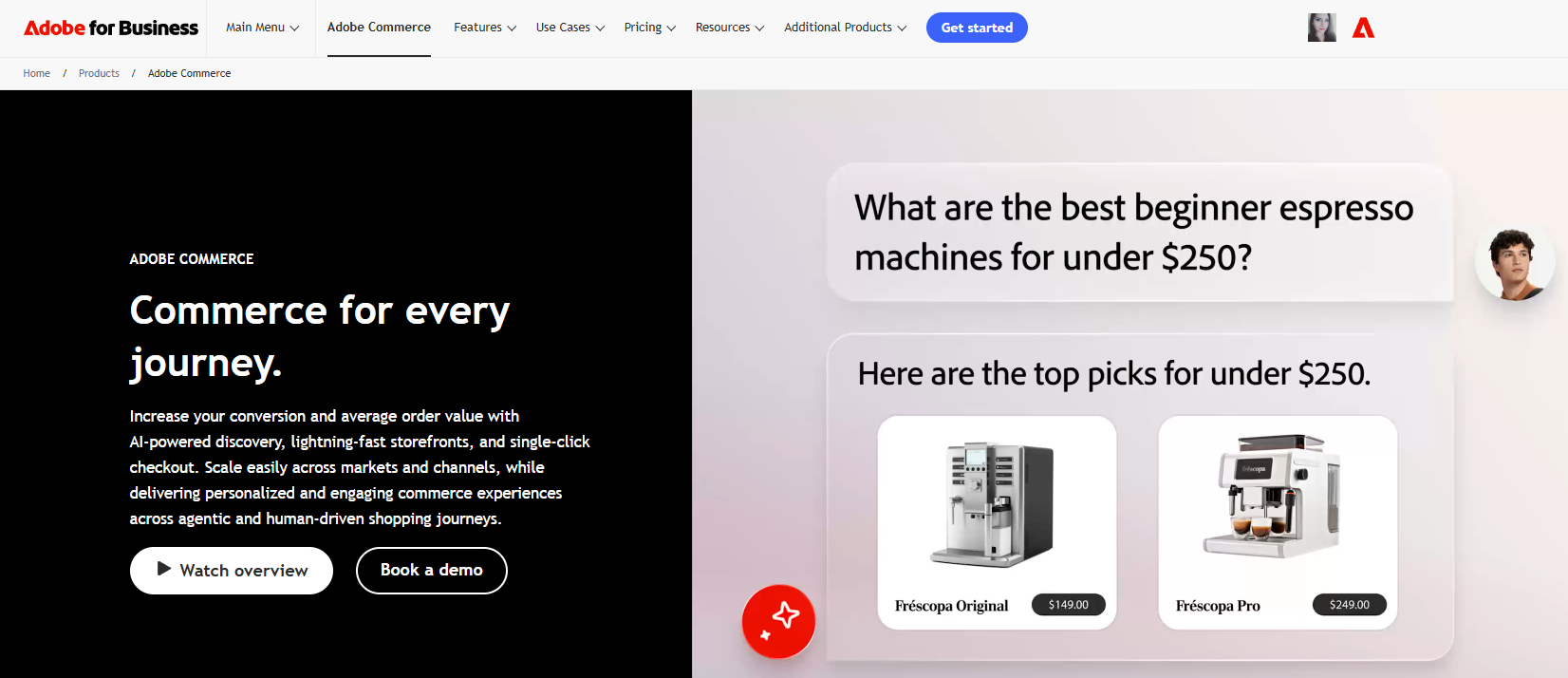
Adobe Commerce is built for teams with developers to spend, and code-level control is the reason to pick it. It suits distributors selling to trade accounts and DIY consumers from one platform, though most construction materials capability gets built or bought rather than switched on.
Best Fit
Large distributors with an in-house development team that want custom builds, a deep extension marketplace, and multiple branded sites under one roof. If your digital transformation plan assumes ongoing engineering capacity, this is the right platform to consider.
Key Capabilities
- Company accounts and hierarchies. Parent companies, named buyers, role-based permissions, and spending limits are native. Deep multi-level structures and per-division permissions usually need custom work.
- Shared catalogs. Each company sees only the products and contract prices agreed with them, assigned per company or customer group.
- Negotiable quotes. Buyers request a quote from the cart, sales applies pricing, and the buyer converts it to an order inside the platform.
- Purchase order approvals. Approval chains and purchase order workflows are part of the B2B module rather than an add-on.
- Company credit. Credit limits and payment terms are managed against the company account.
- Dual pricing by audience. Public retail prices show to DIY shoppers while logged-in trade accounts see their account specific contract rates on the same catalog.
- Requisition lists. Buyers reorder the same materials for ongoing construction projects, which shortens the purchasing process for repeat orders.
- Extension marketplace. Pre-built modules cover tax calculation, delivery scheduling, and unit-of-measure conversion, though each one is a separate vendor, cost, and upgrade dependency.
Pricing
Quote-based licensing tied to annual GMV and average order value. Implementation and maintenance run higher than the license, since the platform expects a permanent technical team and every extension needs testing at each upgrade.
3. Agentforce Commerce (formerly Salesforce Commerce Cloud)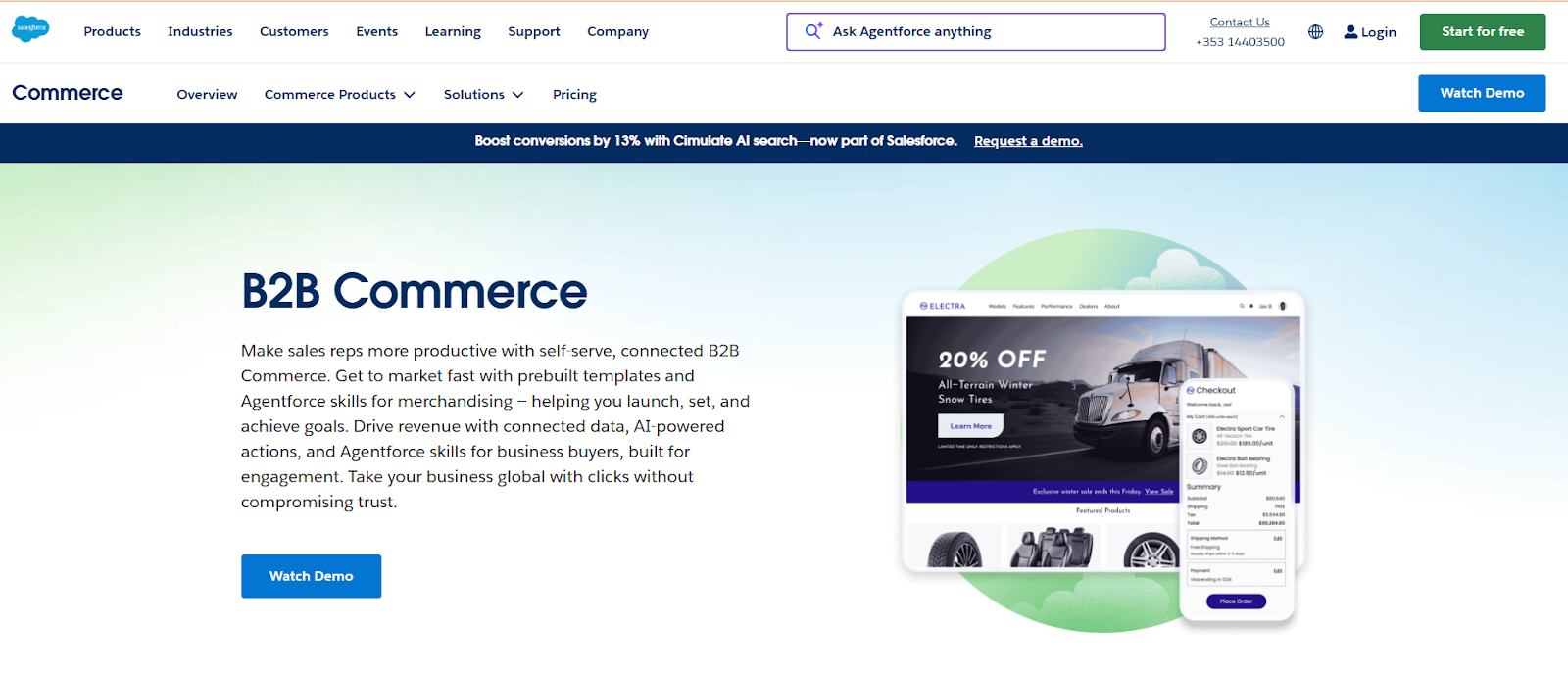
Agentforce Commerce, renamed from Salesforce Commerce Cloud in 2025, is Salesforce’s eCommerce line, and Salesforce B2B Commerce is the part of it that applies here. Cart, quote, and order activity attaches to the same account record your sales teams already work in.
For construction companies running Salesforce CRM and Agentforce Sales, that shared record is the main reason to pick it.
There are no native connectors for the ERPs common in the construction materials business, like BisTrack, Eclipse, or Prophet 21, so anything specific to the industry gets custom-built against your existing systems. Learn more about Salesforce Commerce alternatives for B2B.
Best Fit
Enterprise construction companies and building products manufacturers already standardized on Salesforce CRM, Agentforce Sales, and MuleSoft. If you’re not in that ecosystem already, this isn’t the right B2B eCommerce solution.
Key Capabilities
- Commerce on the CRM record. Cart and quote activity attaches to the account, so sales teams see what a buyer is doing on your digital channels and can step into an open quote at any point in the sales process.
- Entitlement-based catalogs and price books. Catalog visibility and pricing are controlled per account, so each buyer sees the products and rates tied to their agreement.
- Quoting and pricing. Agentforce Revenue Management, formerly Revenue Cloud, handles contract pricing and approval workflows for commercial job bids.
- Custom buyer screens. Lightning Web Components let your developers build job tracking views and portal screens the standard product doesn’t include, which is where most of the customer experience work lands.
- AI suggestions. Salesforce’s AI layer reads buyer behavior to suggest companion materials while a quote is being built.
Pricing
Subscription priced per order or as a percentage of GMV. The real number climbs with MuleSoft licenses, CRM seats, and developer time, since unit-of-measure conversion and anything else specific to building materials gets built.
4. Sana Commerce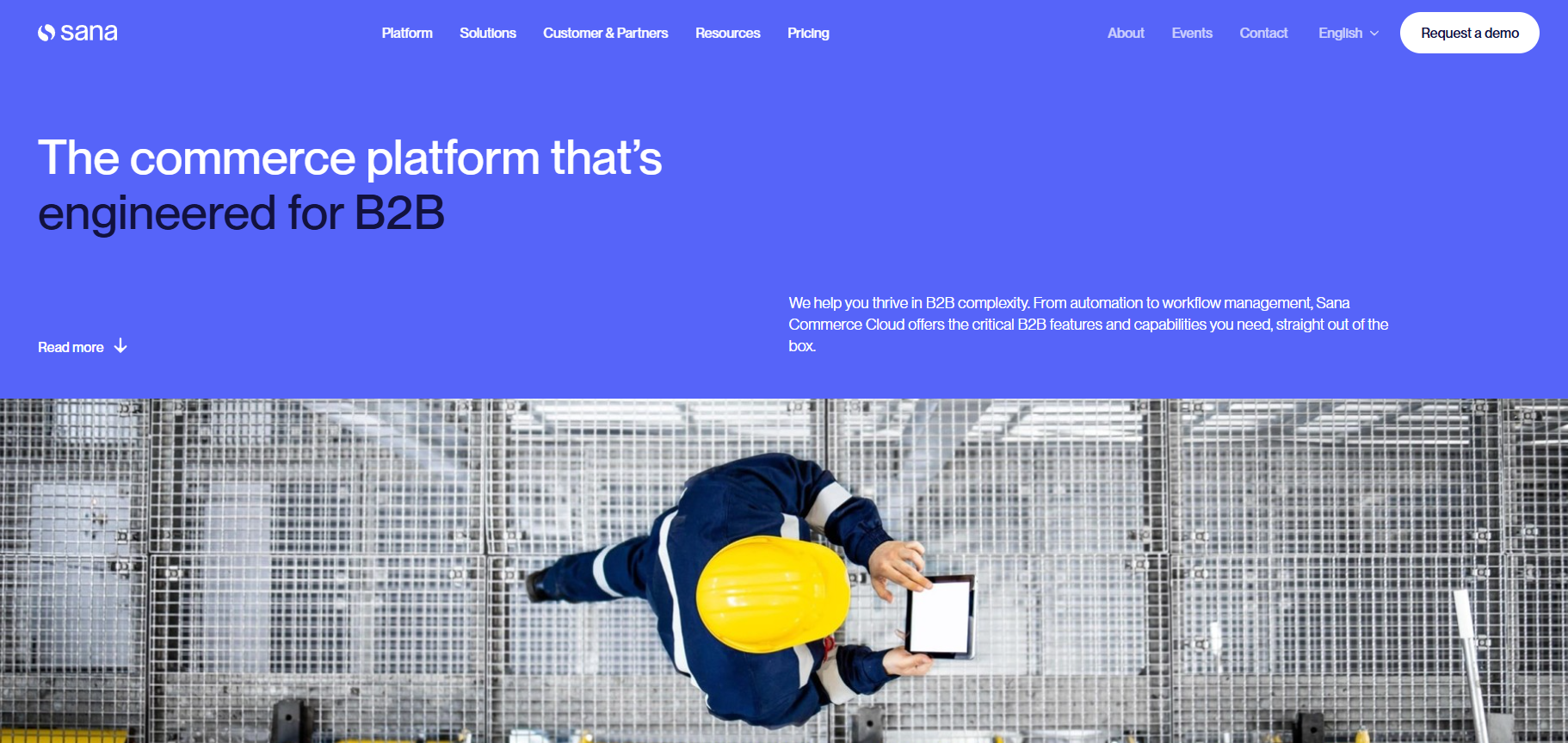
Sana Commerce is a cloud platform with a connector installed inside your ERP. The storefront reads pricing, credit status, and stock from SAP or Microsoft Dynamics live and writes orders straight back, so there’s no second database holding a copy.
For distributors already on either ERP, that removes a category of integration work. The trade-off is that your ERP sets the ceiling. If a rule doesn’t exist in SAP or Dynamics, it doesn’t exist on the site either.
Best Fit
Mid-market distributors running SAP or Microsoft Dynamics that want commerce driven straight from ERP data and don’t need much beyond what the ERP already enforces.
Key Capabilities
- ERP-native integration. Pricing, inventory, customer terms, and order product data read from SAP or Dynamics records live. Supported versions cover SAP ECC, S/4HANA, and Business One, plus Dynamics 365, and Business Central.
- Customer-specific data. Contract price lists, credit limits, and payment terms pull directly from ERP master records without a second system to maintain.
- ERP-driven catalog. The catalog is built from ERP master data, so specifications and stock levels stay consistent across accounts.
- Self-service portal. Buyers buy online, review order history, access invoices, and track shipments themselves.
- Quote requests. Buyers submit RFQs from the cart for orders that fall outside standard catalog pricing.
- Reorder tools. Quick reorder from order history and saved lists shortens the purchasing process for repeat buyers.
- Procurement connectivity. Punchout catalog support covers buyers ordering through Coupa or Ariba.
- International support. Multi-language and multi-currency handle cross-border operations.
Pricing
Custom pricing across multiple editions, with the ERP connector included in the subscription. The number to weigh isn’t the license. It’s whether your ERP can carry the rules you need, because there’s nothing for BisTrack, Eclipse, or Prophet 21, and no separate layer to configure when the ERP falls short.
5. BigCommerce B2B Edition
BigCommerce B2B Edition pairs a cloud e commerce platform with prebuilt B2B buyer tools. It’s the fastest of the five to stand up, and the least equipped for construction-specific work.
Best Fit
Smaller regional distributors adopting digital technology for the first time and testing an online channel with limited internal IT, which is how a lot of other construction companies start before they replatform.
Key Capabilities
- Buyer portal. Corporate accounts come preconfigured with purchasing roles and spending limits across buyer teams.
- Company price lists. Each account can be assigned its own price lists, applied per storefront and customer group.
- Quote requests. Buyers convert cart items into formal bids that sales reps discount inside the merchant dashboard.
- Rep assignment. Store administrators create accounts for sales reps and assign them to specific companies, so a rep sees the accounts they own.
- Quick order tools. Procurement teams type in SKU numbers or upload CSV files to place material list orders quickly.
- Managed hosting. Security patches, infrastructure, and software updates are handled for you, which is the main reason short-staffed IT teams shortlist it.
Pricing
Custom-quoted at the enterprise tier based on annual GMV, with B2B Edition as an add-on. Low entry cost can save money in year one, though third-party middleware fees climb as integration needs grow and there’s no native unit-of-measure conversion or LBM ERP connector to fall back on.
Why OroCommerce Is the Best eCommerce Platform for Building Materials
OroCommerce is the top choice for building materials distributors for one simple reason: it was built specifically for B2B from day one. The complicated features this industry needs are already baked into the system, rather than acting as expensive add-ons you have to build later.
- Everything you need is built-in. Features like quoting, RFQs, manager approvals, and complex corporate account setups are ready to go. Other platforms make you buy extra software for these, which is why so many eCommerce projects go way over budget.
- One price covers it all. You get eCommerce, CRM, quoting, invoicing, and payments under a single license. There are no hidden fees, no charges per user, and no surprise costs. The price you get in year one is the price you can count on.
- Grow without starting over. If you add new branches, buy another company, or expand into new regions, you can run them all on the exact same system. This saves you from having to build and manage multiple websites every time your business grows.
- It works with your current tech. OroCommerce easily connects to the software you already use, like SAP, Oracle, and other back-office tools. The platform adapts to how you work, not the other way around.
- Sales reps stay in control. Customers can easily reorder standard items on their own online, but your sales reps can still jump in to help with complex quotes or questions. You get the efficiency of online ordering without losing the personal, human touch.
- Smart, reliable AI. Because our AI is built directly into the system, it looks at your actual pricing, inventory, and customer data. It gives your team accurate answers they can trust, rather than wild guesses.
See why wholesalers and distributors in construction rely on OroCommerce
Real-World Examples: OroCommerce in Action
UFP Industries: Moving weekly lumber prices online
UFP Industries is a massive supplier of lumber and wood products. In the past, customers had to call or fax branches just to check prices – a huge headache in a market where lumber prices change weekly.
Now, using OroCommerce, builders simply log in to see live pricing, place orders, and download their own invoices. If they need help, sales reps can look at the exact same screen to assist them or place the order for them. Routine tasks are now handled online, freeing up reps to actually build relationships instead of answering emails about price updates.
BME France: Managing two brands from one back office
BME Group is one of Europe’s largest B2B distributors of construction, sanitary, and public works products, with €3.9 billion in annual revenue. In France it operates two brands: Busca for public works materials and Raboni for construction materials. Both run on one OroCommerce platform built with Synolia.
- Each brand keeps its own site and identity with customers, while product data, pricing, and content flow through a single platform.
- Every product shows stock status and that customer’s own price.
- Raboni customers build separate product lists per job site, so one job’s materials stay off another job’s paperwork.
- Buyers see the full range and what’s in stock at the three nearest branches before they log in, which keeps them on the site instead of calling around.
- Akeneo PIM manages product information once and publishes it to both brands.
Two brands that look nothing alike to customers, running on one system underneath. That’s the version of scale most European distribution groups are trying to reach.
When Every Branch Runs a Different ERP
Building materials distributors that grow by acquisition usually inherit a mix of back-office systems. One division runs Epicor BisTrack, another runs Prophet 21, and a third is still on an old AS/400.
Most platforms can’t work with that. They’re designed to plug into one ERP, so a second system means a second deployment. This is where ERP-native platforms like Sana Commerce hit their limit.
OroCommerce sits above your ERPs instead of inside one. It reads from all of them at once. Here’s what that looks like in practice:
- For your customers: One website. A contractor logs in, browses one catalog, uses one credit account, and checks out once.
- For your back office: Orders route to whichever ERP owns that branch, so fulfillment happens where it always has.
- For your IT team: No ERP consolidation project has to finish first. The commerce roadmap stops waiting on the ERP roadmap.
With a unified commerce system, you can sell online the month after you close an acquisition, not the year after IT finishes merging systems.
Further Reading: The B2B eCommerce ERP Integration Guide
Conclusion: How to Choose the Right Platform for Your Business
As you evaluate different eCommerce platforms and put together your RFP, don’t get distracted by flashy features. Focus on these three guidelines to make sure you get a system that actually works for building materials:
- Dig deep on ERP integrations. Don’t just accept a vendor saying “we have an API.” Make sure they have a proven track record connecting to industry-specific ERPs like Epicor BisTrack or Prophet 21. Ask them to prove they can handle thousands of daily price updates without slowing down your website.
- Make sure it empowers your sales reps. A good platform shouldn’t try to replace your sales team. Look for built-in CRM tools, quoting features, and the ability for reps to log in and see exactly what the customer sees. When reps treat the website as a helpful tool rather than a threat, your customers are much more likely to adopt it.
- Look at the true 5-year cost. Don’t just look at the year-one sticker price. Watch out for hidden traps like per-transaction fees, extra software you have to buy, expensive plugins, and forced upgrades. Platforms built specifically for B2B usually cost less in the long run because all the core features are already included.
The OroCommerce Advantage
This is exactly why OroCommerce stands out as the best eCommerce platform for building materials distributors.
We don’t rely on expensive add-ons, hidden fees, or generic integrations that break when things get complicated. OroCommerce was built from the ground up for the messy, complex realities of B2B. Whether you are dealing with a tangled web of multiple ERPs, massive catalogs with constantly fluctuating prices, or a sales team that needs better tools to serve their accounts, OroCommerce handles it all natively.
See why wholesalers and distributors in construction rely on OroCommerce
Test out the features that matter to you in an interactive demo.