navigation

Customer churn quietly eats away at growth to the tune of more than $160 billion a year for U.S. businesses. What’s worse, acquiring new customers has become more expensive than ever. Yet despite that, many B2B companies still focus most of their effort on chasing new accounts instead of keeping the ones they’ve already earned.
The math doesn’t lie: you’re several times more likely to sell to an existing customer than to a new prospect, and repeat buyers spend significantly more over time. But in manufacturing and distribution, retention is about reliability, not just customer satisfaction. Losing a long-term buyer often means losing months of onboarding, system integrations, and purchase history that power future sales.
In this article, we’ll break down why customer retention delivers exponentially higher ROI than acquisition in B2B, the common signals that predict churn before it happens, and the proven customer retention strategies that leading distributors and manufacturers are using to turn everyday accounts into long-term, loyal customers.
The Economics of Retention in B2B
Customer retention isn’t just a marketing metric in B2B commerce. It’s the backbone of financial strategy. Every retained account protects years of onboarding investment, process alignment, and trust built across teams. Losing one hurts top-line revenue and unravels the operational fabric you’ve already paid to create.
Why Customer Retention Always Outperforms Acquisition
Most leaders understand that keeping existing customers is cheaper than looking for new customer acquisition, but we have to emphasize that the cost delta is staggering in B2B. By the time a new business is fully onboarded, credit-approved, and integrated into your ERP or punchout system, you’ve already invested far more than the first few orders will ever recoup.
Meanwhile, acquisition costs keep climbing. The cost to win new customers has risen more than 200% across industries in the past decade. That means every lost account forces a company to spend disproportionately more just to stay even.
In contrast, the probability of selling to existing customers is three to four times higher than converting a new lead. Plus, that buyer is already familiar with your catalog, pricing logic, and service model.
B2B customer retention isn’t just cheaper, but also much more reliable. It stabilizes revenue cycles, flattens sales volatility, and gives your forecasting credibility. That’s why it’s smart to prioritize customer retention of existing clients over chasing new ones.
The Hidden Costs of Losing a B2B Customer
In manufacturing, distribution, or industrial supply, losing a B2B customer is rarely a single lost transaction – it’s a long, expensive unwind:
- Operational Overhead: Offboarding means chasing unpaid invoices, canceling standing orders, and rebalancing warehouse allocations.
- Sales Resource Drain: Replacing that revenue consumes seller bandwidth that could have gone toward growth accounts or category expansion.
- Data Disruption: Years of buying history, search behavior, and substitution logic get lost, forcing recommendation engines and pricing models to “relearn” with new customer data.
- Reputational Echo: Procurement teams move together, and your brand reputation is very important; one bad exit can ripple across multiple potential accounts in the same vertical.
These soft costs rarely show up in quarterly reports, but they quietly compound, eroding profit margins and sales efficiency over time.
Why Retention Has Outsized Leverage in Long B2B Cycles
When you look at quarterly business reviews in B2B industries, buying cycles often stretch across quarters, even years. Once a supplier is embedded in a customer’s workflow, from procurement approvals to engineering specs, switching isn’t that simple anymore. That inertia can be either a moat or a vulnerability, depending on how well you manage the relationship.
A stable retained customer means:
- Shorter lead times for repeat orders (because credit, SKUs, and specs are already aligned).
- Lower support costs (since buyers already know how to use your portal or tools).
- Higher customer lifetime value (because repeat buyers tend to expand into adjacent categories).
Plus, repeat customers spend roughly 67% more than new customers, and loyal accounts tend to buy more often, across more categories, with less price sensitivity.
Retention as a Profit Engine
B2B customer retention is often treated as a soft measure of satisfied customers, when in reality, it’s the strongest predictor of profitability. Bain & Company famously noted that a 5% increase in retention can boost profits by 25–95%, and it’s easy to see why: the longer a customer stays, the more efficiently every future transaction runs.
But, why is customer retention important? B2B retention isn’t about sentiment, but leverage. It preserves the systems, data, and trust you’ve already paid for, while turning customer familiarity into a competitive advantage that compounds over time.
Why B2B Customers Leave: Five Patterns You Can Instrument
Customer loss in B2B rarely happens because of one dramatic failure. More often, it’s the slow erosion of confidence caused by small, recurring breakdowns in execution, such as an unreliable shipment, a confusing quote, or a delayed approval. These moments, though seemingly minor, create friction that compounds over time until the customer quietly starts testing alternatives.
By instrumenting the right data signals and collecting customer insights, sales and operations leaders can detect these patterns before they become revenue leaks. Below are five of the most common and fixable drivers of churn in B2B commerce.
Supply Risk
Reliability is the currency of long-term relationships. When backorders become frequent, lead times fluctuate unpredictably, or partial shipments arrive without suitable substitutes, you get unhappy customers who now question your dependability. For a distributor or manufacturer, that doubt is expensive. Once a buyer starts sourcing backups “just in case,” your share of their wallet rarely recovers.
Supply risk is preventable with visibility and transparency. Integrating ERP and warehouse data into eCommerce platforms allows buyers to see real-time inventory, available substitutes, and delivery expectations before they place an order.
Companies that add proactive shortage alerts and intelligent substitution logic turn potential frustration into a signal of partnership. When you’re encouraging customers to plan around your constraints, they stop seeing them as deal-breakers.
Price Shock
Few things damage customer experiences faster than inconsistent pricing. Uncommunicated increases, mismatched discounts, or discrepancies between a quote and a contract price all send the same message: “We’re not aligned.” In complex B2B environments where pricing reflects negotiated terms, volume tiers, and rebates, credibility depends on precision.
Preventing price shock starts with system discipline. Automated enforcement of contract pricing, approval workflows for deviations, and version tracking of quotes create transparency for both sales teams and buyers. Fairness replaces suspicion when a customer can trace every price change and see that it conforms to policy. In today’s procurement climate, predictable pricing is as valuable as competitive pricing when it comes to retaining customers.
Workflow Friction Inside Buying Centers
Buying is a team sport in B2B. A single purchase might involve engineers, procurement managers, and finance approvers across multiple systems. When a punchout session times out, an approval stalls, or a quote languishes without status updates, frustration spreads quickly, and often the easiest path forward is switching to a supplier whose digital process simply works.
The cure isn’t just a smoother interface, but a real workflow intelligence. Automating approvals, tracking quote aging, optimizing punchout stability, and simplifying reorders for frequent SKUs all help keep the buying motion uninterrupted. Every friction point you eliminate preserves not only a transaction but the internal confidence that your company is easy to do business with.
Project Lifecycle Gaps
A common failure in B2B sales is treating project completion as the end of the relationship rather than the midpoint. After a large installation, buildout, or equipment delivery, many suppliers go silent, which means missing opportunities for replenishment, maintenance, or upgrades. Over time, that silence becomes a lost customer.
Lifecycle tagging within CRM or eCommerce systems can prevent that drift within your customer base. When projects are categorized by phase, such as installation, usage, maintenance, or replacement, sales and marketing teams can trigger timely reorder prompts or service outreach.
Some organizations go further, using predictive analytics to forecast when a customer will need consumables or spare parts. Anticipating demand before the buyer asks protects revenue and reinforces that you understand their business rhythms.
Organizational Change at the Account
Even the strongest customer relationships can unravel when your customer’s business changes. New procurement leads, M&A events, or vendor consolidations often reset the rules overnight. If your platform, integrations, or compliance policies can’t flex to the new structure and provide personalized support, you risk being dropped without notice.
Instrumenting account-level change detection, such as new administrators, inactive buyers, or altered payment policies, provides early warning. The key is adaptability: allowing customers to reconfigure account hierarchies, payment methods, and approval flows without your intervention.
When you make it easy for a new business team to plug into your system, you signal that staying with you is the path of least resistance. That simplicity often contributes a lot to retaining customers in moments of transition.
Key Takeaways About Churn Patterns
Every one of these churn patterns leaves digital fingerprints, like missed reorders, quote delays, inactive users, and approval bottlenecks. The good news is that organizations that outpace competitors aren’t those with zero problems. You only need to be one of those who detect small issues before they become patterns. Retention, in B2B, is no longer just a matter of management of customer relationships – it’s a function of system design, data instrumentation, and operational empathy.
Survey Report: What B2B Buyers Value in Supplier Relationships
Understanding and Measuring Customer Retention: Churn, NPS, and Digital Adoption
Retention in B2B is all about maintaining relevance inside the customer’s operations. You can’t manage what you can’t measure, and yet, many organizations still rely on vague satisfaction surveys or year-over-year sales trends to gauge loyalty. More mature customer retention strategies track multiple dimensions: who stayed, what they bought, and how engaged they remain digitally.
Below are the foundational metrics and insights every B2B commercial leader should understand.
Churn, Retention, and Adoption – The Core Metrics
Here are quick definition refreshers for the core metrics to keep in mind:
Churn Rate
Churn represents the percentage of customers (or revenue) lost over a given period. For distributors or manufacturers, churn can show up as dormant accounts, shrinking order frequency, or disappearing categories rather than formal contract cancellations. Tracking both account churn (how many customers left) and revenue churn (how much business they took with them) gives a fuller picture of risk.
Retention Rate
The inverse of churn, this metric measures how many customers remain active. But in B2B, “active” doesn’t just mean “purchased once.” Many companies now define active customer retention as having placed at least one digital order, RFQ, or reorder within a defined interval, for example, within the past 90 or 180 days.
Adoption Rate
Adoption shows how deeply customers are engaging with your digital tools, like the portal, punchout catalog, or ordering automation. It’s the bridge metric between satisfaction and loyalty. When digital adoption climbs, churn almost always falls, because customers who embed your platform into their workflows become “sticky” by design.
Repeat Order Ratio
A simple but powerful indicator: the percentage of total orders coming from returning customers. A rising repeat order ratio suggests both trust and operational convenience are improving, which are two of the most reliable predictors of long-term retention.
Account Retention vs. Revenue Retention
One of the most overlooked mistakes in retention analysis is assuming that keeping an account on the books equals customer loyalty. In reality, an account can remain active while quietly shifting spend elsewhere.
- Account Retention measures whether the legal entity is still transacting with you.
- Revenue Retention tracks whether that customer’s spend level and category mix remain stable or are eroding.
This distinction is critical in B2B distribution and manufacturing, where customers often diversify suppliers across product lines. A procurement team might still buy fasteners from you, but source all electrical components elsewhere. This is technically “retained,” but with a shrinking wallet share.
To catch this early, leading organizations monitor category-level revenue retention and share of wallet per product family. When revenue starts migrating to competitors, it’s often a symptom of friction in price transparency, lead time, or catalog completeness. This is all fixable through better digital instrumentation.
Why Digital Adoption Is Now the Leading Indicator of Customer Retention
Customer retention used to depend on account managers remembering birthdays and taking buyers to lunch. In 2025, the customer lifetime depends on how easily those buyers can self-serve using a B2B portal, reorder, and find information without waiting for a callback.
McKinsey’s recent B2B Pulse research highlights this shift clearly: eCommerce now ranks as the top revenue growth channel for digitally enabled sellers, and poor digital experiences are a leading cause of supplier switching. Customers who rely on your digital portal for quoting, availability checks, and reordering are far less likely to churn – not because they’re emotionally loyal, but because they’re operationally integrated.
In other words, adoption equals retention. When your digital tools become part of your customers’ daily workflow, leaving you would mean retraining their teams, reconfiguring integrations, and rebuilding approval flows, which means a high switching cost that few organizations want to incur.
Metrics That Correlate with Long-Term Loyalty
To translate these concepts into measurable action and calculate customer retention rate, consider tracking the following digital and behavioral indicators alongside traditional sales KPIs:
- Login Frequency – how often key users from each account access your portal or punchout catalog.
- Self-Service Order Share – percentage of total orders placed directly online versus through manual channels.
- Order Automation Rate – number of orders submitted via APIs, EDI, or scheduled replenishment workflows.
- Quote Aging – how long quotes remain open before conversion or expiration; rising times often indicate buying friction.
- Search-to-Order Ratio – how often customers find what they search for; low ratios suggest product data or inventory gaps.
- User Expansion – growth in the number of active buyers or approvers per account, a strong sign of embedded usage.
When tracked together, these metrics reveal a story much richer than NPS alone. They quantify whether customers are merely satisfied or truly dependent on your ecosystem.
Bottom Line
Modern customer retention isn’t measured in smiles or survey scores – it’s measured in customer behavior. The more customers feel value and the more seamlessly they can operate within your systems, the less incentive they have to leave. For B2B organizations, the future of customer retention lies in understanding these digital signals early and acting on them long before churn shows up in revenue.
More Orders, Bigger Orders: How B2B eCommerce Maximizes Revenue
5 Proven B2B Customer Retention Strategies for 2025-2026
Customer retention in B2B doesn’t hinge on one grand loyalty program or a discount campaign. It’s built quietly, through hundreds of frictionless experiences that make buying and re-buying easier every time. The following five customer retention strategies represent the most effective, measurable ways to create that kind of stickiness in 2025 and beyond.
1. Design an Intentional Onboarding Journey
First impressions matter even in long sales cycles. In B2B, the first 30 days after a new account signs up often determine whether they’ll become a high-value repeat customer or quietly churn before placing a second order.
Many distributors underestimate how often small onboarding gaps, like delayed credit approvals or missing product mappings, hinder the customer journey and stall a relationship before it ever matures.
A structured, automated onboarding process shortens time-to-first-order and builds confidence early. Start with a multi-step registration flow that automatically validates credit, assigns roles (buyer, approver, finance), and provisions access instantly.
For migrating customers, the first login should feel familiar: preload their last-purchase SKUs or invite them to upload a CSV file of their most common items, prompting them to create reorder lists immediately.
Smart teams set up behavioral triggers to catch silent churn before it happens. For example:
- New account created → no first login within 7 days
- First login → no quote or order within 14 days
When these triggers fire, sales or support can step in with how-to guides and offer tailored solutions and incentives. Companies like Petra have automated this entire flow by integrating OroCommerce with Bectran’s credit management system, eliminating friction from day one.
Why it works: Buyers don’t want another portal – they want continuity and personalized interactions. An intentional onboarding journey, solid customer education, and personalized experiences show you respect their time and help them operate at full speed from the start.
2. Leverage Account-Based Client Retention (Not Just ABM)
Account-based marketing gets the spotlight, but account-based client retention quietly drives profitability. The goal isn’t just for your account managers to upsell, but to notice when buying patterns start to slip and intervene early.
The foundation is a customer health score that blends operational and behavioral signals:
- Reorder interval changes (ordering less frequently)
- Quote aging and response time
- Fill-rate trends and backorder frequency
- Search-fail rate on your eCommerce site
When this composite score drops by 10–15 points, it signals potential disengagement. Teams can then deploy prebuilt plays like:
- Reactivation: Outreach when the reorder interval lapses beyond normal.
- Stockout Recovery: Quick follow-up with substitute or ETA.
- Price-change Management: Proactive notice with contextual justification.
Each play should have a clear owner and SLA (e.g., Sales follows up within 48 hours; supply confirms substitute stock in 4).
Why it works: Customer retention strategies shouldn’t be considered as a reactive firefighting. The process should be systematic care and exceptional customer service. By operationalizing these early-warning signals, sales teams stop guessing and start preventing attrition in measurable ways.
3. Give Customers Autonomy with Self-Service Tools
To increase customer retention, you need to create a structure where customers don’t need to wait. Every manual quote, email thread, phone call, or poor customer service call introduces a delay, and each delay is a chance for frustration. Self-service tools turn that friction into freedom.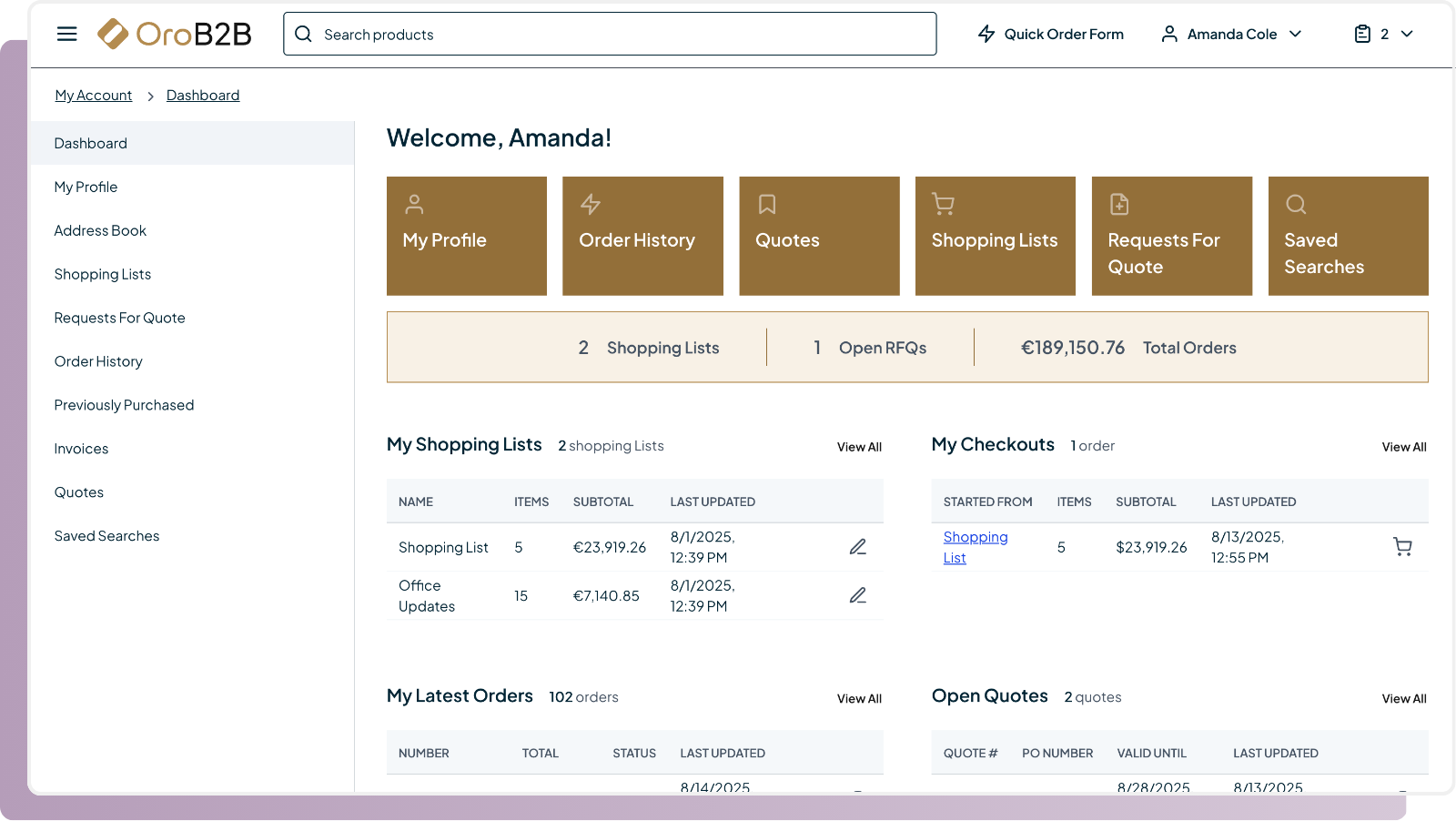 When built right, a B2B portal becomes not just an order entry system but a productivity tool for buyers. Must-have capabilities include:
- Contract-faithful pricing and catalogs that reflect negotiated terms for each account.
- Quick Order forms, Order Templates, and Shared Shopping Lists for repeat buyers.
- Full order history, invoices, shipment tracking, and RMA initiation.
- Real-time warehouse availability (ATP) and engineering-approved substitutes.
The results speak for themselves:
- Braskem saw customer satisfaction rise 13% after launching its customer portal, with 300% adoption growth.
- Dunlop Protective Footwear reached 41% self-service adoption shortly after rollout and continues to climb.
- Ciranda moved 60% of its long-tail customers online, targeting 80% by year-end.
Aim for at least 40% of primary buyers to use the portal within six months, and a second user to be added in 60% of retained accounts.
Why it works: Autonomy reduces friction and cost simultaneously. Buyers who can act independently on your platform are both happier and harder to replace.
4. Create Feedback Loops That Actually Close
Every quote rejection, abandoned cart, or return reason is a signal. The problem is that most companies collect those signals but never act on them systematically. Building closed customer feedback loops turns those weak signals into tangible fixes.
Instrument your systems to capture why customers hesitate or leave a process incomplete:
- Quote rejection reasons (e.g., pricing, specs, lead time).
- Searches that return no results.
- Abandoned carts containing contract SKUs.
- Repeated return codes for the same issue.
Each pattern should automatically route to an owner with a predefined response template – pricing review, content update, or fulfillment check. Define clear triggers, such as:
- Search-fail rate up >50% week-over-week.
- Quote aging >5 days without follow-up.
- Three identical return codes in 30 days.
By operationalizing these signals, companies can fix issues before the account goes silent.
Why it works: Customers rarely announce their departure; they simply disengage. Closing customer feedback loops lets you intercept that moment while recovery is still possible.
5. Turn Data into Loyalty Programs for B2B
Traditional loyalty programs often miss the mark in B2B because they reward spend, not behavior. A smarter approach is to use operational data to reward reliability, consistency, and collaboration.
Design incentives around behaviors that strengthen mutual efficiency rather than margin-eroding discounts:
- Price protection for one purchasing cycle after a cost increase.
- Shipping credits for on-time reorders or consolidated shipments.
- Exclusive access to limited assortments or allocation during supply constraints.
- Data-sharing incentives, like co-developed forecasts or preferred supplier status.
This approach turns everyday operational discipline into an advantage. Buyers save time and money, while you secure predictable revenue growth and better planning accuracy.
Why it works: B2B buyers don’t want points, but a real partnership. When your loyalty framework reflects that, you move from transactional to indispensable.
The Takeaway
Retention in 2025 is less about charm and more about architecture: processes, systems, and signals that anticipate customer needs. Each of these five effective customer retention strategies builds on the same principle: make your customers’ work easier, faster, and more predictable. Do that consistently, and loyalty becomes a byproduct of operational excellence.
If You Build It, Will They Come? How to Drive Adoption for B2B Technology [Free guide]
Avoiding Common Pitfalls in Retention Efforts
Even the best customer retention programs can falter when operational blind spots go unaddressed. These pitfalls often seem minor in isolation but compound over time, undermining customer trust, frustrating buyers, and eroding wallet share. Here are four common mistakes that quietly undo retention work and how to prevent them.
1. Treating All Accounts the Same During Stock Constraints
When inventory tightens, many companies fall back on a “first-come, first-served” model that treats every buyer equally. It sounds fair, but in practice, it punishes the loyal customer base. Your most strategic or most valuable customers should never have to compete with occasional buyers for limited inventory. Always make sure to keep existing customers engaged and reward repeat customers. That’s how your customer success teams can keep enhancing client satisfaction.
The fix
Segment accounts by value and relationship tier, and publish clear allocation rules directly within the portal. High-priority buyers should see transparent availability and substitution logic, ideally tied to their contract or service level. Instruct the dedicated account managers to keep prioritizing customer reviews. This not only preserves revenue from your top segments but also signals reliability at moments when competitors look unstable.2. Publishing Prices That Don’t Match Contract Terms
One of the fastest ways to erode credibility is through pricing mismatches. When buyers log in and see a list price that doesn’t reflect their negotiated ladder or contract discount, it introduces doubt: If the price is wrong, what else might be?
The fix
Enforce contract-faithful pricing across every customer-facing touchpoint, such as catalogs, quotes, punchout, and order confirmations. Ensure your eCommerce platform and ERP share the same price logic, version control, and approval workflows. The buyer should never need to “double-check” what they see. Consistency is retention’s quietest currency.3. Measuring Retention Only at the Account Level
A common mistake in customer retention analytics is assuming that an account that “stayed” is healthy. In reality, even a repeat business might still be drifting, shifting spend to competitors within specific product lines or categories. The account looks retained on paper, but the category-level wallet share tells a different story.
The fix
Track retention at multiple layers: account, category, and SKU family. Identify where share erosion begins, not where it ends. When paired with reorder interval data and digital engagement metrics, these insights highlight early-stage churn risk that traditional account-level metrics miss.4. Leaving Returns and Warranty Processes Off the Portal
Returns and warranty claims are moments of truth in B2B. If a customer has to pick up the phone to resolve an issue – or worse, deal with bad service quality or wait days for a response, they start questioning whether you value their time. The next call might not be to your customer service team but to a competitor.
The fix
Bring returns, RMAs, and warranty claims into the same digital environment as ordering. Give customers self-service initiation, status visibility, and clear documentation flows. This turns what used to be a friction point into a trust-building customer experience.Conclusion
Customer retention doesn’t fail because buyers suddenly stop liking a product. It fails when everyday service delivery and bad customer experiences, such as pricing errors, inventory gaps, and hidden workflows, chip away at client satisfaction and trust. Addressing these pitfalls doesn’t require new technology as much as operational discipline, which means ensuring your digital touchpoints reflect the reliability your brand promises.
Further reading: A Digital Transformation Playbook for Manufacturers and Distributors
Questions and Answers
What is customer churn?
Customer churn is a key performance indicator that tells you how many clients leave your company. It indicates the failure of the company to meet the buyer’s needs on the customer’s terms.
What is customer retention?
Customer retention is a key performance indicator that tells you how many customers stay with your company over time. It indicates the success of a company in meeting customer needs.
Why is customer retention important?
Customer retention is important because sales from returning customers are more profitable. Acquisition costs were paid with the first sale. Also, most of a company’s sales come from a core group of loyal customers. It is important to continue to grow this group of loyal customers.
Who should be concerned with customer retention?
Customer retention is the responsibility of every department in the company. From the floor where the product is made to the accounts receivable clerk that posts payment, everyone has a role in customer retention.
How does CRM increase customer retention?
Five ways in which CRM supports customer retention are:
- It collects data on buyer interactions with your brand and the effectiveness of your marketing strategies.
- Knowing this data helps build a proactive relationship with clients.
- Information stored in CRM software helps you create loyalty programs for valued customers.
- It enables you to personalize interactions.
- CRM is a great tool for gathering and analyzing feedback from people who regularly buy from you.