
navigation

If you’re in B2B and still hoping things will “settle down,” we’ve got bad news: they won’t. Buyers are adding new channels faster than sellers can stitch them together. AI is answering questions reps used to get paid to handle. Payments are evolving so quickly that yesterday’s “innovations” already feel old.
That’s why we pulled this piece together: to cut through the noise and show what’s shifting in 2026, and what practical moves companies can make to keep up. If you want a clear look at the future of B2B eCommerce and how to prepare for it, read on.
Buyer Experience and Channels: Commerce, Not “eCommerce”
What’s changing and why
B2B buyers aren’t short on digital channels – they’re short on digital experiences that meet expectations. A full 45% say they’re dissatisfied with current B2B eCommerce experience, and 65% would pay more to vendors who deliver excellent digital journeys. In other words, the bar isn’t just rising – most companies still aren’t clearing it.
At the same time, the “rule of thirds” in B2B buying behavior has held steady: one-third in person, one-third with a rep, and one-third self-serve. What’s changed is how fluidly buyers expect to move across those modes. Quotes, order history, and pricing must carry across portals, marketplaces, punchouts, and rep interactions, or trust erodes. From the buyer’s perspective, there is no separate “eCommerce” channel. There’s just commerce, and they expect the customer experience to travel with them.
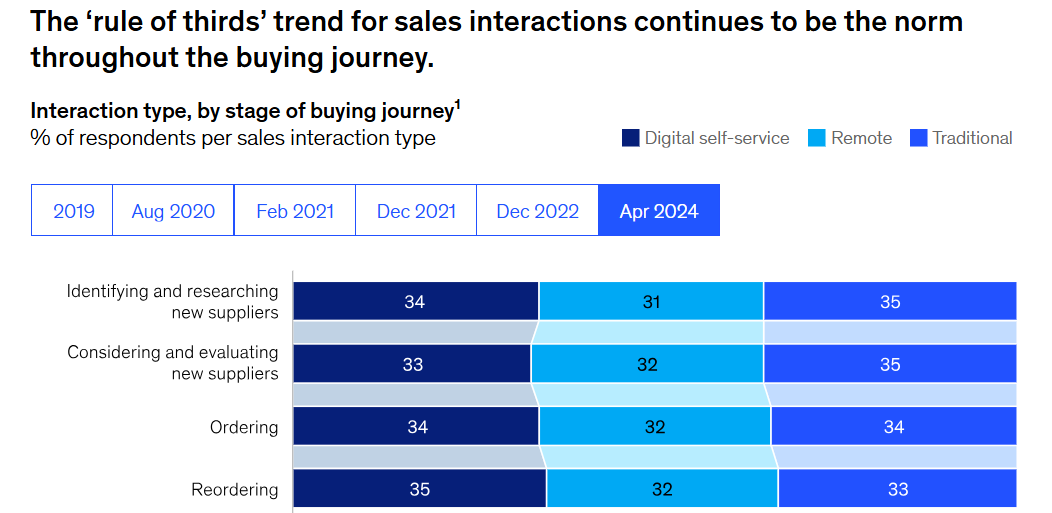
Source: Five fundamental truths: How B2B winners keep growing by McKinsey
Another shift: AI is entering the channel mix. Buyers increasingly use large language models not only to search for products within a catalog, but to scan vendors, contracts, or specifications across the open web.
For sellers this means that if your eCommerce strategy doesn’t ensure your product data, pricing, and specs aren’t accurate, structured, and discoverable, you won’t even make it into the buyer’s shortlist.
How companies should react to evolving buyer journeys
Start with the assumption that your buyers don’t care what system they’re using, as long as it works. They expect context to follow them, quotes to reflect the right price, and product data to make sense whether they’re reading it or feeding it into an AI tool. That’s your baseline. Here’s how to meet it:
- Walk your own buying journey. Try placing an order the way your customer would: across a B2B portal, through a punchout, or via a sales rep. Track where context disappears and fix those breaks first.
- Treat pricing and lead times like contract terms. They’re part of the experience now. If they’re wrong, the deal’s already in trouble.
- Structure your product content for machines to ensure product discoverability. Assume your next buyer is an LLM. If your catalog is inconsistent or buried in PDFs, it won’t make the shortlist.
- Set rules for freshness. If the numbers buyers see aren’t tied to clear update schedules (and monitored like any other SLA) you’ll lose trust faster than you lose the sale.
Artificial Intelligence in B2B Commerce: Practical Scale Ahead
What’s changing and why
Generative Artificial Intelligence (AI) went from pilot projects to production in record time. McKinsey notes that two-thirds of companies now use it in at least one function, and sales is one of the most active areas. In digital commerce, adoption has been fast because the use cases are clear: automating repetitive steps, speeding up quoting, and helping buyers with faster product discovery.
Buyers increasingly expect search to work in plain language (“show me the gasket that fits pump model X, available in two days”), and sellers need faster ways to prepare quotes, analyze margins, and respond to service questions.
How companies should react
Instead of treating AI as a series of disconnected pilots, B2B leaders should begin building what’s essentially a commerce copilot program. That means identifying a handful of areas where AI can support both sides of the transaction and then wiring them into daily workflows:
Buyer-facing use cases:
- AI chat tools that can surface product compatibility, inventory status, or substitutes.
- Guided configuration that translates CAD files or BOMs into orderable SKUs.
- Reorder prompts that anticipate replenishment needs.
Seller-facing use cases:
- AI-assisted quoting (drafting terms, cross-sell suggestions, margin analysis).
- AI-enabled PO processing automation connected to ERP platforms.
- Localized content generation for PIMs.
- Triaging service requests (warranty eligibility, RMA routing).
Leading B2B eCommerce platforms like OroCommerce, Salesforce, and SAP are all building these features into their ecosystems. See, for example, how AI-assisted PO processing works in OroCommerce.
Internal productivity:
- Natural-language interfaces that let staff pull reports, create quotes, or check customer data without needing IT support. OroCommerce’s upcoming AI SmartAssistant and AI SmartInsights are good examples, but similar approaches are surfacing across enterprise software.
Where to start
For companies still in the early stages, three practical steps help catch this wave:
- Pick a single buyer-assist and a single seller-assist use case to pilot (e.g., AI search for buyers and AI quote drafting for sellers).
- Ground AI in trusted data by connecting ERP, PIM, inventory and other back-office systems. Without clean sources and data accuracy, AI just creates noise.
- Measure impact with metrics like quote cycle time, AI-assisted revenue share, or error reduction, so leaders can decide which use cases deserve to scale.
Personalization Expectations: Moving Past the Welcome Mat
What’s changing and why
Most companies still pour personalization efforts into the “front door” – what buyers see before or during the first purchase. But after the order is placed, the experience too often turns generic. Forrester points out that onboarding, replenishment, and service personalization are underfunded, and the fallout is visible in retention and upsell numbers.
Meanwhile, expectations keep climbing. Sixty-four percent of buyers want their negotiated, custom pricing displayed correctly online. Nearly half won’t order without real-time inventory. And 75% say they’ll switch suppliers if tracking isn’t accurate.
Add in the fact that buyers are now using LLMs to scan vendors and product data, and you see why stale, static information is a liability.
How companies should react
Think about B2B personalization less like rolling out a red carpet at the entrance, and more like being a good host throughout the visit. The first impression matters, but so does making sure the lights work in the meeting room and the coffee machine isn’t empty. For B2B, that means:
- Sales and marketing personalization: contract-specific catalogs and pricing, bundles aligned to verticals, and campaigns that speak to account tier or buying history.
- Operational personalization: role-based dashboards so a finance user sees credit terms while a warehouse manager sees reorder prompts.
- Search personalization: vector search and natural language tools that parse technical intent.
- Lifecycle personalization: one-click reorders, predictive restock suggestions, and loyalty programs, like special terms, early access, or input into new product lines.
- Service personalization: proactive warranty reminders, replenishment alerts tied to installed equipment, or self-service portals that answer account-specific questions instantly.
What B2B Buyers Love and Hate in Their Suppliers' Digital Channels
Payments Are Finally Catching Up to B2B Buying
What’s changing and why
For years, payments in B2B lagged behind the rest of the buying journey. Credit card rails, wire transfers, and invoice terms often lived outside the commerce platform, creating delays and errors in cash application. That’s changing fast.
- Same Day ACH is gaining traction in the U.S., letting business buyers move funds and reconcile balances in hours, not days.
- B2B Buy Now, Pay Later (BNPL) is moving into the mainstream. IDC predicts nearly $500B in B2B BNPL transactions by 2026, driven by embedded credit underwriting that happens directly in checkout.
- Platforms are now expected to support ACH, card, BNPL, and even multi-invoice settlement inside the same order flow, not redirect buyers elsewhere.
Why it matters: buyers get flexibility, sellers lower DSO, and finance teams finally see cash application align with order activity. Perhaps most importantly, new buyers who balk at credit card limits or lengthy onboarding can convert faster when terms are approved instantly at checkout.
How companies should react
Forward-looking B2B sellers are rethinking payments not as “back office plumbing” but as a revenue and retention driver. Embedding terms, credit checks, and settlement options inside the commerce flow improves conversion, especially for new or international customers. It also reduces the reconciliation burden that eats up finance hours.
Solutions like OroCommerce’s OroPay bring this logic to life by combining card and ACH processing with Level 2/3 data for lower interchange, plus the ability to embed credit workflows into the checkout process. But whether via OroPay or another provider, the expectation is the same: payments should be natively part of the B2B experience.
Where to start:
- Audit your checkout flows: how many buyers still get kicked to offline invoicing or manual credit checks?
- Embed at least one modern tender type (e.g., Same Day ACH) into your portal to cover scenarios where cards fall short.
- Involve finance early: measure DSO reduction, cash application accuracy, and new-buyer conversion to prove the ROI of payment modernization.
IT Architecture: Composability With Guardrails
What’s changing and why
Composable commerce moved from concept to implementation, and that’s when the cracks started to show. More companies rolled out MACH-style architectures, but real-world complexity didn’t magically disappear. It multiplied. Especially in B2B, where quoting, pricing, and account logic rarely fit into neat, reusable components.
The shift became impossible to ignore when VTEX publicly exited the MACH Alliance, calling it “a financial black hole” and questioning whether the model served enterprise buyers at all. That pushback lit up the industry and forced a more grounded conversation around how composability should actually work.
How companies should react
For 2026–2027, the pragmatic path is hybrid composability:
- Use purpose-built capabilities for workflows that need to hold up under pressure. For B2B, that means core functions like quoting, pricing, and account management – and ideally, choosing a platform that’s already built around those complexities.
- Apply composability selectively, where differentiation or flexibility is worth the overhead.
- Invest in API management and observability so integrations remain transparent and measurable.
- Treat data freshness and uptime as business metrics, not just IT concerns.
Further Reading: Why Manufacturers and Distributors Are Rethinking Their Tech Stacks
No One Owns the Buyer Alone Anymore
What’s changing and why
By 2026, Gartner expects 30% of B2B sales to happen in digital sales rooms. At the same time, Master B2B reports that a third of sellers already see more than half of their offline sales influenced by digital activity. The takeaway: digital is in the room for every deal now – before, during, and after the close.
Yet many organizations still treat eCommerce as its own team, with separate goals, budgets, and incentives. That divide creates friction: sales reps see digital as competition, while digital teams struggle to get credit for revenue that was shaped by online touchpoints but closed offline. With buyers now using about ten touchpoints per journey, this fragmentation directly translates to churn.
How companies should react
Leaders are reorganizing around the idea that commerce is a shared responsibility across marketing, sales, and service. That means:
- Aligning incentives: account teams get credit for revenue no matter where the order is placed.
- Standing up Revenue Operations (RevOps): a single function owning funnel integrity, product and price data quality, and performance metrics across CRM, CPQ, and commerce.
- Embedding eCommerce into the sales cycle: enabling reps to log in on behalf of customers, assist with complex orders, or leverage digital sales rooms to close deals faster.
Further Reading: B2B Sales Enablement Best Practices for Hybrid Selling
Looking Ahead to Digital Transformation in 2026
If you’ve made it this far, you probably spend more time than most thinking about digital transformation, the future of B2B eCommerce, and how it all applies to your business. And fair enough – there’s plenty to keep track of.
AI is showing up in every part of the buying cycle. Payments are being rewired with new rails and credit models to meet evolving customer expectations. Architecture debates are moving out of IT circles and into boardrooms. And digital and sales teams are finally being forced to act like one motion.
It’s a crowded picture, but that’s the reality. The job now is figuring out how to use what’s already here, before buyers move on without you.
Frequently Asked Questions
How can I prepare my business for generative search?
Start by fixing the basics:
- Structure your product data so it’s machine-readable. That means clear attributes, searchable specs, and consistent formatting across your eCommerce site.
- Connect your catalog, pricing, and inventory management systems to your PIM and ERP platforms, so buyers get accurate info no matter where they’re searching.
- Review how your products appear across digital commerce channels — including third-party marketplaces and partner portals. Inconsistent data will get you filtered out.
- Test real-world prompts (“Find me a food-grade seal for a 1-inch valve”) to see how your content performs across multiple channels.
What under-the-radar B2B commerce trends should I pay attention to?
Two big ones:
- Operations are becoming a competitive edge. Businesses are modernizing their backend — replacing legacy platforms, syncing up distribution centers, and reducing delays, because that’s where most of the customer experience breaks down.
- Self-service is expanding. Buyers now expect to handle quotes, invoices, and service requests without needing to call. That means more robust workflows across your eCommerce platform, not just reordering.
Bonus: your data has to travel well. As more buyers browse via social media platforms or research on marketplaces, your product content needs to stay consistent and searchable.
How is customer experience changing, and how can I prepare?
It’s moving beyond the storefront.
- Buyers want a unified experience across reps, your mobile app, and your website. They expect pricing, stock, and order history to stay consistent.
- That means your ERP, commerce, and service systems need to be connected, so your teams aren’t working in silos and buyers rely on accurate, up-to-date info.
- Companies getting this right are investing in tailored experiences across the full journey, not just better design. It’s about clarity, speed, and reducing friction — wherever the buyer shows up.