AI Order Processing
The use of AI to automatically read, validate, structure, and route incoming customer orders (from email, EDI, portals, or PDFs) into a commerce or ERP system without manual data entry.
What It Is
AI order processing covers the pipeline an order travels through before it becomes a confirmed record: parsing the source document, matching items to catalog SKUs, checking pricing and inventory, flagging exceptions, and submitting the result.
It can range from AI-augmented rules (a model assists a fixed workflow) to a more autonomous agent that handles the whole pipeline and only escalates genuine exceptions.
The defining value is handling messy, inconsistent input, such as a PDF purchase order, an email with items listed in prose, or an EDI feed with abbreviated part numbers, and normalizing it into structured, usable data.
In B2B Commerce Context
In B2B commerce, order processing is often the largest hidden labor cost in the order-to-cash cycle, because so many B2B orders still arrive as unstructured documents rather than through a storefront.
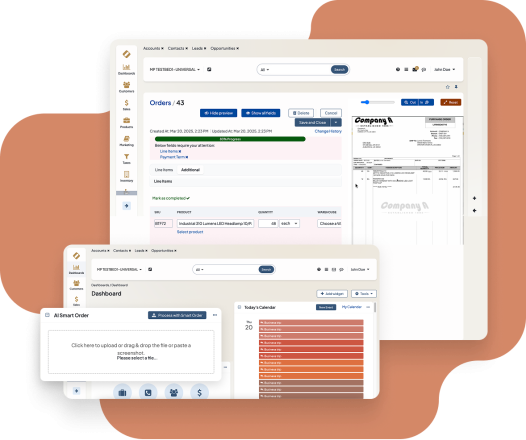
This mirrors the real-world behavior of OroCommerce’s AI SmartOrder: a buyer emails a purchase order as a PDF, and SmartOrder extracts the line items, matches them to catalog SKUs, validates them against live inventory and negotiated pricing, and creates a draft order for a single approval click.
This is the capability behind AI SmartOrder specifically: it reduces the order entry team’s job from re-keying data to validating exceptions.
When You Need It
- A significant share of orders arrive by email, PDF, fax, or inconsistent EDI feeds.
- Manual order entry is a bottleneck or a source of frequent pricing and quantity errors.
- You want to shorten the order-to-cash cycle without adding headcount.
- Your order entry team spends most of its time on data entry rather than exception handling.
Start by automating the highest-volume, most standardized order format first, then expand to messier formats.
What It Is Not
- AI order processing is not the same as AI order management. Processing gets the order into the system correctly; management coordinates what happens to it afterward, fulfillment, splits, backorders.
- It is not OCR alone. OCR extracts text from a document; order processing also validates line items against catalog and pricing rules and reconciles discrepancies.
- It is not a replacement for exception handling. Genuine edge cases, ambiguous items, pricing conflicts, still need a human decision.
Comparison
| Capability | AI Order Processing | Manual Order Entry |
|---|---|---|
| Input handling | Reads PDFs, emails, inconsistent formats | Requires standardized or re-keyed input |
| Validation | Automatic match against catalog and pricing | Manual cross-checking |
| Speed at volume | Scales without added headcount | Scales linearly with staff |
| Error source | Exceptions flagged for review | Human transcription errors |
See also
Ready to see it in action?
Book a demo of OroCommerce
See how agentic workflows fit into complex B2B commerce, with a walkthrough tailored to your stack.