LLM (Large Language Model)
A neural network trained on large volumes of text data, capable of generating, summarizing, classifying, translating, and reasoning across a wide range of language tasks.
What It Is
An LLM is the reasoning engine behind most enterprise AI applications built since 2022. It is a statistical model of language: trained on an enormous corpus of text, it learns to predict what text is most likely to follow a given input. That predictive capability, at sufficient scale, produces a system that can answer questions, write content, extract structured data from unstructured text, translate between formats, and reason through problems step by step.
What makes current LLMs commercially significant is their generalization. Earlier AI models required specific training for specific tasks. An LLM trained on general text can perform a new task described to it in plain language, which is why prompt engineering exists as a discipline. The model does not need to be retrained for every new application; it needs to be instructed clearly.
The commercial landscape for LLMs has changed faster than most enterprise software categories in history. Model capability has improved dramatically, costs have dropped substantially, and the ecosystem of tools for deploying LLMs in production (orchestration frameworks, observability platforms, guardrail libraries) has matured significantly. Enterprises no longer need to choose between capability and deployability.
In B2B Commerce Context
In a B2B commerce deployment, the LLM is rarely the differentiator. The same frontier model is available to every competitor. What differentiates is the architecture around it: the quality of the retrieval layer, the precision of the system prompts, the robustness of the guardrails, and the depth of integration with enterprise systems. The model is the engine. Everything else is the vehicle.
Choosing the right LLM for B2B
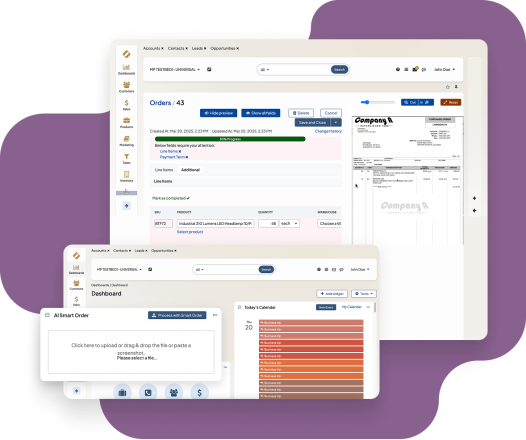
For OroCommerce operators, the LLM integration point is typically the API: the commerce platform exposes its data and actions through APIs, and an LLM application calls those APIs (via function calling or MCP) to interact with live order, pricing, and catalog data. The LLM does not have direct database access; it operates through the same controlled interfaces as any other integration.
When You Need It
- You need to understand unstructured input: emails, PDFs, free-text order requests, customer feedback.
- You want to generate structured output from natural language input: converting a customer's spec description into a product search query, or a sales call summary into a CRM record.
- You are building any AI feature that requires language understanding, such as product search, customer service, quote generation, or document analysis.
- You want to reason across information: not just retrieve a fact, but draw a conclusion from multiple inputs.
You almost certainly need an LLM if you are building any of the other capabilities in this glossary. It is the foundational component.
What It Is Not
- An LLM is not a database. It does not store facts reliably and retrievably. It stores statistical patterns. Asking an LLM to recall a specific price, a specific order number, or a specific contract clause will produce a plausible answer that may be wrong. Use RAG or function calling to give the model access to reliable, current data.
- It is not deterministic. The same prompt to the same model will produce slightly different outputs across runs (unless temperature is set to zero, which eliminates creativity but improves consistency). For use cases requiring exact, reproducible outputs, design with this in mind: validate outputs, log them, and do not rely on identical repetition.
- It is not intelligent in the way humans are. It does not have understanding, intent, or awareness. It has impressive pattern-matching and generation capabilities that are extraordinarily useful in the right architecture. Treating it as a knowledgeable expert leads to over-reliance; treating it as a sophisticated text processor leads to effective deployment.
Comparison
| LLM property | Implication for enterprise B2B deployment |
|---|---|
| No memory between sessions | State and context must be passed explicitly in each prompt |
| Prone to hallucination | Pair with RAG and output validation for factual tasks |
| Non-deterministic outputs | Log responses, set temperature appropriately, validate before acting |
| Strong at language, weak at arithmetic | Use function calling for pricing calculations, not model reasoning |
| Can follow complex instructions | Invest in system prompt quality, it drives output consistency |
See also
Ready to see it in action?
Book a demo of OroCommerce
See how agentic workflows fit into complex B2B commerce, with a walkthrough tailored to your stack.