Agentic AI
An AI system that can set sub-goals, plan a sequence of actions, use tools, and execute tasks autonomously across multiple steps without requiring human input at each stage.
What It Is
Agentic AI refers to AI systems that do more than respond to a prompt. They observe a situation, decide what to do next, take an action (often through an external tool or API), evaluate the result, and continue until a goal is reached.
The loop is: perceive, plan, act, evaluate, repeat.
-

Perceive
-

Plan
-

Act
-

Evaluate
-

Repeat
The defining characteristic is goal-directed autonomy. You give the system an outcome, “prepare a quote for this customer,” and it figures out the steps: pulling account data, checking pricing tiers, applying discounts, formatting the output, and routing it for approval. A human does not confirm each micro-step.
This is structurally different from a chatbot or a copilot. Those tools respond to a prompt and hand control back to the user. An agentic AI holds the workflow until it is done, escalating only when it genuinely cannot proceed.
In B2B Commerce Context
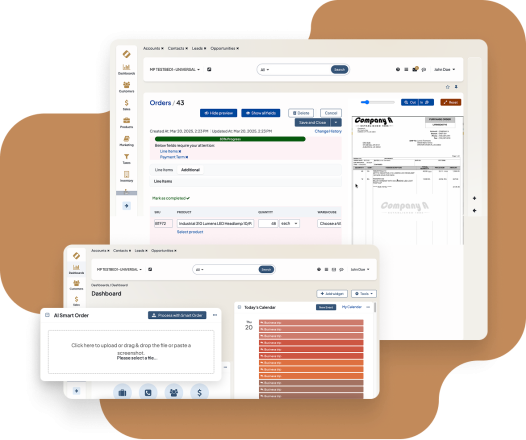
a procurement agent receives an email containing an informal order request. It parses the items, checks inventory across three warehouses, applies the customer’s contract pricing, flags one item as discontinued and proposes a substitute, builds a draft order, and sends it to a sales rep for a single approval click. The rep’s job shifts from data coordination to decision validation.
A practical example:
OroCommerce’s workflow engine and open API layer are designed for exactly this kind of integration. Agentic AI sits on top of the commerce platform and uses it as a set of tools: read catalog, write order, check price, query account, rather than replacing it.
When You Need It
- You process high volumes of orders that require data from more than one system before they can be confirmed.
- Your sales team spends more time building quotes than selling.
- You have exception-heavy workflows where a human currently acts as a router between systems.
- You want to extend selling hours without adding headcount — agentic AI handles overnight or weekend inquiries within pre-authorized rules.
What It Is Not
- Agentic AI is not a chatbot. A chatbot takes input and produces output. It does not act on external systems unless specifically built to do so, and even then it does not maintain goal state across a session.
- It is not robotic process automation (RPA). RPA follows a rigid, pre-scripted sequence of clicks and keystrokes. Agentic AI reasons about what to do next based on context, handles exceptions dynamically, and can adapt when a step fails.
- It is not magic. An agentic system is only as reliable as the tools it calls, the data it has access to, and the guardrails that govern its decisions. Without proper governance design, an agentic AI can make confident mistakes at scale.
Comparison
| Capability | Agentic AI | Standard AI / Chatbot |
|---|---|---|
| Goal persistence | Holds and pursues a multi-step goal | Responds to each prompt independently |
| Tool use | Calls APIs, queries DBs, writes records | Generates text only (unless extended) |
| Exception handling | Adapts dynamically, escalates when needed | Fails or produces a generic response |
| Human involvement | At defined checkpoints only | At every step |
See also
Ready to see it in action?
Book a demo of OroCommerce
See how agentic workflows fit into complex B2B commerce, with a walkthrough tailored to your stack.