AI Workflow Automation
The use of AI models to execute, route, or optimize multi-step business processes, going beyond fixed rule-based logic to handle variability, exceptions, and judgment calls within a defined workflow.
What It Is
Traditional workflow automation is deterministic: if condition A, do action B. It works well until reality introduces a situation the rules did not anticipate. AI workflow automation adds a reasoning layer that can interpret ambiguous inputs, choose between options, handle exceptions, and complete steps that have no single correct path.
The practical difference is coverage. A rule-based order routing system handles the 80% of orders that fit the pattern. An AI workflow system handles the remaining 20%: the order with a missing field, the customer who qualifies for two conflicting discount tiers, the SKU flagged as discontinued with no obvious substitute in the rules table.
AI workflow automation does not eliminate human involvement. It shifts human attention from routine processing to genuine exceptions: the cases where a decision actually requires judgment, not just pattern-matching.
In B2B Commerce Context
B2B commerce operations run on workflow: order intake, credit checking, pricing approval, fulfillment routing, invoicing, and dispute handling. Each step involves rules, but also exceptions. AI workflow automation compresses the exception handling that currently requires human triage.
The use case
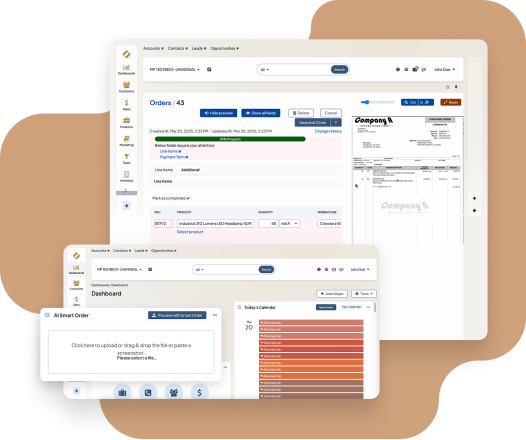
OroCommerce’s built-in workflow engine handles the structured, rule-based layer. AI workflow automation extends that engine’s reach into unstructured inputs and ambiguous cases, such as reading a PDF purchase order attached to an email, interpreting an informal reorder request, or proposing a substitution when a line item is unavailable.
When You Need It
- You have workflows where a human's job is essentially to route information between systems; they do not add judgment, they add coordination.
- Your team regularly handles exceptions that follow recognizable patterns but do not fit any single rule.
- You have unstructured inputs, such as emails, PDFs, and faxes, entering a structured system, and someone manually rekeying them.
- Workflow errors are causing downstream problems, including wrong pricing, missed approvals, and delayed shipments, because a rule-based system failed to catch an edge case.
Audit your current workflow exception rate before deploying. If more than 15% of cases require manual handling, AI workflow automation has a strong ROI case.
What It Is Not
- AI workflow automation is not RPA (robotic process automation). RPA mimics human clicks on a fixed UI path. It is brittle: a UI change breaks it. AI workflow automation works at the semantic level. It understands what needs to happen, not which button to click.
- It is not a full agentic system. AI workflow automation typically enhances specific steps within an existing workflow. Agentic AI creates and manages workflows dynamically. The distinction matters for scoping: you can deploy AI workflow automation within a contained process without building the broader architecture that full agentic systems require.
- It is not infallible. An AI that classifies incoming orders will misclassify some. Design the system with a confidence threshold below which it escalates to a human rather than proceeding. The goal is to reduce human handling, not eliminate oversight.
Comparison
| Approach | Handles exceptions? | Requires structured input? |
|---|---|---|
| Manual processing | Yes (human judgment) | No |
| Rule-based automation | No (breaks on edge cases) | Yes |
| RPA | No (brittle to changes) | Yes (fixed UI paths) |
| AI workflow automation | Yes (within scope) | No (handles unstructured input) |
| Agentic AI | Yes (full reasoning loop) | No |
See also
Ready to see it in action?
Book a demo of OroCommerce
See how agentic workflows fit into complex B2B commerce, with a walkthrough tailored to your stack.