Agentic Commerce
The application of agentic AI to commercial transactions, where buying, selling, quoting, and procurement workflows are executed autonomously or semi-autonomously by AI systems operating within defined business rules.
What It Is
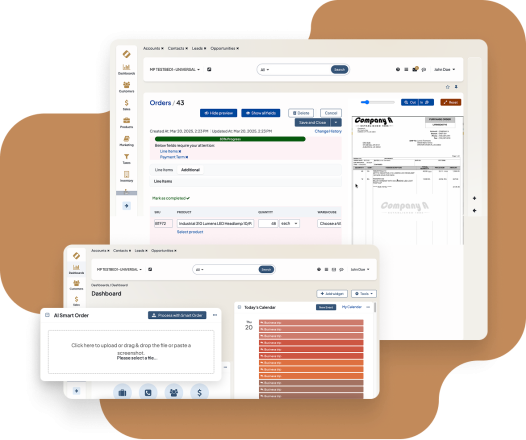
Agentic commerce is commerce that runs itself within boundaries you set. Instead of a buyer navigating a portal, building a cart, and submitting an order, an AI agent handles those steps based on standing authorizations, purchasing history, and contract rules. The human reviews outcomes, not processes.
The concept applies on both sides of a transaction. On the buying side, a procurement agent monitors inventory and places replenishment orders when thresholds are hit. On the selling side, a sales agent handles inbound inquiries, builds quotes, and manages follow-ups without rep intervention for standard accounts.
What makes it “commerce” rather than just “automation” is that it operates within the commercial context: pricing agreements, contract terms, account relationships, and financial controls, rather than around it.
In B2B Commerce Context
B2B commerce is structurally well-suited to agentic approaches because most transactions are not one-off decisions. They are repeatable patterns, such as standing orders, contract renewals, and scheduled replenishments, that follow known rules. That predictability is what an agentic system can be trained and constrained around.
What is the value for B2B?
OroCommerce’s native B2B features, including account hierarchies, contract pricing, workflow automation, and approval chains, are the infrastructure that agentic commerce runs on. Agents call into that infrastructure through APIs or tools rather than rebuilding it from scratch.
When You Need It
- Your transaction volume has outgrown your sales headcount and you cannot hire fast enough to keep pace.
- A significant share of your orders are reorders or follow predictable patterns that could be handled without human review.
- Your customers have asked for self-service options that go beyond a standard portal; they want to delegate their own purchasing to their own systems.
- You are losing deals because response times on quotes or order confirmations are too slow.
The right entry point is not full autonomy from day one. Start with agents that draft and route, with humans approving. Reduce the approval requirement as confidence builds.
What It Is Not
- Agentic commerce is not conversational commerce. When a buyer uses ChatGPT or Google AI Mode to find a product and click through to checkout, a human makes the decision. The AI changed the interface, not the decision-maker. True agentic commerce means the agent had authority to act, not just to present options.
- It is not EDI or traditional order automation. EDI exchanges structured data between systems according to fixed formats. Agentic commerce reasons about what to do, handles unstructured inputs (like an emailed purchase request), and adapts when the situation does not match the standard pattern.
- It is not a replacement for human judgment in complex or relationship-sensitive situations. Pricing negotiations, dispute resolution, and strategic account management require human context that no current agent system can replicate reliably.
Comparison
| Transaction type | Suitable for agentic commerce? | Why |
|---|---|---|
| Scheduled replenishment orders | Yes | Predictable, rule-bound, high frequency |
| Standard catalog reorders | Yes | Known SKUs, established pricing, no negotiation |
| Complex custom quotes | Partially | Agent drafts, human approves |
| Strategic contract negotiations | No | Requires relationship context and authority |
| Dispute or exception resolution | No | Needs human judgment and accountability |
See also
Ready to see it in action?
Book a demo of OroCommerce
See how agentic workflows fit into complex B2B commerce, with a walkthrough tailored to your stack.