AI API Integration
The practice of connecting AI model capabilities, including inference, embeddings, classification, and generation, to existing business applications and data systems through API calls, enabling AI features to operate within established enterprise workflows and infrastructure.
What It Is
AI API integration is how AI model capabilities enter enterprise systems. A B2B commerce platform, an ERP, or a CRM does not have an LLM built in. AI features are added by calling an AI model’s API, sending a request containing the query and context, receiving a response, and using that response within the application’s existing logic.
The integration patterns have matured significantly. Direct API calls to model providers are the simplest approach. Abstraction layers like LangChain standardize the interface so that switching models requires minimal code changes. Protocol standards like MCP allow AI capabilities to connect to enterprise systems through a common interface rather than custom code for each integration.
What has not simplified is the engineering work around the API call: managing authentication and secrets, handling rate limits and timeouts, validating outputs before they enter business logic, versioning the prompts that shape the API request, monitoring costs and latency, and ensuring that failures degrade gracefully rather than crashing dependent workflows.
In B2B Commerce Context
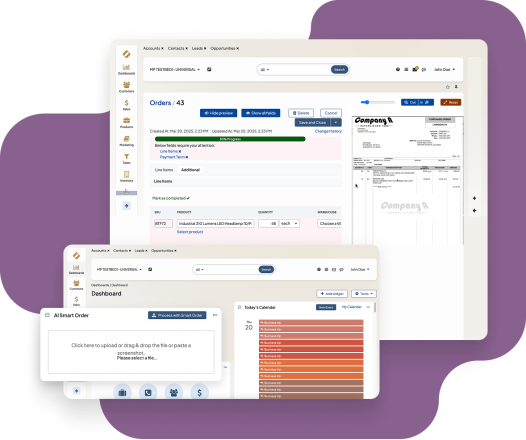
For a B2B commerce operator, AI API integration is the work of connecting AI capabilities to the systems that run the business. The OroCommerce API exposes order management, pricing, and catalog data. An AI API call sends a customer query along with retrieved catalog data and receives a product recommendation or quote draft in return. The integration layer connects those two worlds: it retrieves the right context, constructs the API request, calls the model, validates the response, and passes it back into the commerce workflow.
The integration points that matter most in B2B commerce are
Data governance is the dimension that separates B2B from consumer AI API integration. Consumer applications can often send user queries to a public model API without significant concern. B2B applications routinely contain customer pricing data, supplier relationships, and strategic business information in their queries. API selection, data minimization (sending only what the model needs), and contractual data handling agreements with the model provider are non-negotiable requirements.
When You Need It
- You are adding any AI-powered feature to an existing commerce, ERP, or CRM system.
- You want to use a frontier model's capabilities without building or hosting the model yourself.
- Your AI use cases involve different models for different tasks, such as a classification model, a generation model, and an embedding model, and you need a consistent integration architecture across them.
- You need AI capabilities to respond in real time within an existing user-facing workflow rather than as a batch processing step.
Treat AI API integrations with the same engineering rigor as any production integration: implement retry logic, handle rate limits, validate outputs, log requests and responses, and set latency budgets appropriate to the workflow’s user experience requirements.
What It Is Not
- AI API integration is not the same as building an AI feature. The API integration is the plumbing: connecting your application to the model. The AI feature is what the user experiences. The quality of the feature depends on prompt engineering, retrieval architecture, guardrails, and evaluation, not on the API call itself.
- It is not vendor-agnostic by default. Applications built with direct API calls to a specific model provider have switching costs when they want to change models. Abstraction layers (LangChain, LiteLLM) and protocol standards (MCP) reduce those switching costs. Design for portability if model selection is likely to change.
- It is not free to operate. Model APIs are priced per token or per request. Features that run frequently, process long documents, or use expensive reasoning models accumulate costs that must be monitored and managed. Build cost tracking into the integration architecture from the beginning. LangFuse and similar tools provide this as part of their observability suite.
Comparison
| Integration concern | What to address | Common failure if ignored |
|---|---|---|
| Authentication | Secure secrets management for API keys | Credential exposure in code or logs |
| Rate limiting | Retry logic with exponential backoff | Workflow failure during traffic spikes |
| Output validation | Check response before using in business logic | Wrong price or incorrect SKU enters live system |
| Cost monitoring | Track token usage per feature and workflow | Unexpected cost escalation at scale |
| Model versioning | Pin to specific model version where possible | Silent regression when provider updates model |
See also
Ready to see it in action?
Book a demo of OroCommerce
See how agentic workflows fit into complex B2B commerce, with a walkthrough tailored to your stack.