navigation

If you have been running on SAP Commerce Cloud (formerly SAP Hybris) for a few years, you already know the platform can handle complexity. What you might be questioning now is whether that complexity is working for you or against you.
For organizations managing complex B2B operations, the total cost of running SAP Commerce Cloud can grow quickly.
Between hundreds of thousands for implementation investments, developer dependencies for routine catalog updates, and licensing models that scale with usage, many businesses find themselves researching SAP Commerce Cloud competitors.
This guide walks through what to consider when evaluating SAP Commerce Cloud competitors, how the leading platforms compare for B2B use cases, and what makes a purpose-built B2B platform worth a closer look.
If you are ready to explore a specific option, each section below gives you what you need to make a fair comparison.
A Quick Look At SAP Commerce Cloud
SAP Commerce Cloud (formerly SAP Hybris) is an enterprise eCommerce platform built for large-scale B2B and B2C operations.
For current Hybris users, it’s worth noting that SAP is transitioning the legacy Hybris platform to its cloud version. This significant investment leads many businesses to evaluate whether a more affordable, purpose-built solution might be a better fit for their next chapter.
What SAP Commerce Cloud does well
- Native integration across the SAP ecosystem (S/4HANA, SAP ERP, SAP CRM)
- Handles high-volume online stores with millions of SKUs across multiple geographies
- Supports multi-site, multi-currency, and multi-language deployments
- Covers core B2B needs, including approval workflows and account-based pricing
Where SAP Commerce Cloud may not be the right fit
- Routine catalog, pricing, and portal updates require IT involvement
- RFQ workflows, buyer hierarchies, and contract pricing need heavy customization
- Connecting to non-SAP ERPs or CRMs requires costly custom middleware
- Implementations regularly reach hundreds of thousands, sometimes over a million dollars
Global food manufacturer Lactalis, which runs SAP as its ERP system, chose OroCommerce for its B2B eCommerce operations. Read the full case study.
Why Enterprise B2B Companies Switch From SAP Commerce Cloud
The decision to move off SAP Commerce Cloud usually follows months of escalating costs and a widening gap between what the platform delivers and what the business needs.
Cost and complexity as the primary drivers
- Licensing scales with transaction volume, meaning platform costs grow alongside your revenue
- Total investment over three to five years can reach several million dollars when factoring in consultants, custom development, and upgrades
- Specialized SAP talent is expensive and required for tasks that purpose-built platforms handle out of the box
- Power without usability creates bottlenecks that slow down your entire operation
Signs your organization has outgrown the SAP Commerce model
You may want to consider SAP Commerce Cloud alternatives if any of these sound familiar:
- Business teams still depend on IT for everyday updates like catalog, pricing, or content changes
- Your integration requirements extend beyond SAP to systems like Microsoft Dynamics, NetSuite, or Oracle
- Your mobile and cross-device buying experience isn’t keeping up with customer expectations
- Your implementation partner is focused more on maintenance than on delivering new capabilities
- Platform costs are rising faster than your commerce revenue
- Launching a new website or local version turns into a heavy IT project
If several of these apply, it may be time to explore whether a purpose-built B2B platform could deliver more advantage and flexibility at a lower total cost.
What To Evaluate In A SAP Commerce Cloud Competitor
Switching eCommerce platforms is not a small decision. These are the criteria that matter most for businesses with complex buying structures.
Let’s dive deeper into how features work in practice to help you understand whether the vendor’s roadmap aligns with where your business is heading.
| Evaluation Criteria | Why It Matters for B2B |
| Native B2B functionality (RFQ, approval workflows, corporate accounts, contract pricing) | Determines how much custom development you need to replicate standard B2B buying processes |
| ERP integration beyond SAP (Microsoft Dynamics, NetSuite, Oracle, and SAP itself) | Critical if your tech stack extends beyond the SAP ecosystem |
| CRM integration or built-in CRM capabilities | Unified account visibility across sales and commerce reduces manual work and data silos |
| PIM support for complex, configurable, and multi-attribute product data | Essential for businesses managing large or highly complex product catalogs |
| Business user autonomy (admin tools that don’t require developer intervention) | Directly impacts how fast your team can respond to market and pricing changes |
| API-first architecture and composability | Determines integration flexibility and future extensibility as your stack evolves |
| Deployment flexibility (cloud, self-hosted, hybrid) | Affects compliance, data sovereignty, and infrastructure cost |
| Implementation timeline and partner ecosystem availability | Impacts time-to-value and your ability to find qualified implementation support |
| Total cost of ownership (licensing + implementation + consultants + upgrades) | The true cost comparison, not just license fees |
| Multi-site, multi-brand, multi-org, and multi-geo capabilities | Needed for businesses managing multiple brands, regions, or buyer portals |
| AI readiness for B2B workflows | Determines whether AI can work inside your existing pricing, account, and permission logic without a separate tool stack |
| Integrated B2B payments | Reduces reconciliation overhead by keeping payment logic inside the order-to-cash flow |
| Migration tooling and SAP data portability | Reduces risk and timeline when transitioning customer, catalog, and order data |
| Vendor independence and avoidance of ecosystem lock-in | Protects your long-term ability to switch or extend without prohibitive exit costs |
| Ongoing support model and upgrade simplicity | Determines how much ongoing overhead the platform adds to your operations team |
5 Best SAP Commerce Cloud Competitors At A Glance
| Tool | G2 Rating | Best For | Top Feature | Starting Price |
| OroCommerce | 4.3/5 | Manufacturers, distributors, wholesalers | Native B2B workflows + multi-org architecture | Custom pricing |
| Commercetools | 4.6/5 | Dev-heavy enterprises, MACH adopters | 300+ composable APIs | Usage-based |
| Adobe Commerce | 4.0/5 | Adobe ecosystem, B2C + B2B hybrid | Adobe Experience Cloud integration | From $122,000/year |
| Salesforce Commerce Cloud B2B | 4.0/5 | Salesforce-first enterprises | Native CRM + commerce data unification | ~1–2% of GMV |
| Intershop | 4.4/5 | Complex B2B, manufacturing, procurement | Order management + punchout capabilities | Custom pricing |
5 Top SAP Commerce Cloud Competitors In 2026
These best alternatives below have been selected based on their relevance to enterprise B2B commerce. Get ready for a deeper dive.
OroCommerce
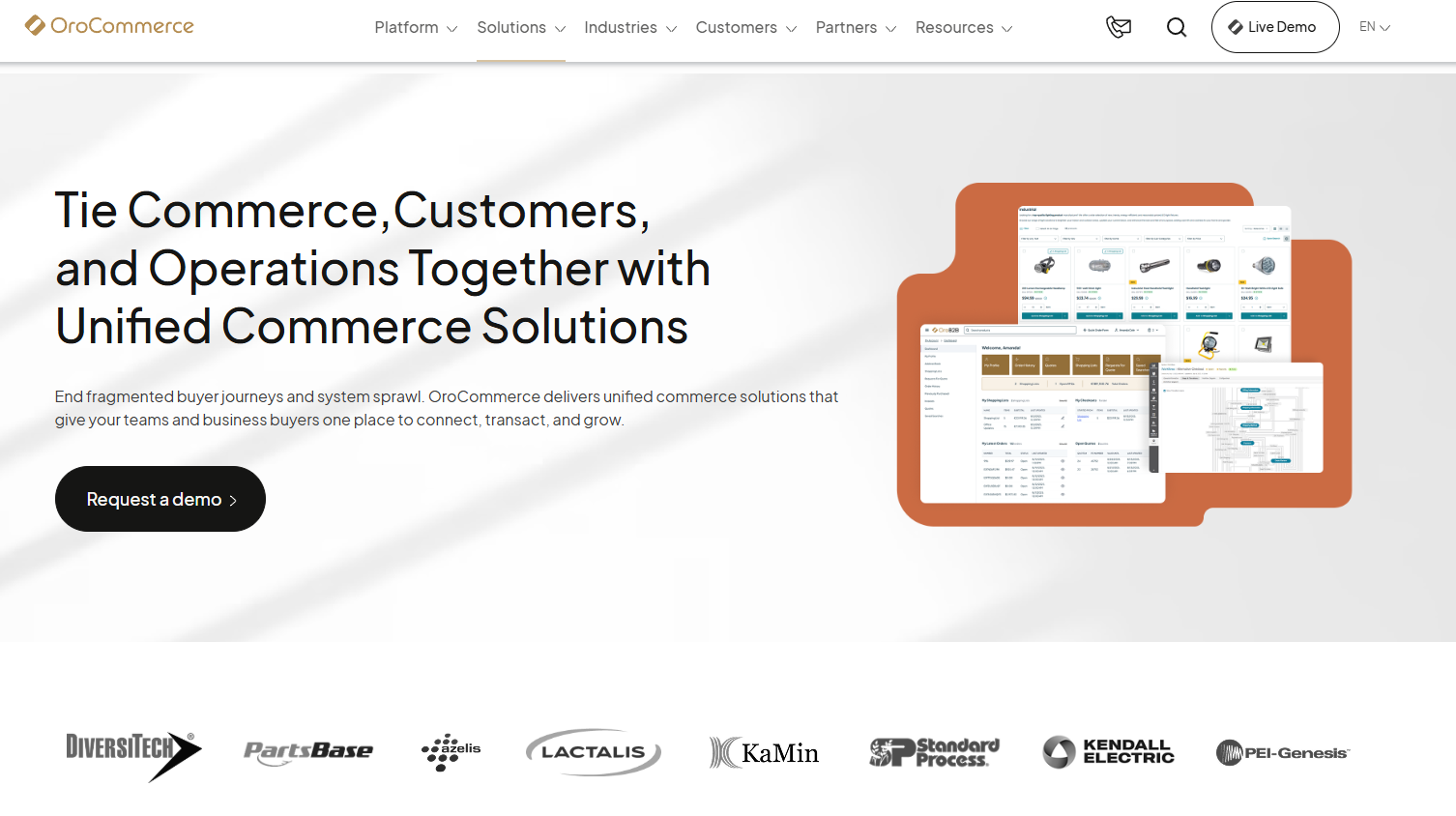
OroCommerce is a B2B-native eСommerce platform built specifically for manufacturers, distributors, and wholesalers.
Unlike SAP Commerce Cloud or other platforms adapted from DTC retail, OroCommerce is an eСommerce platform designed from the ground up for complex corporate accounts, custom pricing structures, and high-volume B2B transactions.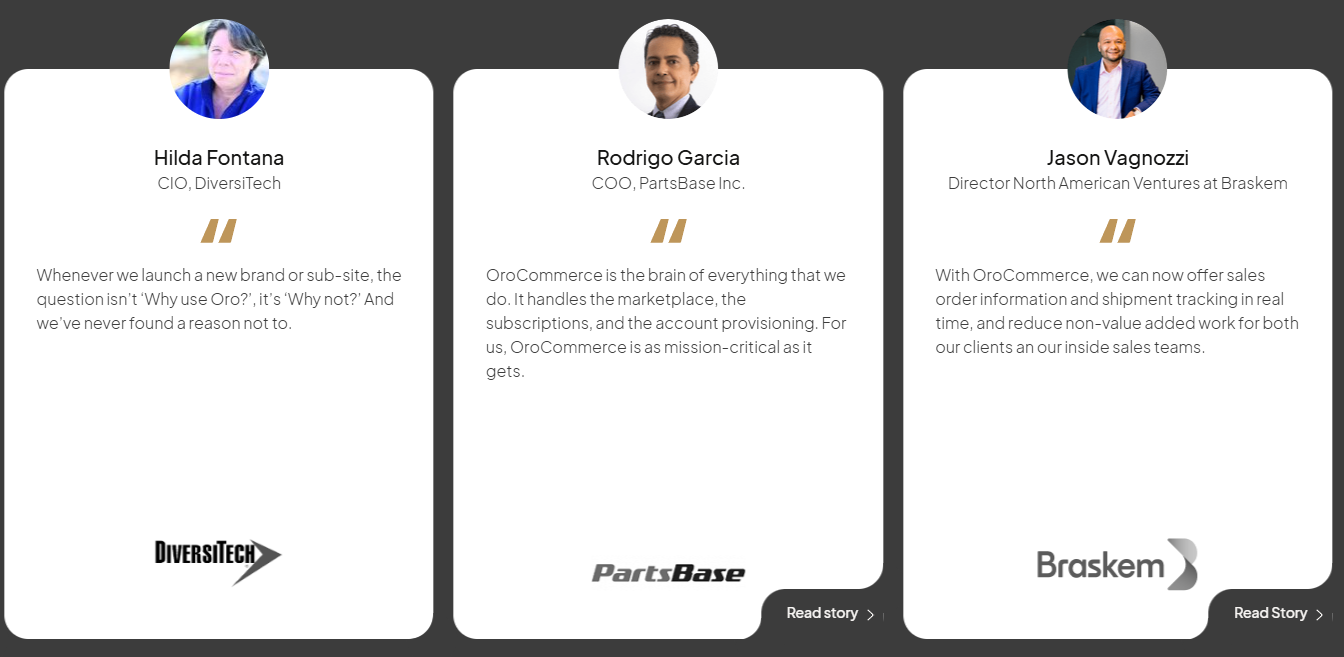 It includes built-in CRM, workflow automation, and AI capabilities, making it one of the few platforms that serve as a true unified commerce solution, with core B2B functions delivered under a single license rather than requiring separate tools for each.
The platform serves over 130 B2B enterprise customers and has been recognized in the Gartner Magic Quadrant for Digital Commerce for 5 consecutive years.
Best for
Mid-market to enterprise manufacturers and distributors with rep-driven sales, multi-step buyer approvals, and negotiated pricing, and operations that run across multiple sites, regions, or business units.
Key features
- Corporate account management with multi-level buyer hierarchies, roles, and permissions
- Flexible pricing engine: customer-specific, contract, tiered, volume, and negotiated pricing
- Native RFQ and quote negotiation workflows
- Sales rep tools: buyer impersonation, field sales app (PWA), and assisted ordering
- Quick order, reorder, and requisition list functionality for companies that sell online at high volume
- Native AI built into commerce workflows: ordering, sales intelligence, analytics, and task automation
- Built-in CRM and product content management
- Integrated invoicing and B2B payments (credit card, ACH, net terms) via OroPay
- Deep ERP integration: SAP ERP, Microsoft Dynamics, NetSuite, Oracle
- Multi-site, multi-brand, multiple languages, and multi-currency support
Pricing
OroCommerce is priced by GMV band, so costs stay predictable as your digital business grows. You’re not charged per storefront, per site, or per buyer account. Enterprise plans start with 25 admin users for your digital, sales, and support teams, and you can deploy on OroCloud, your own infrastructure, or on-premise.
Request a demo to discuss specifics.
Commercetools
Commercetools is a cloud-native, API-first platform-as-a-service built on a composable microservices architecture. It requires investment in development resources to build a complete commerce experience from composable components.
It is a popular choice for organizations committed to MACH architecture principles who want to be free from vendor lock-in.
Read our article on Commercetools alternatives to learn more.
Best for
Technically sophisticated enterprises with strong internal development teams or specialized SI partners who are comfortable with a higher build-versus-buy ratio.
Key features
- MACH architecture: Microservices, API-first, Cloud-native, Headless
- Over 300 composable APIs for product catalog, cart, pricing, and inventory management
- Multi-currency, multiple languages, and multi-region support
- Strong developer tooling enabling businesses to build custom buyer workflows
- Broad integration capabilities across CRM, ERP, and other solutions
- Native B2B capabilities, including custom pricing tiers and account hierarchies
Pricing
Commercetools uses a usage-based pricing model. Total cost of ownership can be significant when development and implementation resources are factored in.
Adobe Commerce
Adobe Commerce (formerly Magento Commerce) has a large install base across enterprise retail and B2B. It offers corporate accounts, purchase orders, and requisition lists, and integrates with Adobe Experience Cloud for personalized customer experiences.
Following the Adobe Summit 2025, Adobe has shifted its roadmap toward Cloud Service (SaaS). Customers already using on-premise Adobe Commerce will continue to receive the same level of support and access to new features, with no planned end date.
Best for
Enterprises already invested in the Adobe ecosystem, or organizations that need combined B2C and B2B capabilities with advanced content management and AI-driven personalization.
Key features
- B2B module with corporate accounts, credit limits, and approval workflows
- Includes product content management capabilities
- Native integration with Adobe Experience Manager and Adobe Sensei AI
- Strong omnichannel capabilities across digital and in-store channels
- Headless delivery via PWA Studio
- Large developer and SI partner ecosystem across the industry
Pricing
Adobe Commerce PaaS starts from approximately $40,000/year.
A minimum total-cost-of-ownership estimate, including implementation and maintenance, typically ranges from $122,000 to $450,000 or more, depending on store complexity.
It’s not suitable for small businesses or early-stage B2B operations.
Salesforce Commerce Cloud B2B
Salesforce Commerce Cloud B2B is built natively on the Salesforce platform. For organizations already running Salesforce CRM, it provides a natural path to digital commerce without introducing a separate system.
Both CRM and commerce data live in the same environment, which supports account-based selling and gives sales reps a shared view of the customer list and order history.
Best for
Enterprise organizations that are already deep in the Salesforce ecosystem and want tight commerce-CRM alignment.
Key features
- Native Salesforce CRM integration with shared account data across sales and commerce
- Corporate account ordering with buyer hierarchies and approval workflows
- Contract pricing and entitlements
- Einstein AI for personalized customer experiences and product recommendations
- Multi-site and multi-currency support
- AppExchange ecosystem for extending platform functionality
Pricing
Salesforce Commerce Cloud B2B is typically priced at approximately 1-2% of GMV.
Implementation costs via a Salesforce SI partner are high, and the platform delivers best value for organizations fully committed to the Salesforce ecosystem.
Intershop
Intershop is a commerce platform with deep roots in B2B and manufacturing, with the majority of its customer base in the DACH region where it originates. It is well-suited for businesses with complex procurement workflows, punchout catalog integrations, and high-volume order management requirements.
Intershop has invested significantly in its digital transformation capabilities, offering a headless, API-first architecture that supports both self-service buyer portals and sales-assisted channels.
Its order management engine is well-regarded for handling multi-step approval chains, split deliveries, and complex fulfillment logic that enterprise B2B buyers depend on.
Best for
Manufacturers and industrial distributors with complex procurement workflows, punchout requirements, and established SAP or non-SAP ERP environments.
Key features
- Advanced order management with approval workflows and punchout catalog support
- Customer-specific pricing, contract management, and tiered discount structures
- Headless and API-first architecture for flexible frontend delivery
- Mobile-optimized buyer experience across every device
- Deep ERP connectivity, including both SAP and non-SAP environments
- Robust multi-site capabilities supporting multi-brand and multi-geo operations
- Strong European partner ecosystem and multilingual support
Pricing
Intershop pricing is custom and based on deployment size, transaction volume, and integration complexity.
Why OroCommerce Is The Best SAP Commerce Cloud Alternative
Both OroCommerce and SAP Commerce Cloud are built for enterprise-scale B2B commerce, but they take fundamentally different approaches.
For manufacturers, distributors, and wholesalers, those differences show up in day-to-day operations, total cost, and how much your team can do without developer involvement.
| OroCommerce | SAP Commerce Cloud | |
| Architecture | B2B-first platform built around account hierarchies, quoting, and workflows | ERP-led Commerce extension, on overly complex and rigid monolithic platform |
| Pricing engine | Customer-specific, contract, tiered, volume, and negotiated pricing out of the box, synced with ERP data | Supports complex pricing only through real-time ERP integration |
| Corporate account management | Native multi-level buyer hierarchies, roles, permissions, and spending limits | Available but often requires customization to match complex B2B account structures |
| RFQ and quoting | Native RFQ, quote negotiation, and multi-step approval workflows built in | Supported, but adapting workflows to specific industry processes carries known development overhead |
| CRM | Built-in CRM included under one license, no separate integration needed | Requires a separate CRM integration, typically Salesforce or SAP CRM |
| ERP integration | SAP ERP, Microsoft Dynamics, NetSuite, Oracle, and others via documented connectors | Strongest in SAP-centric environments |
| Multi-site / multi-org | Designed for multiple sites, business units, and portals from one backend | Available through “cloning” catalogs and business logic, duplicating data and processes and making true scalability impossible |
| Platform scope | eCommerce, AI, CRM, PIM, DAM, invoicing, and payments under one license | Requires additional SAP modules or third-party solutions for comparable coverage |
| AI capabilities | Native AI layer (OroIQ) covering order automation, conversational commerce, business analytics, and more | AI investments are concentrated in SAP Business AI across the broader suite; commerce-specific AI tooling is limited |
| Business user autonomy | Catalog, pricing, and content updates manageable without developer tickets | Routine updates often require developer involvement |
| Pricing model | Single license, no per-site or usage-based fees | Scales with transaction volume and usage; specialized talent adds to ongoing cost |
| Total cost of ownership | Lower TCO through platform consolidation and a single-license model | Implementations commonly run into the hundreds of thousands or millions of dollars |
OroCommerce delivers in a single, unified platform what SAP Commerce Cloud often requires multiple tools, modules, and third-party solutions to achieve. It is purpose-built for the complex needs of manufacturers, distributors, and wholesalers.
For organizations where the SAP ecosystem is already deeply embedded, the switch requires planning. But for those reassessing total cost, operational flexibility, and how much their team can manage independently, OroCommerce is worth a serious look.
Give your teams and business buyers one place to connect, transact, and grow.
Pricing, TCO, And Contracting: What To Expect After SAP
Not all enterprise commerce platforms price the same way, and choosing the wrong model can turn a cost-saving move into an expensive mistake. Getting clear on pricing structures upfront is the first step to making a confident, informed decision.
How enterprise B2B commerce pricing models compare
The three most common pricing structures to understand before making a switch:
| Model | How It Works | Examples |
| Fixed annual license | Set fee regardless of volume or revenue | OroCommerce |
| Usage or GMV-based | Scales with transaction volume or revenue | Salesforce B2B (1-2% GMV), Commercetools, SAP Commerce |
| Module-based | Base license plus fees for additional capabilities | SAP Commerce Cloud, Adobe Commerce, Salesforce B2B |
A platform that looks affordable at launch can become the most expensive option at scale. The pricing model matters as much as the headline number.
Hidden costs to watch for beyond the license fee
- Implementation and SI fees: SAP Commerce Cloud deployments regularly exceed half a million dollars, with complex projects reaching one million dollars or more
- Custom development: Every catalog change or pricing update requiring a developer ticket adds continuous cost
- Integration middleware: Non-native connections to your ERP, CRM, or PIM must be maintained through every upgrade cycle
- Specialist talent: SAP-certified developers command a market premium that compounds over time
- AI and API limits and usage fees
Evaluating total cost of ownership over a 3-5 year horizon
When building your TCO model, focus on these five factors:
- License escalation: Does cost scale with your transaction volume, GMV, or number of sites?
- Implementation amortization: Spread your upfront investment across the full contract term
- Operational overhead: Quantify the ongoing cost of developer dependency for routine tasks
- Integration maintenance: Estimate annual costs for maintaining non-native connections across upgrades
- Upgrade cycles: Confirm whether major version upgrades are included in the license or priced separately
For most B2B organizations, purpose-built platforms like OroCommerce deliver lower TCO by eliminating entire cost categories that SAP Commerce Cloud routinely generates.
Get an estimate of time to ROI and projected revenue increases from digitizing your B2B business with OroCommerce
Final Words About SAP Commerce Cloud Competitors
SAP Commerce Cloud remains viable for large enterprises with dedicated SAP teams, deep SAP ERP investment, and the budget to staff a full-time SAP commerce development function.
For most other B2B organizations in manufacturing, distribution, and wholesale, the total cost, implementation complexity, and operational overhead no longer justify the trade-offs, especially when purpose-built alternatives now deliver comparable functionality at a lower TCO.
Start by being clear on what is not working in your current setup. Find the signs your B2B commerce tech stack is holding you back and map that against what each platform can realistically solve. The clearer you are on the problem, the faster you will find the right choice.
For most enterprise B2B businesses, the answer is OroCommerce. It is the only platform on this list built exclusively for B2B commerce, with pricing, account structures, ERP integration, and workflow automation that complex B2B operations actually need, all under a single license with no hidden fees or usage-based charges.
Stop customizing around the problem.
FAQs About SAP Commerce Cloud Competitors
Who is SAP's biggest competitor?
SAP Commerce Cloud’s most direct competitors in the enterprise B2B space are OroCommerce, Salesforce Commerce Cloud B2B, Adobe Commerce, Commercetools, and Intershop. The strongest alternative depends on your use case.
For manufacturers and distributors, OroCommerce is the most purpose-built option. For Salesforce-first enterprises, Salesforce Commerce Cloud B2B is the natural path.
Is SFCC the same as Commerce Cloud?
No. SFCC stands for Salesforce Commerce Cloud, a separate platform built by a different vendor. SAP Commerce Cloud is designed for organizations running SAP ERP, while Salesforce Commerce Cloud targets businesses already invested in the Salesforce ecosystem.
They have different pricing models, integration patterns, and partner ecosystems and are not interchangeable.
Are SAP Commerce Cloud and Hybris the same?
Effectively, yes. SAP acquired Hybris in 2013 and rebranded it as SAP Commerce Cloud. If you are searching for Hybris alternatives, you are evaluating the same platform under a different name.
Is SAP Hybris being replaced?
SAP is transitioning customers from legacy Hybris to its cloud-native platform. For many organizations, the cost and complexity of that migration serves as a natural trigger to evaluate purpose-built B2B alternatives rather than reinvesting in the SAP stack.