
navigation

In industrial B2B, “commerce” means quote-to-order, order-to-ship, ship-to-invoice, plus the rules that keep each step accurate. When these workflows spread across disparate legacy systems, they become hard to govern and expensive to change.
This article shows the triggers for consolidation, how to quantify the risk of waiting, and offers a litmus test to validate whether a vendor’s ‘unified platform’ claims hold up at the architecture level.
Why IT Teams Get Pushed Toward Consolidation in Industrial B2B
Most industrial organizations operate on architecture they didn’t design – they accumulated it. Years of M&A and regional expansion have created a landscape of mismatched ERPs, legacy custom code, and B2C platforms forced to handle B2B complexity. This fragmentation makes standard business requirements, like global inventory visibility or unified account management, prohibitively expensive to deliver.
Three specific business imperatives are driving the move toward consolidation:
1. Economies of Scale
Leadership wants speed; the stack demands redundancy. A manufacturer might want one customer experience across regions, even though the US and EU have different warehouse rules.
With a fragmented stack, you end up building the same requirement twice: separate customer records, discount logic, and integrations. The business pays double for the capability but still gets inconsistent outcomes. The pressure here is financial: stop funding “special projects” for every region and build a reusable engine.
2. Product and Process Consistency
In regulated verticals like chemicals or medical devices, “close enough” is a liability. A chemical supplier doesn’t just sell a product; they distribute hazmat documentation and shipping constraints. When those rules live in disparate systems or local spreadsheets, the business is forced to police exceptions manually. This shows up as shipping delays, rejected orders, and exposure to fines. IT is being pushed to consolidate not just for efficiency, but to hard-code compliance so it’s no longer optional.
3. M&A Sprawl Consolidation
M&A multiplies the number of systems that must stay alive for now.
A common pattern: an acquisition closes, and leadership wants cross-selling across the combined catalog within a quarter. But because the systems can’t share customer accounts or pricing logic, IT is forced to build a fragile, one-off connector just to book revenue. That connector becomes a permanent maintenance burden. The business is realizing that without a “global template” to onboard new entities, every acquisition just adds to the technological quicksand.
Two forces are making the ‘stay put’ option impossible to defend. First, the complexity of B2B requirements is outpacing the ability of legacy teams to keep up. Second, maintenance costs are eating the innovation budget. Gartner data shows that while 44% of organizations list technical debt as a top challenge, less than 20% of engineering leaders feel effective at managing it.
You know the fractured stack is the bottleneck. You know why you can’t deliver the speed the business demands. But to prove that to the CFO and secure the budget for a replacement, you need more than anecdotes. You need an objective framework to measure the mess.
Further Reading: How to Create a Consistent B2B Customer Experience during M&As
How to Quantify the Risk of Standing Still
Business pressure creates urgency, but urgency does not guarantee budget. To secure capital for a modernization project, IT must move the conversation from subjective complaints about fragility to an objective assessment of financial risk.
The Gartner PAID Model (Plan, Address, Ignore, Delay) provides a framework to do this. It maps technical debt items against business impact to determine priority. Running this audit requires deconstructing your B2B architecture into its component parts and scoring them against three variables: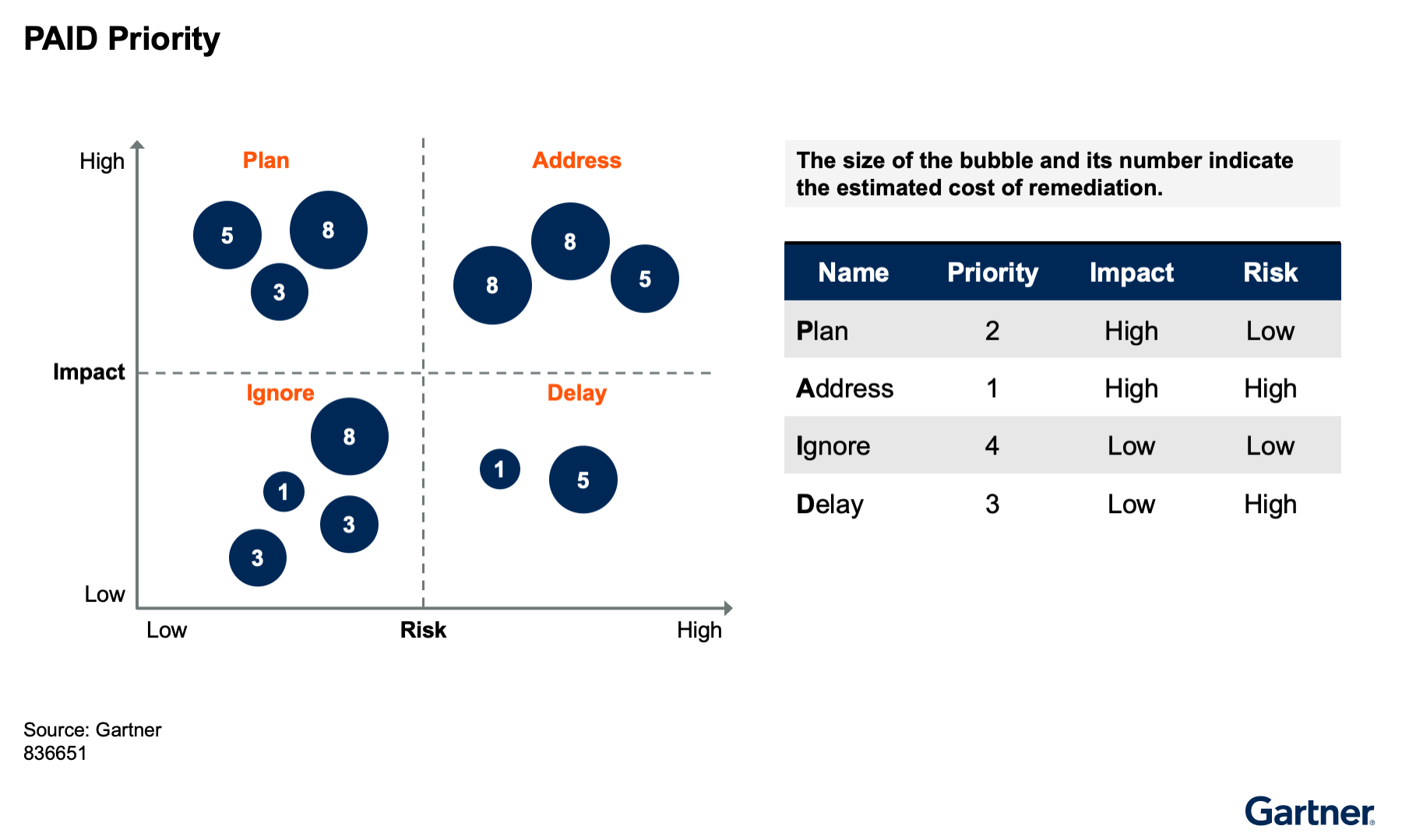
1. The Y-Axis: Business Impact
This measures what happens to the bottom line if the component fails.
In industrial B2B, the commerce engine invariably scores high. Unlike a content blog or an internal HR tool, the B2B portal drives order intake. If the quoting tool fails, sales stop. If the integration to the warehouse drops, shipping halts. The business impact of a B2B outage is immediate revenue loss.
2. The X-Axis: Risk
This measures the probability of failure and the severity of the consequences. This is where “bolted-on” architectures reveal their true liability.
- Architectural fragility: A system that relies on twenty interdependent plugins for core logic creates a chain of failure points. Gartner warns that by 2026, architectural complexity will be the primary driver of technical debt.
- Security exposure: Every plugin is a potential backdoor. The Verizon Data Breach Investigations Report links a sharp rise in breaches to vulnerabilities in third-party software. A platform dependent on a sprawl of extensions scores High on risk.
3. The Bubble Size: Remediation Cost
This represents the price to fix or modernize the asset.
For legacy systems, leadership often underestimates this cost because they look only at licensing fees. A proper audit includes the interest paid on the debt. McKinsey data indicate that maintenance consumes roughly 40% of IT budgets. These hidden operational costs (e.g., the developer hours spent patching rather than building) inflate the bubble significantly.
The Remediation Dilemma: Patching vs. Replacing
Faced with a “High Risk / High Cost” assessment, the executive instinct is to minimize scope. The questions from the Board usually focus on extending the asset’s lifespan: “Do we have to rip it all out?” or “Can’t we just fix the specific pain points?”
In modernization terms, this approach usually relies on encapsulation (connecting new tools to old systems via layers of code) or rehosting (moving the legacy application to the cloud to reduce hardware costs). While these strategies lower immediate capital expenditure, they often fail to address the underlying structural debt in industrial B2B environments.
1. The Maintenance Trap of Legacy Commerce Systems
For organizations running on aging commerce builds, custom-built sites, or web portals that function merely as rigid extensions of the ERP, the primary issue is the cost of “keeping the lights on.”
Attempts to modernize these systems by building new front-ends or moving them to cloud infrastructure rarely yield the expected ROI. The underlying code base remains resistant to change.
But the customer experience is only as fast as the slowest system in the chain. If your legacy commerce build takes 30 seconds to calculate complex pricing, a modern front-end simply displays a “loading” spinner for 30 seconds.
Encapsulation puts a fresh interface on a slow engine, failing to deliver the performance the business demanded. You’re left paying a high maintenance tax to support a system that physically cannot run at the speed of modern commerce.
Further Reading: What ERP Can’t See Is What’s Holding Back Digital Growth in B2B
2. The “Bolted-On” Architecture
The failure of “preservation strategies” becomes even more acute when organizations try to stretch B2C platforms to handle B2B workflows. Ciranda’s experience illustrates the ceiling of this approach. When the organic ingredient distributor launched its first portal on Shopify, adoption flatlined. The platform, optimized for consumer checkout speed, lacked the fundamental architecture for B2B relationships.
Buyers couldn’t access invoices or manage their own order history. The business ended up maintaining two separate sites – one for content, one for transactions – which fractured the customer journey and doubled the SEO workload.
Crucially, the data flow broke at the ERP level. While the platform could push orders into NetSuite, it couldn’t sync credit limits or account history back to the user. Instead of automating sales, the “digital” channel forced the internal team to manually re-enter orders from emails and phone calls.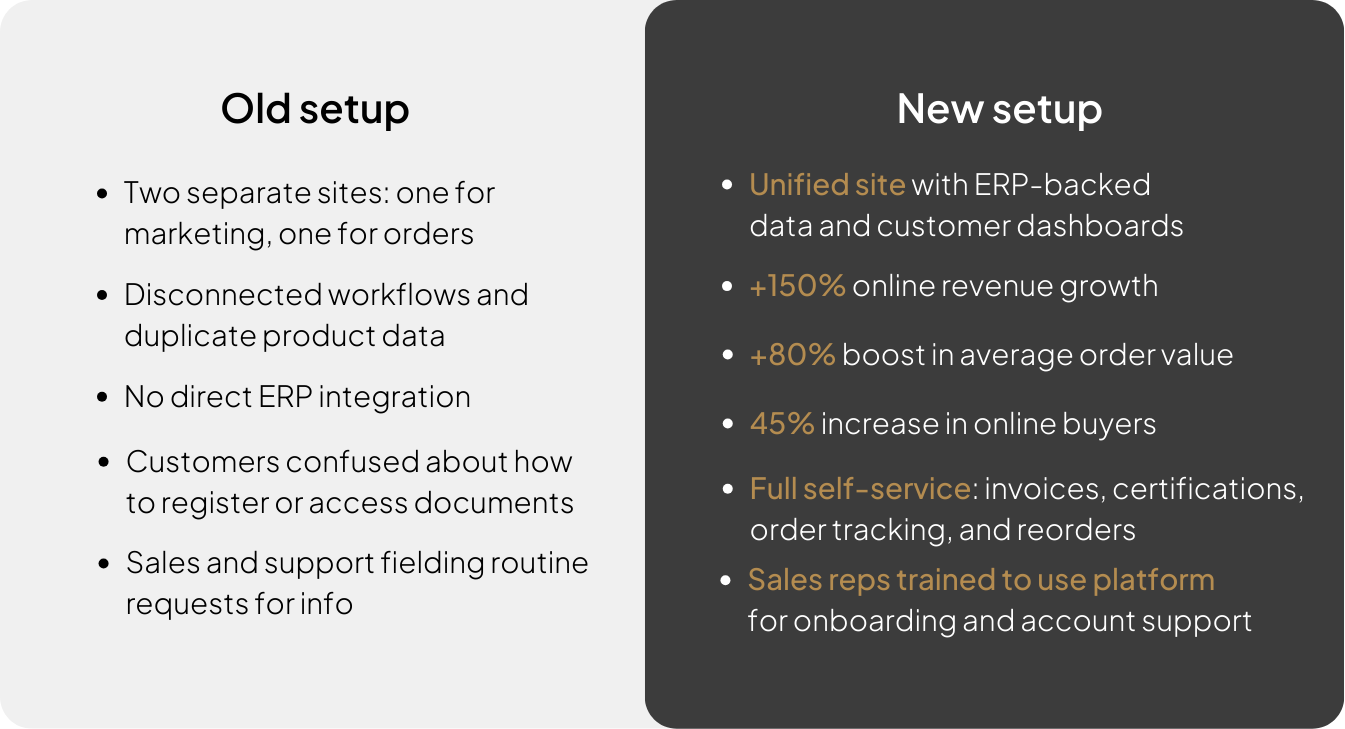 API wrapping cannot fix this functional data model mismatch. B2C platforms operate on a “Customer equals Individual” logic. Industrial B2B requires a “Customer equals Company” hierarchy with infinite tiers of subsidiaries, buyers, and approval limits. Patching this discrepancy requires twisting the core logic of the software, creating a fragile system that breaks with every vendor update.
When Replacement is Necessary
When the data model requires constant forcing to meet business needs, and the cost of maintenance consumes half the IT budget, remediation offers diminishing returns.
For complex industrial requirements, replacement becomes the only viable path to lower the Total Cost of Ownership (TCO). It removes the recurring maintenance tax and eliminates the security risks inherent in a Franken-stack.
If we accept that patching the old stack is financially inefficient, the question shifts to the architecture of the replacement. You need to avoid building a new version of the same fragmented stack.
The Solution: Unification as Architecture, Not Marketing
Consolidation projects often stall when the team realizes the “All-in-One” platform they selected is actually three acquired companies taped together. In the industrial sector, unification must describe a physical architecture, not a product bundle.
To successfully consolidate an industrial commerce stack, the target platform must deliver on three architectural non-negotiables:
One Data Model for the Work that Creates Orders
A viable foundation has a single codebase reading from a single database for core commerce operations: customers, accounts, price lists, quotes, orders, invoices, and the rules that govern them.
That’s where the practical difference shows up:
- A contract price changes once, in one place, and the storefront uses that same record immediately.
- A quote created by sales and an order placed by the customer reference the same customer entity, not two versions stitched together.
- An invoice posted back to the portal appears under the same account hierarchy that controlled the purchase.
A Digital Mirror of the Buyer
Consumer platforms struggle in industrial environments because they assume a buyer is a single individual. In the industrial sector, the “customer” is a complex organization with layers of approvals.
A unified commerce platform must function as a digital mirror of this organizational chart. This requires an Access Control List (ACL) engine capable of granular governance:
- Corporate hierarchies: The system replicates the multi-level structure of the client, allowing parent accounts to audit child accounts while keeping budget centers distinct.
- Customer-managed access: Procurement teams add users, adjust roles, and set spending thresholds without filing tickets, while audit trails still capture who changed what and when.
- Role-based control with depth: A buyer can request a quote, an approver can authorize it, and the seller can enforce credit holds that prevent checkout when the account is flagged.
Native Multi-Entity Management
This is where the consolidation promise is kept. A unified architecture must support multi-entity management native to the core, not as an add-on.
This capability allows IT to solve M&A system sprawl by hosting multiple distinct organizations, websites, and catalogs from a single instance.
- You manage global data (like the master product catalog) centrally, while isolating local data (like taxes, currencies, and warehouses) to specific business units.
- Instead of building a new silo for every acquisition, you deploy a configured instance of the core engine. This onboards new brands quickly without duplicating the technical stack.
Verifying the Architecture
Marketing materials often obscure the difference between a platform that is structurally unified and one that is simply bundled. To validate a vendor’s claims, IT leaders can apply the ISO/IEC 25010 software quality standards as an objective filter.
While standard evaluations track generic performance, an industrial consolidation project demands a stricter audit of two specific areas:
- Functional Suitability: The standard evaluates whether a product meets “implied needs” without modification. In B2B, implied needs include complex organizational structures. If a platform requires a third-party extension to map a standard corporate hierarchy it fails the native suitability test.
- Future-Readiness: ISO traditionally measures maintainability and flexibility, but modern demands require future-readiness. The goal is to absorb innovation without destabilizing the core. A unified foundation provides a clean, centralized data layer, meaning that integrating new capabilities like AI becomes a standardized connection rather than a complex re-architecting effort.
Even with the correct architecture, the physical migration carries weight. To help you identify specific pitfalls in your implementation plan, from data migration gaps to vendor stability risks, you can download our detailed Enterprise Platform Implementation Risk Assessment template.
Validate your project plan against 90 pre-defined risk factors to uncover blind spots before they become blockers.
The ROI of Unification: Speed, Security, and Savings
Validating the architecture is the safety check. Replacing the stack is the heavy lift. But once you remove the friction of the fragmented stack, the daily reality for IT changes. You stop allocating your budget to keep the lights on and start allocating it to growth.
The return on this investment shows up in four hard metrics:

Bolted-on stacks burn budget on middleware just to keep systems talking. Unification eliminates this cost center, letting you pay for the engine rather than the glue.

Managing patches for twenty separate plugins creates an unmanageable security perimeter. Unification collapses this risk into a single, hardened codebase that is exponentially easier to defend.

Expansion shouldn't require a new build for every region. A unified global template allows you to launch new markets by configuration, avoiding the coding surprises that delay rollouts.

You cannot build for the future while spending 70% of your week fixing old integrations. Unification frees your team to stop fighting fires and start implementing high-value tools like AI.
The Cost of Waiting
The ‘do nothing’ option is expiring. Technical debt in industrial B2B compounds. Every month you delay consolidation is another month of paying high interest in the form of maintenance hours, security exposure, and stalled growth.
You know where the friction lives in your current stack. Use the PAID Model to measure it, use the ISO standards to vet your replacement, and build the case for a unified system that supports the scale your business demands.