
navigation

Managing orders across multiple systems, warehouses, and customer portals creates gaps in B2B operations across your customer facing channels. One team sees one inventory count, another sees different numbers, and the inconsistency spreads fast.
For example, customers order online while sales reps quote from outdated data, warehouses pick the wrong stock, and accounting lags, all of which hurt speed, accuracy, and customer satisfaction.
Unified commerce B2B software runs core logic, like contract pricing, quotes, and account hierarchies, in one single engine, not just patched data syncs between tools. Your webstore, sales reps, and warehouse all use the same commerce brain, creating a seamless shopping experience across channels.
This guide explains what unified commerce means for daily operations and compares five leading B2B solutions to find your best fit.
The Basics Of Unified Commerce B2B Software
Many eCommerce solutions fall short because they were never designed for modern B2B operating models. Most eCommerce systems manufacturers and distributors use are often over-customized ERPs or large enterprise suites in which commerce is delivered through separate modules, the cloud, or add-on products.
These setups may appear unified on paper, but remain fragmented at the core, with pricing, inventory, customer data, and order logic spread across loosely connected backend systems. Each new workflow, region, or business unit increases integration effort, operational risk, and long-term cost.
In a B2B context, unified commerce means running buyer-seller interactions and the quote-to-cash cycle on a single solution with shared data and shared business logic.
Instead of duplicating portals or stitching workflows together, every channel operates on the same foundation, ensuring consistent pricing, accurate inventory, and aligned customer records across all interactions.
It reduces manual work, lowers ownership costs, and supports growth without adding architectural complexity.
The key to a unified architecture lies in how it handles the complexity of B2B relationships. In a fragmented stack, a web portal often doesn’t know how a customer’s business is structured. A unified platform natively mirrors your buyers’ real-world organizational chart, handling multi-level corporate hierarchies, budget centers, and approval rules as part of its core logic.
This built-in intelligence makes growth much simpler. Because the foundation is unified, you can launch new brands, manage different regions, or expand into new business models (such as B2B2X) from a single central hub.
Get Free Report: Unifying Commerce in a Multi-System World
Why B2B Businesses Are Adopting Unified Commerce
B2B leaders choose unified commerce to scale efficiently by:
- Expanding from one core system (no sprawling integrations)
- Standardizing commerce rules (consistent pricing, quotes, and workflows everywhere)
- Reducing reconciliation work (one source for orders, inventory, and accounting)
It replaces fragmented tools with unified systems built for growth.
Operational challenges unified commerce solves
Many organizations still run fragmented commerce workflows.
That leads to inconsistent pricing, outdated inventory, duplicate records, and manual workarounds that slow fulfilment and frustrate customers.
Unified commerce technology eliminates those gaps by keeping data connected across multiple channels and teams. The business impact is measurable:
- Faster quote-to-order conversion as terms, approvals, and history carry directly into the record
- Less manual re-keying and fewer internal status checks per order to verify account data.
- Lower support volume for routine questions
- Faster rollout of new portals/regions
The hidden cost of tech debt disappears when you eliminate duplicate systems and manual reconciliation. A unified commerce strategy results in better retention, improved efficiency, and predictable growth without adding complexity.
Core Features Of Unified Commerce B2B Software
The unified commerce architecture helps you avoid the headaches of managing multiple commerce systems with one centralized platform. Your team doesn’t waste time cross-checking availability or fixing pricing errors across separate systems.
Here are the key features you need to look for when choosing the best solution for your needs.
| Feature | What It Does |
|---|---|
| Digital Mirror of the Buyer | Natively manages complex, multi-level hierarchies and approval workflows without external plugins. |
| Advanced pricing and contracts | Apply customer-specific price lists, volume tiers, and negotiated terms automatically at checkout |
| Converged Quote-to-Order | Moves quotes, approvals, and order records through the entire cycle within a single, unified data model. |
| Multi-entity architecture | Run multiple brands, warehouses, or regional sites from one unified platform |
| Integrated CRM and RFQ | Track quotes, negotiations, and customer communications alongside order history |
| Embedded Order-to-Cash | Process payments and reconcile invoices on the same commerce platform your buyers use |
When unified commerce delivers these features natively, you improve operational efficiency. Your sales team works faster because they access real-time inventory.
Your finance team closes books quicker because payment data flows automatically. A unified commerce system simplifies operations by replacing multiple commerce systems with one unified commerce platform that scales as your business grows.
How To Choose The Right Unified Commerce B2B Software
The right unified commerce platform depends on what’s breaking in your current setup and how much control you need over commerce logic.
Start by mapping your current pain points
System sprawl from acquisitions or regional expansion: You need native multi-organization architecture that can onboard new entities without rebuilding the stack. Look for unified commerce solutions where new brands or regions configure within the same instance, not separate installations that multiply licensing costs and create data silos.
Complex quoting and negotiation workflows: Standard webstores don’t handle the back-and-forth of B2B deals. Evaluate whether CPQ, RFQ, and approval workflows run natively in the platform or require third-party plugins that add integration risk and hurt operational efficiency. Sales reps need tools that connect directly to inventory management and pricing systems without manual workarounds.
Heavy dependency on existing ERP or CRM: If your operations already run on a specific ERP or customer relationship management system, integration depth matters more than feature breadth. Assess whether the commerce solution connects through native APIs or requires custom middleware that breaks with every update and increases total cost of ownership.
Mixed B2C and B2B sales models: Running consumer and business sales from one unified commerce system requires handling both simple checkout and B2B complexity (account hierarchies, account specific pricing, bulk ordering). Check whether the platform forces you to maintain separate sites or can serve both models from one instance across multiple sales channels.
Verify architectural claims with technical documentation
“Unified” gets used loosely in marketing. Ask whether customer data, pricing rules, and order workflows actually run in one codebase or if the platform stitches separate modules together behind the scenes. True unified commerce eliminates data silos and the disconnected systems that create delays and damage the customer journey.
Platforms that truly unify backend systems deliver higher customer satisfaction because every team works from the same source of truth, improving customer interactions and strengthening customer relationships.
[Free Chart] Top B2B eCommerce Platform Vendors Compared
Top 5 Unified Commerce B2B Software Tools Compared
Choosing unified commerce software for your business isn’t easy. Every platform brings its own flavor to B2B operations, and not all unified commerce platforms handle complex buyer relationships the same way.
| Platform | Target Users | Architecture | ERP/CRM Integration | Customization | Best For |
|---|---|---|---|---|---|
| OroCommerce | Manufacturers, wholesalers, and distributors | Unified. Account hierarchies, price lists, and the entire quote-to-order flow live in one native codebase. | API-first integrations for ERP/OMS/WMS + built-in CRM (or CRM integrations) | Extensive (modular, open architecture) | B2B companies with system sprawl that want unified quoting, ordering, payments, and customer data |
| Salesforce B2B Commerce Cloud | Enterprise B2B organizations | Product bundle; connects separate clouds through heavy integration. | Native Salesforce CRM connection + connected data across teams | High (enterprise-grade, often developer-led) | Companies already using Salesforce that need global scale, personalization, and flexible rollout |
| Shopify B2B | Smaller wholesalers, manufacturers, and brands running DTC + B2B | Extension-heavy; a B2C core that uses apps and connectors to handle B2B requirements | ERP/OMS/CMS integrations via apps, APIs, and connectors (8,000+ app ecosystem) | Moderate to high (themes, Liquid, headless APIs) | Teams wanting fast launch and a single platform for wholesale + DTC with strong extensibility |
| BigCommerce B2B Edition | Small to mid-sized wholesalers and manufacturers | Integration-led; relies on an acquired B2B edition layer sitting on top of a core engine. | Open APIs for ERP/OMS/CRM integrations | Moderate to high (open-source buyer portal + headless support) | Businesses needing customizable buyer experiences and sales-friendly quoting workflows |
| SAP Commerce Cloud | Enterprise manufacturers and distributors | Ecosystem suite; vast, enterprise-scale modules that often require complex internal syncing. | Native SAP Cloud ERP connectivity + enterprise integration support | High (flexible composability + modular storefront options) | Large global organizations needing scale, and SAP ecosystem alignment |
Top Unified Commerce B2B Software Overview
Below is a quick overview of the top unified commerce B2B platforms, each designed to centralize sales channels, customer data, inventory, and order workflows in one system.
OroCommerce
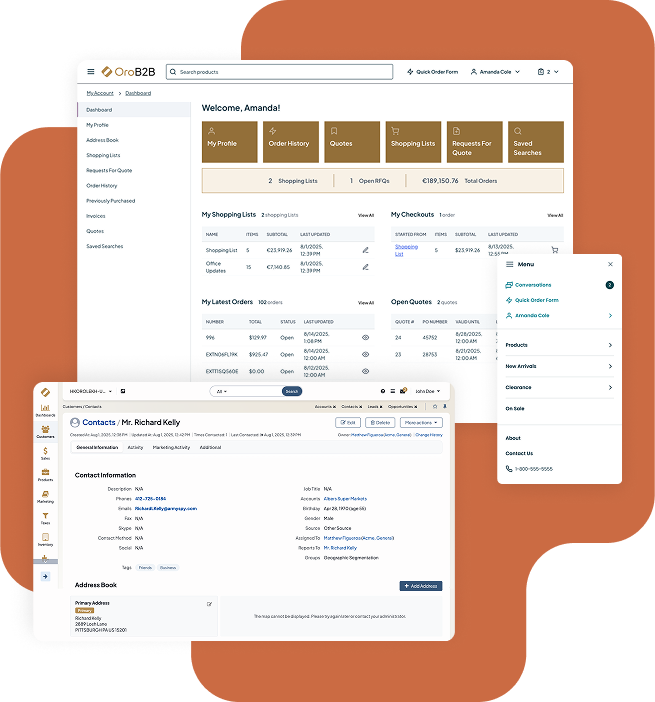
OroCommerce delivers unified commerce solutions built for B2B companies that need to connect commerce, customers, and operations on one platform.
It’s designed for growth environments where acquisitions, siloed systems, and fragmented workflows make it hard to maintain a single source of truth across teams and buyer channels.
Best for: Manufacturers, wholesalers, and distributors dealing with system sprawl who want to unify quoting, ordering, payments, and customer data without a full rip-and-replace.
Key features
- Unified account history that links quotes, orders, and support cases under one customer record
- Accurate contract pricing and availability across portals, catalogs, and sales reps
- Built-in CRM or CRM integrations to keep customer data consistent across channels
- Native quoting, CPQ, and RFQ tools that connect directly into order workflows
- Integrated payments with OroPay (cards, ACH, and invoice-based payments)
- PIM, DAM, and CMS included to centralize product content and brand truth
- Multi-site and multi-organization support for regions, brands, and acquired businesses
- Workflow automation plus AI SmartOrder and AI SmartAgent for faster self-service and order processing
- Shared dashboards and reporting built on one unified data foundation
- API-first architecture with enterprise security, role-based access control, and SOC2 compliance
Pricing overview
A single license grants full access to every native feature, from complex quoting and workflows to built-in CRM and AI-driven automation. You aren’t charged for new storefronts or buyer accounts, meaning one license powers your entire global operation without per-site fees.
Request a demo for details.
Salesforce B2B Commerce Cloud
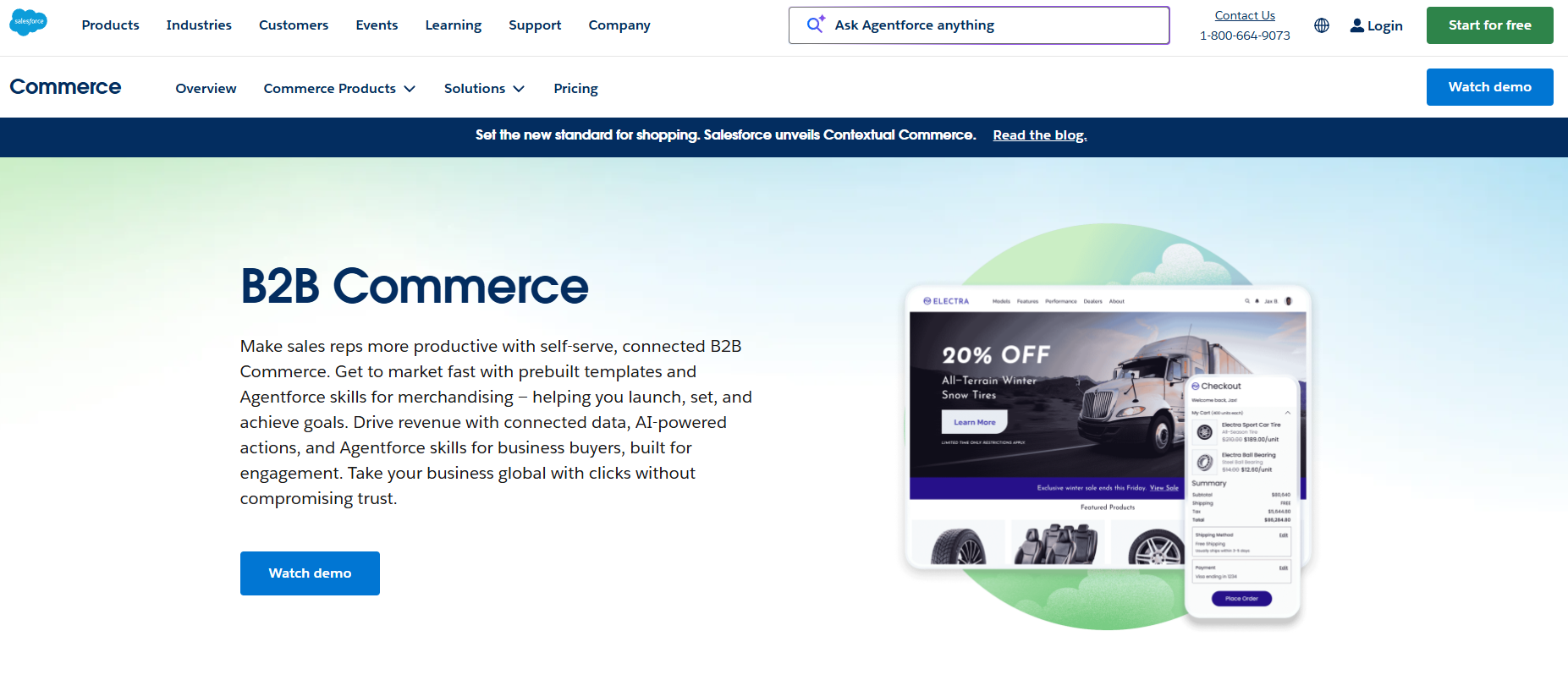
Salesforce B2B Commerce is a connected, self-serve platform designed to make sales reps more productive while giving business buyers a consumer-grade ordering experience.
With prebuilt templates and Agentforce skills, companies can launch faster, automate merchandising tasks, and drive revenue using connected data and AI-powered actions.
Best for: Enterprise B2B organizations that want a unified, Salesforce-connected commerce platform with flexible rollout options and global scalability.
Key features
- Account segmentation with buyer entitlements, negotiated pricing, tailored promotions, and personalized catalogs
- Optimized checkout and B2B order management built for complex purchasing workflows
- Agentforce merchandising skills to automate inventory updates, price changes, and personalized promotions
- AI promotions and SEO support to improve conversion and performance
- Unified insights and analytics for tracking revenue and buyer behavior
- Headless B2B commerce for flexibility and lower total cost of ownership
- Global scaling tools to manage multiple brands and sites, with localization for language, currency, and catalogs
- Trust, reliability, and security designed for enterprise commerce environments
Pricing overview
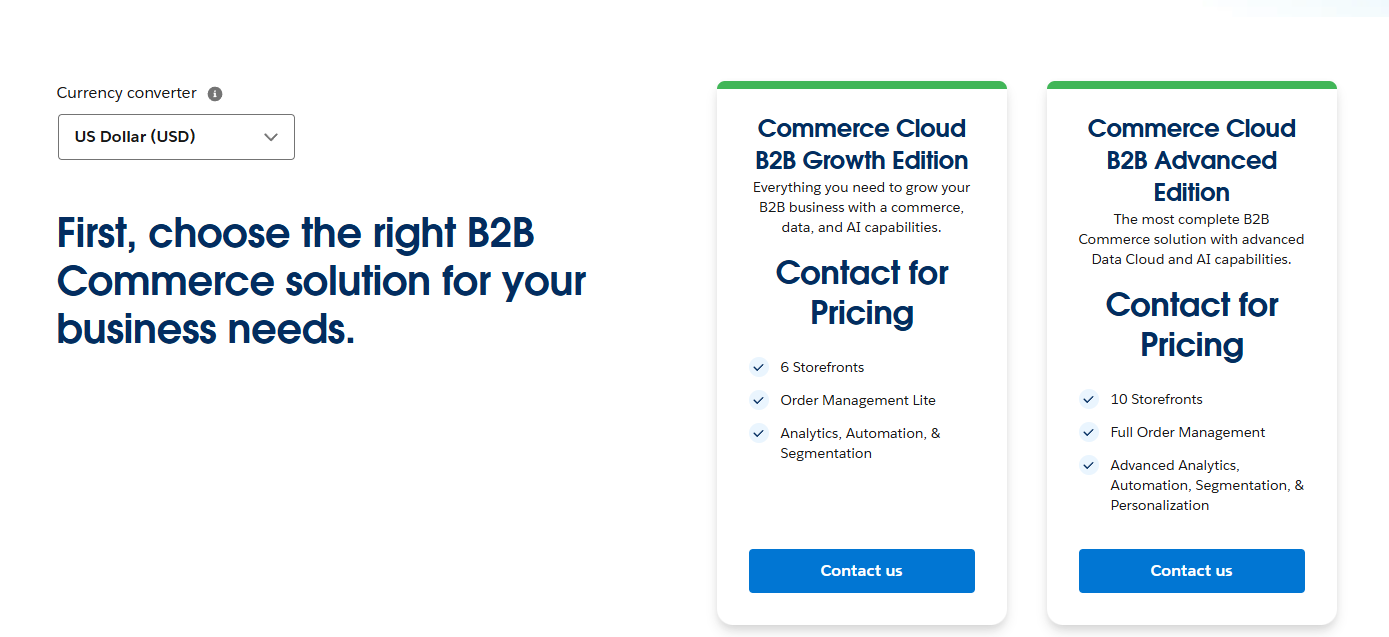
Salesforce uses quote-based pricing for B2B Commerce, so the page doesn’t list exact prices. You need to contact the company for more information.
Shopify B2B Commerce Platform
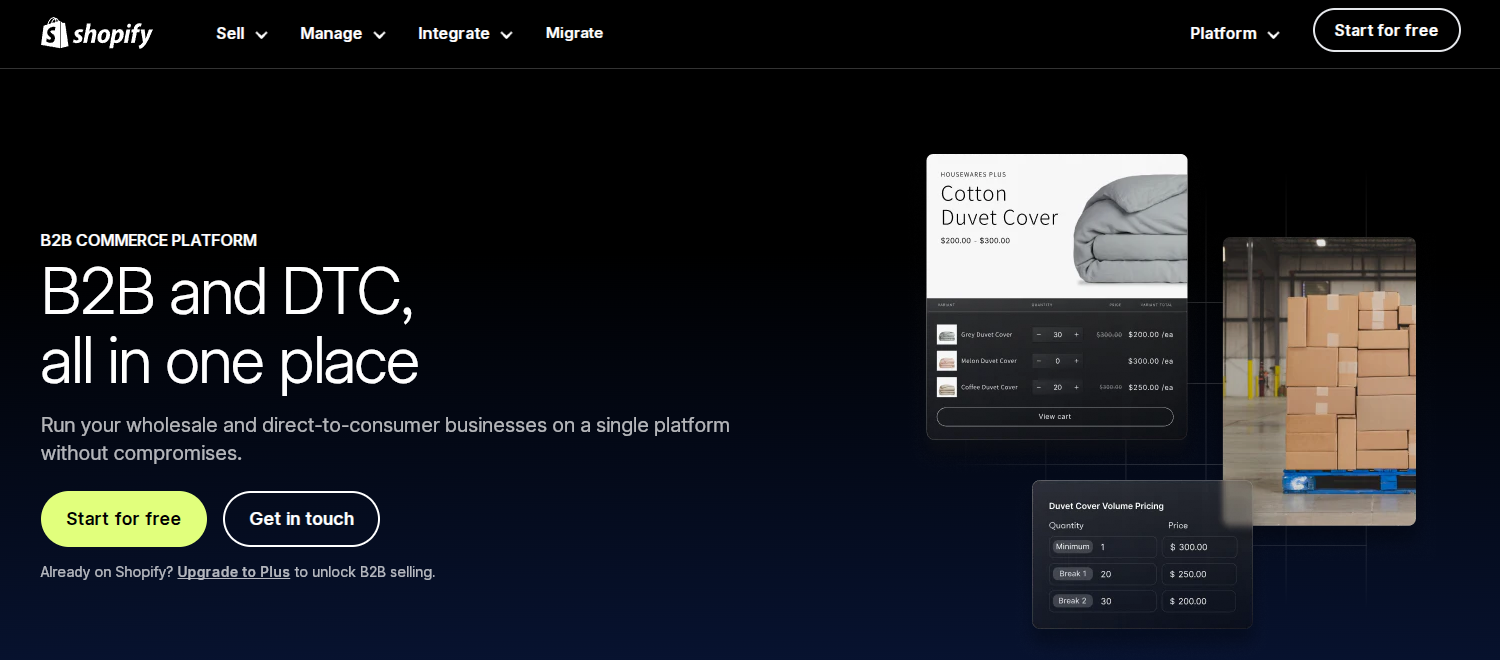
Shopify’s B2B Commerce platform lets you run wholesale and DTC in one place, so you can sell to business buyers without splitting your tech stack or managing separate storefronts. This is central to Shopify’s unified commerce approach, especially for teams optimizing for speed and ecosystem flexibility.
It comes with built-in tools for custom pricing, curated catalogs, flexible payment terms, and self-serve purchasing while still supporting sales reps and omnichannel growth.
Best for: Smaller wholesalers, manufacturers, and brands that want to scale B2B and DTC on one platform with fast setup and strong customization options.
Key features
- Company profiles for multiple buyers and locations with permissions, terms, and tax settings
- Customer-specific catalogs, custom pricing, quantity rules, and volume pricing
- B2B-optimized storefront themes, plus headless and API-based build options
- Self-serve portal with quick bulk ordering, easy reordering, and account management
- Sales rep tools with admin permissions for assigned accounts and order placement
- Workflow automation with Shopify Flow, company account requests, and checkout-to-draft workflows
- Integrations with ERP/OMS/CMS tools, plus APIs and connectors for custom syncing
- Access to Shopify’s ecosystem of 8,000+ apps to extend functionality
Pricing overview
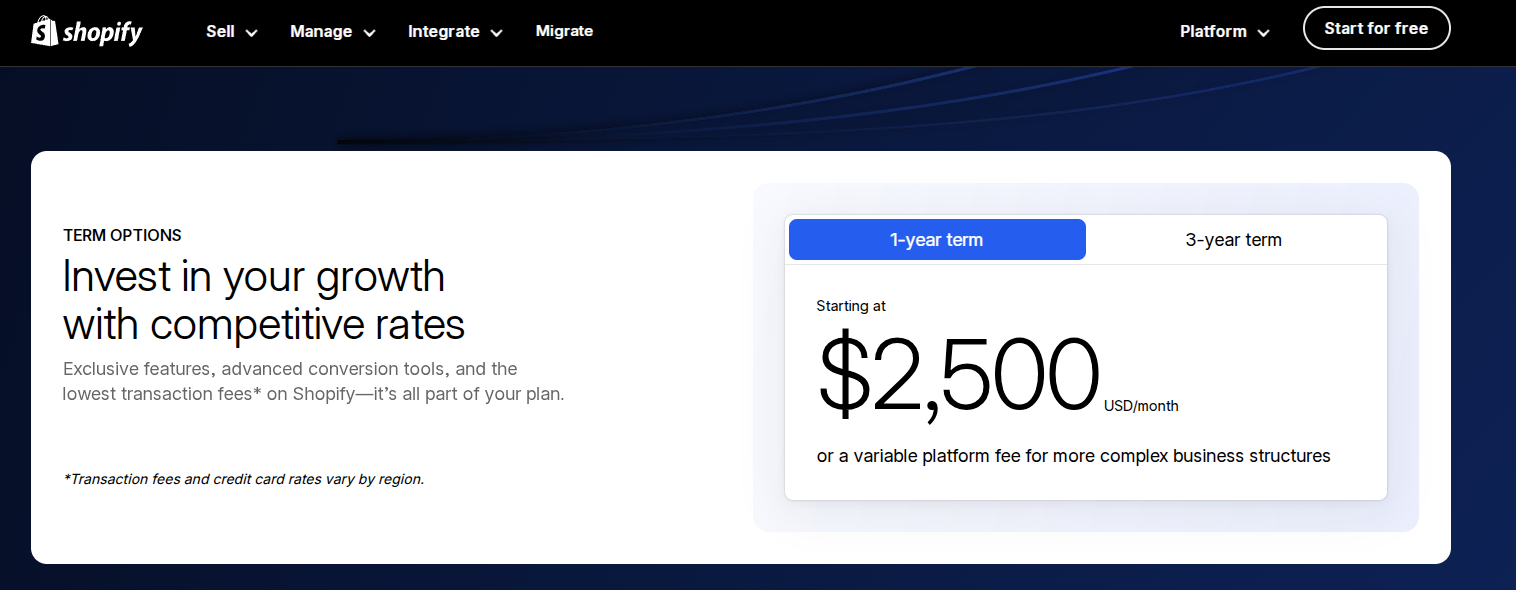
Shopify Plus starts at $2,500/month USD on a 1-year term or $2,300/month USD on a 3-year term, with transaction and credit card rates varying by region.
For more complex business structures, pricing may shift to a variable platform fee, so exact costs depend on your setup.
BigCommerce B2B Edition
BigCommerce B2B Edition is built for companies that need a more flexible, customizable way to sell B2B online without forcing buyers into clunky workflows.
It focuses on modern buyer experiences, sales-friendly tools like CPQ, and strong control over accounts, pricing, payments, and permissions.
Best for: Wholesalers and manufacturers that want B2B features with customization, headless support, and easier integrations across ERP/OMS/CRM systems.
Key features
- Open-source Buyer Portal for building bespoke B2B buying experiences
- Custom catalogs and pricing for customer groups or individual accounts
- Multi-company hierarchy with role-based access control
- CPQ quoting engine to improve sales efficiency and support complex quoting
- Sales rep masquerade to place orders on behalf of buyers
- Credit management, payment visibility controls, and support for purchase orders
- Invoice portal to speed up invoicing and payment processing
- Multiple storefronts for localized experiences by region, language, and currency
- Headless support with API-first, MACH-based architecture
- Shared lists, easy reorders, and mobile-optimized performance for faster purchasing
Pricing overview
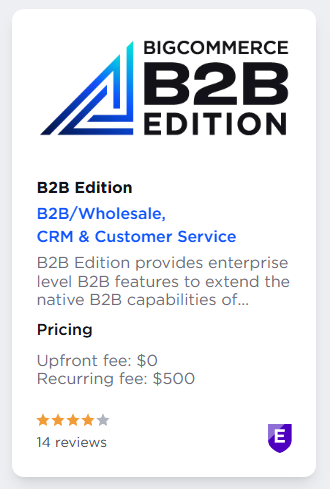
BigCommerce B2B Edition has $0 upfront costs with a $500 recurring fee. Exact total costs can vary depending on your plan, integrations, and the level of customization your business needs.
SAP Commerce Cloud
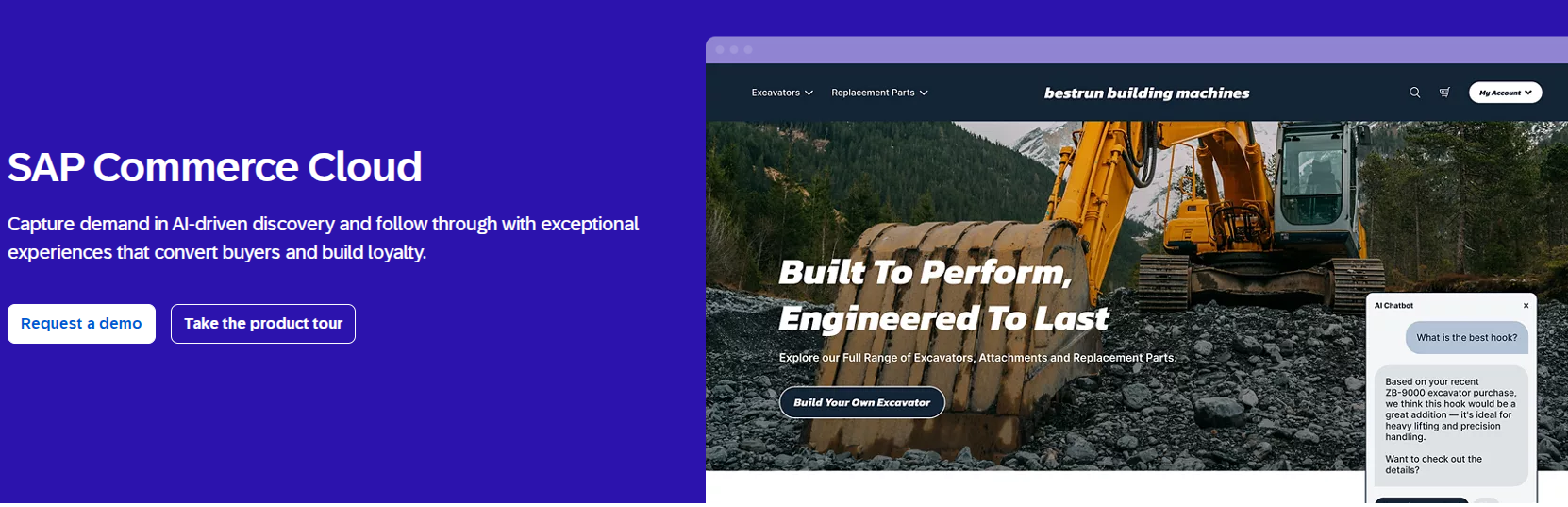
SAP Commerce Cloud is a unified enterprise platform designed to help B2B, B2C, and B2B2C brands capture demand through AI-driven discovery and deliver consistent, high-performing shopping experiences.
It combines embedded AI, end-to-end business data, and flexible composability so organizations can personalize buying journeys, improve efficiency, and scale across regions, channels, and emerging AI touchpoints.
Best for: Enterprise manufacturers and distributors that need global scale, strong integration with SAP Cloud ERP, and AI-driven commerce capabilities.
Key features
- Core commerce with optional composability and AI-enabled monitoring
- Commerce AI to support personalization and productivity across teams
- Product catalog management with AI agents to enhance and organize catalog data
- Pricing, promotions, and payments with flexible partner options
- Search and discovery powered by natural language and relevance
- Composable storefront with modular components for flexible front-end experiences
Pricing overview
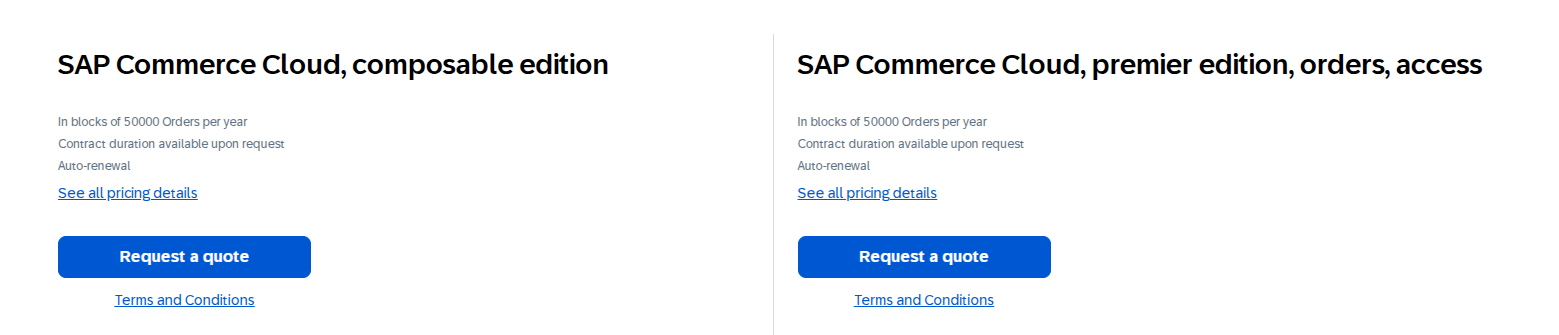
SAP Commerce Cloud uses quote-based pricing and is sold in 50,000-order-per-year blocks, with pricing based on annual order volume or Gross Merchandise Value (GMV).
Both the Composable Edition and Premier Edition are “price upon request,” with contract duration details available directly from SAP.
Why OroCommerce Is The Best Unified Commerce B2B Software

OroCommerce fits teams that need unified commerce to hold up across both self-service and sales-assisted ordering.
The platform keeps customer structure, pricing terms, approvals, and the order record governed in one place, so portal orders and rep-entered orders follow the same rules.
It enables the following in day-to-day B2B operations:
- One governed account model: parent/child accounts, roles, and permissions apply consistently across channels.
- Terms that travel with the transaction: contract pricing, approvals, and credit policies stay attached as quotes become orders and orders move through fulfillment.
- A single operational view of the order: service, sales, and finance work from a single order status and set of documents, while ERP/WMS remain connected for fulfillment and financial posting.
- Lower “site sprawl” costs: adding portals or regions doesn’t require standing up separate stacks when the same ruleset and data model can be reused.
You get all B2B features under one license. No surprise fees if you add more sites, warehouses, or business units.
The platform handles tricky B2B requirements that usually trip up other systems. You can set custom pricing for customer groups, build approval workflows, and run B2B and B2C sales from the same instance.
OroCommerce’s open-source foundation means you’re not boxed in. Your IT team can tweak and expand the platform as your business changes.
For example, DiversiTech unified operations after years of acquisitions, leaving them with 12 ERPs and scattered processes. With OroCommerce, they replaced disconnected tools, including their legacy CRM, with one platform for ordering, documents, and customer data.
Lactalis connected 12 regional businesses and saw digital orders jump by 230%.
A unified engine lets you stop managing a collection of tools and start scaling from a native foundation that handles every part of the B2B transaction by design.
One platform for quotes, orders, payments, and customer data. See it in action.
Conclusion About Unified Commerce B2B Software
Unified commerce works best when wholesalers, manufacturers, and distributors run everything on a single foundation, including pricing, inventory, orders, and customer data in one place. That means every team sees the same real-time information, and buyers get consistent answers across every channel.
Disconnected systems create delays, errors, and lost revenue, especially when sales, finance, and warehouse data don’t match. Unified commerce fixes this by keeping operations and customer experiences connected without relying on fragile integrations.
As buyer expectations rise, businesses need self-service ordering, instant status updates, and accurate contract pricing.
OroCommerce supports scalable B2B growth with enterprise-ready tools built for complex workflows. Book a demo to see it in action.
FAQs About Unified Commerce B2B Software
What is the best B2B eCommerce platform?
The best B2B eCommerce platform depends on your business needs, but OroCommerce is a strong choice for manufacturers, wholesalers, and distributors looking to unify commerce, customer data, and operations on a single platform.
It supports complex B2B requirements, such as account hierarchies, contract pricing, quoting (CPQ/RFQ), and integrated order-to-cash workflows, without relying on a patchwork of disconnected systems.
If you’re aiming to scale efficiently, it’s smart to choose a platform built around a single source of truth instead of stitching together multiple tools.
What is an example of unified commerce?
A unified commerce system runs all your sales channels from one place. Say you process orders online, on sales rep tablets, and in your physical showroom. Everything updates the same inventory and customer records right away.
Wholesale buyers see up-to-date stock and their contract pricing, whether they order online or through a rep. Your finance team can finally work from one order ledger, not juggle a bunch of disconnected systems.
What is a B2B commerce platform?
A B2B commerce platform is software for selling products to other businesses. It covers wholesale basics like bulk pricing, purchase orders, credit terms, and approval workflows.
These platforms manage your product catalog, process orders, and track customer accounts. The best ones play nicely with your ERP and accounting systems.
Which platform is best for a B2B business?
Pick a platform that matches your technical skills and budget. Think about whether you need omnichannel commerce or can handle integrated systems. Unified platforms help cut down on errors and give you real-time data across all your channels.