navigation

If you run IT for a manufacturer or distributor, you probably know the post-M&A drill: new logos on the website, emails about synergy, and a company-wide call to rally everyone around the new direction.
But behind the scenes? It’s often chaos. Suddenly you’re managing five ERPs, three web stores, and a never-ending queue of “quick wins” for the board. And while your finance team runs the numbers on projected savings, your customers are the first to notice that things don’t add up.
This is the hidden cost of the deal: the operational drag and customer pain that lingers long after the ink is dry.
Welcome to the fragmented stack era of B2B.
The M&A Growth Play and Its Side Effects
Industrial manufacturing and distribution are deep in the middle of a roll-up wave. Whether it’s PE-backed megadeals or regional specialists banding together to stay relevant, consolidation is everywhere.
But here’s what gets less airtime: integration is where most deals go off the rails. By some estimates, 70–90% of acquisitions fail to create shareholder value. The outliers that do succeed have one thing in common: they invest in post-merger integration, not just cost-cutting or rebranding.
Yet, even when companies set aside budget for the basics (like, network security, keeping the ERP online, making sure payroll and accounting don’t miss a beat), the customer experience is rarely prioritized.
Back-office systems, product data, and storefronts remain disconnected. Buyers notice the seams: different websites, inconsistent pricing, clunky order tracking.
If you’re wondering how much of a problem this really is, consider this: McKinsey’s B2B Pulse shows buyers now put a full third of their spending through digital self-service channels, even for orders above $500k. But as digital adoption grows, so does buyer frustration. According to a recent survey, 45% of B2B buyers say they’re dissatisfied with the online experience their suppliers provide, most often due to inefficient ordering, lack of visibility, and too many steps for basic transactions.
Every extra hurdle or inconsistency adds up, making it more likely that customers will ask for improvements, or quietly look for alternatives when the process gets too painful.
Why M&A Splinters the Tech Stack and Your Customer Experience
It’s almost a universal law: every acquired business comes with its own ERP or a home-grown beast nobody fully understands.
The “easy” early decision? Let them all co-exist. IT builds point-to-point bridges, thinking it buys time. Fast forward, and you’re staring at duplicate pricing engines, two or more PIMs, and at least a couple of outdated customer portals. Instead of “synergy,” you’re juggling duplicate data and scrambling every time a customer wants a simple order update.
And it’s not just IT that suffers. Fragmentation trickles out:
| Source of Fragmentation | Technical Symptom | Internal Department Headache | Customer Impact |
| Data | Conflicting product IDs, batch sync failures | IT and Ops scramble to reconcile data; bad reporting; sales re-key orders and chase down updates | Customers see pricing errors, out-of-stock surprises, inconsistent product info |
| Identity | Separate SSO/passwords, siloed user management | IT and help desk handle more password resets; customer service can’t see all accounts | Buyers juggle multiple logins, lose trust, face delays getting access |
| Experience/UI | Different UIs, carts, and promotion logic | Sales and support waste time explaining process differences, lose cross-sell opportunities | Extra clicks, cart abandonment, confusion at checkout |
| Order Visibility | No end-to-end view across ERPs | Customer service can’t track orders; escalations rise | Customers wait for order confirmations, can’t see full order journey |
| Integration Overload | Too many point-to-point connections, APIs timeout | IT drowns in maintenance, can’t deliver on new projects | Customers experience outages, delays, or missing updates |
Customers notice the friction, even if they don’t say it out loud. Maybe they’re rerouting simple requests through email because your portals don’t talk to each other, or quietly building spreadsheets just to track orders across brands. Every workaround is a reminder that behind the scenes, things are more tangled than they should be.
The pressure to keep patching those gaps is real, but it only goes so far.
New Survey Report: What Frustrates B2B Buyers in Their Digital Commerce Experience
The Antidote: A Unified B2B eCommerce Layer
If you’ve ever inherited a Frankenstein stack, you know the temptation: patch the holes, bolt on another portal, and hope customers won’t notice. But B2B buyers are sharper than ever, and their patience for jumping between logins, guessing at order status, or waiting for manual quotes is thin.
The manufacturers and distributors winning post-M&A don’t start with backend surgery. They put a unified, B2B-focused commerce layer on top of the mess, and make the customer experience the backbone for everything else.
What “Unified” Means for Your Customers and Teams
One login, one experience
Picture this: a customer who buys from three of your brands (each a legacy acquisition) logs in once, lands on a dashboard showing all their orders, quotes, and account details, no matter which business unit, no matter which ERP is hiding underneath. They can reorder from catalogs, manage multiple shopping lists, and assign roles to their team members, all in a single portal.
For your internal teams, it means fewer panicked “I can’t find this PO” calls and a CRM view that lines up with what customers see.
Consistent pricing, inventory, and credit data
Consistency matters. Buyers see up-to-the-minute pricing and inventory availability, even if one item lives in SAP and another in JD Edwards. They get accurate lead times, credit status, and custom discounts at checkout, not “we’ll email you a quote later.”
Sales and support can answer questions in real time, with confidence, because they’re all looking at the same truth, not two-day-old exports from someone’s spreadsheet.
A single source of truth, less friction everywhere
Every buyer (and employee) gets one set of credentials, no more juggling passwords for separate sites. A single PIM and promotions engine powers consistent content and offers across brands. User roles, approval workflows, and permissions are all managed in one place, so onboarding a new customer or employee stops being an IT project.
How Unified Commerce Fixes M&A Fragmentation: Two Stories
DiversiTech: Making Complexity Usable
DiversiTech is one of the largest HVAC components maker in North America, and that means, after years of acquisitions, they ended up with twelve separate ERPs, each with its own quirks.
That used to mean:
- No one – customers, sales, or support – had a clear view of an order from end to end.
- Simple requests, like a packing slip or warranty update, required a call and a wait.
- IT kept extra hands just to stitch together updates across systems.
When they unified on OroCommerce, the day-to-day reality changed. Customers could see all their orders in one place, regardless of which business unit handled fulfillment. Packing slips, warranty status, and order tracking were accessible online, without a game of “ask your rep.”
Nobody cared how many ERPs ran in the background. What mattered was customers stopped feeling like they were buying from twelve different companies.
Lactalis: Standardizing Without Suffocating Local Business
Lactalis is a global dairy powerhouse, built on decades of acquisitions and brand expansion across more than a dozen countries. Each new region came with its own business processes, sales models, and technology – some modern, some outdated.
Launching new digital initiatives in this landscape was slow and resource-intensive. Even onboarding customers or adapting order flows for local rules required manual fixes and custom builds for every country. There was no easy way to scale or deliver a consistent experience across brands.
Switching to a single commerce platform didn’t mean flattening every market to a single mold. Instead, Lactalis standardized the backbone: core workflows, product data, and integration logic, but left just enough flexibility for each country to handle its unique business.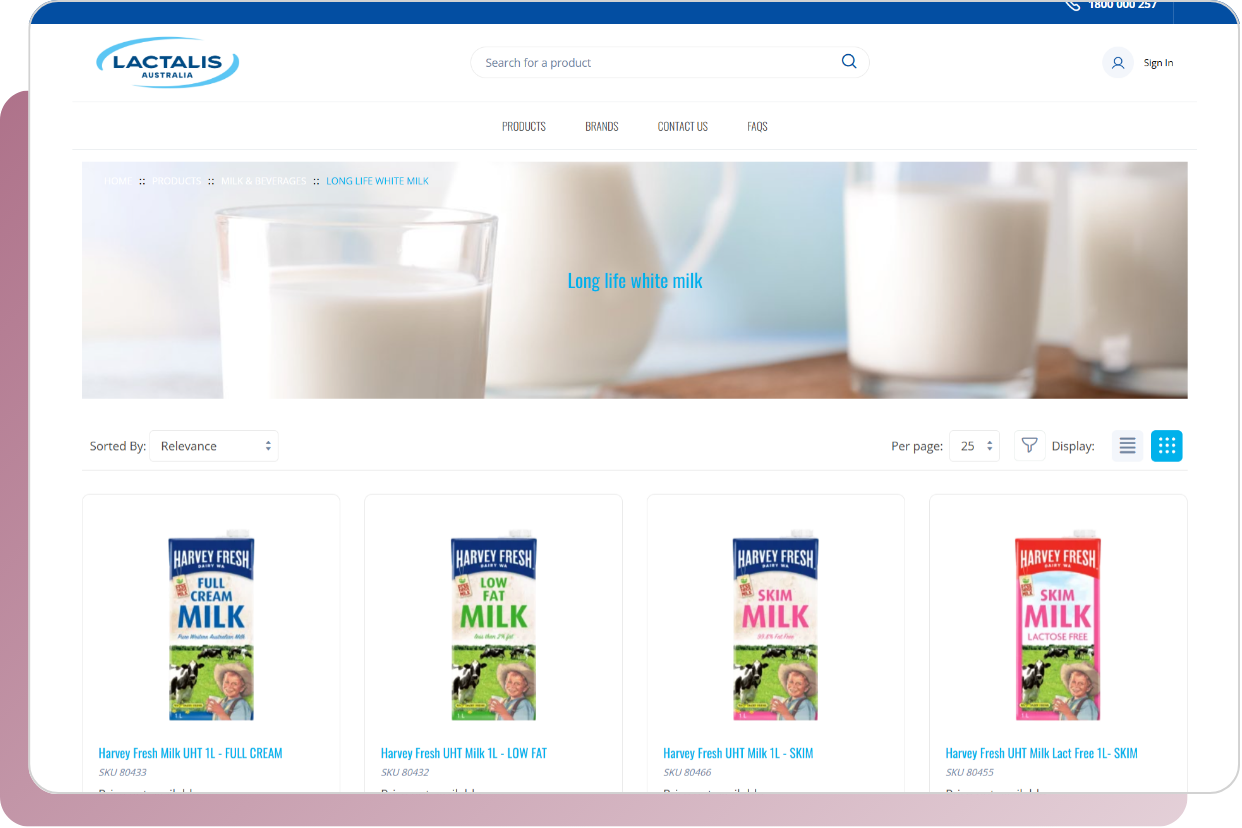 That shift cut deployment times by more than half, reduced manual entry by 44%, and made it possible to open direct-to-customer sales in new markets. Instead of complexity slowing them down, integration became a lever for faster, more profitable growth.
Five Steps to Integration-Led Growth
Bringing multiple systems and teams together after a merger isn’t solved overnight. The most reliable results come from following a steady, practical sequence, prioritizing what matters most for customers and the business.
Here’s how manufacturers and distributors are making integration work on the ground: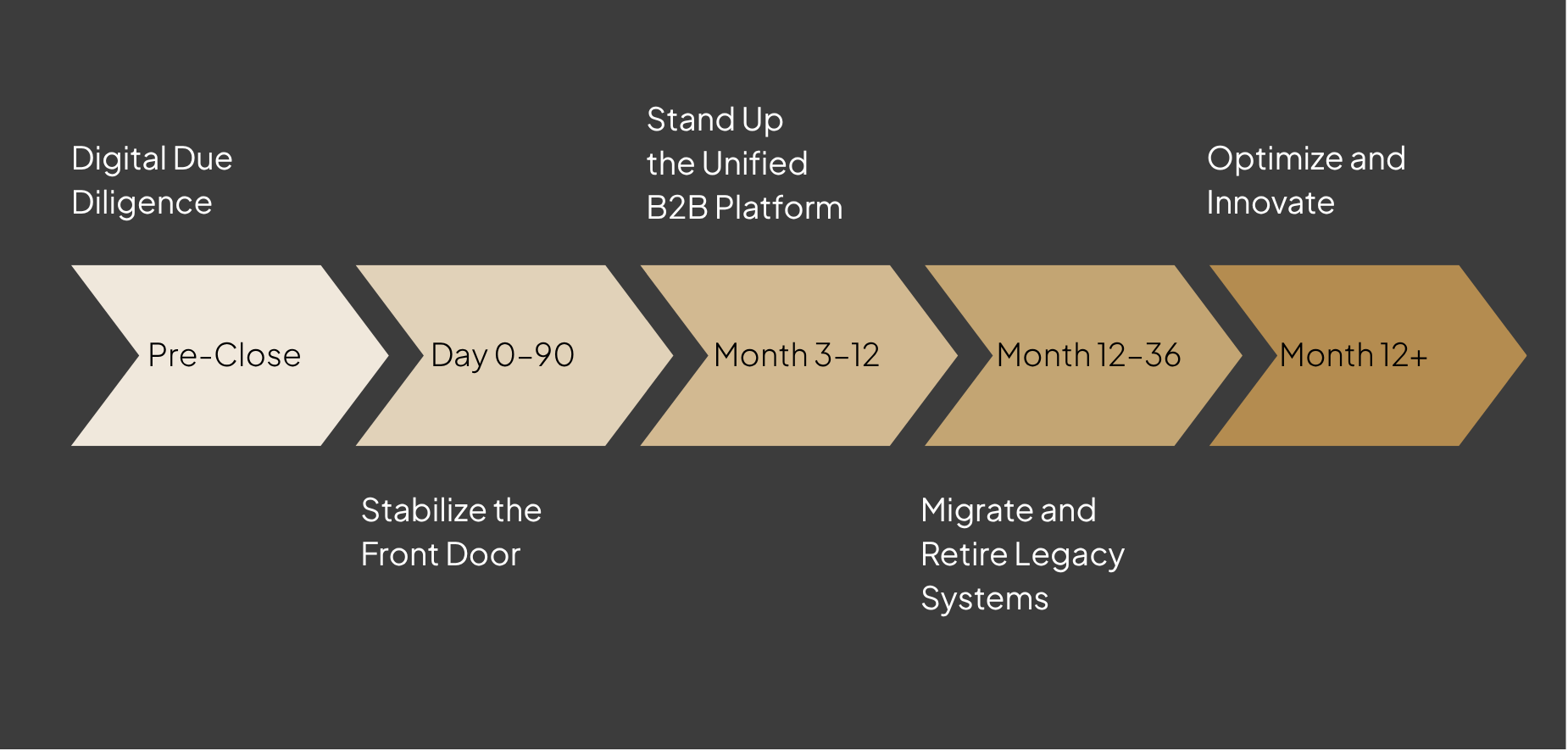
1. Digital Due Diligence (Pre-Close)
What it means: Before the deal closes, map every buyer-facing system, website, portal, and touchpoint. Not just what IT uses, but what customers and sales teams rely on daily.
What to do:
- List every way a customer can place an order, check inventory, or get support.
- Identify which systems are critical and which are “nice to have.”
- Spot fragile spots: where is manual rekeying or workaround hiding the real pain?
Why it matters: If you skip this, you’ll miss hidden bottlenecks and end up with “surprise” outages or angry customers when you make your first integration move.
2. Stabilize the Front Door (Day 0–90)
What it means: The first 90 days post-close are make or break for customer confidence. Customers shouldn’t have to guess which portal or team to use.
What to do:
- Implement single sign-on (SSO) so every customer (and internal user) logs in once, even if the backend is still messy.
- Use branded redirects, so “old” URLs and bookmarks bring users to the right unified experience.
- Launch a shared knowledge base, updated for new workflows, so customer service and sales teams answer consistently.
Why it matters: This is about protecting revenue and relationships while the dust settles, so your integration work isn’t undermined by frustrated buyers or overwhelmed support.
3. Stand Up the Unified B2B Platform (Month 3–12)
What it means: Pick a commerce platform built for B2B and multi-ERP reality. This isn’t the time for generic webstores or homegrown fixes.
What to do:
- Start with your most valuable or at-risk customer segments.
- Deploy middleware (or iPaaS) to tie together ERP data, pricing, inventory, and customer info.
- Clean up your product data, customer lists, and approval hierarchies. Dirty data now means headaches later.
Why it matters: This is the phase where customers start to notice change: orders, pricing, and account data line up across channels. Sales and support teams stop chasing information in silos. Internally, you lay the groundwork for automating key processes and making it easier to scale as you add brands or expand internationally.
4. Migrate and Retire Legacy Systems (Month 12–36)
What it means: Once the new experience layer is running, you can slowly and safely phase out redundant portals, custom tools, and, eventually, old ERPs.
What to do:
- Plan your migrations region by region or brand by brand. Don’t try to flip the switch all at once.
- Decommission duplicate workflows and old modules only after everyone is using the new system.
- Track usage and customer satisfaction; if customer adoption stalls, dig in to find the friction.
Why it matters: This is where you see savings: less spend on support and licenses, less confusion for sales teams, fewer mistakes for customers.
5. Optimize and Innovate (Month 12+)
What it means: With a stable foundation, you can build for growth, whether that’s smarter quoting, AI-powered recommendations, or new sales channels.
What to do:
- Layer in CPQ, AI tools like AI SmartOrder, or other features based on customer feedback or your innovation goals
- Monitor your digital Net Promoter Score (NPS), order accuracy, and time-to-resolution to spot improvement opportunities.
- Track and communicate savings from retiring legacy systems and faster onboarding of new acquisitions.
Why it matters: This is where the integration becomes a competitive advantage, not just an IT project. The companies that keep iterating are the ones that keep winning.
Bringing It All Together
Pulling companies together on paper is one thing. Pulling together the customer experience and your internal operations is where the real work begins. In B2B, buyers don’t expect perfection, but they do expect clarity and consistency. Every integration decision is a chance to either simplify or complicate their journey.
Manufacturers and distributors that invest in a unified B2B eCommerce layer aren’t just cleaning up after a deal. They’re building a foundation that makes future growth easier, new acquisitions faster to onboard, and day-to-day selling less dependent on workarounds.
With unified technology in place, every transaction and every relationship feels like it comes from one company, no matter how many acquisitions came before.