navigation

B2B organizations keep ending up in a strange place: operationally tighter, commercially static.
You’ve pushed through ERP updates and rollouts, maybe even a full consolidation. Yet customers still send orders as PDFs, sales teams still rekey data into the system of record, and “digital revenue” often means a couple of large customers on custom EDI pipes.
At the same time, every serious forecast points in the same direction: the future belongs to buyers who self-serve most of the journey while working with a digitally enabled salesforce at the key moments that matter.
This piece looks at why that shift keeps colliding with ERP-centric digital programs, and what changes when ERP stays the backbone while a dedicated commerce and customer engagement layer takes on the work of shaping the next transaction.
Budget Gravity: When “Digital” Money Pools in the Back Office
Across manufacturing and distribution, digital transformation budgets have grown fast, yet large studies still put failure or underperformance at roughly 70%. Most of that spend landed in ERP: multi-year rollouts, consolidations, and clean-ups that stabilized the system of record while the customer-facing side barely moved.
ERP then quietly becomes the digital program. One $1B industrial manufacturer spent almost three years moving to a new ERP. During that time, every discussion about a proper sales portal or self-service for smaller accounts ended with the same phrase: “after go-live.” By the time the system stabilized, two key customers had adopted competitors’ portals and had no interest in changing habits again.
What gets pushed back is usually the work that would shift how customers and sales teams behave:
- Building a B2B eCommerce or portal experience that reflects how different segments buy.
- Cleaning up CRM and sales processes so reps can work from digital signals, not just booked orders.
- Running lean experiments with segment-specific or region-specific digital journeys.
The result is an organisation that looks heavily invested in digital on paper, while the thin layer in front of ERP still behaves like an internal system with a login.
The ERP-Front-End Trap: Transactions Without Learning
Most “portals” on top of ERP are order-entry screens with nicer fonts. They do one narrow job: let a customer key in something they already know they want. Internally, that’s enough to tick the box that says “we have eCommerce.”
Look a level deeper, and the pattern shows up:
- Navigation follows internal codes and hierarchies buyers never use.
- Checkout mirrors the ERP order-entry form, field by field.
- Quotes, approvals, and budgets stay trapped in back-office workflows.
Then comes the part executives rarely see. A thin ERP-front-end usually doesn’t answer questions like:
- How often do buyers search and get nothing useful back?
- Where do baskets die – at search, pricing, approval?
- Which accounts log in, struggle, and then go back to phone or email?
- When a customer starts browsing a new category, does anyone notice?
That missing layer of signal is what you need to reshape the catalog, sharpen content, and tell sales who to talk to and why. It’s also the raw material for practical AI: compatibility-aware recommendations, early churn warnings, and better handling of stock issues.
When your “portal” is just an ERP screen with a login, you see orders booked, not journeys attempted. You get online transactions with no way to learn from the attempts that failed.
The natural next question is: what happens when a B2B eCommerce layer is built to learn from every attempt, not just the final order?
Giving ERP a B2B eCommerce Front-End
If ERP is your memory, the commerce front line is your eyesight and reflexes. It’s the part of your stack that faces customers, sees what they try to do, and reacts fast, without asking for a core system change every time behavior shifts.
Built Around How Your Customers Are Organized
B2B buyers don’t show up as “one account with one login.” They show up as tangled organizations:
- Holding companies with subsidiaries, plants, and job sites.
- Dealers buying on behalf of many end customers.
- Mixed teams where procurement, engineering, and finance all touch the order.
A B2B eCommerce portal treats this as the foundation. Roles, prices, budgets, assortments, and approvals adapt accordingly.
ERP Rules, Exposed in Human Terms
ERP holds the rules that keep you out of trouble: pricing, credit, tax, lead times, Incoterms. The front-end doesn’t fight those rules; it explains and applies them.
Done well, that means:
- Buyers see their contract prices immediately after login, no PDF hunting.
- Availability reflects warehouses that can realistically serve them, not global stock.
- Shipping and cut-off logic is baked into delivery options, not hidden in small print.
- Compliance limits what they can buy before it becomes a problem, not after.
The question for an executive is simple: how many support tickets, angry emails, and manual corrections are just your rules showing up in ways customers don’t understand?
Workflows that Match B2B Buying, Not Internal Forms
B2B purchasing is rarely “add to cart, pay, done.” There are approvals, partial shipments, recurring orders, and deals that stretch across quarters.
A B2B-ready commerce layer handles this without dumping the complexity on buyers:
- Requests for quote that turn into orders without rekeying.
- Approval flows that mirror how the customer manages budgets, not how you route paperwork.
- Lists and templates for projects, recurring jobs, or equipment fleets.
- Split deliveries, back-orders, and substitutions handled in a way a buyer can follow.
If the only thing your site does is “one basket, one shipment, one payment,” large parts of your revenue will stay stuck in email, no matter how modern the ERP underneath looks.
Behavior as a First-Class Data Source
ERP shows you what was ordered. The B2B eCommerce front-end shows you what people tried to do before they gave up, changed course, or went elsewhere.
That means tracking:
- Fails searches
- Looped navigation
- Quotes that sit untouched for weeks.
- Accounts that log in, struggle, and drop off
These patterns expose friction, margin leakage, and emerging demand long before the ERP catches up.
A B2B eCommerce front end exists to make that visible and actionable.
Proof in Practice
ICL: When Rekeying Hits Its Limit
ICL’s Growing Solutions division sells fertilizers in more than twenty markets, backed by four separate ERPs. The core systems were solid; the problem was everything wrapped around them:
- Orders arrived by phone and email, then staff retyped them into SAP or Oracle.
- Customers had no direct view of negotiated prices, stock, or invoices.
- “Digital” mostly meant internal efficiency, not a different way to buy.
ICL introduced country portals as the customer-facing front end on top of those ERPs. Dealers log in once to see their own prices, check availability, place or repeat orders, and pull documents. 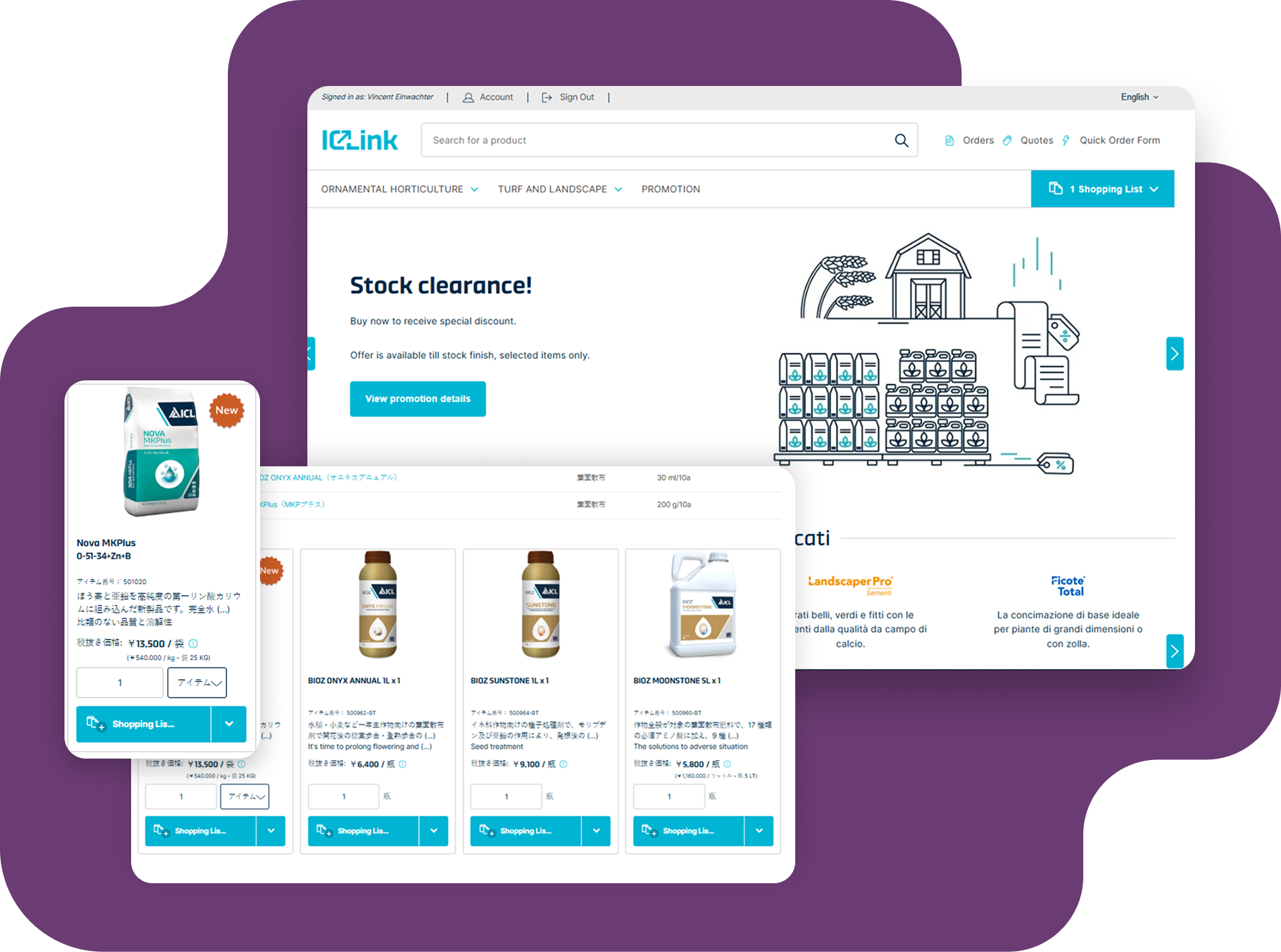 Results:
- 20+ portals live, four ERPs connected, 9,000+ users onboarded.
- Around 60% of customers shifted to online ordering in the first rollout wave.
- Customers using the portals have purchased more over time than those who stayed offline, while internal teams stepped away from routine rekeying into higher-value work.
The ERPs still hold the facts. The portals turned those facts into a daily working environment for customers.
HVAC manufacturer: Unifying Twelve ERPs at the Customer Edge
A major HVAC manufacturer grew through acquisition and ended up with twelve ERPs. Budgets could have continued flowing into ERP consolidation, but customers would still face a scattered experience: different systems for orders, service, and documents, with support as the only reliable interface.
They chose a different angle: build a unified customer portal in front of the core ERP and PIM, pulling in data from the rest.
For customers, that meant:
- One place to place orders, track shipments, and pull invoices or packing slips.
- A clear flow for submitting and tracking warranty claims.
For internal teams:
- Order updates moving automatically from ERP into what customers see.
- Service and sales working from the same account view instead of chasing data across systems.
ERP continues to run operations. The shift in behavior came from giving customers a single digital environment that makes sense – something ERP alone could never deliver.
Where ERP Leaves Off, OroCommerce Takes Over
Many teams reach a point where the ERP is stable, the data is reliable, yet buyers still can’t complete basic tasks online. Approvals break. Catalogs don’t match roles. Project-based orders slip back to email. Dealer workflows don’t fit the interface.
That gap isn’t solved by adding another screen on top of ERP. It needs a front end built for the way B2B buying works. Once that front end exists, the organization finally has a place where customer behavior becomes visible and change becomes possible.
OroCommerce is built as that front end for manufacturers and distributors, and extends beyond basic ordering. It lets you:
- Mirror complex account structures across regions, legal entities, and channels.
- Run rich catalogs, segment-specific assortments, and role-aware pricing from ERP data.
- Shape quote, approval, service, and reorder flows without touching ERP.
- Capture every meaningful search and stalled journey so teams can act on real signals.
On the same platform, you can run storefronts, customer portals, marketplaces, CRM-style account views, plus AI tools like AI SmartOrder and AI SmartAgent. ERP keeps the record of what happened. OroCommerce becomes the place where customers work with you and where you can finally influence what happens next.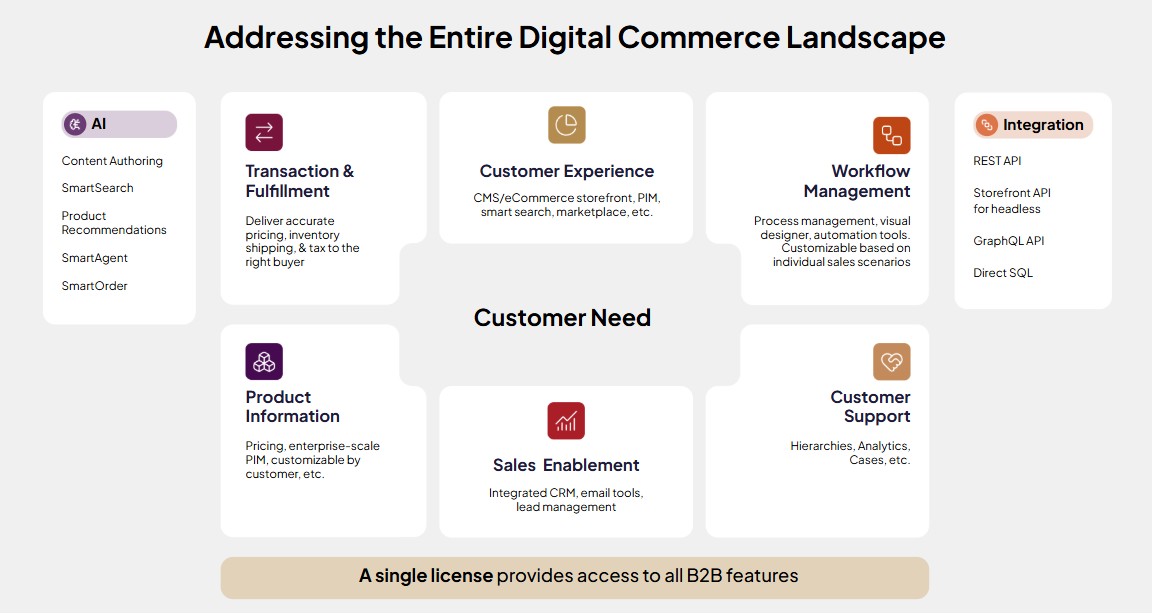 Every missed search, stalled approval, and order that slips back to email is a signal the business never saw. Multiply that across a year, across thousands of attempts, across an entire customer base, and the hidden cost stops being theoretical.
Companies that build a true B2B eCommerce front end stop losing those signals. They turn them into momentum.