
navigation

Digital transformation is the process of rebuilding how a company operates, sells, and serves customers around digital tools instead of manual, disconnected ones. It reshapes business processes, customer experience, and the systems that run day-to-day operations.
Companies rarely pull this off alone. Most internal teams lack the bandwidth to redesign their own operating model while still running the business, which is exactly why digital transformation consulting exists.
This guide covers 30 top digital transformation consulting firms, split into two tiers: seven global enterprise consultancies built for multi-region programs, and 23 mid-market and regional implementation partners built for focused, platform-specific work.
We picked this mix so a Fortune 500 manufacturer and a growing regional distributor can both find a fit here, rather than treating a five-person agency as equivalent to an influential consultancy firm with offices on four continents.
Once you’ve reviewed the firms below, the platform decision is the next piece of the puzzle. Digital transformation services can plan and run the project, but OroCommerce is built specifically for B2B manufacturers, distributors, and wholesalers going through this exact transition.
What Is Digital Transformation Consulting?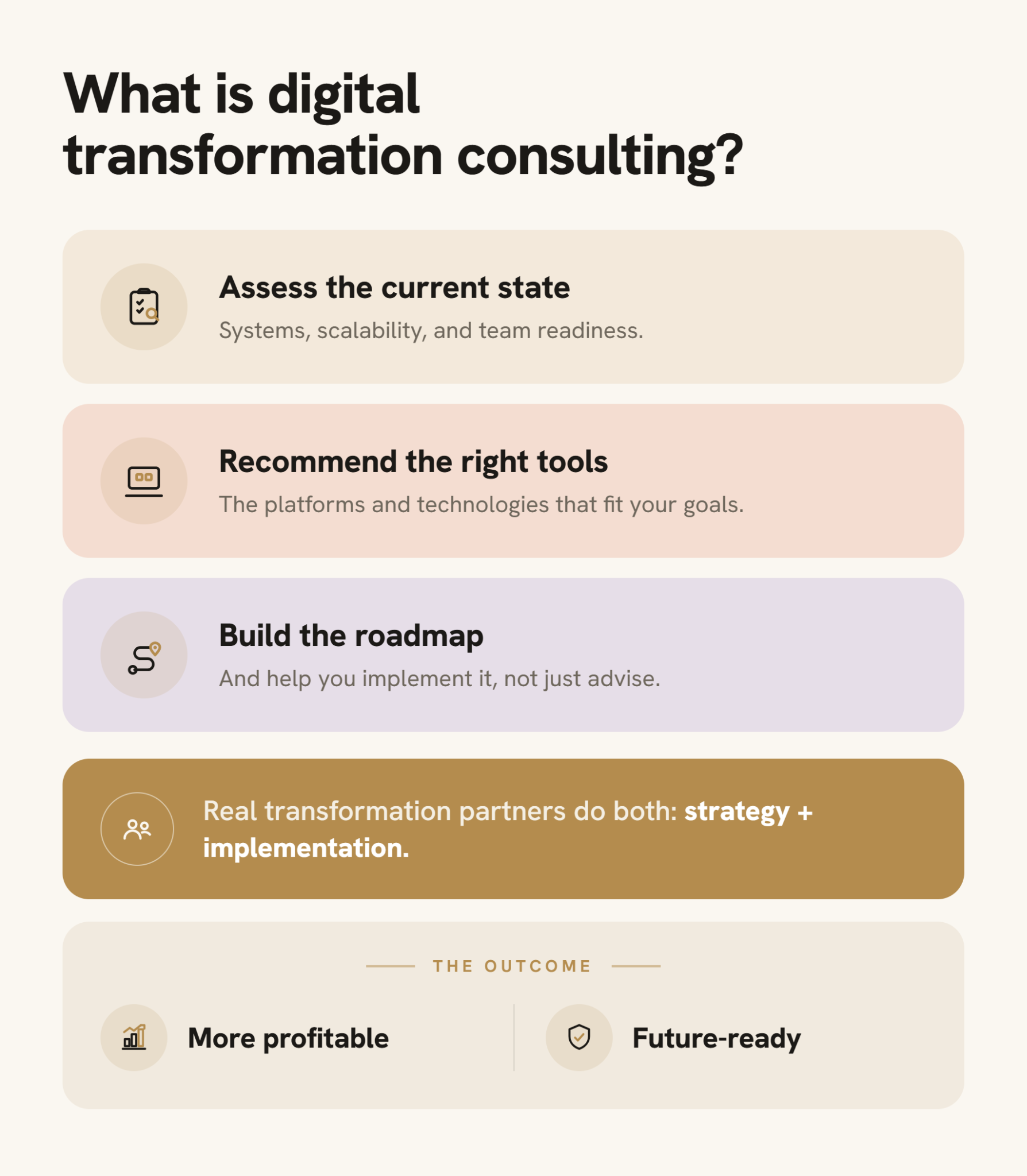
Digital transformation consulting services help companies identify and implement the right digital technologies to become more profitable and future-ready. These digital services span everything from strategy to hands-on delivery.
A digital transformation consulting firm starts by assessing a company’s current systems, its ability to scale, and its internal team’s capacity for change.
From there, digital transformation consultants recommend specific tools and platforms, then build an implementation roadmap. Firms with real advisory and implementation expertise handle both halves: they set the strategy, then help carry it out.
It separates a genuine transformation partner from one that hands over a slide deck and walks away.
How Digital Transformation Helps Your Business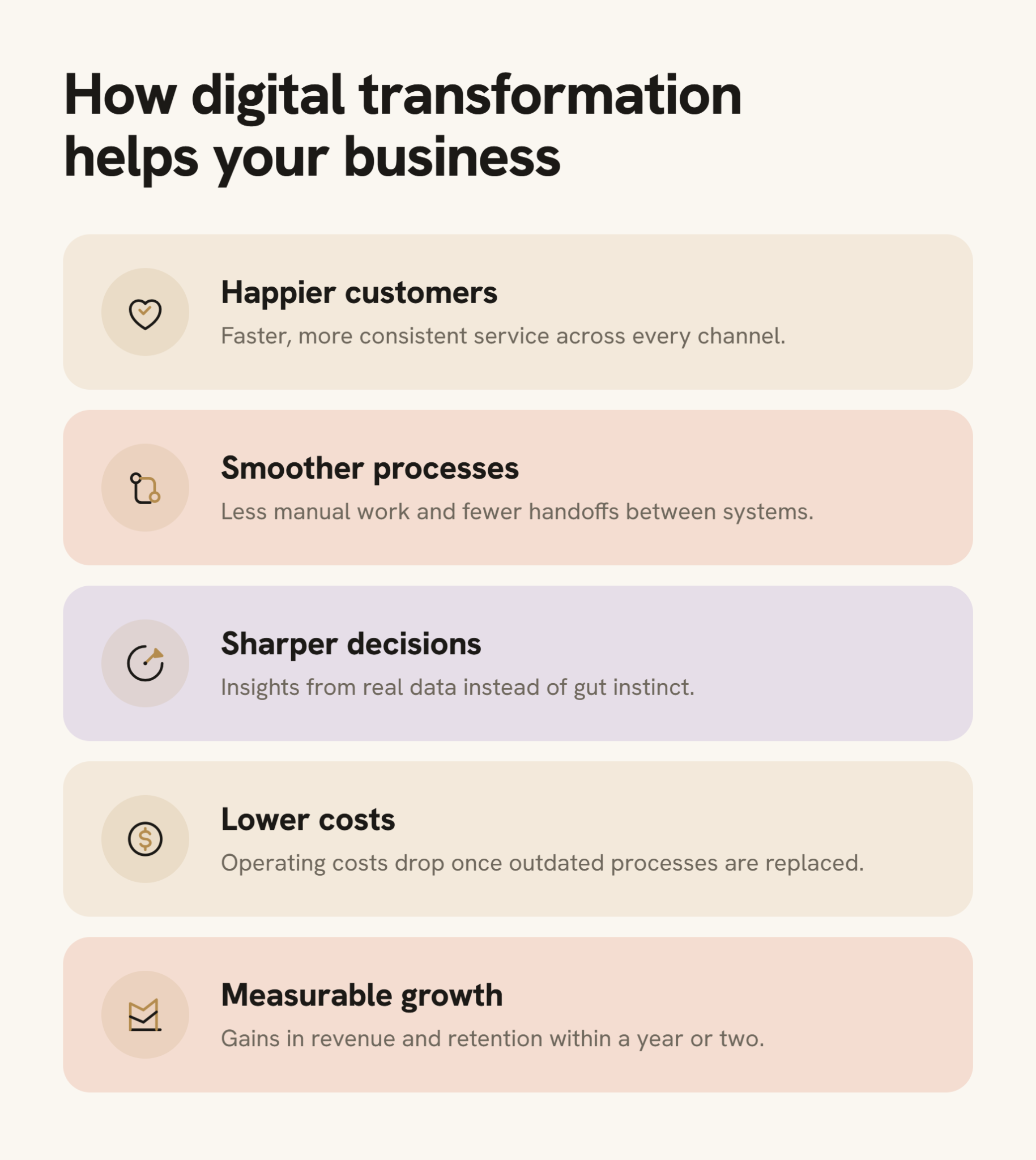
A successful digital transformation touches nearly every part of a company, not just the technology stack. Here’s where companies typically see the biggest gains:
- Customer satisfaction: Faster, more consistent service across every channel a customer uses
- Internal processes: Less manual work and fewer handoffs between disconnected systems
- Decision-making: Actionable insights pulled from real data instead of gut instinct
- Cost efficiency: Lower operating costs once outdated processes are replaced
- Business outcomes: Measurable gains in revenue or retention within a year or two, once a capabilities assessment has flagged the weakest links
Meeting rising customer expectations usually needs more than new software. It requires updating your business strategies and often shifting company culture so employees actually adopt the new way of working rather than quietly reverting to the old one.
The right digital capabilities, applied at the right stage of your digital transformation journey, are what make that shift stick.
Top Digital Transformation Consulting Firms: Quick Overview
Getting this right on your own is difficult, which is why many businesses turn to specialized consulting firms to guide the process.
The right partner brings not just technical expertise but also proven frameworks for change management, ensuring the transformation delivers lasting results rather than a one-time upgrade.
Below are some of the top digital transformation consulting firms worth considering.
| # | Firm | Best For | Region |
| Tier 1: Global Enterprise | |||
| 1 | Accenture | Large, multinational enterprises running complex, multi-year transformation programs | Global, 120+ countries |
| 2 | Deloitte Digital | Large enterprises in regulated industries needing strategic and technical depth in one place | Global |
| 3 | McKinsey Digital & BCG Digital Ventures | Executive teams needing strategic alignment before committing to an implementation partner | Global |
| 4 | Capgemini | Enterprises wanting one vendor for both the build and long-term operational support | Global |
| 5 | Cognizant | Enterprises prioritizing cost-efficient, engineering-heavy delivery over high-touch consulting | Global, strong US/India presence |
| 6 | IBM iX / IBM Consulting | Enterprises already invested in IBM’s tech environment wanting design and engineering together | Global |
| 7 | Publicis Sapient | Large brands undertaking a full digital-first rebuild of customer-facing platforms | Global |
| Tier 2: Mid-Market & Regional | |||
| 8 | Americaneagle.com | Companies wanting one partner for design, development, and hosting together | US, Switzerland, UK, Bulgaria |
| 9 | Smile | European enterprises standardizing on open source infrastructure | France, Benelux, Switzerland |
| 10 | Synolia | French B2B companies implementing CRM alongside an eCommerce rebuild | France |
| 11 | Weidenhammer | Manufacturers needing tight ERP to eCommerce integration rather than a full rebuild | United States |
| 12 | Agence DN’D | Single-market B2B or B2C brands wanting one team across the entire project | France |
| 13 | Kiboko | Companies integrating several existing systems into one eCommerce platform | France |
| 14 | Antadis | Established B2B brands rebuilding their digital customer experience from the ground up | France |
| 15 | Turbine Kreuzberg | Brands prioritizing distinctive customer-facing design alongside their platform rebuild | Germany |
| 16 | Madia BV | Benelux companies wanting marketing and platform strategy from a single partner | Netherlands |
| 17 | ALGORITMA | Italian/European brands needing web and mobile commerce delivered together | Italy |
| 18 | MultiMedia | Italian companies needing infrastructure and ERP support alongside their digital rebuild | Italy |
| 19 | Xngage | Manufacturers/distributors wanting a partner who understands their industry’s buying process | US (Ohio) |
| 20 | Lokion | Companies wanting a longstanding partner across strategy, UX, and implementation | United States |
| 21 | Summa Solutions | North American brands expanding into Latin America needing regional delivery | Argentina, Mexico |
| 22 | DATASOLUTION | Multi-region B2B brands needing local delivery teams backed by global platform depth | France, US, Australia |
| 23 | acidgreen | Australian B2B companies managing complex pricing and ERP integrations | Australia |
| 24 | DataArt | Companies whose transformation requires bespoke software rather than a standard platform build | US (NY HQ), global delivery |
| 25 | NetResearch | Companies already committed to OroCommerce or TYPO3 as their platform | Germany |
| 26 | Redsen | Companies needing a framework and risk oversight before choosing an implementation partner | France, European delivery |
| 27 | Pivotree | Enterprises modernizing toward a composable, API first commerce stack | Canada, US, global delivery |
| 28 | Azilen Technologies | Enterprises wanting AI and automation woven directly into their rebuild | India (HQ), US, UK |
| 29 | Intellias | Companies needing custom engineering talent at lower cost than Western firms | Ukraine origin, Chicago HQ |
| 30 | Ekino | Enterprises wanting design led transformation alongside technical delivery | France, global network |
Tier 1: Global Enterprise Digital Transformation Consulting Firms
These seven firms show consistently at the top of independent digital ranking lists for large-scale work, and most B2B buyers would call them the top consulting firms in this space by reputation alone.
They bring deep bench strength, global delivery networks, and digital solutions built to run consulting projects across dozens of countries at once, reshaping how a large business operates from the inside out.
1. Accenture
Location: Global, 120+ countries
Primary specialization: Large-scale systems integration, cloud computing migration, and enterprise AI deployment across nearly every industry.
Key strength: An enormous global delivery bench and deep partnerships with major cloud services vendors.
Limitations: Its scale and cost structure make it a poor fit for small and mid-market companies with tighter budgets.
Best for: Large, multinational enterprises running complex, multi-year transformation programs.
2. Deloitte Digital
Location: Global
Primary specialization: Operating model redesign paired with enterprise technology delivery, backed by Deloitte’s audit and risk background.
Key strength: A strong change management practice and deep industry-specific playbooks for finance, healthcare, and manufacturing.
Limitations: Not the fastest or leanest option, so smaller companies without complex compliance needs may find a lighter partner more efficient.
Best for: Large enterprises in regulated industries that need both strategic and technical depth in one place.
3. McKinsey Digital and BCG Digital Ventures
Location: Global
Primary specialization: Digital strategy, new business models, and organizational design at the executive level.
Key strength: Deep executive relationships and strong frameworks for justifying transformation spend to the board.
Limitations: Neither firm typically handles hands-on system implementation directly, so companies usually need a second partner for execution.
Best for: Executive teams that need strategic alignment before committing to an implementation partner.
4. Capgemini
Location: Global
Primary specialization: Large-scale systems integration paired with ongoing managed services, especially cloud migration and enterprise application management.
Key strength: Broad industry coverage and a strong track record with legacy ERP modernization.
Limitations: The firm’s size means smaller projects can get less senior attention than they would from a boutique partner.
Best for: Enterprises that want one vendor handling both the build and long-term operational support.
5. Cognizant
Location: Global, strong US and India delivery presence
Primary specialization: Application modernization and data analytics implementation at scale, including robotic process automation for back-office functions.
Key strength: Cost-competitive delivery models and strong offshore engineering capacity.
Limitations: Companies looking for boutique-level strategic guidance rather than execution-heavy delivery may find its approach too engineering-led.
Best for: Enterprises prioritizing cost-efficient, engineering-heavy delivery over high-touch consulting.
6. IBM iX / IBM Consulting
Location: Global
Primary specialization: Customer experience design paired with enterprise-grade technology integration, including AI and hybrid cloud.
Key strength: Machine learning capabilities inherited from IBM’s core research divisions.
Limitations: The tight coupling with IBM’s own tech stack can limit flexibility for companies already committed to other vendors.
Best for: Enterprises already invested in IBM’s technology environment that want design and engineering under one partner.
7. Publicis Sapient
Location: Global
Primary specialization: Digital-first product and platform builds for consumer-facing and B2B enterprise brands alike.
Key strength: Strong agile delivery practices and deep commerce platform expertise.
Limitations: Built for large-scale digital rebuilds, not lighter-touch platform migrations.
Best for: Large brands undertaking a full digital-first rebuild of their customer-facing platforms.
Tier 2: Mid-Market and Regional Implementation Partners
These 23 firms specialize in focused, platform-specific implementation work: eCommerce builds, ERP integrations, PIM rollouts, and similar projects.
They typically cost less than the top digital transformation consulting firms above and offer closer, hands-on relationships for mid-market companies.
1. Americaneagle.com
Location: United States, Switzerland, UK, Bulgaria
Primary specialization: Enterprise web platform builds, hosting, and digital marketing, backed by more than 45+ years in business.
Key strength: A 500+ person team and measurable, scalable delivery across large client rosters.
Limitations: Better suited to companies needing broad digital offerings than deep, narrow platform expertise.
Best for: Companies that want one partner handling design, development, and hosting together.
2. Smile
Location: France, Benelux, Switzerland
Primary specialization: Open source commerce and business application development, delivered by nearly 1,700 contributors.
Key strength: Deep bench of open source engineering talent and strong presence across French and Benelux markets.
Limitations: Less suited to companies committed to proprietary, closed-source platforms.
Best for: European enterprises standardizing on open source infrastructure.
3. Synolia
Location: France
Primary specialization: CRM and eCommerce platform implementation, and the French leader among open source eCommerce and CRM platforms.
Key strength: A large existing client base of hundreds of businesses and strong open source platform depth.
Limitations: Primarily France-focused, with limited presence outside French-speaking markets.
Best for: French B2B companies implementing CRM alongside an eCommerce rebuild.
4. Weidenhammer
Location: United States
Primary specialization: ERP and eCommerce system integration for the middle market.
Key strength: Weidenhammer has deep familiarity with mid-market ERP platforms common among manufacturers.
Limitations: Better suited to integration-heavy projects than ground-up platform design.
Best for: Manufacturers needing tight ERP-to-eCommerce integration rather than a full rebuild.
5. Agence DN’D
Location: France
Primary specialization: eCommerce experience design and development, covering the full project lifecycle from strategy through delivery.
Key strength: End-to-end involvement across every phase of a project rather than handoffs between teams.
Limitations: A smaller regional shop, not built for multi-country enterprise rollouts.
Best for: Single-market B2B or B2C brands wanting one team across the entire project.
6. Kiboko
Location: France
Primary specialization: PIM, CRM, and ERP configuration for eCommerce.
Key strength: Flexibility across multiple platform environments depending on client budget and goals.
Limitations: Better suited to configuration-heavy projects than greenfield custom builds.
Best for: Companies integrating several existing systems into one eCommerce platform.
7. Antadis
Location: France
Primary specialization: Open source eCommerce strategy and brand transformation, founded in 2002.
Key strength: Two decades of B2B-specific project experience.
Limitations: Limited scale for enterprises needing multi-region delivery.
Best for: Established B2B brands rebuilding their digital customer experience from the ground up.
8. Turbine Kreuzberg
Location: Germany
Primary specialization: Custom eCommerce design and frontend development, spanning UX, UI, and online marketing.
Key strength: Strong design capability alongside technical delivery.
Limitations: Less focused on backend ERP or CRM integration depth.
Best for: Brands prioritizing a distinctive customer-facing design alongside their platform rebuild.
9. Madia BV
Location: Netherlands
Primary specialization: Cross-channel eCommerce and ERP consulting for both B2C and B2B clients.
Key strength: Combined creative and technical delivery under one team.
Limitations: Primarily serves the Dutch and Benelux market.
Best for: Benelux companies wanting marketing and platform strategy from a single partner.
10. ALGORITMA
Location: Italy
Primary specialization: Multi-platform eCommerce and mobile app development, spanning web, iOS, Android, and CRM builds.
Key strength: Broad technical range spanning web, mobile, and CRM in one shop.
Limitations: Better suited to project-based builds than long-term managed services.
Best for: Italian and European brands needing both web and mobile commerce delivered together.
11. MultiMedia
Location: Italy
Primary specialization: Infrastructure and ERP-adjacent software services for companies of all sizes.
Key strength: Broad service coverage from infrastructure through application support.
Limitations: Less specialized in pure commerce platform builds compared to eCommerce-focused peers.
Best for: Italian companies needing infrastructure and ERP support alongside their digital rebuild.
12. Xngage
Location: United States (Ohio)
Primary specialization: B2B commerce architecture for manufacturers, distributors, and wholesalers, including ERP, CRM, and PIM systems.
Key strength: Deep, industry-specific focus on the exact buyer profile most B2B platforms serve.
Limitations: Narrower industry focus than generalist digital agencies.
Best for: Manufacturers and distributors that want a partner who already understands their industry’s buying process and supply chain realities.
13. Lokion
Location: United States
Primary specialization: Platform implementation and customer engagement strategy, with more than 20 years of experience.
Key strength: A long track record across a wide range of client sizes.
Limitations: Broader generalist focus rather than a single-platform specialty.
Best for: Companies wanting a longstanding partner across strategy, UX, and implementation.
14. Summa Solutions
Location: Argentina, Mexico
Primary specialization: Multi-system integration for eCommerce, ERP, and order management.
Key strength: A strong Latin American delivery footprint at competitive cost.
Limitations: Best suited to companies with at least some presence in Latin American markets.
Best for: North American brands expanding into Latin America who need regional delivery expertise.
15. DATASOLUTION
Location: France, United States, Australia
Primary specialization: Adobe Commerce, Magento, and Shopify Plus implementation for global B2B and B2C brands, delivered through a network of more than 400 specialists, including its Australian subsidiary acidgreen.
Key strength: Combined local delivery teams backed by a genuinely international specialist bench.
Limitations: Works best for companies already leaning toward Adobe Commerce, Magento, or Shopify.
Best for: Multi-region B2B brands needing local delivery teams backed by global platform depth.
16. acidgreen
Location: Australia (part of DATASOLUTION)
Primary specialization: Adobe Commerce and Magento implementation for Australian B2B and B2C brands, with 26 years of experience and more than 1,500 websites built.
Key strength: Certified partnerships across Adobe Commerce, Shopify Plus, BigCommerce, and OroCommerce, plus deep ERP integration experience.
Limitations: Strongest for Australian and APAC-based companies rather than global rollouts.
Best for: Australian B2B companies managing complex pricing, multi-tiered accounts, and ERP integrations.
17. DataArt
Location: United States (New York HQ), global delivery
Primary specialization: Custom software engineering, data, and AI solutions for finance, travel, healthcare, and retail, founded in 1997.
Key strength: Strong engineering depth for complex, non-off-the-shelf technical builds.
Limitations: Less focused on off-the-shelf commerce platform implementation than custom development.
Best for: Companies whose transformation requires bespoke software rather than a standard platform build.
18. NetResearch
Location: Germany
Primary specialization: B2B commerce consulting with dedicated OroCommerce expertise, alongside TYPO3 CMS implementation.
Key strength: More than 100 years of combined TYPO3 experience across one of the largest German teams in that space, plus direct OroCommerce specialization.
Limitations: Narrower platform focus than full-service digital agencies.
Best for: Companies that have already committed to OroCommerce or TYPO3 as their platform.
19. Redsen
Location: France, European delivery
Primary specialization: CIO advisory, IT governance, and project scoping ahead of execution, with case studies spanning B2B marketplace builds for industrial clients.
Key strength: A strong project recovery and risk-management practice for transformations already underway.
Limitations: Focused more on scoping and governance than full-scale hands-on implementation.
Best for: Companies that need a comprehensive framework and risk oversight before choosing an implementation partner.
20. Pivotree
Location: Canada, United States, global delivery
Primary specialization: eCommerce strategy and managed services across the full digital supply chain, including data, platforms, integrations, and catalog operations.
Key strength: Strong composable-commerce expertise for enterprises moving away from monolithic platforms.
Limitations: Best suited to companies ready for a headless architecture, not those wanting an all-in-one platform.
Best for: Enterprises modernizing toward a composable, API-first commerce stack.
21. Azilen Technologies
Location: India (HQ), United States, United Kingdom
Primary specialization: AI-driven product engineering, including generative AI and automation, and an existing implementation partner for OroCommerce’s B2B commerce platform.
Key strength: A deep bench across artificial intelligence, predictive analytics, and cloud operations, with 400+ engineers.
Limitations: Strongest for companies prioritizing AI and automation over pure commerce platform work.
Best for: Enterprises wanting AI and automation woven directly into their rebuild rather than bolted on afterward.
22. Intellias
Location: Ukraine origin, Chicago HQ, global delivery
Primary specialization: AI-enabled product engineering and custom software across automotive, fintech, and retail sectors, with more than 20 years of experience.
Key strength: Strong technical depth combined with competitive delivery costs out of its Central and Eastern European engineering hubs.
Limitations: Less focused on off-the-shelf commerce platforms than custom builds.
Best for: Companies needing custom engineering talent at a lower cost than Western European or US-based firms.
23. Ekino
Location: France, global network
Primary specialization: Digital agency work spanning strategy, design, and technical delivery for large enterprises.
Key strength: Broad creative and technical range under one roof.
Limitations: Less specialized than pure-play commerce or ERP integration firms.
Best for: Enterprises wanting design-led transformation alongside technical delivery.
How to Choose the Right Digital Transformation Consulting Firm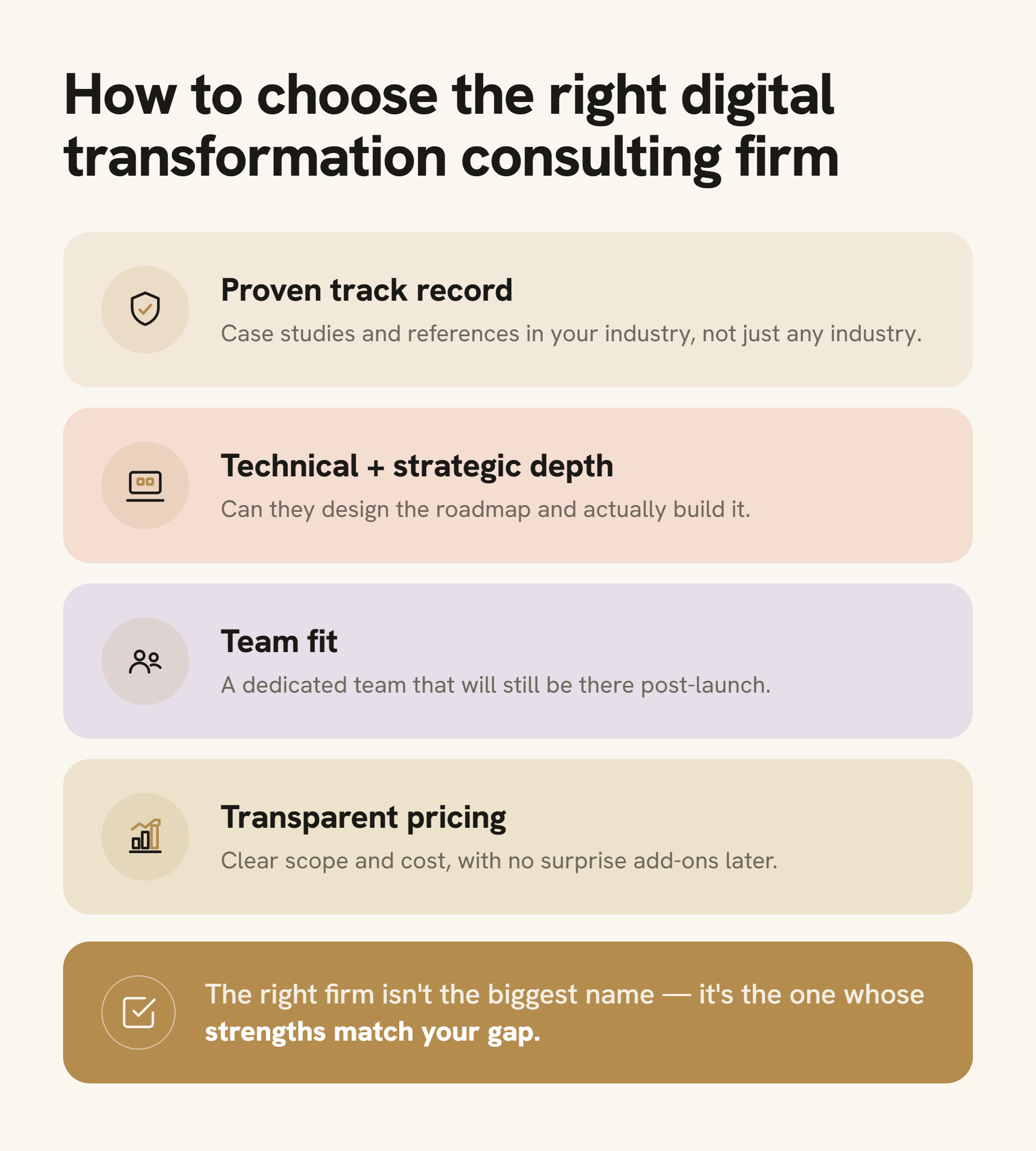
Choosing among these companies comes down to matching a firm’s specialized expertise to your specific buyer criteria, not picking whichever name is most recognizable.
Work through the criteria below before you shortlist anyone.
- Customer experience goals: Look for a firm with demonstrated design work in your industry, not generic case studies from unrelated sectors.
- Data analytics maturity: If your team is early in its data journey, look for a partner with strong data scientists on staff, not just implementation engineers.
- Business continuity needs: Regulated or high-uptime industries need a firm with a proven business continuity record during past migrations.
- Change management capability: A firm without real change management experience will hand you new software and no adoption plan, and your organizational culture will resist it.
- Cost model: Match the firm’s pricing structure, whether project-based or ongoing retainer, to your budget cycle and approval process.
- Need for ongoing support: Confirm whether the firm offers continuous support after go-live, or whether that responsibility shifts entirely to your team.
Get these six right, and the rest of the selection process gets a lot easier.
Questions to Ask Top Digital Consulting Firms
Once you’ve narrowed your list using the criteria above, ask each finalist these six questions directly.
- What is your experience in our line of work? The consultant should offer resources to visualize your objectives and help build your digital initiatives. Narrow your search to firms with real experience in your specific industry standards and line of work.
- How well do you understand our specific needs? Discuss your current business processes and technologies in detail. The firm should bring a fresh perspective to your challenges, not a generic pitch reused across every client.
- What is your training and education model? Whatever the size of your transformation, your employees need proper training to adopt it. Ask exactly how the firm handles employee training, whether through live sessions, guides, or ongoing coaching, and how it tracks key performance indicators for adoption. One of the key aspects to check here is whether training continues after launch or stops the day the project closes.
- How well can you integrate with our workflows? Ask how the firm plans to work with data critical to your operations, and how their work will affect your internal team’s day-to-day routines.
- Who owns the intellectual property? Clarify upfront whether you’re buying an off-the-shelf product or a custom build you’ll own outright. This affects your long-term flexibility and competitive edge.
- What is your development method? Agile development gives you room to adjust scope as a project evolves. Ask how the firm handles change requests mid-project, not just at kickoff.
Asking these questions upfront helps you separate firms that offer genuine partnership from those simply selling a one-size-fits-all package.
Pick a Trusted Partner to Transform Your Organization
The top digital transformation consulting firms on this list bring genuine niche expertise or enterprise scale to the table, but the right one depends on your budget, your industry, and how much hands-on delivery you need versus strategic guidance.
Before you decide, weigh these factors together:
- Global consultancies like Accenture and Deloitte Digital: best when you need multi-region scale and deep executive alignment.
- Regional specialists like Redsen and Xngage: best when you need closer, industry-specific delivery at a lower cost.
- Platform specialists like NetResearch and acidgreen: best when you’ve already picked your commerce platform and need hands-on implementation.
- AI-forward engineering firms like Azilen and Intellias: best when automation and AI need to be built into the transformation from day one.
According to McKinsey’s research on organizational transformations, only 30% of transformation programs succeed at meeting and sustaining their intended performance targets.
A data-driven approach to tracking progress against those targets, checked regularly rather than once a year, is what separates the programs that succeed from the ones that quietly stall as the digital age moves on without them.
That gap is exactly why choosing the right partner from this list, rather than the most familiar name, matters as much as the technology itself, and why industry recognition alone shouldn’t decide your shortlist.
A digital transformation consulting service helps you plan and execute the work, but the platform is what that work actually runs on day-to-day. Once you’ve chosen a consulting partner from this list, the platform decision matters just as much.
OroCommerce is built specifically for B2B manufacturers, distributors, and wholesalers going through this exact transition, giving your new partner a foundation designed for the complexity your business landscape already has, without forcing a total rebuild of every business function along the way.
Learn about OroCommerce and how it can help you scale eCommerce and make your digital transformation successful
FAQs About Top Digital Transformation Consulting Firms
What is digital transformation consulting?
It’s a service that helps organizations identify, plan, and implement new technologies to modernize business functions and improve profitability. Consultants assess existing systems and digital skills gaps, then build a roadmap covering both strategy and hands-on implementation.
What does a digital transformation consulting firm do?
A digital transformation consulting firm evaluates a company’s current processes, technology, and readiness for a cultural shift. It then recommends specific tools and platforms, often managing the rollout directly rather than only advising from the sidelines.
What are the biggest digital transformation consulting firms?
Accenture, Deloitte Digital, McKinsey Digital, BCG Digital Ventures, Capgemini, Cognizant, IBM iX, and Publicis Sapient are consistently ranked among the biggest and most influential consultancy firms for large-scale work, based on global delivery scale and enterprise client rosters.
How much does a digital transformation consulting firm typically cost?
Costs vary widely by firm tier and project scope. Global enterprise consultancies typically charge premium day rates for multi-year programs, while regional and mid-market firms offer project-based pricing that’s often a fraction of that cost for focused implementation work.
How long does a typical digital transformation project take?
Most projects run 6 to 18 months depending on scope, ranging from a single platform migration to a full, multi-system operating model redesign that touches business leaders across every department.