navigation

In consumer eCommerce, “upsell” usually means nudging shoppers toward a pricier version of whatever they’re browsing. In B2B eCommerce, the word means something entirely different and far more operational.
When manufacturers and distributors talk about upselling, they’re talking about supporting existing customers with better quantities, better-fit products, and fuller, more accurate orders. It’s less about widgets or impulses and more about making procurement smoother, preventing errors, and ensuring buyers get exactly what their operation needs the first time.
Teams go searching for “upselling strategies” for one reason: they want their digital channel to generate revenue impact. They’ve already digitized the basics, and now they’re asking the deeper question: How do we use what we know about our customers to guide them toward better decisions, encourage new customers, and strengthen loyalty?
That’s where modern B2B digital commerce finally changes the game. Upsell becomes scalable only once there’s a single place where patterns, preferences, order history, and operational context come together and can be acted on. When the storefront, search engine, and account dashboard understand the buyer’s intent, the system can surface the same helpful nudges for more value that a seasoned sales rep would offer.
Today, we break down the practical upsell plays for manufacturers and distributors, what buyers experience in each moment, and how eCommerce + AI make these interactions more accurate and more valuable over time.
Core Upsell Plays Enabled by B2B eCommerce
Digital commerce changed the nature of upselling strategies in B2B. Instead of relying on a sales rep noticing an opportunity, the platform can surface the right prompt at the right moment in the customer journey, precisely when buyers are making decisions. These aren’t consumer-style nudges, but operational improvements that deliver a value proposition to existing customers while aiming to strengthen customer relationships.
Below are the five foundational upsell plays manufacturers and distributors can activate when their digital channel finally has the data, structure, and logic to understand buyer intent.
Play One: Helping Buyers Choose Better Units for Large Orders
Bulk ordering is where the most overlooked upsell opportunities live. Buyers often default to familiar pack sizes or historical habits, even when a different unit makes more operational or financial sense. A strong B2B platform guides buyers toward the right formats automatically through smart upgrade prompts.
Where This Appears
- Bulk entry forms
- Quick order interfaces
- CSV uploads for high-volume replenishment
What Buyers Experience
The platform performs advanced analytics on past purchases, peer account behavior, and order patterns to suggest better-suited units. These upgrade prompts aren’t there to push “more money”, though. They simply reflect what other customers in similar operations consistently choose.
Examples:
- Recommending pallet quantities instead of cartons when volumes cross a certain threshold
- Suggesting industrial-grade packaging when the order signals heavy usage
- Highlighting a more efficient version of the same SKU when relevant
This is among the simplest but most effective upselling techniques because it educates customers at the moment of intent and removes friction from the buying process.
Business Outcome
- Fewer fragmented shipments
- Higher average order value when appropriate
- Less back-and-forth with a sales rep
- More confident buyers and a smoother upsell process overall
This is one of the most “invisible but powerful” upselling tactics and an example of how digital channels can significantly enhance productivity without feeling like a classic upsell tactic.
Play Two: Improving Reorders With Thoughtful Alternatives
Reorders are the heartbeat of manufacturing and distribution revenue. They also happen to be the ideal moment for subtle, operationally meaningful upselling and cross-selling.
Where This Appears
- Account dashboards
- “Frequently purchased” lists
- Intelligent replenishment reminders
What Buyers Experience
Instead of static reorder lists, buyers see curated suggestions shaped by what other customers with similar profiles have upgraded to over time. This feels less like a pitch and more like a trusted recommendation.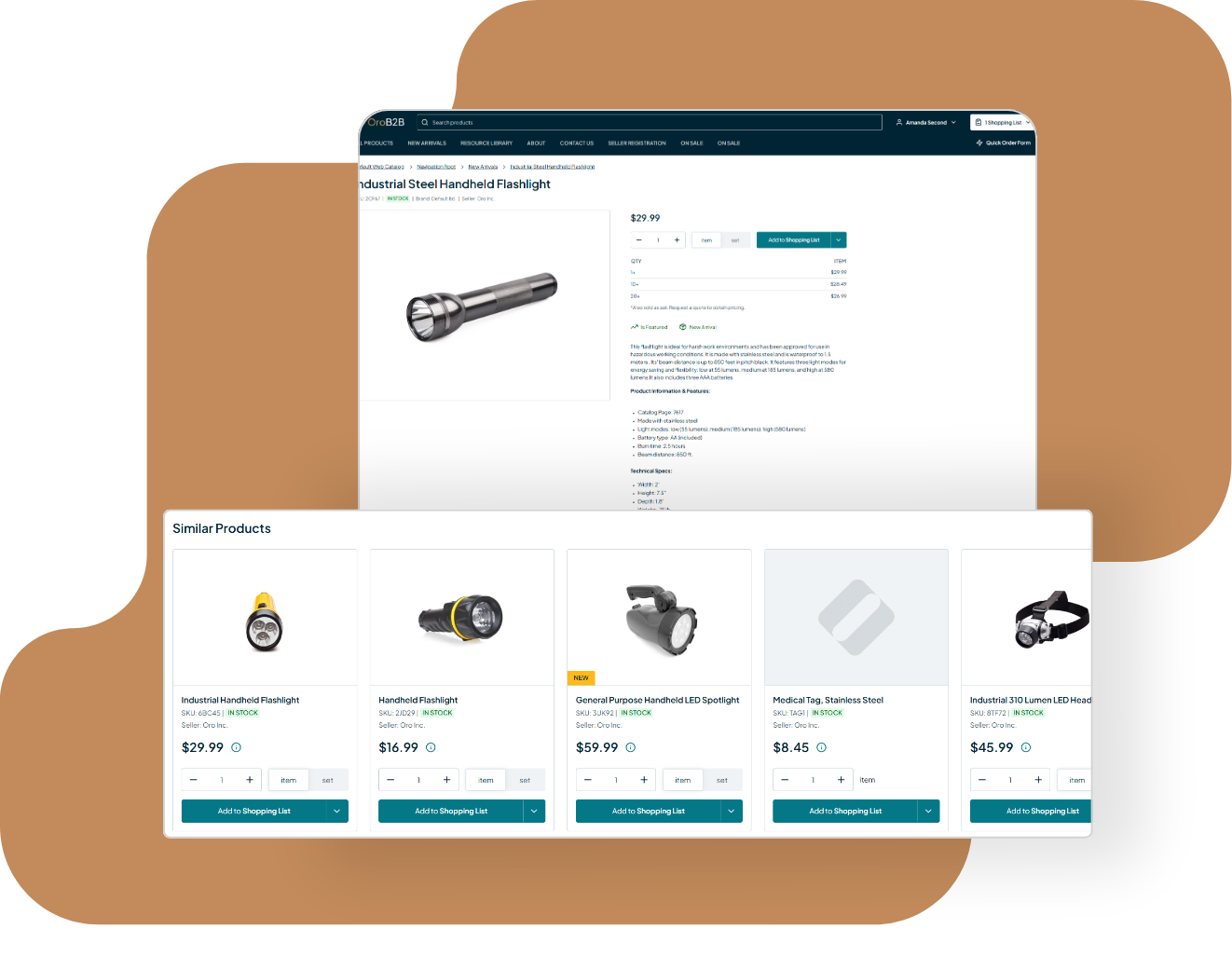 Examples:
- Offering a longer-life variant of a frequently replaced part
- Recommending a higher-efficiency model based on what similar plants adopted
- Highlighting a more suitable equivalent when product usage grows
This is positioning the brand as a partner rather than a vendor, and it’s naturally enhancing customer satisfaction and customer retention.
Business Outcome
- Stronger, stickier customer relationships
- Migration toward strategic SKUs
- Fewer service issues thanks to better-fit products
- Meaningful lift in customer lifetime value over time
This is where successful upselling feels like customer service, instead of persuasion.
Gartner Insight: How to Shrink Sales Cycles With Digital Commerce
Play Three: Helping Buyers Complete Orders at Cart
Cart and checkout are high-impact moments. And we’re not talking about pushing a premium version, but about ensuring buyers don’t miss critical items. Think of safety gear, consumables, attachments, installation components, or services that are required to complete the job.
Where This Appears
- Cart summaries
- Checkout flows
- Side-by-side order review screens
What Buyers Experience
Smart upsell prompts surface complementary products that fit directly with what’s already in the cart.
Examples:
- Required accessories for a piece of equipment
- Compatible filters, seals, or consumables
- Extended service packages or calibration services
- Compliance-related add-ons that avoid regulatory risk
The best thing is that these are not considered sales pitches for persuading customers. They are relevant upgrades and preventive measures that reduce errors and power users who expect a complete, accurate shipment the first time.
Business Outcome
- More complete orders
- Fewer support calls and order corrections
- Higher average order value from relevant products
- A smoother overall customer experience
This is cross-sales at its most useful: ensuring the original purchase actually works once it arrives.
Play Four: Suggesting Stronger Configurations During Quote Workflows
RFQs are where B2B buyers make some of their most strategic choices. Digital marketing and commerce bring structure to these decisions and ensure that the options presented align with your operational patterns.
Where This Appears
- Request-for-quote workflows
- Quote creation screens
- Revision flows for negotiated deals
What Buyers Experience
When assembling a quote, buyers receive optional configurations informed by industry norms and historical outcomes.
Examples:
- Extended service coverage based on typical lifecycle issues
- More durable assemblies selected by similar operations
- Stronger performance specs where conditions justify it
- Add-ons that avoid expensive mid-cycle replacements
In the context of these real-world examples, the upsell offer feels like expertise, instead of a tactic. It’s supporting and encouraging customers instead of persuading them, which is one of the main goals.
Business Outcome
- Higher-value, more future-proof quotes
- Fewer revision cycles
- Clear alignment with real-world performance requirements
- A more confident purchasing decision
It’s the kind of sales technique that blurs the line between digital and human advisory.
Download feature-by-feature B2B eCommerce software comparison chart
Play Five: Guiding Buyers Toward Better Options During Search
Search is the earliest and often the most overlooked moment to convince customers to make the best choice. A mature platform sees intent and reacts in real time.
Where This Appears
- Search results
- Category listings
- Low-stock or discontinued item scenarios
What Buyers Experience
When a chosen SKU is low in stock, discontinued, or suboptimal, the system immediately routes buyers to better options informed by peer behavior and performance data.
Examples:
- Showing equivalent items that similar operations successfully use
- Recommending a higher-capacity version when usage patterns justify it
- Highlighting substitutes when an item is no longer in production
These aren’t manipulative upselling efforts. They just remove the friction and prevent “dead-end” searches.
Business Outcome
- Fewer abandoned sessions
- Fewer “call the rep” interruptions
- Better match between intent and final purchase
- Faster path to the right product
This is where digital channels behave like a highly informed assistant, making each moment smoother and more efficient.
AI as a Force Multiplier for These Plays
AI strengthens these upsell moments by paying attention to signals teams rarely have time to track. It reads the patterns inside years of orders and uses them to make small but meaningful adjustments in the buying flow.
- Spotting when a buyer is ready for a better unit. As customers grow, their needs change. They use larger packs, longer-lasting parts, or more efficient versions. AI catches these shifts early and brings forward the option that fits the direction their operation is already moving toward.
- Predicting the next reorder window. Replenishment is influenced by work cycles, season, maintenance routines, and production pace. These signals rarely sit in one place. AI connects them and prompts the buyer before shortages appear.
- Choosing relevant add-ons instead of flooding the cart. B2B buyers don’t want a long list of accessories. They want the one or two items that prevent delays. AI highlights those, based on what similar customers attach in the same situations.
- Retiring suggestions that don’t resonate. Preferences change. Supply chains change. Industry norms shift. AI adapts by watching what buyers ignore and removing prompts that no longer matter, keeping the storefront focused and credible.
See what AI developed specifically for B2B looks like
What Strong Digital Commerce Foundations Make Possible
Cross-selling and upselling in B2B typically break down because the underlying system can’t express the logic the business already knows. If your platform can’t represent product relationships, account structures, approval paths, replenishment patterns, or compatibility rules, even the smartest AI or the best sales strategy will struggle with upselling and cross-selling offers.
That’s why you need strong digital commerce foundations. They don’t add complexity, but they will remove friction so every upsell moment feels accurate, useful, and relevant. Your B2B commerce engine has to reflect how your business really operates. That means capturing nuance: how you price, who sees what, what matters during RFQs, and how customers’ products relate to one another.
Let’s talk about the advanced features that aren’t just nice to have, but they’re the actual infrastructure that makes every earlier upsell play work.
Segmented Catalogs and Price Lists
B2B buyers aren’t interchangeable. Different customers use different SKUs, have different contract terms, and qualify for different units or pack sizes. Upsell prompts only land when they respect those boundaries and prioritize customer’s needs.
A strong platform should support:
- Customer-specific catalogs
- Contracted and tiered pricing
- Region- or industry-based product visibility
Role-Based Views That Reflect How Buying Works
B2B commerce isn’t one user clicking “buy.” It’s engineers, procurement, accountants, and supervisors all interacting with different parts of the catalog.
Role-based views keep upsell prompts aligned with the user’s purpose:
- Engineers see technical upgrades
- Buyers see pricing options and availability
- Approvers see compliance-friendly equivalents
These premium features ensure each suggestion feels relevant to the person holding the screen.
Workflow Control Inside RFQs and Approvals
Many B2B upsell opportunities live inside the negotiation cycle, instead of the checkout screen. If your platform can weave suggestions into RFQs, revisions, and approvals, you catch both loyal customers and new customers at the moment they’re already thinking through configuration choices and complementary products.
Key capabilities include:
- Approval-tier visibility rules
- Optional line-level upgrades
- Substitute or alternate SKUs during revision
- Configurations tied to real industry benchmarks
A Storefront Model That Supports Recommendations Anywhere
Most platforms restrict recommendations to product detail pages, which is actually the last place a serious B2B buyer spends their time. The real upsell offer should happen earlier: during bulk entry, quick order, account dashboards, and quotes.
Your B2B portal storefront needs the flexibility of advanced features to display recommendations across:
- Quick order tables
- CSV upload confirmations
- Replenishment dashboards
- Cart and checkout flows
- Search and category results
That flexibility is the difference between “we have upsell widgets” and “we can influence every step of the customer journey.”
Architecture That Can Exchange Real-Time Data With AI Engines
If the platform can’t talk to an AI model in real time, most of the intelligence disappears. Recommendations become generic, replenishment prompts fall out of sync, and upgrade logic goes stale.
A modern platform must comfortably support:
- Real-time API calls
- High-volume data exchange
- Fast response tolerances (sub-second ideal)
- Event-driven signals (e.g., “customer added X to cart,” “inventory changed,” “budget threshold hit”)
This lets AI models adapt instantly to buyer behavior instead of blindly following prewritten rules.
Product Models Rich Enough to Express Real-World Relationships
Nearly every upsell moment depends on understanding the relationships between products. If the system only stores SKUs, descriptions, and prices, it can’t suggest relevant alternatives or offer a bundle deal, no matter how smart the AI is.
The product model needs to express:
- Compatibility
- Variants and pack sizes
- Substitutes and equivalents
- Safety-critical accessories
- Higher-efficiency or longer-life options
- Assembly requirements
This is the backbone of accurate recommendations, and often the part most platforms underinvest in.
The Spine Message: What All of This Really Means
If the B2B eCommerce platform can’t express the relationships your business already understands, no upsell strategy will ever work consistently. AI will guess, buyers will ignore prompts, and sales teams will lose trust in the system.
But when the foundation is right, increasing sales becomes effortless:
- Better options appear naturally.
- Reorders become smarter.
- Carts become complete.
- Quotes become more strategic.
- Product choices feel guided, not pushed.
See why OroCommerce is the right foundation for B2B upsell and cross-sell plays
Turning Everyday Buying Activity Into Better Outcomes
Most manufacturers and distributors don’t need to tear down their buying journeys or invent something flashy to increase revenue. The opportunity is usually hiding in plain sight within the thousands of small decisions buyers make every week – what they reorder, what they skip, where they hesitate, and when they ask for help.
When a digital platform can read those patterns, connect them, and surface the right nudge at the right moment, the existing journey will start working harder without even feeling any different to the customer.
This is also where AI fits naturally into the process. It doesn’t replace your sales representative, and it doesn’t “sell” on its own. It simply fills the space between human interactions, the quiet moments when a buyer is building a quick order list at 7 AM, checking stock levels between meetings, or opening an RFQ after hours. Those are the moments where buyers are most open to guidance, and where even small improvements make a significant difference in potential revenue and satisfaction.
The point is simple: buyers often would choose a better unit, a more complete configuration, or a more suitable alternative if the system recognized what they were trying to do. Revenue growth in the next phase of B2B commerce won’t come from louder promotions or broader catalogs, but from how effectively digital channels surface decisions customers were already inclined to make.
When digital touchpoints offer that clarity at the exact point of need, the commerce platform won’t just be a place to submit orders, but a quiet revenue growth engine.
OroCommerce leans into this philosophy. Our B2B-native logic, flexible storefront model, and AI-ready architecture make it possible to bring those hidden decisions to the surface consistently, accurately, and without forcing teams into heavy customization.
Questions and Answers
Do these upsell prompts annoy strategic customers?
Not when they’re done the right way. B2B buyers aren’t reacting to “sales tactics”, but responding to relevance. If the prompt upgrades mirror how similar customers buy, prevent an error, or help them get a more complete order, it’s seen as helpful, not pushy. The only time prompts annoy buyers is when they feel random or disconnected from their actual needs. A software platform built with solid B2B logic avoids that problem from the start.
Do we need AI to start, or can we begin with rule-based prompts?
You can absolutely start with rules. In fact, many high-performing programs begin with simple logic, such as compatibility rules, pack-size suggestions, common substitutes, or recommended accessories. AI becomes valuable once your catalog is large enough, your customer base is diverse enough, and your buying patterns are complex enough that manual rules don’t scale. Think of AI as an accelerator, not a prerequisite.
Where do teams usually see the first signs of impact?
Typically, in the quiet, operational areas:
- Cleaner bulk orders
- Fewer “can you check stock?” emails
- Higher attach rates for accessories or consumables
- More complete RFQs
- Fewer abandoned searches
The numbers move before anyone officially “launches an upsell strategy.” It starts showing up in everyday buying behavior.
How does this change what reps do day-to-day?
It frees them from micro-tasks. When digital channels handle routine add-ons, replenishment timing, compatibility checks, or product alternatives, reps spend more time on advisory conversations. They can solve problems, shape configurations, and build stronger customer relationships. AI doesn’t shrink the role of a sales representative, but expands the part of the job that actually drives customer loyalty and satisfaction.
What if we’re still moving from email-based ordering to digital?
You can still do this. Early-stage digital adoption is actually one of the best times to introduce helpful prompts because you’re shaping habits from the start. The key is to keep things simple with no heavy AI or complex personalization. Begin with rule-based suggestions for customers’ needs tied to the initial purchase, compatibility, pack sizes, or substitutes. As digital usage grows, the sophistication of upsell opportunities can grow with it.