navigation

Every executive board expects an AI strategy this year.
The data confirms the rush. McKinsey’s State of AI research found that 88% of companies report regular AI use in at least one business function.
But execution tells a different story. In our 2026 AI in B2B Commerce survey, only 17% report their AI adoption is “very effective” with significant ROI.
The gap between expectation and reality is expensive. Companies buy AI tools they don’t understand to solve problems they haven’t defined.
This guide strips away the buzzwords. It defines what artificial intelligence in B2B eCommerce actually does. It also explains why B2B requires a specialized approach, and where these AI capabilities generate measurable business value today.
Key Takeaways
- Execution, not ambition, is the bottleneck. 88% of companies use AI somewhere in the business, but only 17% call their B2B AI adoption very effective.
- B2B AI is a different discipline than B2C AI. Organizational, data, commercial, and relationship complexity mean it must enforce contracted pricing and approval hierarchies automatically.
- Back-office automation delivers the fastest ROI. 81% of companies have deployed AI-powered order automation, the highest adoption of any capability, visible on day one.
- Every barrier below has a fix. Legacy integration, data quality, resistance, governance gaps, and unclear strategy each get a concrete fix in this guide.
- Hybrid models beat full automation. Keeping sales and service teams in the loop for relationship decisions consistently outperforms full automation.
OroCommerce takes a native approach to AI in B2B ecommerce. We embed AI and machine learning capabilities directly into the platform instead of bolting on standalone AI tools.
That means the AI already understands your contract pricing, inventory allocations, and customer data because it lives inside the system that runs your business.
It skips the integration barrier that stalls so many B2B AI deployments. Book a demo to see how AI works inside a live B2B ecommerce platform.
Defining AI in B2B eCommerce
E-commerce refers broadly to buying and selling online, and “AI in ecommerce” refers specifically to the systems layered on top of that transaction flow to make it faster, smarter, and more personalized.
Artificial intelligence refers to systems that identify patterns in data and apply them to new situations. AI’s ability to handle inputs it hasn’t seen before comes from recognizing similar patterns from its training.
This behavior separates it from traditional software automation. Standard automation executes static rules. It breaks when it hits an exception.
For B2B commerce, you need to understand five specific categories of AI technology:
- Machine learning: predicts behavior from historical data
- Natural language processing: turns human language into structured actions
- Generative AI: creates new content from patterns in vast data
- Predictive analytics: forecasts what happens next
- Computer vision and image recognition: interprets visual data
1. Machine learning
Machine learning analyzes historical data to find hidden patterns. It takes vast data and predicts customer behavior.
Supply chain management teams rely on these models for inventory management, for example. The software analyzes historical sales data alongside shifting market trends. It uses that context to forecast demand and set optimal inventory levels, preventing costly stockouts.
A distributor running low on a fast-moving valve, for instance, can get a reorder alert before the warehouse actually runs dry. That’s the practical value of good inventory management: fewer emergency orders, fewer angry calls.
2. Natural language processing (NLP)
Natural language processing (NLP) allows machines to understand human language. It serves as the bridge between unstructured text and structured business operations.
It powers semantic search, customer service chatbots, and document processing. For example, a sales rep can type “show open orders over $10K from automotive customers” instead of clicking through menus and filters.
The system interprets the request, applies the filters, and returns the data instantly. That saves sales reps real time every day.
3. Generative AI
Generative AI creates new content based on patterns it learns from vast data sets.
For manufacturers and distributors managing large catalogs, this solves a scaling problem. A company with 50,000 SKUs can generate product descriptions and technical specifications in hours instead of months.
Generative AI also assists sales and service teams in creating product descriptions and outreach tailored to specific customer segments or regions. The output requires human review for accuracy and brand consistency, but the speed advantage is significant.
4. Predictive analytics
Predictive analytics is the discipline that turns historical data into predictive insights about what happens next. These AI systems model customer purchase history, seasonal cycles, and market data instead of just describing what already occurred.
They forecast demand, flag churn risk, and anticipate customer needs before a buyer even reaches out. This is the engine behind demand forecasting, dynamic pricing, and sales intelligence capabilities covered later in this guide.
5. Computer vision and image recognition
Image recognition allows AI-powered tools to interpret visual data the same way NLP interprets text. In B2B commerce, this shows up most often in visual search.
A buyer uploads a photo of a part, and the platform matches it against the catalog. It also shows up in quality control on the supply chain side, where computer vision flags defects or mismatched SKUs faster than manual inspection.
Is it agentic AI or an AI co-pilot? Get IDC's AI autonomy framework
Why AI for B2B Commerce Is a Different Challenge
You cannot copy a retail AI strategy and paste it into a manufacturing portal.
Consumer algorithms optimize for impulse purchases from online shoppers. B2B commerce operates on negotiated relationships, complex approval chains, and a customer experience built over decades.
Customer expectations in B2B are shaped less by convenience and more by accuracy, trust, and consistency.
The structural differences force a different AI technology approach across four dimensions.
1. Organizational complexity
B2B purchasing is a committee decision. A single account hierarchy includes corporate procurement, branch managers, and local buyers, all key stakeholders with specific spending limits and approval workflows.
AI must enforce these contracted permissions automatically. That’s why account structure and role-based access matter so much in a B2B portal built for ecommerce.
2. Data complexity
Consumer purchase history spans months. B2B customer data spans years or decades. Analyzing historical data means accounting for contract renewals, economic cycles, and buyer behavior tied to corporate entities rather than individuals.
For example, customer purchase history for a manufacturing account might show reduced orders. Is demand down, or did they shift one category to a competitor while staying loyal elsewhere?
Data-driven decision making requires account-level context over time to interpret patterns correctly and show actionable insights.
3. Commercial complexity
Every customer has negotiated commercial terms: pricing discounts, volume breaks, catalog restrictions, that AI integration must enforce automatically. Consumer platforms assume one catalog and one price.
B2B commerce assumes every relationship has unique rules.
4. Relationship complexity
Finally, you cannot automate a complex, high-stakes negotiation. Customer loyalty in the enterprise space is built on technical expertise and trust.
The objective of AI here is to augment your sales team. This frees your experts to manage the nuanced customer interactions that protect your margins and strengthen customer relationships.
This doesn’t mean AI has no role in the relationship. It just means it supports the rep, it doesn’t replace the conversation.
How Does This Change AI Technology Implementations?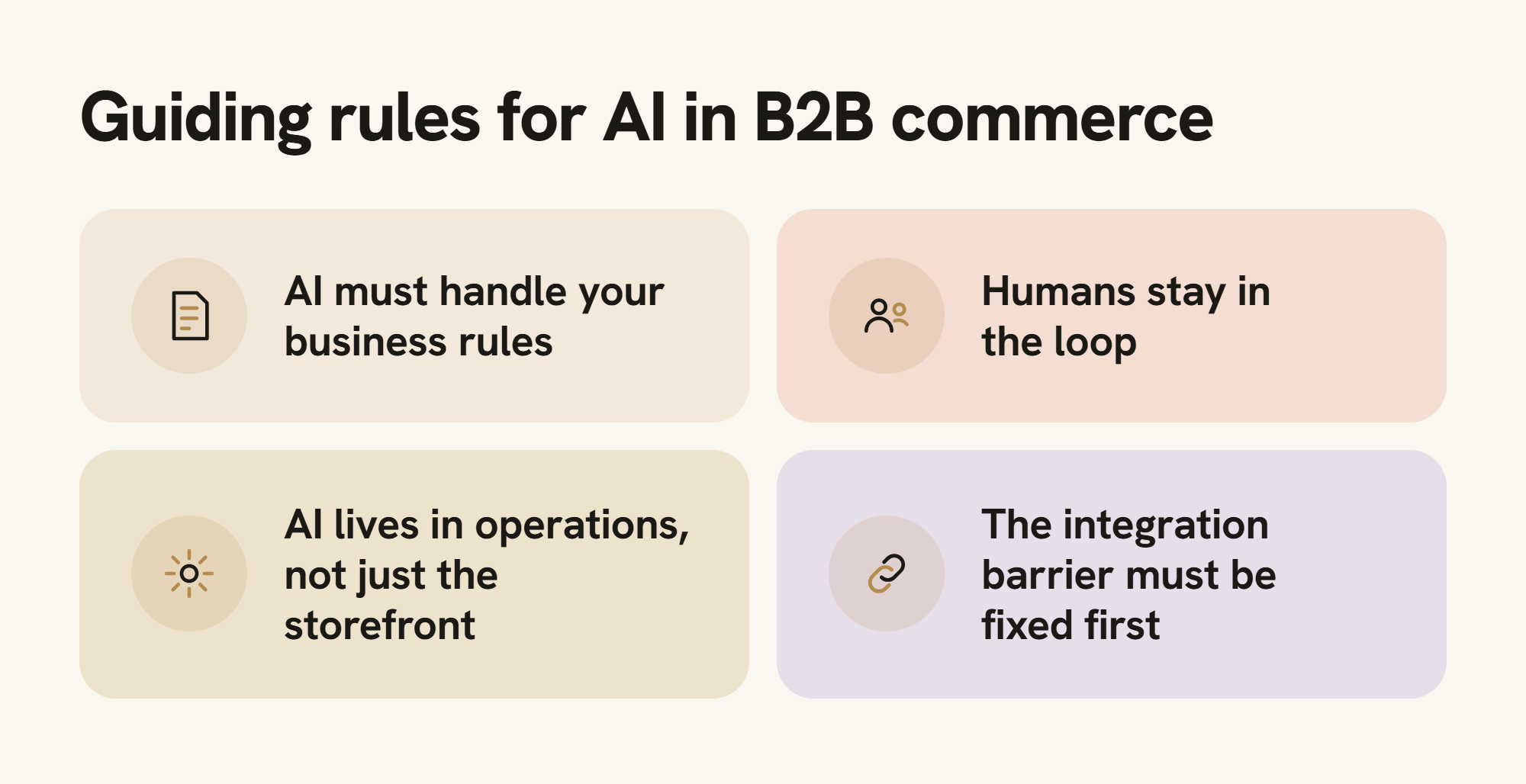
These four layers of complexity dictate the rules of engagement. Ignore them, and your AI pilot will burn the budget without generating business outcomes.
- AI must handle your business rules. B2C recommendation engines don’t understand customer-specific catalogs or compliance restrictions. AI that recommends products a buyer isn’t authorized to purchase creates problems, not revenue.
- Humans stay in the loop. AI handles routine tasks and data processing. Sales and service teams manage relationships and complex negotiations, and companies attempting full automation see worse results than those using hybrid models.
- AI lives in operations, not just the storefront. The business value comes from enforcing pricing logic, routing orders correctly, and preventing errors, not from making checkout faster.
- The integration barrier is real. The algorithm is rarely the problem. Integrating AI into disconnected, siloed legacy systems is the actual threat to your deployment.
The complexity explains why so many pilots fail. It also explains why the ones that succeed focus relentlessly on measurable outcomes.
Separate AI substance from AI marketing with our Honest Guide to AI Claims in B2B Commerce.
The Business Case for B2B Commerce: Where AI Generates Immediate ROI
AI capabilities in B2B commerce fall into two broad categories: those that shape the buyer experience, and those that run back-end operations. Understanding these categories helps prioritize which capabilities matter for improving operational efficiency and driving business outcomes.
For the buyer experience
- Customer service chatbots provide enhanced customer service via 24/7 handling of order status, tracking, returns, and invoice questions, escalating complex issues to humans.
- AI-powered search uses semantic understanding and image recognition for visual search, handling technical queries better than keyword matching.
- Product recommendations suggest compatibility-based products and learn customer preferences to anticipate customer needs and offer alternatives.
- Guided product configuration walks buyers through compatibility and spec decisions based on requirements and purchase history.
- Smart reordering uses predictive analytics to flag restock timing and quantities based on historical data and consumption patterns.
The best setups use a hybrid model: AI handles tier-one support, and humans handle relationship management.
For back-end operations
- AI-powered order automation extracts structured data from PDFs, emails, faxes, and spreadsheets, and flags anomalies like unusual quantities before processing.
- Internal AI assistants let sales teams query systems in natural language instead of navigating menus, and apply role-based permissions automatically.
- AI-generated insights turn plain-language questions into instant answers, surfacing patterns in customer satisfaction, order frequency, and purchasing trends.
- Demand forecasting analyzes historical data, seasonal trends, and market conditions to optimize inventory levels across warehouses.
- Dynamic pricing strategies include adjusting prices based on market conditions, inventory levels, and customer segments while applying contract terms. Pull from real-time data feeds, competitor pricing, market indices, and current inventory levels, rather than static price lists. Set a hard guardrail: negotiated contract terms should always override automated price adjustments.
- Sales intelligence flags accounts ready for upselling or at risk of churn, and scores leads sales reps might miss.
Personalization and conversion rates
Personalization is where AI-powered tools translate directly into revenue and improving customer engagement.
When product recommendations, search results, and content reflect a buyer’s actual purchase history and customer preferences, conversion rates improve because buyers spend less time hunting for the right SKU and more time ordering it.
Three metrics matter most when tracking the impact of personalization on business value:
- Add-to-cart rate: how often personalized recommendations lead to an item being added, versus generic merchandising
- Average order value: whether targeted marketing and cross-sell suggestions increase basket size per order
- Repeat purchase rate: whether personalized experiences strengthen customer loyalty over multiple ordering cycles and the entire customer journey
The most reliable way to validate impact is A/B testing:
- Run personalized product recommendations against a generic, non-personalized catalog view for a defined segment.
- Test AI-generated product descriptions tailored to a specific customer segment against your standard copy.
- Measure add-to-cart rate and average order value across both groups before rolling the change out account-wide.
Practical example: from hours of rekeying to 30-second order processing
DiversiTech, a major HVAC manufacturer and distributor faced order chaos across two regions. In North America, customer service teams manually rekeyed orders from email and fax. In Europe, nine ERP systems operated in parallel during consolidation.
They deployed AI to handle both:
- North America: AI reads incoming purchase orders and converts them to draft orders automatically.
- Europe: AI normalizes order data across nine ERPs, routing everything into the new Dynamics 365 environment.
The system now processes orders in under 30 seconds, recently handling a 64-page PDF with 716 line items. Customer service reported a 20% productivity gain.
The team size stayed the same. Staff who previously spent hours on data entry now focus on customer relationships and problem-solving.
AI capabilities by business impact
| Capability | Primary Benefit | Implementation Complexity | Typical ROI Timeline |
|---|---|---|---|
| Order automation from unstructured docs | Efficiency (labor savings) | Low to Medium | Immediate. Time savings measurable day one. |
| Demand forecasting | Efficiency (inventory costs) | Medium | 3 to 6 months. Needs a full business cycle to validate forecasts against actual orders. |
| Customer service chatbots | Efficiency (support costs) | Low | Immediate. Ticket deflection and response time improvements show instantly. |
| Natural language queries for internal systems | Productivity (faster decisions) | Medium | 1 to 3 months. Works immediately, but adoption takes time. |
| Dynamic pricing optimization | Revenue (margin improvement) | High | 6 to 12 months. Must analyze win rates and margins across many deals and market conditions. |
| Product recommendations | Revenue (basket size / average order value) | Medium | 3 to 6 months. Needs transaction volume to measure basket size impact accurately. |
| Sales intelligence & lead scoring | Revenue (win rate) | Medium | 3 to 6 months. Proves value when deals close; requires full sales cycle to validate. |
| AI-generated insights & reporting | Productivity (decision speed) | Low to Medium | Immediate. Answers questions instantly; value shows in faster decision-making. |
The business case is clear, and the capabilities exist. Yet many companies deploy AI without capturing this value.
What Stands in the Way: Barriers to Success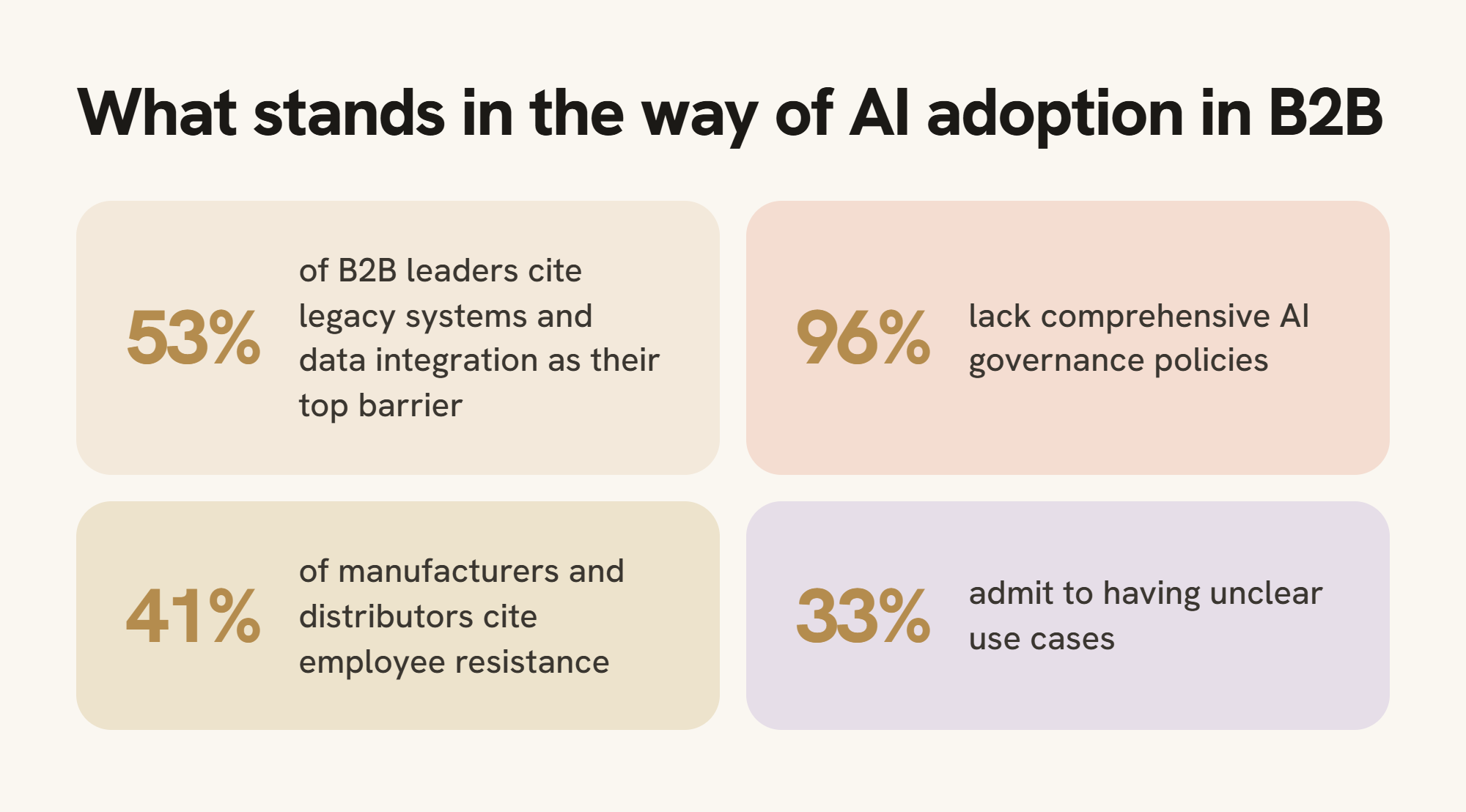
The gap between “planning to use AI” and “generating ROI” is defined by five specific barriers.
According to our 2026 AI in B2B Commerce survey, organizations aren’t struggling with the technology itself. They’re struggling to fit that technology into existing workflows.
If any of these barriers sound familiar, you’re not alone. Most B2B teams hit at least two of them.
1. The integration challenge: 53% cite this as the top barrier
Legacy infrastructure is the primary bottleneck.
Most ERPs and CRMs were designed as static systems of record. They weren’t built for the real-time, bi-directional data flow that advanced AI requires.
Integrating AI with these existing systems demands significant architectural effort, a process closely tied to the broader ecommerce consolidation trend many B2B companies are going through right now.
When companies try to bypass this by buying standalone AI tools, they create point solutions. These tools hold their own isolated customer data, creating new silos instead of solving the problem.
2. The data quality problem
AI models learn from historical data. If that history is full of errors, the AI will be flawed.
Common gaps include:
- Incomplete order history
- Inconsistent product attributes
- Pricing rules that exist only in a spreadsheet
In B2B, manual data entry errors compound over time. An AI trained on “garbage” inputs will confidently recommend the wrong product or quote an unprofitable price.
As we cover in why B2B ecommerce needs to fix product data first, fixing data quality means going back through ERP records, standardizing formats, and cleaning accumulated errors.
That work happens before AI delivers value, which is why many implementations stall in the cleanup phase. Clean data alone doesn’t guarantee good outputs, though. AI models still need to be validated before you scale a pilot across the business:
- Holdout testing: validate model outputs against a known-good sample before go-live
- Human review thresholds: require review for any AI-generated recommendation below a defined confidence score
- Drift monitoring: watch for degrading accuracy as customer behavior and market conditions shift over time
Skipping validation is how a model that performed well in a demo quietly degrades in production.
3. The organizational challenge: 41% cite employee resistance
Technology is easier to change than culture.
Sales reps ignore pricing recommendations they don’t understand. Customer service teams bypass chatbots because they don’t trust the output. The resistance isn’t always about job security; sometimes the AI just doesn’t match how work actually happens.
Lack of internal expertise compounds this. Without people who understand the technology, companies struggle to troubleshoot issues or determine whether poor results mean bad data, bad configuration, or unrealistic expectations.
4. Missing governance: 96% lack a full policy
Most companies run on informal guidelines or are still developing frameworks. Without governance, companies fix problems reactively instead of preventing them. A working governance framework needs four components:
- Defined ownership and approval roles. One named owner decides what AI can access and change, including sensitive customer data and data privacy obligations.
- A monitoring process. Ongoing checks on model outputs in production catch degraded performance before it reaches customers.
- Audit trails for model decisions. A record of what the AI recommended, the data used, and whether a human overrode it, useful for compliance.
- Escalation paths for errors. A documented process for handling contract violations, mispriced orders, or bad recommendations, so the fix doesn’t depend on who notices first.
None of this needs to be complicated on day one. A simple spreadsheet tracking who approved what beats no record at all.
For a deeper framework on building these controls, see our enterprise AI governance guide.
5. The strategic challenge: 33% admit unclear use cases
Simply buying software is not a strategy. Many are implementing AI because competitors are doing it, not because they’ve identified a specific problem to solve.
This leads to ROI uncertainty. If you can’t define the business outcomes before you start, you can’t measure success. Confusing deployment with value is the fastest way to burn budget.
What’s Next: Future Trends in Artificial Intelligence in B2B Commerce
Those barriers aren’t disappearing overnight. But they’re forcing companies to get smarter about how they approach AI. The result is a shift in where investment flows, which AI solutions companies choose, and how implementations work, part of the broader digital transformation reshaping B2B commerce.
None of these trends move in a straight line. Adoption will vary a lot by industry and company size.
1. The shift to native capabilities
Platform consolidation is reducing complexity. Companies are realizing that maintaining a dozen isolated AI tools creates more technical debt than value. The integration costs are too high.
The market is consolidating toward ecommerce platforms with native AI and ML capabilities embedded directly into the core commerce engine. This is the exact architectural philosophy behind OroCommerce.
Instead of bolting external AI tools onto a storefront, we embed AI natively into the B2B eCommerce platform.
Because the AI lives where the business logic lives, it instantly understands your contract pricing, inventory allocations, and corporate hierarchies. Companies avoid the integration complexity of stitching standalone AI tools into their stack.
2. Governance catches up to deployment
The AI trust gap is forcing a change in oversight.
As AI interacts more deeply with customer data and contract logic, legal and security teams are stepping in. Data privacy and compliance frameworks are moving from optional guidelines to mandatory requirements.
Organizations are shifting their focus from “How fast can we deploy?” to “How do we control the output?”
3. Conversational commerce moves to the buyer side
Internal natural language tools were the first step. The next step is buyer-facing: conversational interfaces where an online shopper or procurement contact describes what they need in plain language.
The system returns a compliant, priced quote instead of making the buyer navigate a traditional catalog.
Expect this to extend the same NLP already used for internal queries out to the storefront itself, creating real competitive advantages for companies that move first.
4. Supply chain autonomy
Today’s demand forecasting and inventory management tools show recommendations for a person to approve. The next stage is part of the shift toward greater agent autonomy in commerce.
These agents adjust reorder points and trigger replenishment orders directly within pre-approved thresholds. Human sign-off gets reserved for exceptions, not every transaction, which shifts supply chain teams from routine tasks to managing exceptions.
5. Dynamic pricing orchestration at scale
Right now, dynamic pricing pilots tend to focus on a narrow product set or account segment because of the complexity involved.
The direction of travel is orchestration across entire catalogs, tens of thousands of SKUs repriced continuously against market data and competitor movement.
That only happens within governance guardrails that keep negotiated contract terms untouchable. Expect pricing optimization to become a background system function rather than a project-by-project rollout.
6. The agentic horizon
The consolidation and governance frameworks above are mandatory groundwork for agentic AI in B2B commerce.
The industry is moving toward autonomous agents that can negotiate contracts and manage supply chains directly. But an agent can’t function without a unified view of the business.
By consolidating your commercial logic now, you’re building the infrastructure that autonomous agents will eventually require.
Learn more about agentic AI in B2B commerce.
The Starting Point for Success in Artificial Intelligence in B2B Commerce
Given this evolution, the path forward is not to overhaul your entire enterprise. The most successful implementations follow a specific, five-step pattern:
- Centralize source data: bring order history, product data, pricing, and customer data into one unified view before layering AI on top
- Clean source data: standardize formats, fix inconsistent product attributes, and correct manual-entry errors before AI ever touches it
- Start narrow: pick one bottleneck, like manual PO entry, high search abandonment, or slow quote turnaround
- Prove value: run a targeted pilot on that one problem and measure the result in hours saved or revenue captured
- Build the foundation: use the pilot to justify scaling the unified, clean data and business logic organization-wide
Fragmented data across ERPs, spreadsheets, and point solutions is the root cause behind most failed pilots, which is why centralizing and cleaning source data come first. AI implementation amplifies whatever data quality already exists, good or bad.
Many teams start with nothing more than automating a single weekly report, then expand from there. You don’t need a company-wide rollout to prove the concept.
Implementing AI is an operational discipline, not magic. The companies that win treat it as infrastructure, and as a core part of their digital transformation strategy, not a side project.
Measuring impact
None of the steps above matter if you can’t show the result. Before scaling past a pilot, define how you’ll measure it:
- Conversion rate metrics. Track add-to-cart rate, average order value, and repeat purchase rate for any personalization or recommendation deployment, comparing the AI-assisted segment against a control group.
- Margin tracking for dynamic pricing. Compare realized margin on AI-priced orders against the prior static baseline over a full quarter to smooth out seasonal noise.
- Market benchmarking. Use external market data, industry pricing indices, competitor movement, and demand trends, to judge whether a market shift explains the change.
To put numbers behind your own deployment, you can calculate your AI and platform ROI.
Explore how unified commerce infrastructure accelerates AI deployment
Frequently Asked Questions
How is AI used in B2B?
AI in B2B spans the buyer experience and back-end operations.
On the buyer side, that means AI-powered search, product recommendations, and chatbots. On the operations side, it means order automation, demand forecasting, and dynamic pricing.
The highest-adoption use case today is back-office order automation, deployed by 81% of surveyed companies.
How does AI-powered personalization work in B2B eCommerce?
AI-powered personalization draws on customer purchase history, browsing behavior, and account-level context to tailor product recommendations, search results, and content to specific customer segments. Unlike B2C personalization, it must also respect negotiated pricing, catalog restrictions, and approval permissions unique to each account.
What are the benefits of AI adoption in B2B eCommerce?
The core benefits fall into three buckets: operational efficiency, improved customer experience, and better decision making.
Operational efficiency means fewer manual tasks and faster order processing. Customer experience means faster search and more relevant recommendations, backed by actionable insights from historical and real-time data.
As the capability table above shows, benefits range from immediate efficiency gains to longer-term revenue impact from pricing optimization and sales intelligence.
What are the main challenges of implementing AI in B2B commerce?
The five main barriers are legacy system integration, data quality, organizational resistance, missing governance, and unclear strategy. 53% of B2B leaders cite integration as the top obstacle, and 96% lack full AI governance policies.
What is the 30% rule for AI?
There’s no single official standard behind the “30% rule.” It’s commonly used as a rule of thumb: AI-powered tools should automate around 30% of routine, repeatable tasks, not the whole process end to end.
That lines up with the hybrid-model principle in this guide. AI handles routine tasks and data processing, while sales and service teams keep ownership of relationship-driven, judgment-heavy work.
How is artificial intelligence used in e-commerce?
E-commerce AI refers broadly to machine learning, NLP, and generative AI applied to online selling, powering search, recommendations, chatbots, and pricing. B2B ecommerce platforms apply the same core AI technology as B2C, but they layer in account hierarchies, contract pricing, and approval workflows that consumer platforms don’t need.
Will AI take over B2B sales?
No. The evidence throughout this guide points toward augmentation, not replacement. Companies attempting full automation see worse results than those using hybrid models.
AI handles routine tasks, data processing, and predictive insights. That frees sales reps to spend more time on negotiation and relationship work, the work that actually protects margins and customer loyalty.