
navigation

Many wholesale companies, manufacturers, and distributors struggle with disconnected systems, especially when sales channels have grown faster than their ability to integrate systems behind the scenes.
Sales teams may not have accurate, real-time visibility into what’s actually available to sell because inventory management, ERP, and order management systems aren’t fully synced. Operations teams can’t always see what customers ordered across channels, like eProcurement, sales rep orders, or online portals, because sales data is split across tools. Customer service teams jump between systems to serve customers and answer basic questions about pricing, order status, returns, or shipping.
Delays create friction for buyers who expect fast, accurate support. It can lead to overselling, fulfillment delays, invoice disputes, and a poor customer experience.
This guide breaks down how unified commerce works, the technical building blocks behind it, the benefits for different teams, and how it changes the B2B customer journey and experience.
The Basics Of Unified Commerce And Why It Matters Today
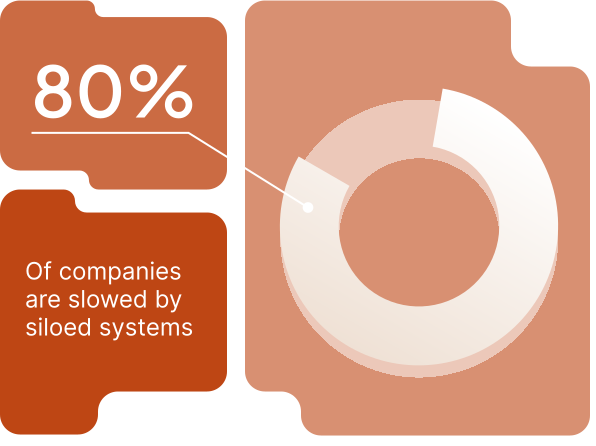
Unified commerce replaces a stack of disconnected tools with a single platform and a unified data model, creating a unified commerce solution for your entire business.
Instead of running separate order management systems and trying to stitch them together later, you manage customers, pricing, catalogs, quotes, orders, and approvals in one place, while inventory and fulfillment data stays connected to the systems that own it. Order workflows support every buying motion, including portals, inside sales, field reps, and eProcurement, without forcing teams into separate tools.
And it’s more than “integration.” Integration is essential in B2B. The risk shows up when every new requirement becomes another point solution plus another sync path. Over time, middleware turns into a web of dependencies: pricing logic lives in multiple places, availability gets interpreted differently by channel, and small changes require coordinated updates across systems.
That’s where scalability starts to crack and technical debt shows up fast, especially when you add regions, business units, or new customer portals. A unified commerce strategy keeps core data, business logic, and workflows centralized, so integrations extend a shared foundation instead of multiplying sources of truth.
Unified commerce vs omnichannel vs multichannel
| Approach | Channel Connection | Back-End Systems | Data Sync |
| Multichannel | Separate | Separate | Manual or none |
| Omnichannel | Connected front-ends | Often fragmented backends | Periodic/batch updates |
| Unified | Fully integrated | Single platform | Real-time |
Omnichannel commerce connects your eCommerce site to brick-and-mortar stores and retail operations, but the backends often still don’t talk. That causes duplication and slow updates.
Multichannel means simply selling in more than one place, but all customer-facing channels operate independently. Customers and internal teams often get inconsistent experiences, limited order visibility, and delayed updates.
With a unified commerce approach, every channel runs on the same customer and order foundation. In-store staff see the same product availability and customer history as your online team. Teams spend less time reconciling and more time executing.
Why unified commerce is becoming a necessity
Scaling on a fragmented stack has become financially unsustainable. For industrial leaders growing through acquisition or regional expansion, disconnected systems act as a tax on momentum and operational efficiency. Each new business unit brings incompatible ERPs and standalone commerce tools, pushing IT to spend innovation budget on keeping customer rules consistent and order flows reliable across channels.
The operational failure happens when the integration layer has to compensate for this mess. stops being a data pipeline and turns into a place where business rules get recreated to make systems agree. Pricing rules get duplicated. Availability gets interpreted differently depending on which system you ask, and when. That’s how data drift shows up.
Then the cost hits. Bad orders get created. People fix them by hand. Credits and rebills follow. Service has to explain contradictions they didn’t cause.
Unified commerce corrects this by centralizing execution logic and unlocking three specific operational advantages:
- Every channel validates orders against the same engine, ensuring the web portal and sales rep quote identical contract terms.
- Integrations extend a single foundation rather than duplicating it, returning middleware to the role of moving data rather than managing rules.
- New regions or acquisitions launch via a global template, preventing every rollout from turning into a custom integration project.
How Unified Commerce Works Under The Hood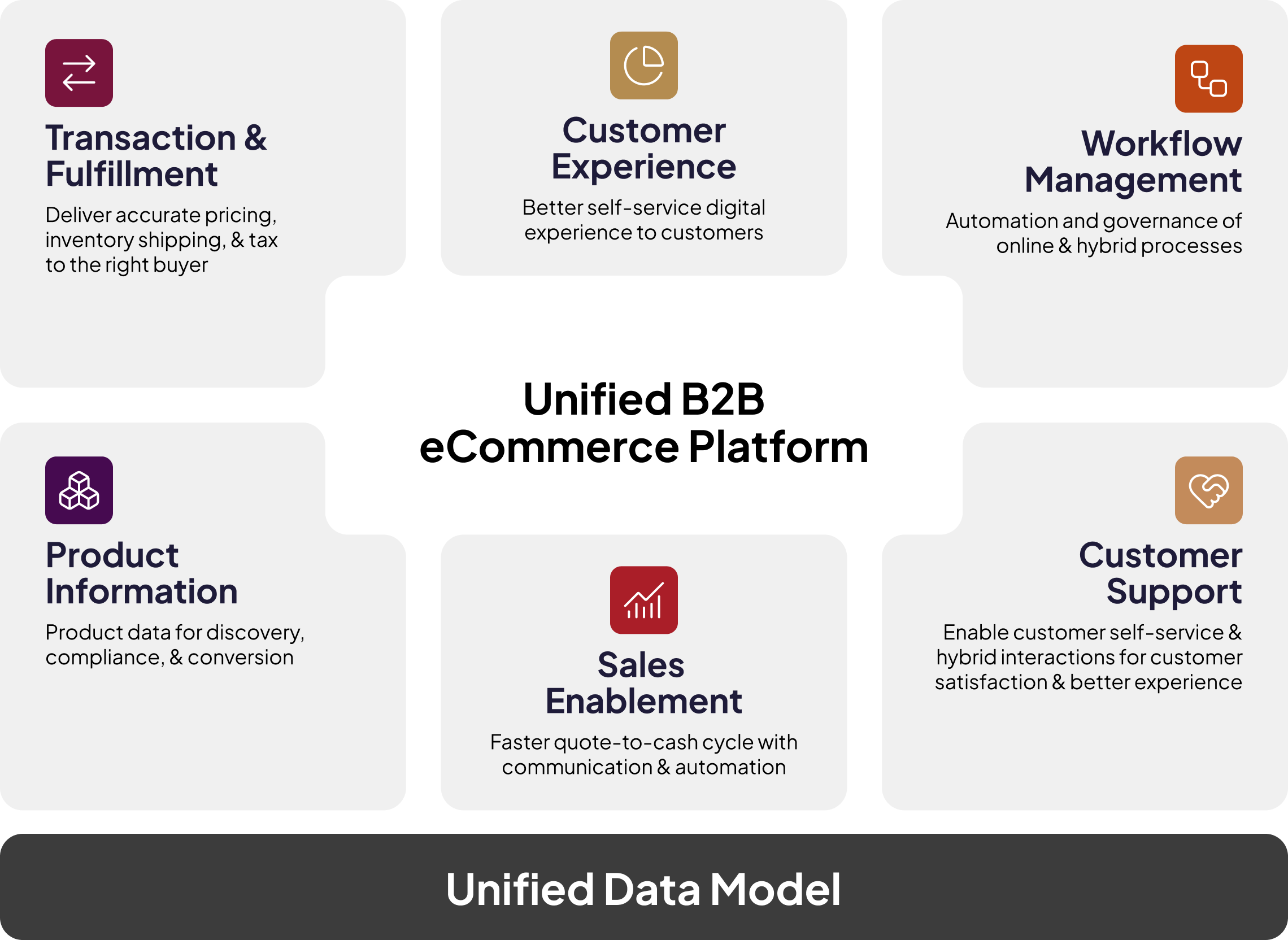
A unified approach is built on a simple idea: a shared foundation for data and operations, so every channel (online or sales-assisted) runs on the same real-time source of truth. Here’s what makes this all possible.
| Component | Description | Business Impact |
| Unified data model | Centralizes the objects that create and control orders: company accounts, hierarchies, roles, quotes, orders, and related workflows. | Removes data silos, reduces tool sprawl, and gives every team the same visibility. |
| Centralized business logic | Executes pricing rules, approval workflows, and shipping constraints from one engine, rather than replicating them in middleware. | Fewer pricing disputes and fewer manual exceptions; policy changes roll out without a multi-system scramble. |
| Connected availability | Aggregates stock levels across multiple warehouses and ERPs to provide a single “Available to Promise” count. | Prevents overselling/backorders, improves fulfillment accuracy, and builds customer trust. |
| Native quote-to-cash workflow | Manages the full lifecycle, from RFQ negotiation to invoice payment, without handing off data between disparate tools. | Validates every transaction against live contract terms, ensuring the final invoice matches the quoted price. |
| Order status synchronization | Accept payments and get consistent order updates from purchase to delivery and returns. | Fewer support issues and clearer updates for customers and teams. |
| API-driven extensibility | APIs make it easier to add new channels or integrations without rebuilding core systems. | Faster innovation, easier scaling, and lower long-term tech risk. |
When these pieces work together, unified commerce strengthens business operations and enables consistent account experiences, faster execution, and informed decisions across the entire business.
Get Free Report: Unifying Commerce in a Multi-System World
Business Benefits Of Unified Commerce Across Teams
When your tools, teams, and data all work together in one place, everything gets easier, and customer analytics become more accurate.
You can sell faster, avoid the extra costs of disconnected systems, and have updates automatically reflected.
Improve sales performance without making it harder to buy
- More portal adoption: When pricing and availability match what buyers get offline, more orders stay self-service and fewer calls hit reps.
- Faster repeat orders: Saved lists and reorders help buyers purchase again without rebuilding an order from scratch.
- Higher AOV: Relevant recommendations and add-ons based on buying patterns help customers add what they actually need.
- Better assisted selling: Reps can create the draft order and send it to the buyer to review and approve in the portal, which speeds up order turnaround and reduces order entry mistakes.
Simplify operations and save money
- Less tech overhead: Fewer systems to connect, maintain, and fix across teams.
- Less manual work: Data syncs automatically without spreadsheets or manual data entry.
- Launch new channels faster: Add new sales channels without rebuilding everything from scratch.
- More efficient day-to-day work: AI tools can help improve inventory planning, pricing, and customer support.
Make better decisions with a clear view of what’s going on
- Real-time reporting: Track performance across channels, accounts, reps, and locations.
- Better forecasting: Shared order and customer activity improves demand planning and inventory allocation.
- Clearer insights: See where issues start (e.g., pricing mismatches, fulfillment constraints, account holds) and fix the source.
Having a unified commerce solution means building a better business from the ground up, with consistent experiences and real-time operational control across every single channel.
Unified Commerce And The Modern B2B Customer Experience
Unified commerce brings B2B buyers a consistent, seamless shopping experience at every touchpoint. With inventory, pricing, and customer data in one place, buyers don’t get stuck in broken handoffs between channels, whether they buy online, work with a rep, or place orders through an eProcurement system.
It also helps your support team because they can see the full customer history and respond faster with more context.
Enabling the “Hybrid” transaction
B2B buyers move between self-serve portals, mobile experiences, call centers, inside sales, field reps, and on-site visits throughout a single buying journey. A unified eCommerce platform keeps all of those interactions connected in real time.
A buyer can start an order online and finish it with a rep without losing cart details, pricing, or shipping preferences along the way.
Personalization powered by unified customer data
B2B customers expect experiences that match their contract pricing, buying rules, purchase history, and account structure. Unified commerce makes this possible by keeping customer profiles accurate and up to date everywhere.
Key personalization capabilities include:
- Custom pricing by account, location, or buying group
- Catalogs that show the right products for each buyer
- Approval rules tied to roles and spend thresholds
- Recommendations based on reorder patterns, customer behavior, and account purchase history.
It only works when one system owns the commerce rules and orchestrates how customer and order information moves across channels.
Adoption built on trust and consistency
Unified commerce takes the key step by delivering accurate availability, consistent pricing, and real-time order updates across the entire customer journey. If something goes wrong, service teams can pull up the full customer record instantly and fix issues faster.
And when buyers can reorder, track shipments, check stock, and manage purchases on their own, adoption of your digital buying channel increases because the work stays in one place. This consistency is essential to build customer loyalty over the long term.
How to Implement Unified Commerce Successfully
Implementing unified commerce requires consolidating systems on the right foundation across tools, data, and teams, and it needs to be treated as a business strategy. These steps help you roll it out in a practical way without disrupting day-to-day operations.
1) Check if you’re ready before you build anything
Start with an honest look at what you have today. Conduct a comprehensive assessment of your current sales channels, systems, and workflows, so you know what’s working, what’s impacting your operational efficiency, and what needs to change before you roll out unified commerce.
That includes your digital channels (a customer portal, eProcurement, etc.), inside sales process, field reps, and customer service operations.
2) Fix the tech gaps in your stack
Older systems can slow you down, especially if they don’t support modern APIs. Decide early whether your current ERP, WMS, CRM systems, or eCommerce tools can be modernized and integrated, or whether you need to replace the systems that keep data trapped in silos.
3) Clean up your data first
Unified commerce only works if your data is reliable. Clean up product data, standardize units and packaging details, remove duplicate customer accounts, and make sure you can manage inventory information accurately before you migrate or connect systems.
4) Align your teams around one shared goal
Unified commerce is a teamwork project. Sales, customer service, IT, and operations need to agree on how data flows, who owns what, and how customer and order activity moves across channels.
Without alignment, teams end up rebuilding the same silos inside a “new” platform.
5) Integrate the core systems first (ERP + inventory)
Start by connecting your ERP and inventory/WMS systems so availability, order status, and customer terms stay accurate everywhere. It prevents overselling, reduces disputes, improves fulfillment accuracy, and gives every team the same real-time view.
Learn more about mastering eCommerce ERP integration.
6) Roll it out in phases (don’t do everything at once)
Launch unified commerce for one workflow, customer segment, region, or channel at a time. Test, fix issues, train people, then expand.
It lowers risk and keeps your business running during the switch.
7) Train your staff and support the change
Give reps, customer service teams, and operations staff real training. Show them how unified data helps them quote faster, answer order questions instantly, solve issues with context, and keep customers moving without delays.
8) Update metrics so the new model actually sticks
Make sure you’re rewarding the right behavior. Track shared success across channels and teams, not channel vs. channel competition. When goals align, teams work together instead of protecting their own numbers.
Unified Commerce For Multi-Entity Enterprises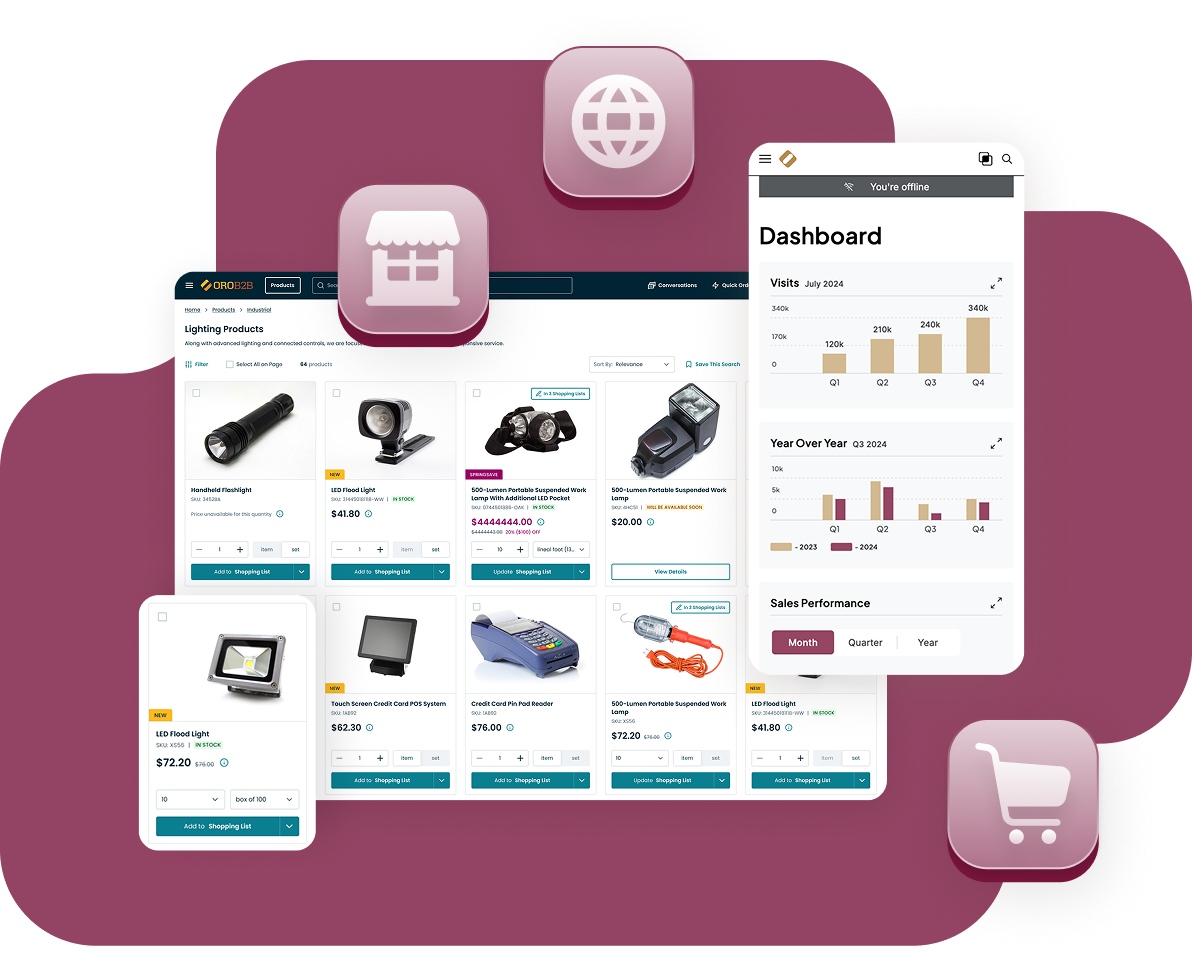
Large wholesale, manufacturing, and distribution organizations typically operate across multiple regions, business units, warehouses, customer segments, and selling motions. Unified commerce helps bring these channels and customer touchpoints together so teams can stay aligned and deliver consistent experiences at scale.
Manage enterprise complexity across catalogs, pricing, and accounts
- Hybrid business models: Support B2B, direct-to-consumer (DTC), dealer networks, and partner-driven selling from a single platform.
- Multi-brand and multi-region operations: Manage different portals, rules, currencies, languages, and fulfillment logic without running separate systems.
- Post-M&A complexity: Reduce tool sprawl and fix fragmented customer, product, and pricing data after acquisitions.
- Contract pricing and approvals: Support negotiated pricing, account hierarchies, buyer roles, and approval workflows without manual workarounds.
Enable consistent, high-touch experiences across every channel
- Service consistency: Customers expect the same experience through a portal, a rep, or customer service.
- Omnichannel clienteling: Teams can recognize customers, understand account context, and continue the relationship across channels.
- Personalized pricing and catalogs: Each account sees the right products, availability, and pricing based on their contract terms and buying behavior.
Support sales reps, distributors, and direct customers
- Assisted selling: Reps can build quotes and orders with real-time inventory, customer-specific pricing, and accurate delivery expectations.
- Self-service portals: Customers can reorder, track shipments, manage invoices, and update account details without calling support.
- Partner-friendly workflows: Distributors, dealers, or resellers can place orders and access the right catalogs and pricing based on their relationship and permissions.
Once you understand the model, the next step is choosing a platform that can support it.
Your Guide to B2B2X: Mapping the Complexity of Modern B2B Selling
Why OroCommerce Is The Best Platform For Unified Commerce in B2B
Unified commerce breaks down when “unified” is limited to a storefront and the rules live somewhere else. OroCommerce is designed to centralize the work that creates orders in B2B, so self-service and sales-assisted flows operate on the same foundation.
ERP and warehouse systems still play their role, but they connect into a commerce layer that can enforce consistent terms and policies across channels.
OroCommerce’s unified commerce architecture
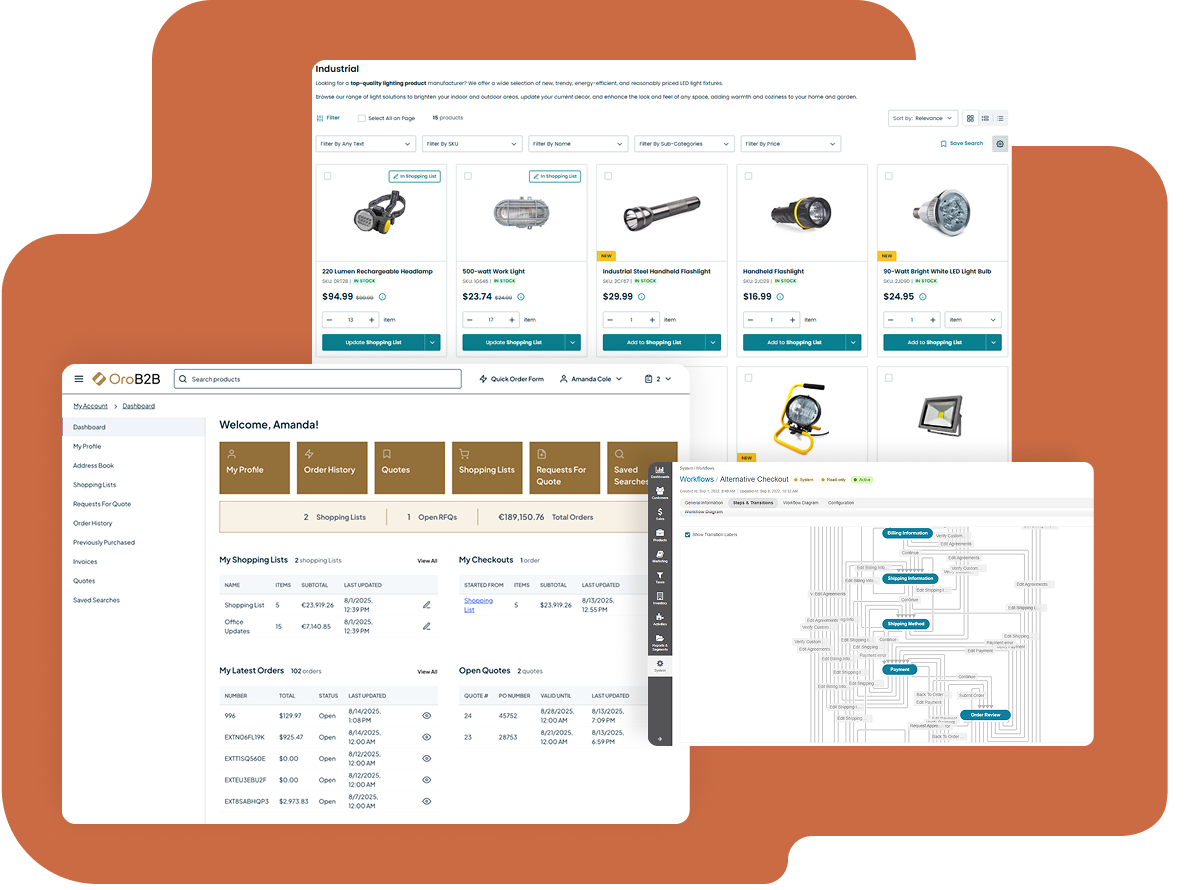
OroCommerce is built around B2B fundamentals: companies as customers, hierarchies, roles, approvals, and contract pricing. That data model is the core. The workflows that create orders share the same foundation and product.
Quotes, orders, case management, invoicing, and payments share the same account context, so teams aren’t stitching together separate products just to support everyday B2B operations.
That architecture matters because it reduces the need to assemble a platform from separate products. Fewer handoffs mean fewer places where rules get duplicated and drift over time.
Compared to assembled suites that look unified on the surface but behave like a collection of acquired modules, this keeps the total cost of ownership lower and makes innovation less fragile.
Native AI extends the same workflows without adding another tool that needs its own integration plan.
Built to Scale Complex B2B and B2B2X Models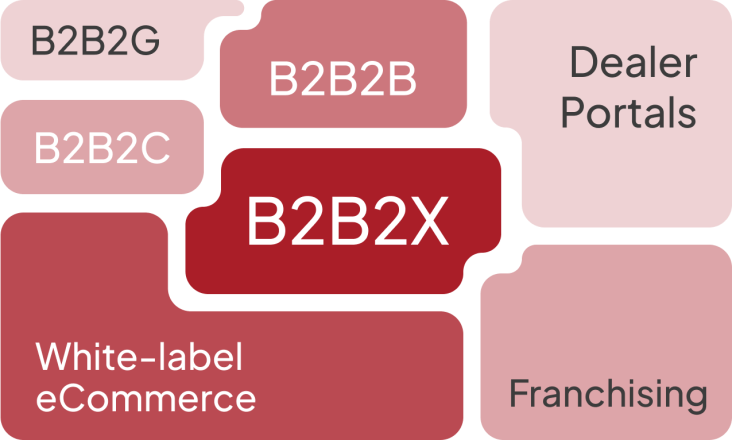
That shared foundation powered by a unified commerce approach is what makes complex B2B models scalable. Multi-site and multi-organization are built in, so one instance can run many portals and business units without cloning rules.
In B2B2X scenarios, the platform can represent each relationship as its own buying context: who the dealer is, which selling entity they buy from, what they’re allowed to see, and which terms apply. That’s what keeps catalogs, pricing, and permissions accurate as partner programs expand across markets.
It holds up under enterprise pressure. Azelis runs 140+ portals on a single OroCommerce instance. Another enterprise manufacturer runs one instance fed by 12 ERPs after acquisitions.
In environments like these, stitched stacks tend to multiply admin overhead, and rule drift with each rollout; OroCommerce keeps the foundation consistent as portals and back-office variation expand.
Ready to align every buyer and team interaction on one platform?
The Future Of Unified Commerce
Unified commerce is heading toward a simple outcome: orders get created correctly the first time, no matter who starts them. The platform becomes the place where account terms live, and order rules are enforced, so you don’t spend your day untangling mismatched versions of truth.
AI is one reason this matters now. If your stack is fragmented, AI ends up learning from copies and contradictions. It produces confident answers that don’t match contracts, inventory signals, or what the service sees. That’s how “AI on top” turns into a Frankenstack that creates more exceptions than it removes.
On a unified foundation, AI can take on the work that burns time without undermining trust. AI SmartOrder can create a draft order from a messy PO and flag missing fields or term conflicts before submission. AI SmartAgent can provide buyer support using the correct account context, so the answers match what the business will honor.
The future goal is architectural confidence as new tech keeps changing. A consolidated, governed commerce core lets you adopt what’s next without weakening or rebuilding the foundation.
Why unified commerce is the foundation of operational freedom in B2B
B2B operations need the flexibility only unified systems can really offer. Integrated data and streamlined workflows create the foundation modern wholesale, manufacturing, and distribution teams rely on.
Resilience in uncertain markets comes from having accurate data all in one place. When supply chains shift or customer needs change, you can adjust fast without sending endless emails or working with spreadsheets.
Channel-agnostic growth lets you add new sales methods (rep-assisted, self-serve portal, marketplaces, partners) without rebuilding your infrastructure every time.
Your unified platform supports it all from the same backend. Keep pricing, inventory, and customer rules aligned across branches, regions, and business units.
Continuous experience optimization happens when every single interaction feeds your central system. You spot friction points faster and test improvements across all channels at once.
Conclusion: Unified Commerce As A Strategic Advantage
Today, B2B buyers expect consistent pricing, accurate availability, and account-specific experiences. When your systems stay disconnected, gaps appear, and those blockages cost sales.
A unified commerce platform connects all your sales channels, customer data, and back-end systems into one platform. It drives growth while reducing the complexity that slows teams down.
OroCommerce delivers unified commerce built for complex wholesale, manufacturing, and distribution operations, including B2B, B2B2X, and hybrid selling models. It consolidates commerce workflows while staying flexible enough to match how your business actually sells.
What sets OroCommerce apart:
- Native B2B capabilities reduce middleware and manual work
- Enterprise-grade features for high-volume ordering, contract pricing, and complex account structures
- Scalable architecture grows without constant platform changes
See how OroCommerce can support your long-term growth and modern customer experience goals.
Frequently Asked Questions About Unified Commerce
What is unified commerce in B2B?
Unified commerce in B2B means tying together all your sales channels, customer data, pricing rules, inventory management, and backend systems into a single platform
Your buyers can order in whatever way works for them, and you always know what’s in stock, what it costs, and what’s happening with the order.
What is a unified commerce platform?
A unified commerce platform centralizes key B2B commerce operations, like product data, orders, customer accounts, pricing, and inventory, into one system.
Instead of managing separate tools and manually syncing data, your teams work from one real-time source of truth, where updates happen once and apply everywhere.
What is the best unified commerce platform for manufacturers, distributors and wholesalers?
OroCommerce stands out as a unified system for B2B companies. You get features built for account-specific pricing, quoting, buyer permissions, approvals, and customer-specific catalogs.
Manufacturing, distribution, or wholesale businesses need more than what generic retail platforms offer, and OroCommerce fulfils this need successfully.
How to implement unified commerce?
Start by auditing your current systems and mapping where disconnected systems create rework across channels, pricing, and inventory. Then connect ERP and inventory management first, standardize product and customer data, and roll out in phases, so you can improve financial reporting and make faster informed decisions.
What is the difference between unified commerce and omnichannel?
Omnichannel commerce gives buyers multiple ways to place orders, but it often relies on separate systems that only sync occasionally. Unified commerce ties everything together through one platform, so pricing, availability, and order status stay consistent online and in-store, meeting customer expectations.
What are the 4 types of eCommerce?
There are four main types:
- B2B (business-to-business)
- B2C (business-to-consumer)
- C2C (consumer-to-consumer)
- C2B (consumer-to-business).
Each accommodates specific consumer behavior and transaction styles, from complex invoices to simple online payments.