navigation

Today, most B2B companies are drowning in tech: another tool, another integration, and now AI adding even more pressure. Being absolutely in love with the complexity of enterprise B2B, we’ve been on a mission to make it manageable since the launch of OroCommerce in 2017.
And together with our customers we’ve been evolving. OroCommerce today is not just an online catalog, it’s the core engagement layer for your customers, sales, accounting, and service teams, connecting inventory, invoicing, orders, quotes, and returns into one coherent flow. When this layer is solid, everything else gets easier, including AI.
AI stops being yet another problem to solve, it augments and improves what already works. But that only happens when the foundation is clean, connected, and built for how your business actually runs.
That’s why our 7.0 release focuses on these three core pillars:
- Enterprise strength to support real scale
- A unified platform that brings quote-to-cash into one flow
- AI tools and infrastructure that set you up for what’s next
Let’s dive in.
See how all the new features and upgrades work inside the platform
Enterprise Control at Scale
Controls and infrastructure for organizations that won’t tolerate workarounds.
Identity & Access Provisioning
Manually adding and removing user accounts is slow, frustrating, and risky. HR and IT teams spend too much time managing access, while leadership worries about security gaps and compliance. OroCommerce now makes this faster and safer with built‑in integrations for enterprise identity management.
- OpenID Connect (OIDC) support – Connect your OroCommerce instance with identity providers like Okta and Microsoft Entra (Azure AD) for secure single sign‑on (SSO). (documentation)
- SCIM integration – Automate user creation, updates, and removals directly from your company’s identity system. (documentation)
- SSO‑only enforcement – Require authentication exclusively through trusted identity providers for specific domains or user groups. (documentation)
The result is simpler, safer identity management, less manual work, fewer errors, and peace of mind for everyone who manages or accesses your system.
Enterprise-Grade Commerce Efficiency
Managing commerce operations across regions can be demanding. Prices must stay accurate as exchange rates change, complex catalogs need precise data mapping, and large organizations must handle high volumes of orders and configurations efficiently. These improvements make it easier to maintain data accuracy, reduce routine work, and improve performance at scale.
- Multi‑Currency Price Rules – Use system exchange rates directly in pricing formulas so price lists adjust automatically as currency rates change across global markets.
(documentation) - Advanced Product Import – Import products with category matching by ID or by full category path, improving catalog accuracy in complex product hierarchies.
(documentation) - External Order Import – Import historical or ERP‑generated orders in JSON format, giving buyers a unified order history while retaining legacy data integrity. (documentation)
- Advanced API Search – New filters enable more flexible and precise search in the Back Office API, bringing it closer to UI level search and unlocking powerful integrations.
- Organization Selector Upgrade – A new lazy‑loading, auto‑complete selector improves usability and performance in large multi‑organization environments (10+ orgs).
These capabilities give enterprise organizations the tools to manage their scale and complexity with greater consistency and less manual effort.
Platform Architecture and Security Enhancements
Modern enterprise commerce demands a platform that scales without compromising security, speed, or architectural integrity. This release upgrades OroCommerce’s core framework, strengthens security, and improves site performance for both developers and users.
- Symfony 7 Support – Upgrading to the latest Symfony version improves performance, modernizes the codebase, and unlocks new capabilities for developers.
- Security Hardening – Adds Subresource Integrity (SRI) support to ensure JavaScript and CSS files have not been tampered with, reducing risks tied to CDNs and third party assets.
- Asset Preloading – Lets developers preload key frontend assets to speed up page rendering, improve SEO performance, and make the storefront feel faster.
- Controlled Guest Access – Administrators can expose specific storefront pages to guest users without custom work, giving tighter control over public content.
Together, these updates give enterprises a faster, more secure, and scalable platform foundation for long‑term growth.
See how all the new features and upgrades work inside the platform
One Platform, Unified Experience
From first interaction to final payment without duct tape.
Unified Payments and Invoicing
For B2B organizations, moving from quote to payment can be complex when data and payments live in different systems. OroCommerce closes that gap, centralizing payments and invoicing for faster, more reliable financial operations.
- OroPay Integration – A native B2B payment solution built with Global Payments, supporting Level 2/Level 3 credit cards and ACH transactions with enterprise‑grade compliance (documentation).
- Customer Invoicing Portal – Buyers can view, track, and pay invoices directly from the storefront using OroPay or Stripe Elements, simplifying post‑purchase payments (documentation).
- Back‑Office Invoice Management – Sales and finance teams can manage the entire invoicing lifecycle inside OroCommerce, with API integrations available for ERP synchronization (documentation).
- Invoice APIs and Payment Flexibility – Expanded invoice APIs support custom payment statuses and external payment links, making ERP integration tighter and giving teams more control over complex payment flows.
Together, these updates bring the entire quote‑to‑cash process into OroCommerce, reducing system complexity and giving both buyers and businesses faster, more transparent financial operations.
Buyer‑Seller Collaboration Enhancements
In high-touch B2B sales, visibility and coordination between buyers and sales teams are essential. The 7.0 release expands OroCommerce’s quoting tools to make negotiations smoother, tracking clearer, and collaboration easier for both sides of the process.
- Linked RFQs and Quotes – Improved navigation connects requests for quotes (RFQs) and finalized quotes, giving buyers and sales teams greater visibility throughout negotiations.
- Project Name Tracking – A new “Project Name” field helps organize RFQs and quotes by initiative. It’s especially useful for B2B buyers such as contractors who build bill‑of‑materials (BOMs) for specific projects, making it simpler to group, search, and manage related quotes. (documentation)
- Customer‑Facing Attachments – Sales teams can attach contracts and spec sheets directly to quotes or orders, with buyers able to access them from the storefront.
- Back‑Office Quote API – External systems like CRMs or field sales tools can create and manage quotes through a new API, streamlining the quoting process across integrated sales workflows. (API sandbox)
These capabilities give sales and account teams better visibility, simpler collaboration, and stronger integration with buyer workflows, from the initial RFQ to the final approved quote.
Enhanced B2B Buyer Experience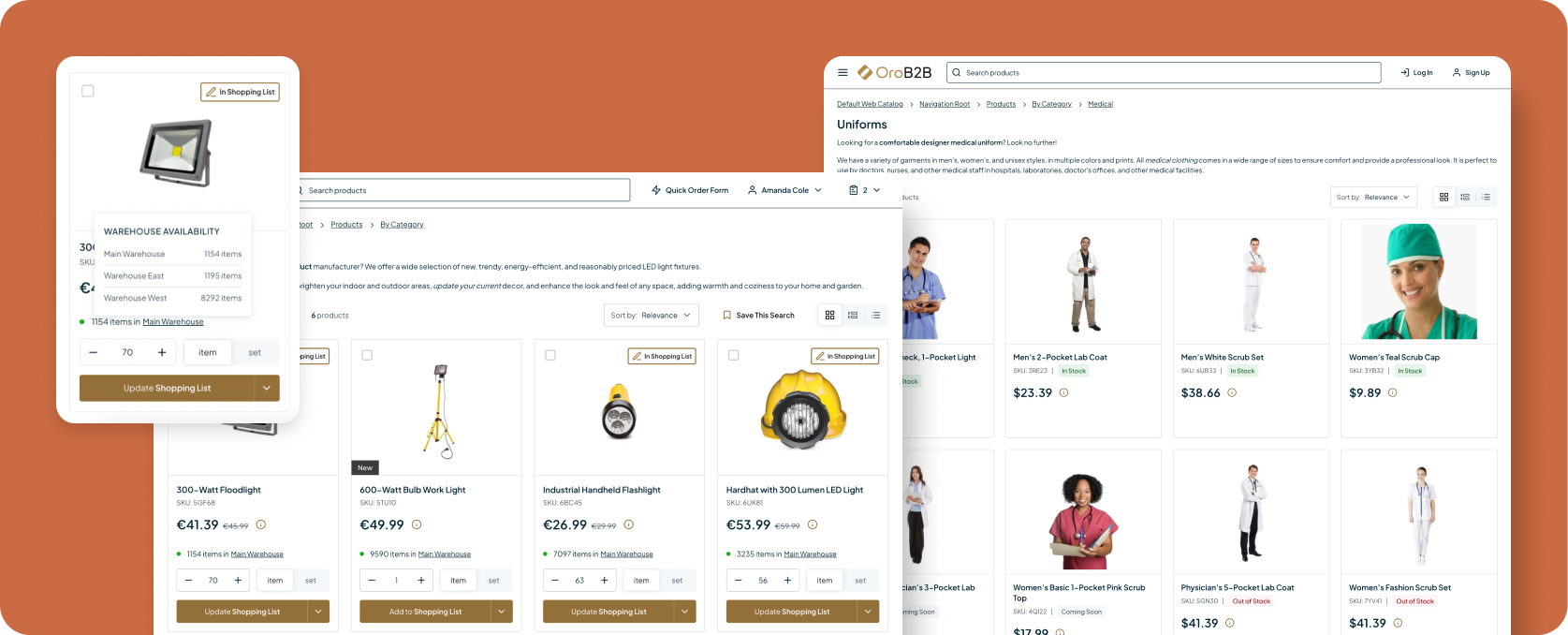
B2B buyers manage complex order cycles, recurring procurement schedules, and multi‑level approval processes that go far beyond retail shopping. This release reinforces OroCommerce’s commitment to B2B excellence, strengthening the storefront with tools that enhance control, transparency, and efficiency for professional buyers and procurement teams.
- Recurring Orders – Buyers can now automate repeat purchases directly from past orders. Each recurring order can have its own frequency, start and end dates, and active status (pause, resume, or cancel). The storefront provides full visibility into scheduling and history for hands‑off replenishment (documentation).
- Inventory Visibility – Real‑time inventory levels are displayed across product pages, search results, and checkout. Data updates automatically and can include per‑location stock, low‑stock alerts, and lead‑time messages to support accurate planning (documentation).
- Inventory Validation & Save for Later – If an item becomes unavailable, the storefront automatically flags the line item before the checkout and moves it to a “Save for Later” section on the shopping list. Buyers can re‑order those products once stock returns, keeping their planning intact without blocking current checkouts.
(documentation). - Selective Guest Access – Administrators can configure which storefront pages remain publicly accessible, such as marketing pages, landing pages, or informational content, while keeping product data, pricing, and customer‑specific content private to authenticated users (documentation).
- Order PDF Access – Buyers can download fully formatted PDF versions of their orders directly from the storefront or receive them automatically as attachments in confirmation emails. Layouts follow the company’s branding and can include custom metadata fields or document templates (documentation).
- Dashboard Scorecards – A new buyer dashboard widget displays key activity summaries, open RFQs, existing shopping lists, and total orders, helping procurement teams track engagement and manage purchasing goals in one view (documentation).
These enhancements make OroCommerce’s storefront a true B2B command center, enabling buyers to plan, order, and manage purchases at enterprise scale with precision and confidence.
AI for Today and Tomorrow
Tools you can use now, and the infrastructure to build on for what’s next.
AI Infrastructure and Governance
As AI becomes central to B2B innovation, organizations need both flexibility to experiment and controls to ensure reliability and security. OroCommerce introduces a dedicated AI infrastructure layer that connects external AI tools while maintaining full governance over how AI interacts with business data.
- AI Integration Layer with MCP Server Support – Establishes a unified, secure architecture for integrating external AI services, including custom or third‑party large language models (LLMs). Partners and customers can safely experiment with their own AI workflows using OroCommerce data and APIs.
- Langfuse Prompt Management – Centralized prompt management lets teams version, test, and update AI prompts used across OroCommerce’s suite of Smart tools, ensuring consistency and traceability.
- Resilient Prompt Fallback Mechanism – If the prompt‑management service becomes unavailable, OroCommerce automatically falls back to cached or code‑based prompts to keep AI features running without interruption.
- Gemini Model Adoption – OroCommerce’s built‑in AI features are transitioning to the Google Gemini model family, delivering faster response times and improved accuracy across all supported AI‑powered experiences.
These updates give B2B enterprises a secure, controlled environment for AI innovation, enabling experimentation without compromising governance or data integrity.
Ready‑to‑Use AI for B2B Teams
OroCommerce’s AI philosophy is simple: less sci‑fi, more ROI. These capabilities focus on practical improvements that fit naturally into everyday B2B workflows: improving order handling, data access, and decision‑making where it matters most.
- SmartOrder Improvements – Smart Order now recognizes Customer Product Numbers (CPNs) in uploaded purchase orders, mapping customer‑specific identifiers to internal SKUs. AI‑powered recognition has also been enhanced for greater accuracy when extracting products and quantities from both digital and scanned POs.
- SmartInsights – An AI‑driven analytics co‑pilot that allows users to explore business data in plain English, generating charts, tables, and KPIs in seconds. It respects existing roles and permissions, keeping analytics aligned with corporate data governance.
- SmartAssistant – Smart Assistant is an AI co-pilot that handles routine work and completes tasks on demand like creating sales orders, quotes, or shopping lists, or acting on insights (e.g. finding buyers who haven’t ordered in six months and adding them to a new segment). By automating multi-step processes in OroCommerce, it reduces manual effort, lowers errors, and speeds up key flows such as quote-to-order.
- OroIQ – The new backoffice AI orchestrator and conversational interface for your sales and service teams connecting all backoffice AI‑powered tools in OroCommerce. OroIQ lets users query data, execute tasks, and access features like SmartAssistant and SmartInsights through a single natural‑language console.
These tools bring usable, reliable AI capabilities directly into daily B2B workflows, improving accuracy, insight, and efficiency without the need to expose your proprietary data to 3rd parties via custom integrations.
Where B2B Commerce Goes From Here
OroCommerce 7.0 is the culmination of our dedication to, and genuine love for, the complexity of enterprise B2B.
We are giving you the operational freedom and control needed to run at scale, the efficiency of a truly unified commerce layer, and a clear, confident path forward with practical AI tools and reliable infrastructure.
Already on OroCommerce? Talk to your integration partner about upgrading to 7.0 and unlocking these capabilities.
New to OroCommerce? Share your use cases, and discover how OroCommerce fits the way you operate.