navigation

Extracting real value from AI adoption in the enterprise takes more than a bigger budget.
AI adoption in the enterprise means moving artificial intelligence out of isolated pilots and into daily use across core business functions. Getting there is proving extraordinarily difficult for most companies.
Thirty-seven billion dollars flooded into the market last year, the fastest software category expansion in history. The pressure on business leaders to deploy is immense, and on the surface, it looks like everyone is succeeding.
Yet when the CFO asks for the financial payoff, the room goes quiet.
Our latest survey results reveal a stark divide in how AI deployments in manufacturing and distribution are performing. Only 17% report achieving a significant return on investment. Nearly half (48%) say the technology is “somewhat effective,” with positive dashboard movement but no transformational value, and 15% report no expected value.
The lack of immediate ROI isn’t a failure of vision or effort. B2B commerce is incredibly complex, and finding the right path forward requires a different playbook than what the broader market is selling. If you’d rather talk it through, book a demo with our team for a straight answer on what’s realistic for your architecture.
This article is for B2B leaders who rolled out generative AI over the past year and still can’t show the CFO a return. It covers adoption maturity, the barriers stalling AI initiatives, the playbook high performers follow, and the governance work most companies skip.
Where Enterprise AI Adoption Stands Today
Enterprise AI adoption looks contradictory because you’re measuring two different numbers at once. Many enterprises point to McKinsey, the global management consulting firm, which reports that 88% of enterprises now use some form of generative AI. MIT, the Massachusetts Institute of Technology, found 95% of pilots deliver zero P&L impact in a study of 300 deployments.
Those figures aren’t in conflict. The 88% measures who touched generative AI anywhere, even a single pilot.
The 95% measures who has AI running in production at scale, generating repeatable results. Most companies clear the first bar and never reach the second.
B2B commerce operates on a different kind of complexity than other industries. Large enterprises can’t just buy an algorithm to handle negotiated contracts, custom pricing logic, and sprawling supply chain management. Scaling AI systems across business units requires deep integration, not a plugin.
Four stages of AI maturity in B2B
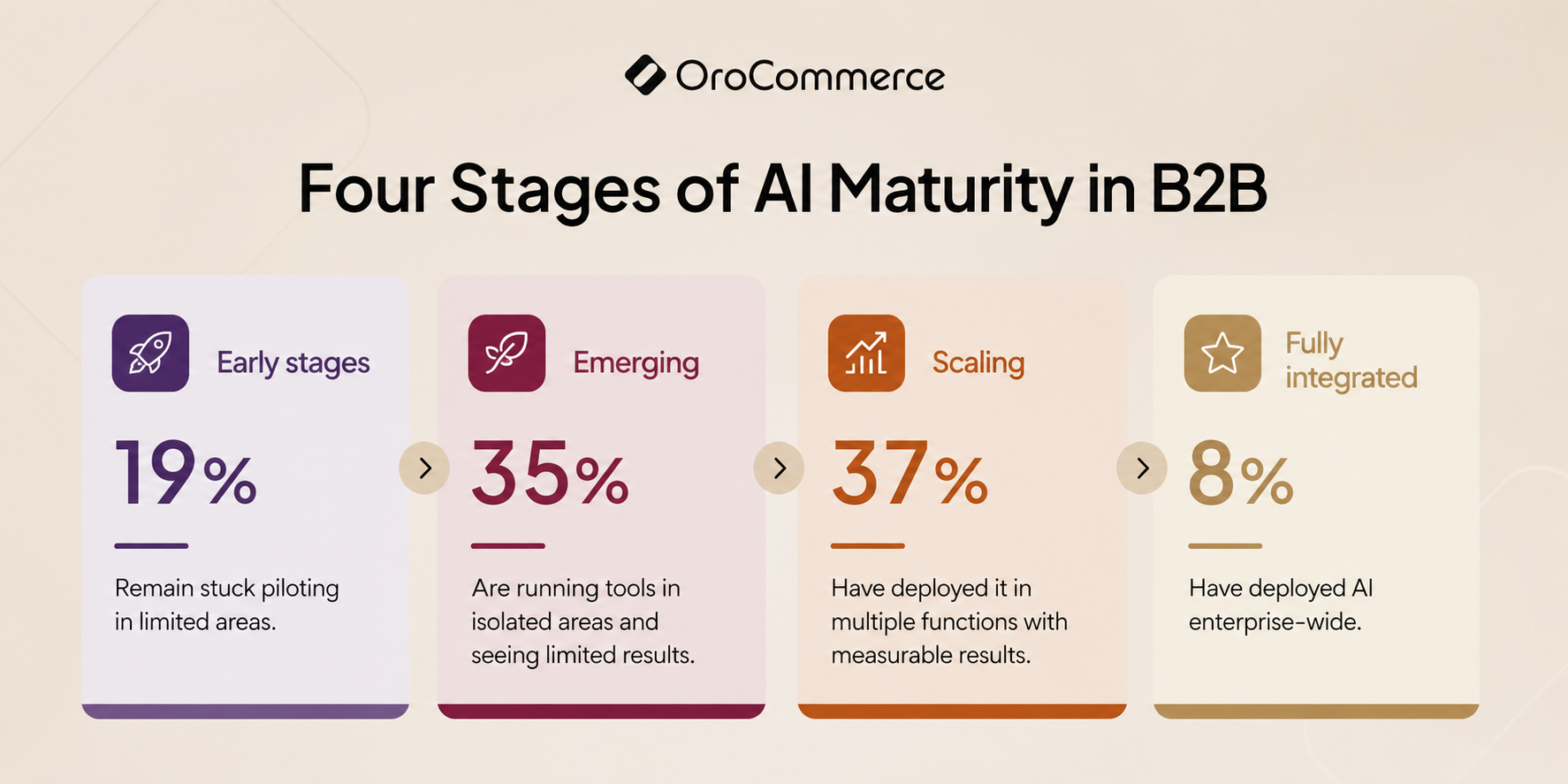
Mapping B2B commerce maturity makes the reality of scaling AI clear. Our AI report benchmark reveals four distinct stages of adoption:
- Fully integrated: Only 8% have deployed AI enterprise-wide.
- Scaling: 37% have deployed it in multiple functions with measurable results.
- Emerging: 35% run tools in isolated areas and see limited results.
- Early stages: 19% remain stuck piloting in limited areas.
This aligns closely with macroeconomic data from BCG (Boston Consulting Group), showing a massive “emerging” bucket of companies experimenting and a tiny elite building future-proof infrastructure.
The gap is widening. Leaders capturing value compound their competitive advantage, while two-thirds of the market stays caught in the middle. To understand why initiatives stall there, you have to look at what “adoption” is actually measuring.
The AI Ecosystem: What “Adoption” Actually Means in B2B Commerce
“AI adoption” isn’t one thing. B2B commerce spans several domains and different types of AI solutions, and confusing them is why buy-versus-build talks go in circles.
AI-augmented tools are features bolted onto software you already run. AI-first tools are standalone products built around one capability. Agentic tools are autonomous systems that complete multi-step tasks end to end.
| Category | What it looks like in B2B commerce | Example use case |
| AI-augmented | Capabilities added to an existing ERP, CRM, or commerce platform | An order-intake tool that reads emailed PDFs and drafts orders |
| AI-first | A standalone AI product purchased separately and integrated in | A dedicated pricing-intelligence tool that ingests your data via API |
| Agentic | Autonomous agents that plan and execute a task with little oversight | An agent that negotiates reorder quantities with a supplier’s system |
Each category carries a different integration cost, which sets up the buy-versus-build decision covered later. Many enterprises track adoption as a single number. It actually spans many types of usage: how many people use a tool, how deeply, and which departments haven’t touched it at all.
Measuring AI Maturity: Beyond the Four-Stage Model
The four-stage model above measures how widely companies deploy AI, not how deeply people use it, and that gap is where most ROI quietly disappears.
Picture two “scaling” companies. One has reps opening their AI tool daily because it saves real time.
The other trained everyone once, saw usage spike, then watched it drop off. Both count as “scaling” in a breadth survey. Only one extracts value.
Company-wide averages also hide huge variance between departments. Finance might show deep, daily usage, ops might sit somewhere in the middle, and sales, the group facing the resistance barriers below, has barely opened the tool.
Integrating AI into existing workflows, not just switching it on, is what real AI integration across your AI ecosystems actually requires.
If you’re not sure where your own departments land on that breadth-versus-depth picture, a quick demo is the fastest way to find out.
What Stops AI Initiatives from Scaling
When AI initiatives fail to deliver, the instinct is to blame the technology. Our findings point to a different culprit.
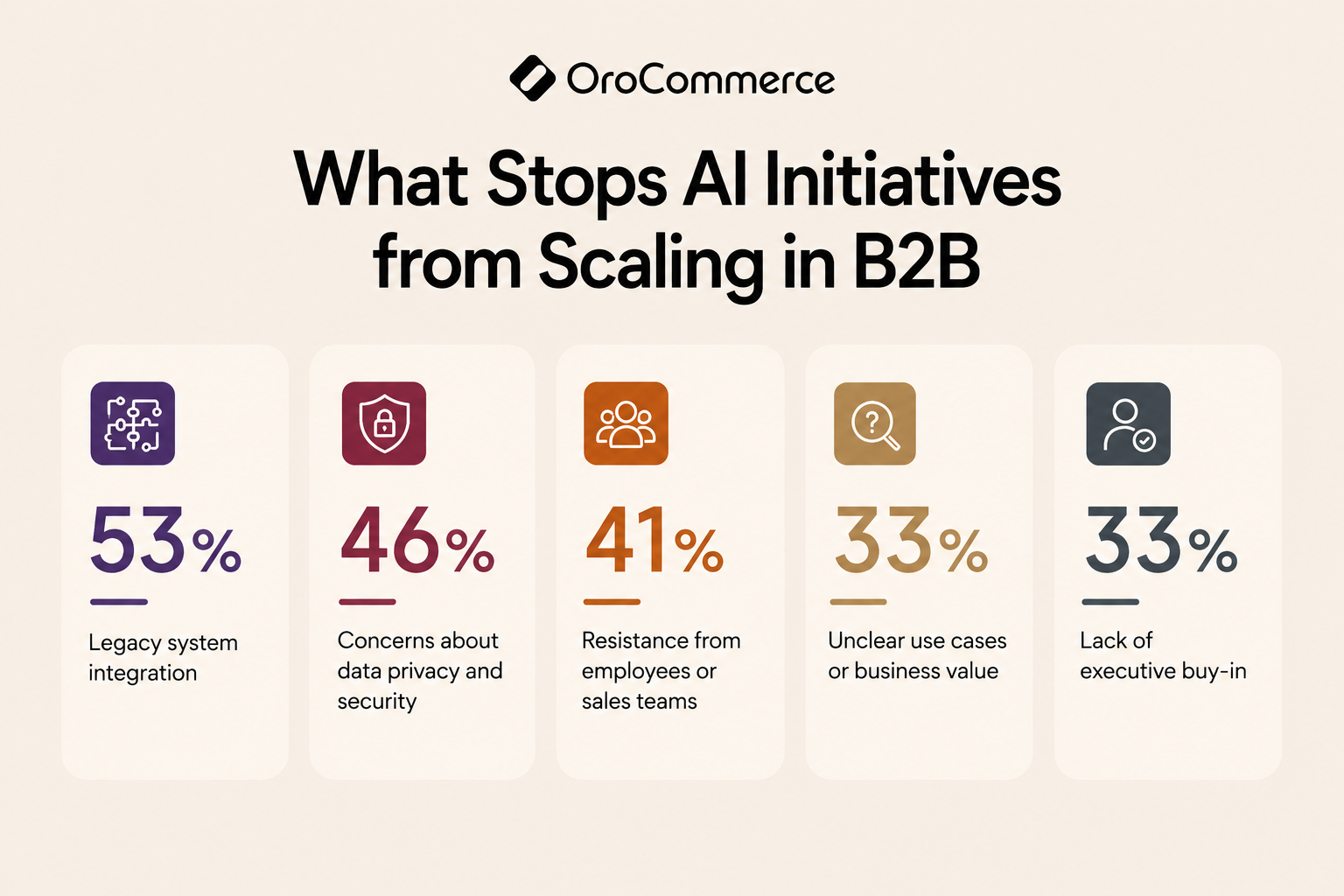
The barriers preventing long-term success have shifted from technological limitations to deep-rooted operational hurdles. When we asked B2B leaders to name their top roadblocks, here is what they told us:
- Legacy system integration (53%)
- Concerns about data privacy and security (46%)
- Resistance from employees or sales teams (41%)
- Unclear use cases or business value (33%)
- Lack of executive buy-in (33%)
Feeling stuck here is a normal part of the modernization process. Here’s why each barrier is paralyzing so many AI investments.
The legacy integration trap
This is the heaviest anchor holding B2B companies back. You likely inherited multiple ERPs through acquisitions, alongside custom-built portals and legacy databases.
McKinsey accurately calls this the “great AI and ERP divide.” AI models need unified, context-rich data to function, and if a twenty-year-old backend system traps your pricing logic, the algorithm fails.
That is why we advocate the Strangler Pattern: use a unified commerce layer to modernize architecture without a massive ERP rip-and-replace.
Data security and the shadow AI problem
B2B commerce runs on sensitive information, from negotiated contract terms to purchase histories. Feeding this proprietary data into public AI technologies poses an enormous privacy risk.
Compounding this is “shadow AI.” Snowflake, the cloud data platform company, found that 57% of employees use unapproved tools at work, uploading customer histories into consumer-grade chatbots just to draft quotes faster.
Shadow AI isn’t only a privacy risk. It’s a sign real productivity gains are already happening somewhere you can’t see, govern, or scale.
Employee resistance and relationship fears
B2B sales rely entirely on trust. When you introduce new AI capabilities, your teams naturally worry that heavy automation will disrupt the human touch. But beneath that sits a deeper anxiety: is this tool here to help me, or replace me?
Our data captures this. Only 8% of employees feel “very positive” about these tools, while 40% sit in “neutral,” waiting for proof the software will cut their administrative drag, not their jobs.
Deploy without empathy for those fears, and your team will bypass the technology. As one executive told us, when reps don’t trust the data, they ignore the algorithm and keep doing things the old-fashioned way.
Lack of “AI-ready” data quality
Only 23% cited data quality as their top barrier, yet it’s a silent killer across all business units. In our industry, “clean data” doesn’t just mean a standardized catalog.
It means parsing unstructured data and aligning it with credit limits, supplier rules, and inventory levels across disconnected systems, the root cause hiding under the legacy and governance problems above.
Building an AI Governance Operating Model
An AI governance operating model doesn’t require a full committee. For most mid-market distributors and manufacturers, three practical pieces cover the real risk.
The regulatory backdrop is shifting as this is written. Amendments adopted June 16, 2026 postponed the EU AI Act’s high-risk system obligations, originally due August 2, 2026, to December 2, 2027.
What still takes effect on August 2, 2026 is Article 50: AI-interaction disclosure, deepfake labeling, and machine-readable content marking. The European Commission also keeps active enforcement powers over general-purpose models. This is a live, shifting timeline, so confirm current status before treating either date as final.
Only 4% of respondents have complete governance policies in place, leaving roughly one third of the market with no policy at all. Basic governance, the kind 62% have already started, should cover three things:
- Name an AI governance owner. One accountable person, not necessarily a full committee, who owns policy decisions as regulations evolve.
- Define escalation paths for high-risk uses. Pricing anomalies and sensitive negotiations need an automatic route to a human, the same guardrail covered below.
- Set basic data-flow rules. Spell out what can and can’t be pasted into public AI tools, and write it into a short AI policy.
Skip this and regulatory compliance becomes almost impossible. Governance isn’t just a legal exercise; it also covers knowledge management: who documents each decision once it’s made.
It gives employees the psychological safety to use AI systems without fear of exposing sensitive contract terms. A short written policy helps you address who owns each call and how it gets recorded. Both business leaders and technical teams should be able to point to that same policy.
How High-Performers Extract Business Value from AI
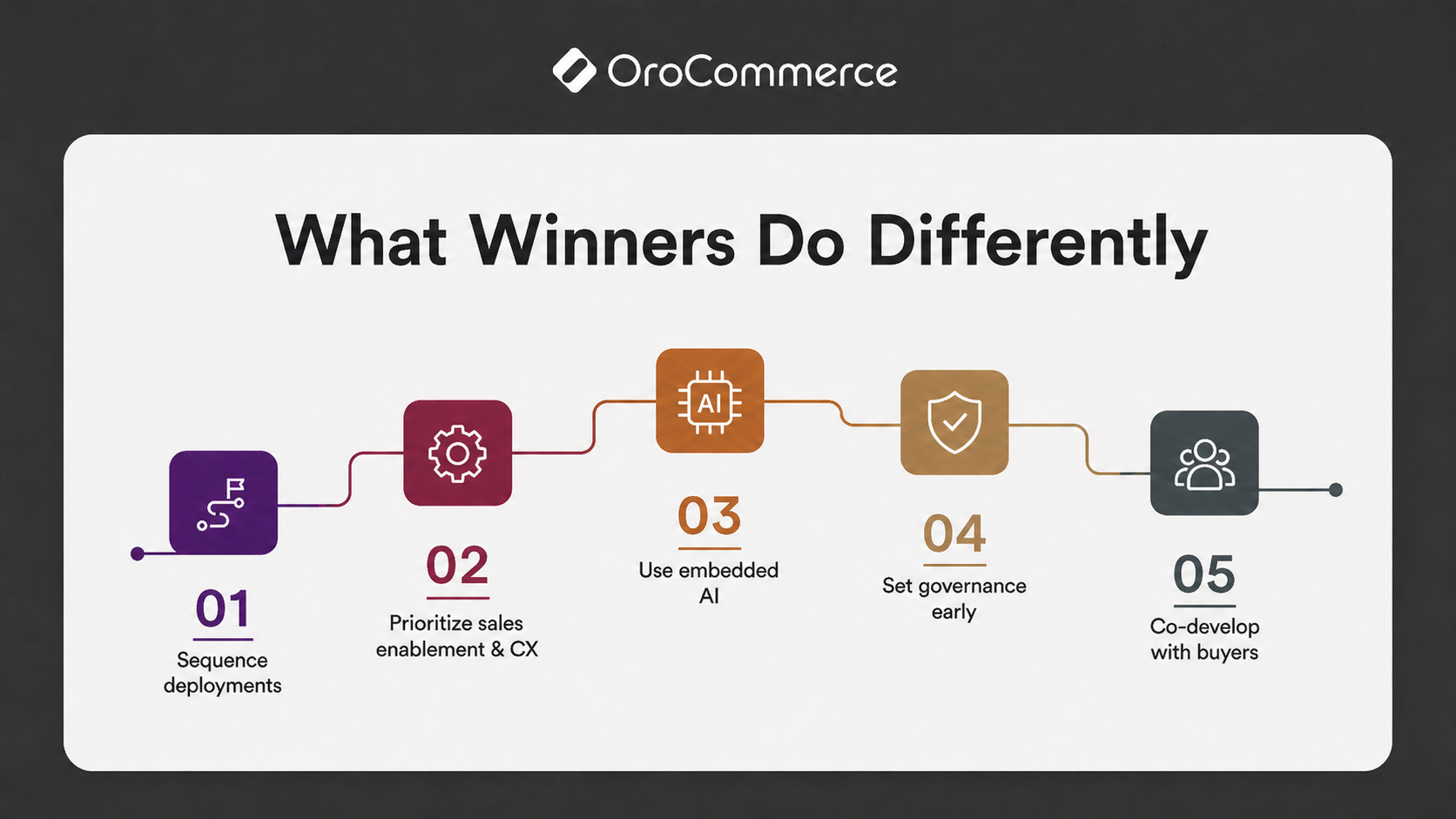
Companies generating significant returns faced the same legacy ERPs, data silos, and skeptical sales teams as everyone else. The difference is how they responded, running AI as a disciplined operational workflow instead of a shiny new toy. Here’s what separates them.
| Practice | Adoption rate or stat | What it means for B2B leaders |
| Back-office automation deployed first | 81% implemented | Build trust with low-risk wins before touching revenue-facing work |
| Customer service automation | 73% implemented | Automating support scales faster once order entry is already clean |
| AI embedded in existing enterprise software | 60% of organizations | Adopt AI where your pricing and customer hierarchies already live |
| Vendor-built deployments succeed vs. internal builds | 67% vs. 33% | Buying embedded AI beats building custom models for most B2B teams |
1. They deploy in a pragmatic sequence
The companies winning today build from the ground up. They secure their initial ROI by automating unglamorous backend operations long before touching complex, revenue-facing applications. Our data shows staggering implementation rates for operational use cases:
- Back-office automation: 81% implemented
- Customer service automation: 73% implemented
By automating high-friction tasks like manual order entry first, they build internal trust and secure immediate time and cost savings. Only after proving AI ROI in the back office do they move up the stack to complex areas like inventory forecasting and sales enablement.
Further reading: 10 AI Use Cases in B2B Commerce That Teams Are Deploying Right Now
2. They don’t choose between efficiency and customer experience
There is a persistent myth that adopting AI requires sacrificing the human touch. The successful group proves otherwise. When asked about their top outcomes, they reported enhanced employee productivity (54%) alongside improved customer satisfaction (51%).
Because the technology handles the administrative drag, their sales and support teams have more time to focus on high-value buyer interactions.
3. They buy embedded platforms instead of building from scratch
Unless your core business is software engineering, hiring an army of data scientists to build custom machine learning models is a massive financial risk. The leaders know this.
- 60% of organizations rely on AI tools that are deeply embedded within their enterprise software (like their commerce platform, ERP, or CRM).
- External MIT research backs this up: vendor-built deployments succeed twice as often as internal builds (67% vs. 33%).
By embedding intelligence directly into existing processes, these companies ensure the algorithms immediately understand their complex pricing and customer hierarchies.
However, relying on embedded AI introduces a different challenge: evaluating the platform itself. In our recent review of seven major B2B commerce platforms with AI, we found that many out-of-the-box AI tools are adapted from consumer retail models. They handle generic tasks well but struggle with wholesale-specific workflows without heavy custom configuration.
Successful organizations scrutinize whether the embedded intelligence inherently understands B2B complexity, while still prioritizing open systems for avoiding vendor lock-in as the underlying language models evolve.
4. They co-develop with their buyers
Successful organizations refuse to build in a vacuum. A massive 86% of B2B companies are engaging their customers directly regarding AI features, either by validating concepts before building (63%) or actively co-developing pilots together (23%).
In a relationship-driven industry, treating your buyers as design partners ensures you only build tools they will actually use.
5. They establish basic governance immediately
You can’t deploy advanced technology without a framework for safe knowledge management. While only 4% of respondents have comprehensive governance policies, 62% have established basic, working guidelines.
That means 66% of the market has something in place to protect their proprietary data. Governance gives employees the psychological safety to use the tools without fear of exposing sensitive contract terms.
If you follow this playbook – fix the foundation, establish governance, and embed the tools – you position your organization perfectly for the next massive shift in the market – agentic AI.
Putting the Playbook into Practice: DiversiTech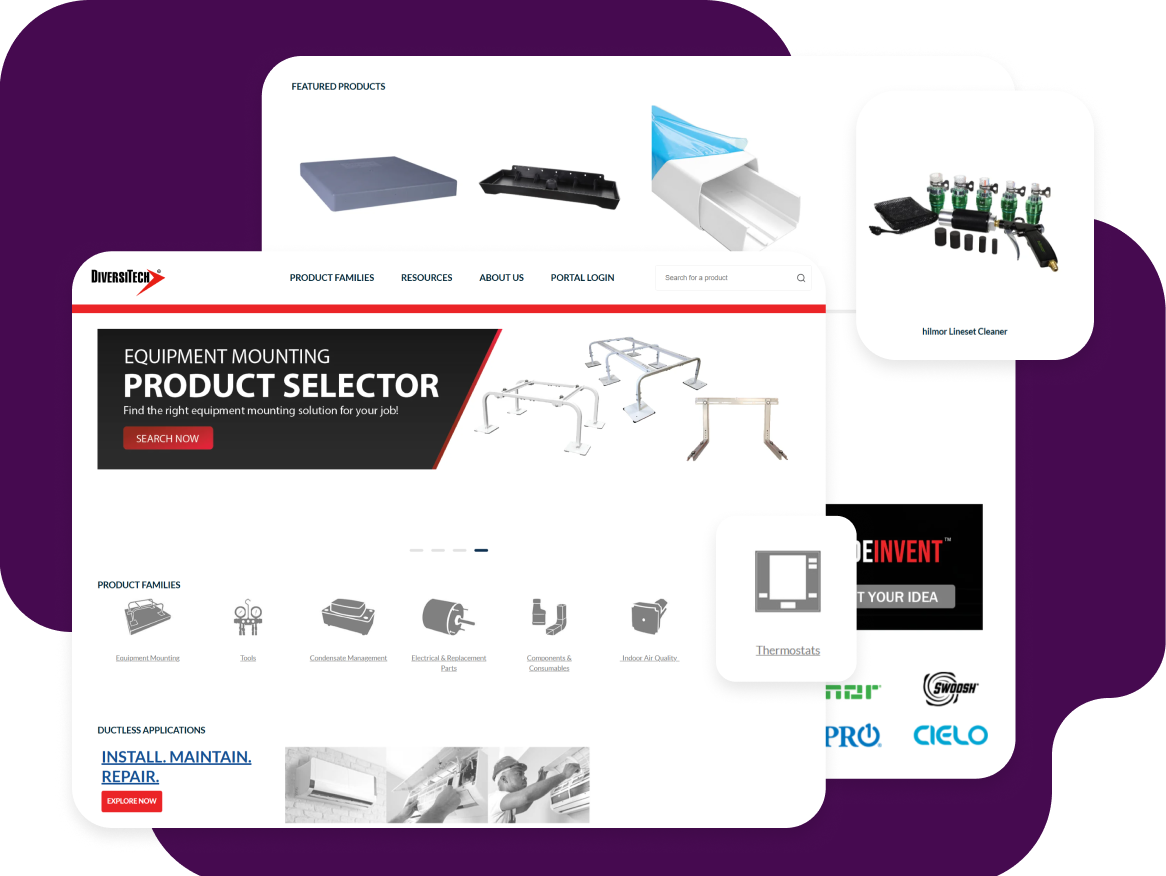
Imagine rolling out advanced AI when your reps are still manually typing out faxed purchase orders. That was the daily reality for DiversiTech, North America’s largest HVAC distributor.
Through years of acquisitions, they inherited 12 legacy ERPs. Instead of slapping a flashy AI chatbot on top of the mess, they took a pragmatic approach.
- They implemented OroCommerce, Oro Inc’s unified commerce platform for B2B manufacturers and distributors, as a unified commerce layer before deploying any algorithms.
- That layer sat between their buyers and 12 fragmented ERPs, creating one clean source of truth for pricing, inventory, and customer records.
- They then deployed OroCommerce’s native AI-powered order intake tool (see how it works here), which reads unstructured emailed PDFs and normalizes them into draft orders.
- The result: an immediate 20% productivity gain, with no need to build a custom translation system for their ERP consolidation.
Because they solved the architectural problem first, DiversiTech is now comfortably testing predictive sales alerts to empower better internal decision-making. They earned the right to innovate because they built the foundation to support it.
Preparing for the Next Phase
When we asked B2B leaders where they expect AI’s greatest impact on customer experience, they pointed to complex, revenue-driving functions:
- Guided buying and decision support (57%)
- Predictive maintenance and reordering (49%)
- Dynamic pricing optimization (48%)
- Intelligent search and discovery (45%)
These capabilities require clean data to function safely. Guided buying demands clean product data, predictive reordering needs real-time inventory visibility, and dynamic pricing needs hard-coded margin rules.
You can’t deploy these features if you haven’t solved the legacy integration barriers holding your data hostage. Companies ready for guided buying today spent last year automating order entry and cleaning catalogs. You cannot skip steps.
The agentic AI reality check
This brings us to the loudest buzzword in the market: agentic AI. Consumer retail is aggressively testing autonomous AI agents that browse, negotiate, and purchase goods on their own.
For B2B commerce, the timeline and risks look very different. Gartner, the enterprise technology research and advisory firm, warns that upwards of 40% of agentic projects will be canceled by 2027. That tracks with McKinsey’s 2026 AI Trust Maturity Survey, which found only about 30% of organizations have reached a mature level of agentic AI governance.
Get Free Access to IDC's Anty-Hype Playbook for Agentic Commerce
Successful modernization relies on human-AI collaboration, with the technology accelerating your sales team while experts keep control over negotiations. The architecture must include strict guardrails, so whenever the system hits a sensitive negotiation or pricing anomaly, it routes the task to a rep.
Preparing Your Workforce for AI
Deploying AI without preparing the people who use it is why rollouts stall at the resistance barrier above. Three moves make the difference.
- Invest in AI-fluency training before role redesign. Training, not restructuring, is the top lever for building genuine comfort with new tools.
- Identify and back internal champions. The power users who reach deep, daily usage in the maturity framework above are your best evangelists.
- Create a point person for AI operations. A new role type is emerging: an internal owner who triages requests, tracks usage, and builds training resources.
Those champions build the skills the rest of the team needs, and their day-to-day decision-making shows everyone else what actually works. You don’t need a large team to start. You need one person accountable for turning scattered AI usage into actionable intelligence and a coordinated effort.
The 2026 AI Outlook: Where B2B Commerce Is Investing Next
The window for endless experimentation is closing. Our analysis suggests enterprise AI adoption is moving into a disciplined phase.
Senior leaders are shifting strategic planning away from hype and toward the foundation-building that lets them drive AI initiatives, even as business needs keep changing. Many enterprises now treat that foundation work as the real driver of growth.
When we asked executives where they plan to direct AI investment over the next 12 months, the priorities were:
- Advanced analytics and business intelligence: 55%
- Product data management and catalog enrichment: 40%
- Sales enablement and CRM automation: 39%
- Supply chain and logistics optimization: 38%
These priorities mark the end of the plugin era. Most organizations treated AI like a widget, bolting third-party tools onto legacy systems and expecting them to process massive volumes of unstructured data. That approach is collapsing under its own weight.
Renting external, proprietary models creates an operational ceiling, since a standalone app doesn’t know your pricing tiers or shipping logic. Forcing tools to constantly ping a fifteen-year-old ERP introduces latency, and handing commercial data to isolated external systems is a real liability.
Track this shift through OroCommerce’s ongoing momentum report.
The Shift to Native Infrastructure
Companies pulling ahead have abandoned the bolt-on strategy, shifting AI investment directly into their core data engines because intelligence must live natively where the business logic lives.
When the algorithm shares the same database as your account hierarchies, you eliminate the integration tax. The system automatically inherits your security rules and reads your inventory directly.
While organizations use AI at unprecedented volumes, you can’t buy your way out of technical debt with a smarter algorithm. True readiness means shifting focus from software to architecture.
The path to sustainable enterprise AI adoption requires unifying your data foundation before you delegate authority to AI agents. If your team is ready to map that foundation against your own systems, book a demo and we’ll show you where OroCommerce fits.
Get the raw data on what is surviving in B2B production today
What percentage of B2B companies see ROI from AI?
Only 17% of B2B companies report a significant return on investment from AI, per Oro’s benchmark survey of businesses in manufacturing and distribution. Another 48% call results “somewhat effective,” with dashboard activity but no transformational value, and 15% report no value at all.
What is the biggest barrier to AI adoption in B2B commerce?
Legacy system integration is the top barrier, cited by 53% of B2B leaders. Fragmented ERPs trap the pricing and inventory data AI models need, which is why unifying the data layer has to come before scaling AI.
Should B2B companies build or buy AI tools?
Most B2B leaders should buy embedded AI rather than build custom models. Vendor-built deployments succeed twice as often as internal builds (67% vs. 33%), and 60% already rely on AI embedded in their commerce platform, ERP, or CRM.
What is agentic AI and is it ready for B2B commerce?
Agentic AI refers to autonomous systems that plan and execute multi-step tasks with minimal oversight. It isn’t ready for unsupervised B2B use yet. Gartner predicts over 40% of agentic projects will be canceled by 2027, so deploy agents with strict guardrails and human escalation paths.
How long does it take to see ROI from AI in B2B commerce?
Timelines vary, but companies seeing returns fix their data foundation first. DiversiTech saw a 20% productivity gain almost immediately after unifying its ERPs and deploying AI order intake, because the architecture was ready before the algorithm arrived.