
navigation

Sana Commerce, also marketed as Sana Commerce Cloud, is a B2B eCommerce platform built to sit directly on top of an SAP or Microsoft Dynamics ERP. It runs your online store against ERP data instead of a separate commerce database. That tight coupling is its biggest strength and its biggest limitation, depending on what you need.
That’s exactly why you’re likely weighing Sana Commerce competitors against other ERP-integrated eCommerce platforms right now.
This guide compares the five strongest options on the market today: OroCommerce, SAP Commerce Cloud, Adobe Commerce, Microsoft Dynamics 365 Commerce, and Oracle NetSuite SuiteCommerce.
To make that comparison useful, this article breaks down five decision criteria: ERP integration depth, total cost, customization, scale, and B2B-specific functionality. Use them to shortlist the right e-commerce platform before you talk to a single vendor.
Before you compare tools, it helps to know what actually separates a strong B2B eCommerce platform from a weak one.
What to Look For in Sana Commerce Competitors
Finding the best eCommerce platform for your business depends on seven factors. Weigh all seven before you sign a contract:
- ERP integration depth and pattern. Some platforms connect to your ERP natively. Others rely on middleware, and a few expose an API-first layer you build on yourself.
- Total cost of ownership. License fees are just the starting point. Factor in implementation, integration, and ongoing maintenance before you compare sticker prices.
- B2B-native functionality. Price lists, quoting, account hierarchies, and approval workflows should work out of the box. Customer-specific pricing should be configurable without developer help.
- Customization and extensibility. Open source platforms give you full control over the codebase. Closed platforms trade that control for a more managed experience.
- Scalability. Multi-org, multi-website, and multi-currency support matter the moment you expand into new markets or add a second brand. The ability to scale without re-architecting is essential once you outgrow a single site.
- Marketplace and partner network. A strong network of certified integrators and prebuilt connectors shortens implementation. Some platforms also support third-party sellers inside the same storefront.
- Deployment flexibility. Cloud, on-premise, and headless options each suit different IT strategies. Confirm the platform supports the deployment model your organization actually uses.
Wholesale distributors have their own version of this checklist. See how it changes for wholesale-specific B2B eCommerce platforms.
Sana Commerce Alternatives at a Glance
Here’s a fast side-by-side view of the five Sana Commerce alternatives covered in this guide, plus Sana Commerce itself as a reference point. Ratings come from G2, the peer review platform for business software.
| Tool | G2 Rating | Best For | Top Feature | Pricing Model |
| OroCommerce | 4.3/5 | Mid-market and enterprise manufacturers, wholesalers, and distributors that need ERP-agnostic flexibility | Native connectors for SAP, Microsoft Dynamics, NetSuite, and Oracle under one license | Custom, all-in-one |
| SAP Commerce Cloud | 4.3/5 | Large SAP-native enterprises | Deep native integration with SAP S/4HANA | Custom enterprise quote |
| Adobe Commerce | 4.0/5 | Businesses needing heavy front-end and content customization | Open architecture plus Adobe Experience Cloud integration | Custom, revenue-based |
| Microsoft Dynamics 365 Commerce | 4.3/5 | Microsoft-centric organizations already on Dynamics 365 | Unified retail and B2B commerce inside the Microsoft stack | Custom, per-user subscription |
| Oracle NetSuite SuiteCommerce | 4.1/5 | Businesses standardized on NetSuite ERP | Commerce and back office on one database | Custom, subscription-based |
| Sana Commerce (reference) | 4.4/5 | Existing SAP or Dynamics customers wanting an ERP-first storefront | Real-time ERP sync without a middle layer | Custom, roughly $10,000+ per year |
5 Top Sana Commerce Competitors in 2026
These five platforms are worth evaluating against Sana Commerce. Each entry below covers what it does, who it fits, and what it costs.
OroCommerce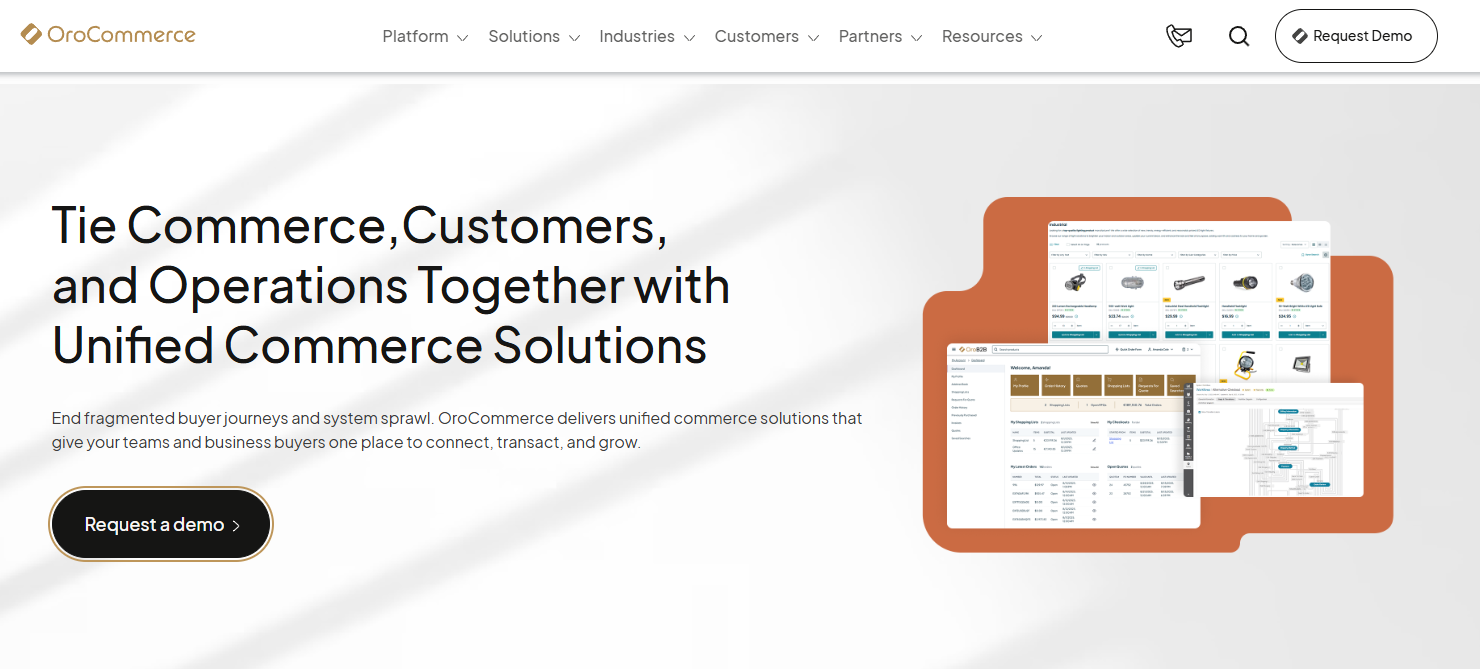
OroCommerce is a unified commerce solution for manufacturers, distributors, and wholesalers, built to handle complex catalogs and account structures.
Instead of pinging your ERP for every product view, it runs commerce logic on its own layer and syncs on a schedule your business actually needs.
That also makes it easier to onboard new customers without adding pressure on ERP performance. The platform ships as single-tenant SaaS, on your own infrastructure, or fully on-premise.
Best for
Mid-market to large B2B wholesalers, distributors and manufacturers that want ERP flexibility without giving up B2B-native depth.
Key features
- Quote-to-cash in one system: Configure, price, and quote complex orders, then carry them through invoicing and payment without switching tools.
- AI SmartOrder: Converts buyer purchase orders sent by email or PDF into draft orders automatically, cutting manual data entry.
- Integrated payments with OroPay: Accept cards, ACH, or invoice-based payments directly in the platform, connected to finance systems for real-time reconciliation.
- Built-in PIM and DAM: Manage product specs, attributes, and digital assets in one system instead of bolting on third-party tools.
- Multi-organization backend: Add new brands, regions, or acquired companies onto the same instance without re-architecting your stack.
Pricing
Custom pricing based on your business size and requirements. No per-website or per-location fees.
Book a demo to get a quote based on your catalog size.
SAP Commerce Cloud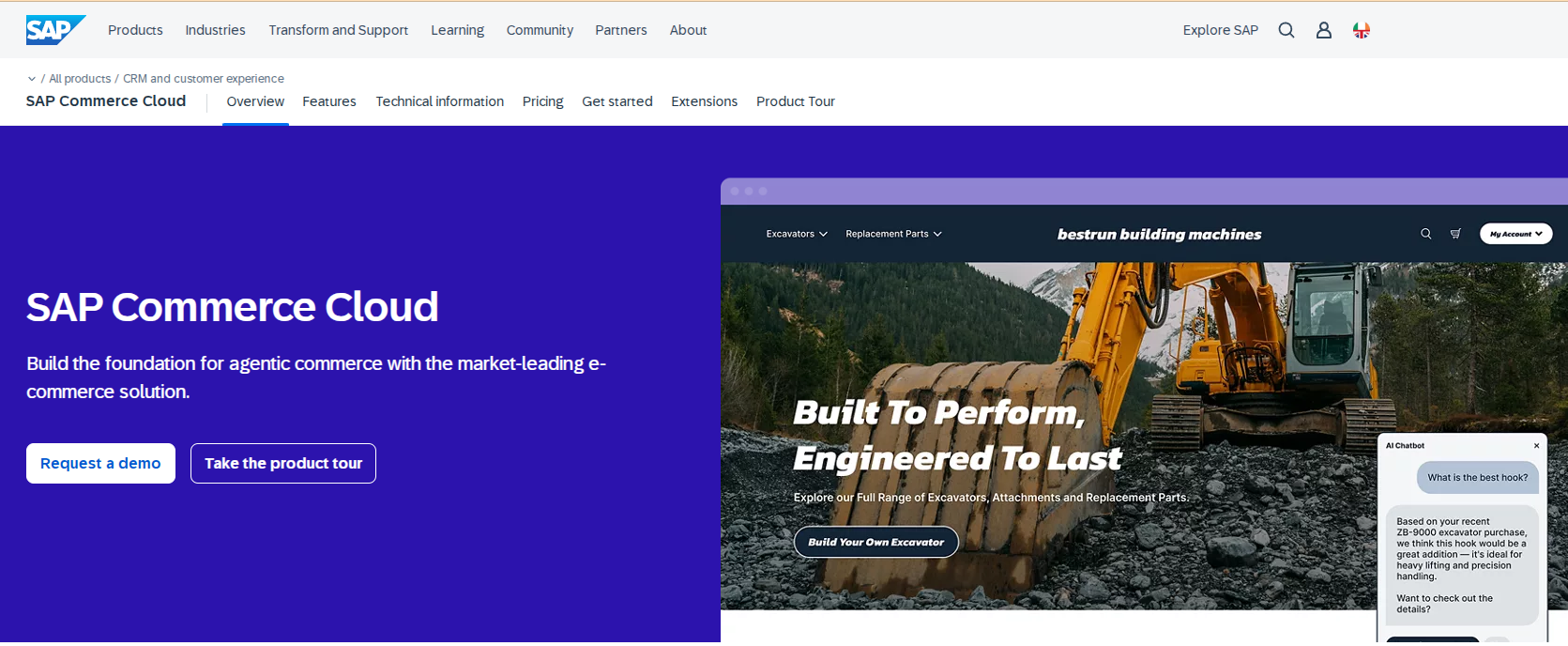
SAP Commerce Cloud, formerly known as Hybris, is an enterprise commerce platform built for organizations already running SAP as their core ERP.
It supports both B2B and B2C use cases, with implementation typically requiring SAP-certified partners and a longer rollout timeline than most mid-market alternatives.
Learn more about how SAP Commerce Cloud competitors compare on cost and flexibility.
Best for
Large enterprises already standardized on SAP S/4HANA or SAP ECC that need commerce built directly on top of that environment.
Key features
- Native SAP data integration: Direct connectivity to SAP ERP and CRM data without third-party middleware.
- Composable storefront options: Headless front-end architecture for teams that want to build custom buying experiences
- Enterprise catalog engine: Handles large, complex product catalogs with rule-based pricing across regions.
- Global multi-site support: Run multiple storefronts across languages, currencies, and business units from one backend.
- Omnichannel order management: Coordinates B2B and B2C orders across web, mobile, and in-store channels from a single system.
Pricing
Custom enterprise quote based on GMV, modules, and deployment scope.
Adobe Commerce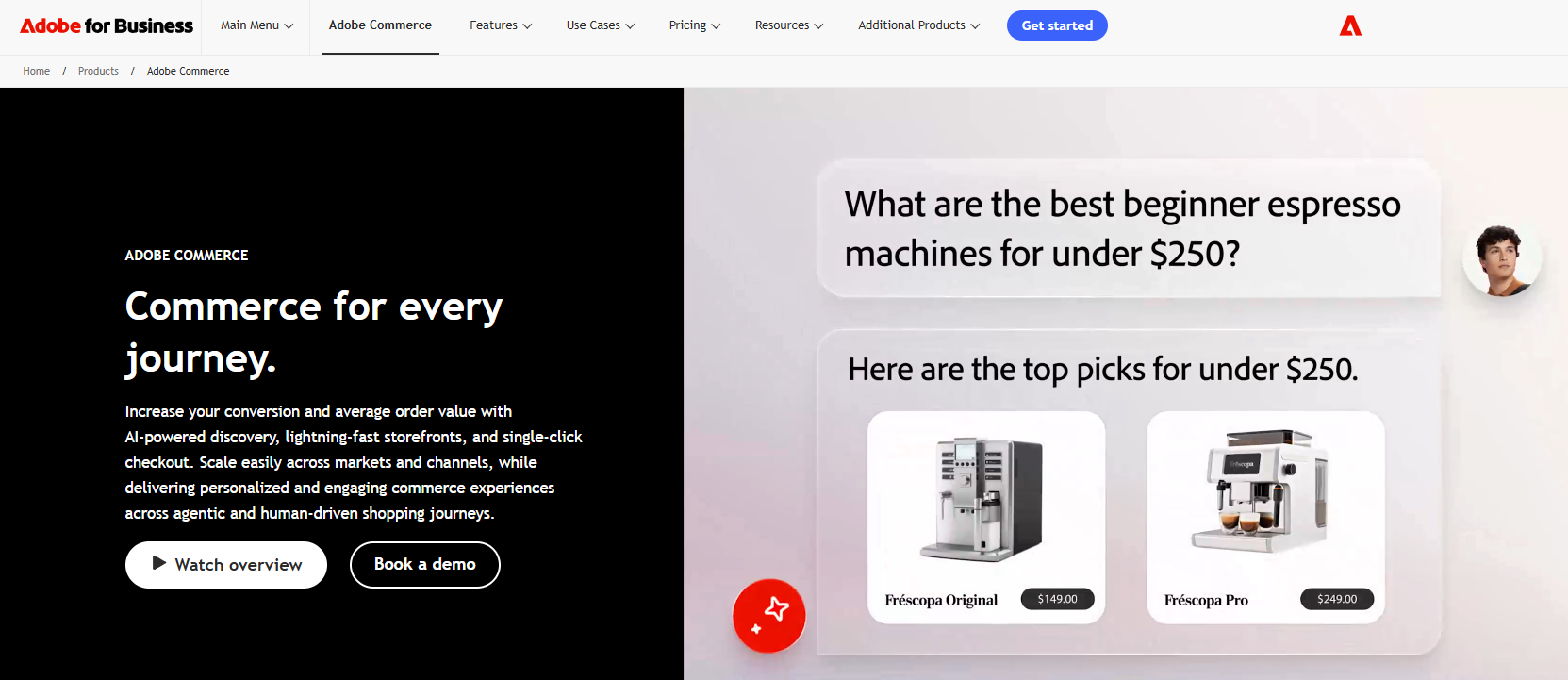
Adobe Commerce, formerly Magento Commerce, is an enterprise eCommerce platform with roots in open-source software, now part of Adobe’s Experience Cloud suite. It’s available self-hosted, as PaaS on AWS, or as Adobe Commerce as a Cloud Service, Adobe’s managed SaaS offering.
Read a deeper breakdown of Adobe Commerce competitors.
Best for
Enterprises with heavy front-end customization needs and existing investment in Adobe’s marketing tools.
Key features
- Open codebase access: Full control over the platform’s source code for custom storefront builds.
- Adobe Experience Cloud integration: Native connections to Adobe Analytics, Target, and Marketo for unified marketing and commerce data.
- B2B commerce module: Company accounts, shared catalogs, and requisition lists layered on top of the core platform.
- Page Builder: Drag-and-drop merchandising tools for building and updating storefront content without developer time.
- Multi-store management: Run multiple storefronts and currencies from a single admin panel.
Pricing
Custom, generally based on annual gross merchandise volume.
Microsoft Dynamics 365 Commerce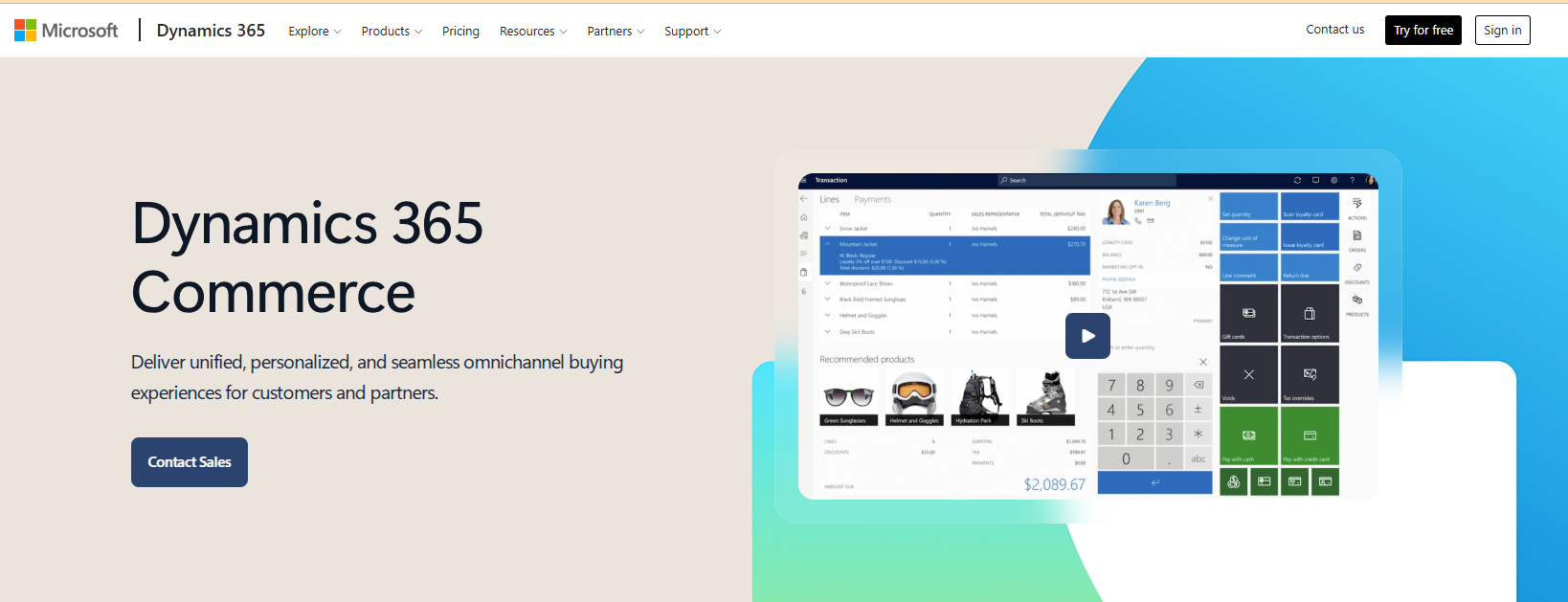
Microsoft Dynamics 365 Commerce is Microsoft’s unified commerce module inside its Dynamics 365 business applications suite, connecting online, in-store, and back-office operations on shared infrastructure.
It’s built for organizations already running Dynamics 365 for finance, operations, or customer relationship management.
Compare it against other enterprise B2B eCommerce platforms.
Best for
Microsoft-centric enterprises standardized on Dynamics 365 for finance, operations, and customer relationship management.
Key features
- Unified commerce data model: Retail, B2B, and back-office systems share the same underlying data.
- Power Platform extensibility: Build custom workflows and automations using Microsoft’s low-code tools.
- Omnichannel order orchestration: Coordinate fulfillment across online, in-store, and call center channels.
- Native Power BI reporting: Sales and inventory dashboards built into the same Microsoft environment you already use.
- Built-in loyalty and promotions: Configure discounts, loyalty programs, and pricing rules without a separate engine.
Pricing
Custom, quoted per user with additional fees for commerce-specific modules.
Oracle NetSuite SuiteCommerce
Oracle NetSuite SuiteCommerce is the eCommerce layer built on Oracle’s NetSuite ERP, unifying the storefront with inventory, order management, and financial data in a single database. It supports both B2B and B2C selling from the same account.
Best for
Small businesses and medium-sized businesses already running NetSuite as their ERP that want commerce on the same system.
Key features
- Single-database architecture: Storefront, inventory, and financials run on one NetSuite instance without a separate sync process.
- SuiteScript customization: Extend and automate storefront behavior using NetSuite’s native scripting tools.
- Multi-subsidiary support: Manage separate legal entities, currencies, and tax rules from the same account.
- Built-in customer account management: Order history, invoices, and account details live in the same record as the ERP data.
- Real-time inventory visibility: Stock levels update instantly across every sales channel tied to the account.
Pricing
Custom, subscription-based, priced by user count and selected modules.
ERP Integration Guidance
ERP integration depth is the single factor that most separates Sana Commerce alternatives from each other. Getting this decision right is vital, since it shapes cost and flexibility for years. Use these tips during evaluation:
- Identify the integration pattern. Native integration builds the connector into the platform’s core for faster syncs. Middleware routes data through a separate connector layer. API-first exposes raw endpoints your team builds against.
- Weigh cost against flexibility. Native integration usually costs less upfront but locks you closer to one ERP vendor. Middleware and API-first approaches cost more to build but keep your options open later.
- Test for seamless integration under load. Ask every vendor to show real-time inventory and pricing sync under realistic order volume, not a clean demo environment.
- Ask about downtime behavior. Confirm how the storefront behaves if the ERP connection drops, and for how long.
- Establish data ownership up front. Get clear on who owns the underlying commerce data if you ever migrate away from the platform.
- Flag tight coupling as a scaling risk. A platform that depends entirely on your ERP for every storefront interaction can slow down as your catalog and traffic grow.
Learn more about planning an ERP modernization strategy that accounts for this.
Decision Guide: Which Sana Commerce Alternative Fits You
Your ERP setup and your growth plans should point you to the right platform. Focus on that instead of brand recognition. Here’s a fast way to narrow the field:
- If you want ERP flexibility and B2B-native depth, evaluate OroCommerce.
- If you’re a large SAP-native enterprise, evaluate SAP Commerce Cloud.
- If you need heavy front-end and content customization, evaluate Adobe Commerce.
- If you’re a Microsoft-centric organization standardized on Dynamics 365, evaluate Microsoft Dynamics 365 Commerce.
- If you’re already running Oracle NetSuite as your ERP and want bundled commerce, evaluate Oracle NetSuite SuiteCommerce.
Before you commit to a vendor, ask each one these questions:
- What does real-time ERP sync actually look like under peak order volume?
- What’s included in the base license versus billed as an add-on?
- How long does a typical implementation take for a catalog your size?
- What happens to your data if you migrate off the platform later?
- Which third-party tools and connectors are prebuilt versus custom-built?
- How many users need access, and does the price scale per seat?
- Who owns support after go-live, the vendor or a certified partner?
Why Choose OroCommerce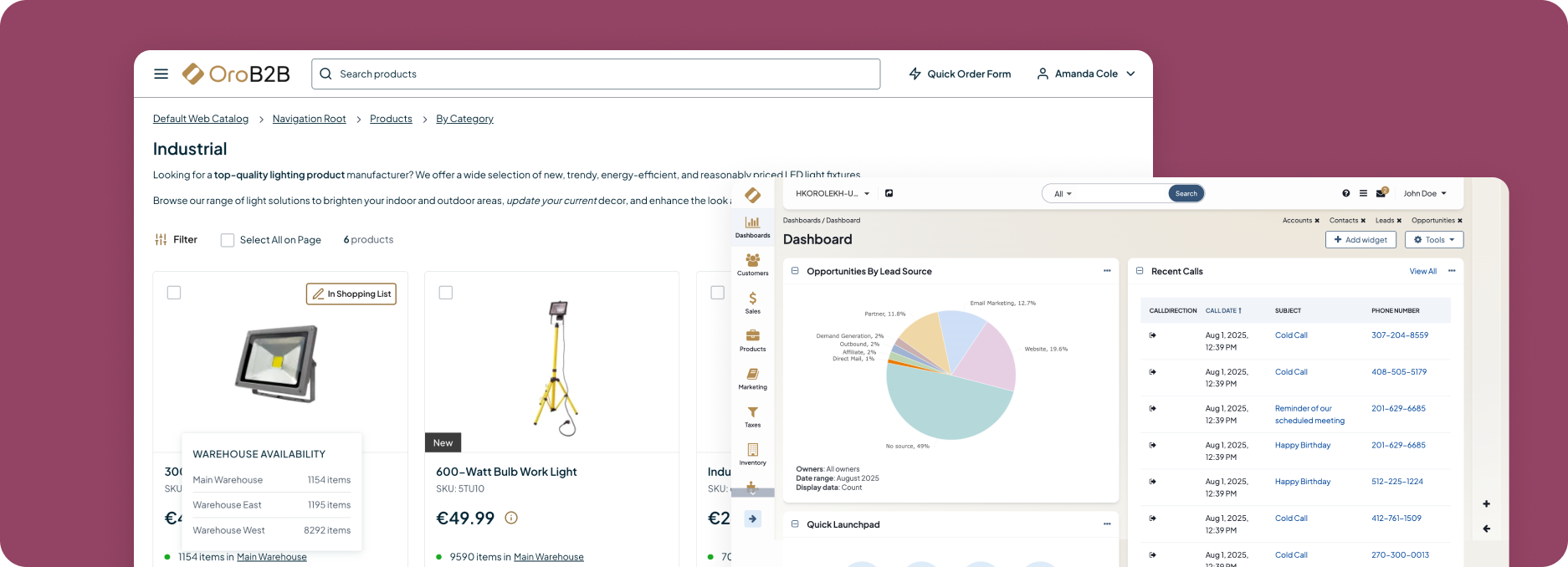
Most Sana Commerce alternatives solve one piece of the puzzle. OroCommerce takes a unique approach. It’s built as a unified commerce solution that ties your storefront, CRM, quoting, payments, and product data into one platform instead of a stack of disconnected tools.
That matters because fragmentation drives the cost of most B2B eCommerce projects. An acquisition leaves customer records stranded in separate databases, and a quoting tool that doesn’t sync with the core pricing engine creates the same problem from a different angle.
Sales teams stop trusting a single source of truth because one doesn’t exist. Oro built OroCommerce to solve exactly this. It orchestrates your existing systems instead of forcing a rip-and-replace, with a flexible architecture that leaves room for continued innovation as your business grows.
Capabilities that set it apart
A few capabilities set it apart from the other Sana Commerce competitors on this list:
- A single view of the customer relationship. Buyers get a self-service portal into ERP data for pricing, stock, and order history. Sales, service, and finance all work from the same real-time record.
- A connected quote-to-cash cycle. Quoting, CPQ, RFQ, invoicing, and payment via OroPay all run natively inside the platform, so every quote flows into an order without a handoff between tools.
- One source of product and brand truth. Built-in PIM, DAM, and CMS keep specs, assets, and content consistent across every storefront and portal, without bolting on separate systems.
- Automation and AI where it counts. AI SmartOrder turns emailed or PDF purchase orders into draft orders automatically. Plus, intelligent reorder suggestions and automated back-office tasks reduce manual work for the sales team.
- Architecture built for scale. A multi-organization backend supports account hierarchies, new brands, and acquired companies without re-architecting the stack, and open APIs keep ERP, WMS, and OMS integrations clean.
Proven at scale
That architecture holds up under real conditions. Azelis, a global distributor of specialty chemicals and ingredients, runs more than 150 localized portals on a single OroCommerce instance. Buyers get access to over 90,000 digitized products in their own language and compliance context.
Lactalis connected 12 regional businesses on one platform and onboarded 15,000 customers in under two years. Digital orders increased by 230% while manual processes dropped by 44%.
Gartner, the enterprise technology research and advisory firm, recognized OroCommerce in its 2025 Critical Capabilities for Digital Commerce report. The recognition cited the completeness of its built-in functionality, including storefront, CMS, DAM, search, order management, RFQ, CRM, and marketplace tools in a single platform.
If ERP flexibility and B2B-native functionality matter more to your organization than staying inside a single vendor’s environment, it’s worth seeing the platform firsthand.
Let’s walk through how OroCommerce handles your catalog and ERP setup.
Total Cost, Licensing, and ROI
Total cost of ownership always runs higher than the license fee alone. Ask every vendor to itemize implementation, licensing, integration, subscription fees, and support before you compare numbers.
Buyers commonly forget to budget for a few line items until it’s too late. Product information management (PIM), marketplace extensions, and custom connector development often show up as separate costs after signing.
Return on investment for any Sana Commerce alternative comes down to three things: fewer manual order errors, faster ERP synchronization, and less time spent on repetitive account management tasks.
Every vendor on this list uses custom pricing instead of a published price list, which makes comparison harder without asking directly. This applies to companies of every size.
Use this framework to calculate eCommerce total cost of ownership and compare vendors on equal footing.
Implementation, Ecosystem, and Long-Term Support
Implementation success depends less on the platform itself and more on the partner network behind it. Check partner size, certified integrator availability, and prebuilt connector depth before you sign.
A strong partner network shortens your time to launch, and the right partner can deliver a smoother rollout than the software alone. Look at integrator availability, marketplace depth for add-ons, and what the standard SLA guarantees for uptime.
Migration risk deserves its own conversation early on, since portability becomes critical once years of ERP-synced order history live on the platform. Create a rollback plan before implementation starts, and confirm your data stays portable if you switch platforms later.
This applies across every vendor on this list, not just one. This free ROI calculator can help you model implementation payback before you commit.
Final Words About Sana Commerce Competitors
ERP integration depth, total cost, and B2B-native functionality decide this comparison, not brand recognition. Run every vendor through those three filters before you sign a contract.
Each platform on this list fits a different starting point. SAP-native enterprises will likely stay with SAP Commerce Cloud, and Adobe-invested teams may prefer Adobe Commerce. Microsoft shops often land on Dynamics 365 Commerce, while NetSuite customers frequently choose SuiteCommerce for the single-database convenience.
For most mid-market and growing enterprise buyers, OroCommerce stands out as the strongest overall solution among the five alternatives compared here. It combines ERP flexibility with B2B-native functionality that ERP-first platforms offer only as an add-on.
The fastest way to know if it fits your business is to see it working against your own catalog and ERP setup. Book a demo and bring your specific requirements to the conversation.
FAQs About Sana Commerce Alternatives
What are the top 3 eCommerce platforms?
The right answer depends on your business type. For B2B manufacturers and distributors, OroCommerce, SAP Commerce Cloud, and Adobe Commerce consistently rank among the strongest options for ERP integration and complex catalogs. B2C brands typically lean toward Shopify Plus and BigCommerce instead, since B2B account structures aren’t their focus.
Which platform is best for B2B?
OroCommerce targets B2B from the ground up, with account hierarchies, contract pricing, and approval workflows included as core functionality. Platforms like Adobe Commerce and SAP Commerce Cloud support B2B too, but often through add-on modules rather than native design built for the purpose.
What is Sana Commerce's annual revenue?
RocketReach estimates Sana Commerce’s annual revenue at $105 million for 2025. The company is headquartered in Rotterdam, Netherlands. It has grown its ERP-integrated eCommerce business primarily among SAP and Microsoft Dynamics customers in manufacturing and distribution industries across Europe and North America.
Is Sana Commerce an ERP or an eCommerce platform?
Sana Commerce is an eCommerce platform, not an ERP. It’s designed to run directly on top of an existing SAP or Microsoft Dynamics ERP, syncing pricing and inventory in real time rather than replacing the ERP itself. Businesses still need a separate ERP system to use it.
Who are Sana Commerce's main competitors?
Sana Commerce’s main competitors include OroCommerce, SAP Commerce Cloud, Adobe Commerce, Microsoft Dynamics 365 Commerce, and Oracle NetSuite SuiteCommerce. Each takes a different approach to ERP integration, ranging from fully ERP-agnostic to tightly coupled with one ERP vendor. The right choice depends on your existing tech stack and budget.
What's the best Sana Commerce alternative for mid-sized businesses?
OroCommerce tends to fit medium-sized businesses best because it combines ERP flexibility with B2B-native functionality out of the box. It avoids locking a growing business into a single ERP vendor while still supporting complex catalogs and account hierarchies as the business expands into new markets.