
navigation

Salesforce Commerce Cloud is an enterprise eCommerce platform that sits inside the broader Salesforce ecosystem, alongside Sales Cloud, Service Cloud, and Marketing Cloud.
It delivers strong enterprise capabilities. But its GMV-based pricing, B2C-derived data model, and tight integration with the wider Salesforce stack push many B2B teams to consider commerce platforms with more transparent pricing.
This guide compares the top Salesforce Commerce Cloud alternatives through a B2B lens, not a generic eCommerce one. You’ll see how each option handles corporate accounts, contract pricing, complex catalogs, and ERP integration.
By the end, you’ll have a shortlist of modern platforms and enterprise alternatives matched to your target audience and growth roadmap.
Why B2B Teams Look for Salesforce Commerce Cloud Alternatives
The reasons B2B teams look for alternatives are practical, not philosophical: cost predictability, B2B feature gaps, and architectural preferences.
- Two underlying codebases (Demandware for B2C, CloudCraze for B2B) mean B2B teams inherit a platform that was never engineered as one product. It has a shared roadmap, shared brand, separate foundations, and a higher total cost of ownership of the platform.
- GMV-based pricing makes the total cost less predictable as transaction volume grows. That complicates multi-year budgeting for high-volume sellers.
- Native B2B workflows like RFQ, contract pricing, and multi-step approvals often need configuration or extension work. The platform’s data model started in B2C retail.
- Many B2B teams already pay for Salesforce CRM and Service Cloud separately. Adding Commerce Cloud means stacking costs across multiple Salesforce products instead of consolidating.
- Teams that prefer a true API-first architecture sometimes find Salesforce Commerce Cloud’s extension model and pricing tied to the broader commerce cloud environment, with technical complexity that shows during integration projects.
Support costs and additional fees for sandboxes, price books, and AppExchange add-ons can pile up beyond the headline platform cost.
What to Look for in Salesforce Commerce Cloud Alternatives
These criteria separate platforms built for B2B from those that bolt on B2B onto a B2C foundation.
- B2B-specific requirements vs. B2C feature sets. Native support for corporate accounts, role-based permissions, and quote workflows matters more than a polished consumer storefront.
- Pricing model structure. Revenue-share pricing where the platform takes a percentage of GMV scales your costs directly with your growth. That’s painful at high transaction volume. GMV-tiered licensing, by contrast, sets costs based on volume bands rather than a cut of every dollar. Know which you’re signing before you negotiate.
- Complex pricing rules. Tiered pricing, contract pricing, and customer-group discounts must be supported natively. Workarounds with promotion engines rarely scale to true B2B complexity.
- Account management. Multi-buyer accounts, approval workflows, purchase orders, and account hierarchies should ship out of the box. Manual configuration of these workflows adds significant implementation cost.
- ERP, CRM, and PIM integration. Seamless integration with the rest of your stack is non-negotiable for B2B. Look for prebuilt connectors and an open API layer that protects you from custom middleware.
- Catalog complexity. Large SKU counts, configurable products, and customer-specific assortments must perform under load.
- Self-service buyer portals. Buyers want to manage their own orders, reorders, quotes, and invoices. Strong self-service cuts sales team overhead.
- Multi-org and multi-site management. Confirm the platform supports multiple brands and business units from one backend, and handles B2B2X models natively.
- Total cost of ownership. Three-year TCO including licensing, implementation, integrations, and ongoing maintenance. Sticker price rarely tells the whole story.
Score every shortlisted platform against these eight criteria before scheduling a single demo, and the right fit usually shows on its own. Many vendors don’t tick all of them.
Salesforce Commerce Cloud Alternatives at a Glance
The table below compares the five Salesforce Commerce Cloud alternatives in this guide. G2 ratings are accurate as of publication. Each platform is detailed in the reviews that follow.
| Platform | G2 Rating | Best For | Top B2B Feature | Starting Price |
| OroCommerce | 4.3 / 5 | Mid-to-large B2B enterprises in manufacturing, distribution, and wholesale | Unified eCommerce, CRM, AI, and CPQ in one license | Custom, all-in-one tiered pricing |
| Adobe Commerce | 4.0 / 5 | Mid-to-large enterprises with in-house dev capacity | B2B module: shared catalogs, requisition lists, quotes | Custom (GMV/order-volume tiers) |
| commercetools | 4.6 / 5 | Tech-forward enterprises with strong engineering depth | MACH composable architecture, B2B and B2C on one platform | Custom (subscription, GMV/API tiers) |
| SAP Commerce Cloud | 4.3 / 5 | Large enterprises in SAP-led estates | Native SAP S/4HANA and ERP integration | Custom enterprise Rev. share pricing |
| HCL Commerce | 4.0 / 5 | Enterprises needing extreme transaction scale, B2B + B2C | B2B, B2C, B2B2C, and marketplace models on one platform | Custom |
Best Salesforce Commerce Cloud Alternatives in 2026
Here are the five strongest Salesforce Commerce Cloud alternatives for B2B in 2026, reviewed against the criteria above.
1. OroCommerce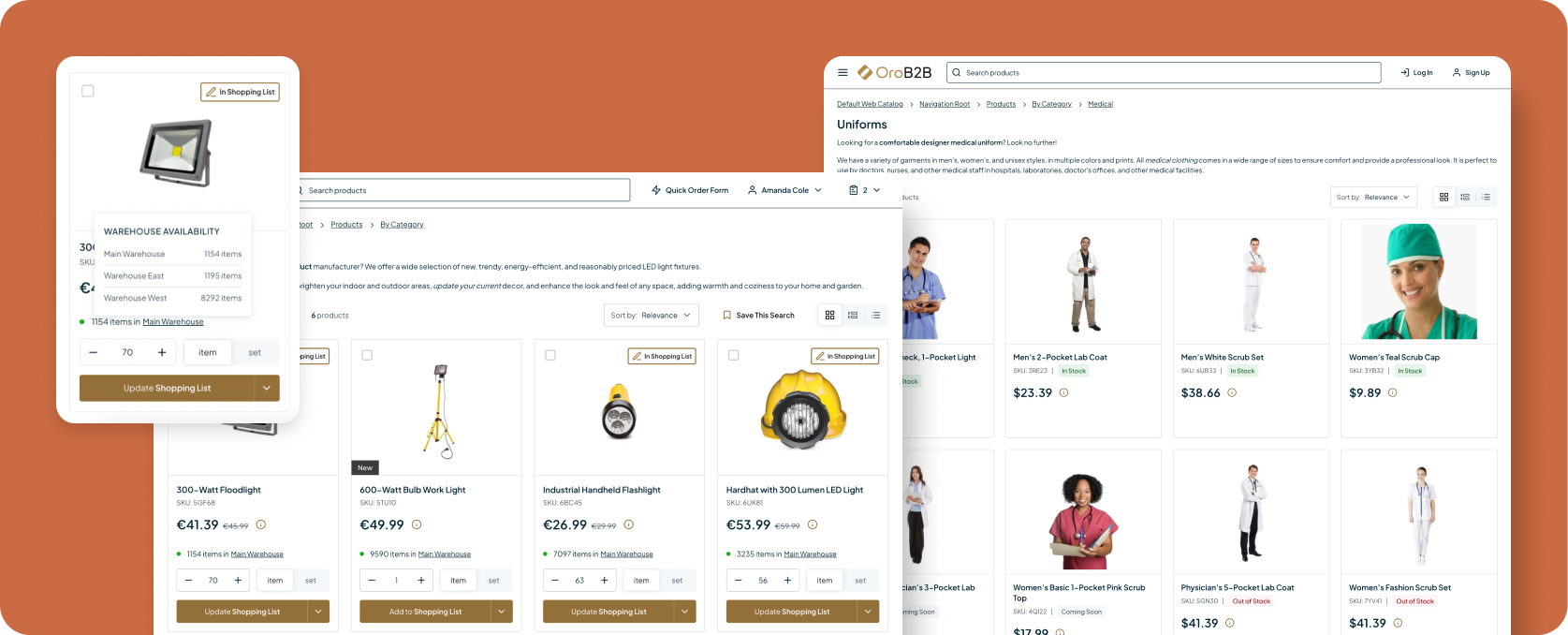
OroCommerce is a unified B2B platform built for manufacturers, distributors, and wholesalers. Your storefront, customer data, quoting tools, content management, and marketplace capabilities run on one system under one license. Everything ships together. Adding websites, warehouses, or business units costs nothing extra.
Every essential B2B feature ships natively: corporate account hierarchies, configure-price-quote, a rule-based pricing engine, automated workflows, and AI tools for B2B use cases.
Gartner has recognized OroCommerce in its Magic Quadrant for Digital Commerce for five consecutive years.
Best for
Mid-market and large enterprises in manufacturing, distribution, and wholesale that need real B2B functionality, complex pricing, multi-organization buyer structures, and deep ERP integration requirements on one platform without stacking separate product modules.
Key features
- Account hierarchies and customer accounts. Map complex buyer org structures with granular roles, permissions, and delegated purchasing across business units and branches.
- Customer-specific catalogs and custom pricing. Account-level and segment-level price books, a combined price list engine, and negotiated contract management are all native.
- Integrated CPQ and RFQ. Native quote-to-order workflows, configurable product logic, and multi-round negotiation tools. A low-code workflow engine routes approvals and order logic without custom development.
- OroIQ native AI. OroCommerce’s built-in AI layer handles order automation, buyer self-service, and back-office task execution, with more tools coming.
- Seamless ERP integration. Pre-built connectors for Microsoft Dynamics, SAP, NetSuite, JD Edwards, and Infor sync pricing, inventory, and order data in real time.
- Customer self-service. A full buyer portal covers order history, reorder tools, invoice access, and payment through OroPay, taking pressure off the sales team.
- Built-in CRM and sales force automation. Native CRM keeps customer data, leads, and opportunities in one place. You don’t need a separate CRM platform.
- Marketing automation and customer engagement. Pipeline management, lead tracking, and marketing tools live on the same platform as the storefront.
- Multi-org and multi-site. Run multiple brands, sales channels, and marketplaces from a single backend.
Pricing
OroCommerce uses a “one platform, one license” model with no per-site fees and no usage-based charges. Request a tailored quote based on your scale and requirements.
2. Adobe Commerce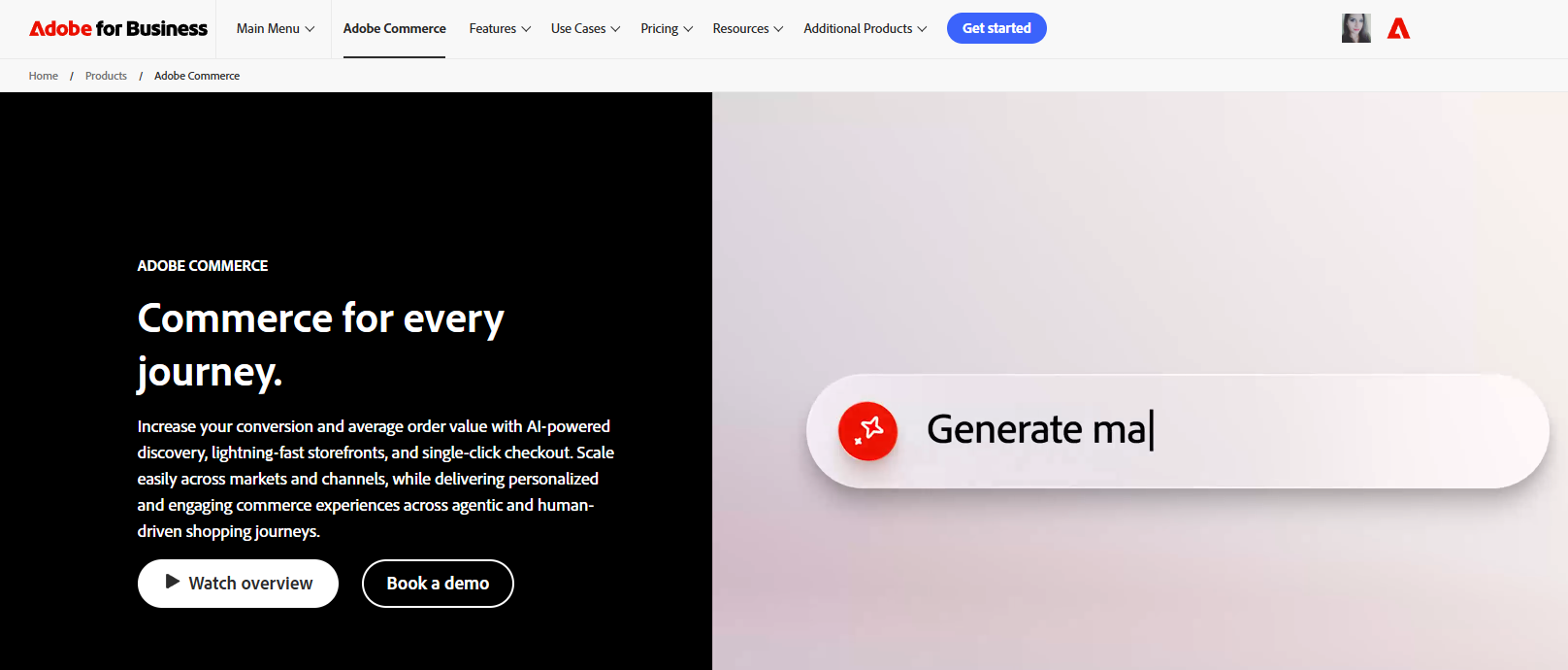
Adobe Commerce, formerly Magento, is an enterprise eCommerce platform for B2B and B2C sellers, delivered as Adobe Commerce as a Cloud Service (also marketed as Adobe Commerce Pro).
According to Adobe, the platform offers a unified catalog supporting more than 250 million SKUs and 30,000 prices per SKU, with full B2B functionality alongside an API first, composable architecture.
It integrates natively with Adobe Experience Manager, Adobe Real-Time CDP, Adobe Analytics, and Marketo Engage, and benefits from one of the most mature partner networks in enterprise commerce.
Learn more about Adobe Commerce competitors.
Best for
Mid-to-large enterprises with in-house development capacity, complex catalog requirements, or existing Adobe stack investments that want B2C and B2B on a single platform with deep customization.
Key features
- B2B module: Company account hierarchies, shared catalogs, purchase orders, requisition lists, and quote-to-order ship with commercial editions, with advanced features for managing large product catalogs.
- Headless and composable options: API-first architecture, GraphQL coverage, and visual authoring support headless setups for teams that want to decouple frontend and backend.
- Adobe ecosystem integrations: Tight handoffs to Adobe Experience Manager for content, Marketo Engage for marketing automation, and Real-Time CDP for unified audiences. Marketing teams get a coherent toolset.
- AI capabilities: AI-powered storefronts, built-in merchandising, GenAI-driven content, and recommendations across category, search, and product pages.
- Extensive documentation: A large global developer community, certified partners, and well-maintained reference docs cut hiring and onboarding friction.
Pricing
Adobe Commerce uses tiered pricing based on gross merchandise value or order volume. List pricing isn’t published; quotes are custom by edition, deployment, and add-ons. First-year totals for full enterprise builds typically reach six figures once cloud hosting and implementation are included.
3. commercetools
commercetools is a popular API-first, headless B2B eCommerce platform built on a microservices architecture.
It pioneered the MACH approach (Microservices, API-first, Cloud-native, Headless) and remains the go-to choice for engineering-heavy teams that want full control over their tech stack.
Learn more about commercetools alternatives.
Best for
Tech-forward enterprises that treat commerce as a competitive differentiator, want full control over their stack and have the engineering depth to run a composable architecture across multiple touchpoints.
A strong fit for product teams that need to launch new channels (mobile, in-store kiosks, voice) on their own release cycle.
Key features
- MACH architecture: Microservices, API-first, cloud-native, and a headless architecture by default. Every capability is an API-accessible service.
- commercetools frontend: A complete tooling package for business users and developers to build and customize digital storefronts at speed.
- Multi-tenant SaaS: commercetools handles infrastructure, scaling, and security. Engineering teams focus on commerce logic, not platform plumbing.
- B2B and B2C on one platform: A single project can serve consumer and business storefronts at the same time, useful for hybrid brands.
- Strong global footprint: Multi-region deployments, multi-currency, multi-language, and tax frameworks support global rollouts with regional data sovereignty options.
Pricing
commercetools uses a SaaS subscription with custom pricing tied to GMV and API call volume across multiple plan tiers. Implementation timelines reflect the composable model: enterprises typically budget six to twelve months for a full build because much of the experience layer is custom.
4. SAP Commerce Cloud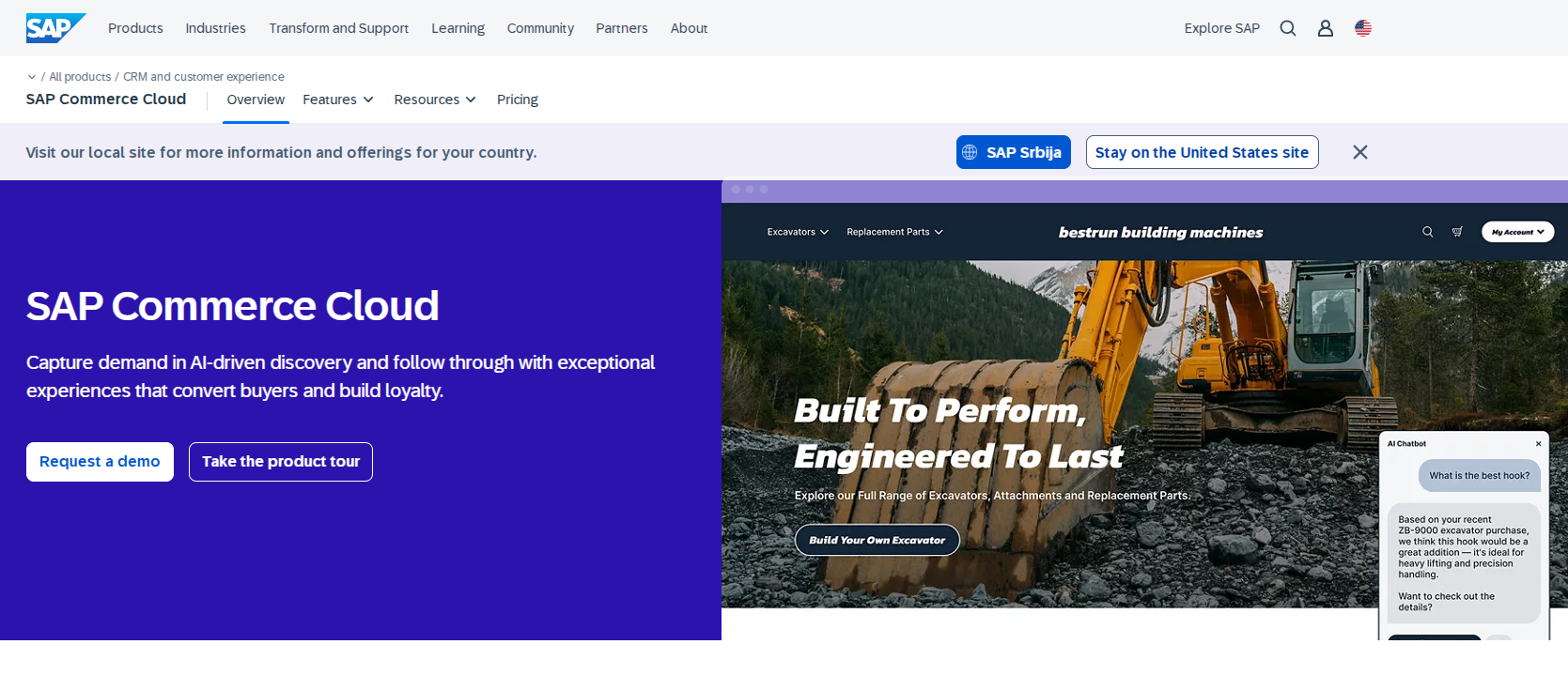
SAP Commerce Cloud, formerly Hybris, is an enterprise commerce platform for B2B and B2C with a strong fit for organizations already running on SAP ERP.
It integrates deeply with SAP S/4HANA, SAP CRM, and the broader SAP business suite, and is used by organizations deeply rooted in the SAP ecosystem.
Predictive analytics tied to SAP data gives enterprises a coherent view across commerce and the back office.
SAP Customer Experience also includes adjacent products like SAP Emarsys, which extends commerce data into campaign management, push notifications, and AI-driven personalization.
Learn more about SAP Commerce Cloud competitors.
Best for
Large enterprises already running on SAP ERP that need complex global B2B operations with deep ties to existing finance, supply chain, and customer data systems inside the SAP estate.
Key features
- Enterprise-grade B2B: Company hierarchies, contract management, complex pricing, multi-catalog support, and approval workflows are core capabilities, not add-ons.
- Tight SAP integration: Native connectors to SAP ERP, S/4HANA, and SAP Customer Experience Cloud cut the integration burden that dominates enterprise budgets.
- Omnichannel customer engagement: SAP Emarsys handles campaign management, push notifications, and AI-driven personalization on top of commerce data.
- Global commerce features: Multi-site, multi-currency, multi-language, and granular tax handling for cross-border manufacturers and distributors.
- Headless storefront: Composable Storefront (formerly Spartacus) gives teams an Angular-based starter for headless setups, with full API access for custom builds.
Pricing
SAP Commerce Cloud uses custom enterprise quotes that vary by deployment scope, region, and existing SAP commitments. Pricing isn’t published but reportedly averages around six figures.
SAP also signaled that mainstream maintenance for some on-premise Hybris versions is winding down through 2026, so many existing customers are planning migrations to the SaaS edition or another modern platform.
5. HCL Commerce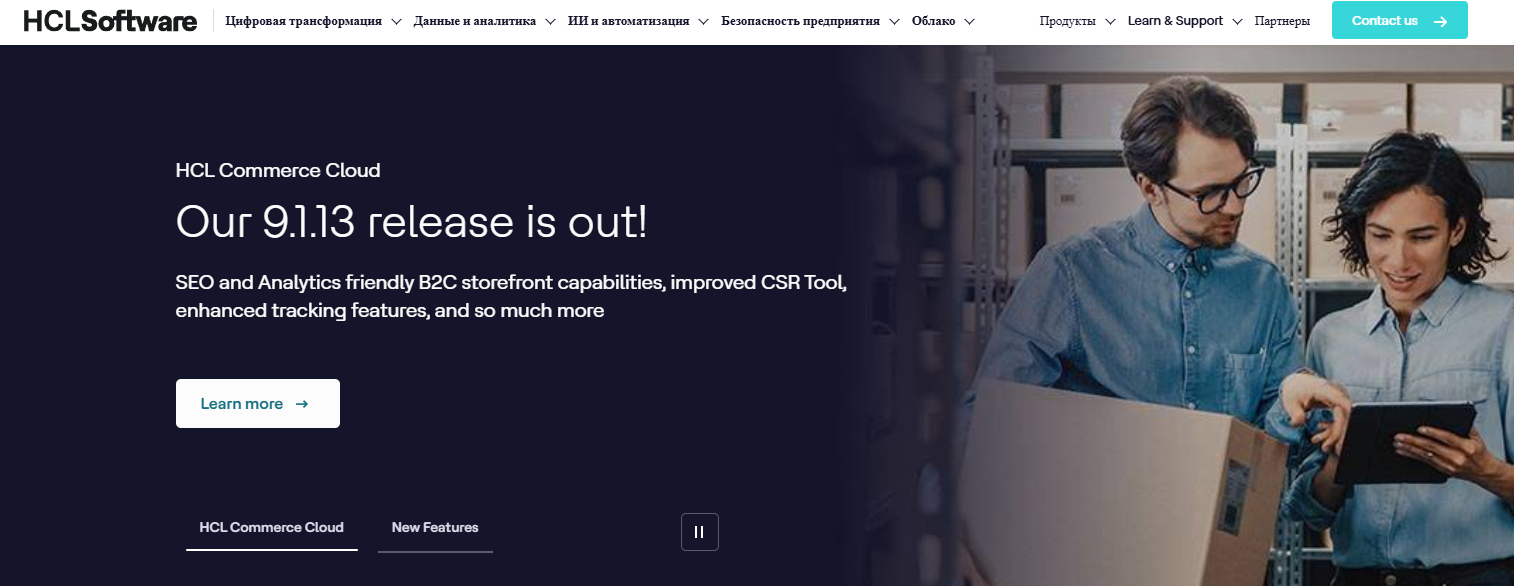
HCL Commerce is an enterprise ecommerce platform from HCLSoftware. It supports B2C, B2B, B2B2C, D2C, and marketplace models on one platform.
The solution combines customizable storefronts, segmented catalogs, role-based pricing, contract management, and workflow approvals.
Unified commerce is built in, with a native clienteling app, click and collect, multichannel promotions, and multi-inventory management and fulfillment.
Best for
Large enterprises in retail, manufacturing, and high tech that need extreme transactional scale and a battle-tested platform supporting thousands of multisites, tens of millions of SKUs, and billions in annual online GMV. Especially organizations in North America and EMEA looking for a bundled, modular suite over an assemble-it-yourself stack.
Key features
- Bundled composability: Base license includes decoupled B2C and B2B storefronts, a CDP, visual page composer, catalog ingestion tool, customer service hub, and marketplace operation application as self-contained modular apps.
- Enterprise-grade scalability: Supports companies with several thousands of multisites, tens of millions of SKUs, and billions of dollars in annual online gross merchandise value.
- Unified commerce: Native clienteling app with extensive capabilities for click and collect, multichannel promotions, multi-inventory management, and fulfillment across channels.
- Deployment flexibility: On-premises or single-tenant SaaS deployment on AWS, GCP, and Microsoft Azure to support data sovereignty and regulated-industry requirements.
Compared with direct competitors, HCLSoftware has a thinner library of prebuilt integrations for search, PIM, OMS, CDP, and personalization, which can extend integration timelines and increase implementation effort. Vertical depth is concentrated in manufacturing and retail, so customers in other industries may find fewer out-of-the-box features and less vendor expertise. AI and automation are also limited today.
Pricing
Final terms are negotiated per contract. Pricing is custom and tied to deployment type, scale, and bundled HCLSoftware products.
How OroCommerce Compares to Salesforce Commerce Cloud for B2B
The core difference comes down to design intent. OroCommerce was purpose-built for B2B manufacturers, distributors, and wholesalers.
Salesforce Commerce Cloud began as a B2C retail platform and expanded its B2B capabilities largely through acquisitions, resulting in an ecosystem that requires multiple cloud licenses to match what OroCommerce delivers under one license, making it cost-effective.
Platform comparison
| Feature | OroCommerce | Salesforce Commerce Cloud |
| Architecture | B2B-native, modular architecture, API-first, open-source | B2C-origin platform with B2B capabilities added via acquisitions |
| Native B2B features | Corporate accounts, RFQ, CPQ, approval workflows, and multi-org hierarchies all included | Often require additional Cloud licenses, technical support or custom development |
| Complex pricing | Tiered, contract, and volume pricing native to the platform | Typically requires a separate Revenue Cloud license |
| Account hierarchies | Full parent-child enforcement and buyer permissions out of the box | Primarily CRM tools; enforcement requires customization |
| Marketplace and B2B2X support | Native multi-vendor marketplace included | Requires third-party extensions (e.g., Mirakl) at added cost |
| AI tools | B2B-focused suite included at no extra cost | Agentforce optimized for retail merchandising; requires clean, structured CRM data |
| ERP & CRM integration | Pre-built connectors; built-in CRM included; free Salesforce CRM connector available | Native Salesforce CRM sync; ERP via AppExchange or custom build |
| Pricing model | Single annual license; no per-site or per-user fees | 1-2% GMV take rate; storage overages billed separately |
| Additional storefronts | Unlimited, included | Extra stores increase the GMV rate by ~0.5% |
| Data storage limits | No hard storage caps | Limits apply; overages incur additional charges |
| Deployment options | Single-tenant SaaS, managed hosting, or self-hosted | Strictly multi-tenant cloud SaaS |
| Customization depth | Open-source; full access to customize without rebuilding core | Proprietary Lightning Web Components; deep changes require certified SF developers |
| Implementation timeline | Faster time-to-launch for complex B2B requirements | Most implementations exceed one year; even provisioning a store can take two weeks |
Licensing: one platform vs. multiple clouds
Activating core B2B functionality on Salesforce typically means licensing Sales Cloud, Service Cloud, Commerce Cloud, Experience Cloud, and Marketing Cloud separately.
Each carries its own cost, architecture, and development requirements.
OroCommerce bundles eCommerce, CRM, CPQ, marketplace, CMS, and AI tools under a single license with no per-site charges as you scale.
When OroCommerce is the stronger fit
- Scaling beyond phone/email ordering into self-service
- Consolidating multiple systems or business units post-acquisition
- Needing complex pricing, catalogs, or marketplace functionality without surprise costs
- Launching multiple storefronts, regions, or D2C sub-brands from one back end
- Wanting deployment flexibility and full control over infrastructure and data
Customer results
| Customer | Industry | Outcome |
| Braskem | Petrochemical Manufacturing | +13% satisfaction, 22k+ work hours saved, 12k+ orders/month |
| Lactalis | Food Manufacturing | +230% digital orders, 44% fewer manual processes, 12 markets on one platform |
| PartsBase | Aviation Marketplace | 33% higher AOV, 130% YoY PartStore revenue growth |
| Azelis | Chemical Distribution | 150 portals live, serving over 200 markets |
Using Salesforce CRM? Connect OroCommerce at no cost and keep your Sales Cloud setup.
Migrating From Salesforce Commerce Cloud: What B2B Teams Should Know
A platform migration is a strategic project, not a swap. Teams that succeed scope it explicitly and treat data, integrations, SEO, and rollout patterns as separate workstreams. Here’s what to plan for when you move off Salesforce Commerce Cloud.
Common migration triggers
- Rising GMV-based licensing costs as transaction volume grows. That makes multi-year budgeting harder for finance teams.
- Persistent B2B feature gaps that require ongoing custom development or AppExchange add-ons to support core workflows like contract pricing, RFQ, or multi-step approvals.
- Salesforce ecosystem dependency that locks the commerce roadmap to broader Salesforce decisions, including pricing changes, feature retirements, and licensing for adjacent products like Service Cloud or Marketing Cloud.
Data migration scope
A complete data migration off Salesforce Commerce Cloud typically covers six categories. Scope each one separately and confirm record counts on both sides before cutover.
- Products and product catalogs, including variants, media, and customer-specific assortments. Confirm catalog size on both sides; identical counts can hide attribute mismatches.
- Customer accounts, including corporate hierarchies, buyer roles, and contact records.
- Order history, including line items, status, fulfillment data, and any returns or RMA records.
- Pricing rules, including price books, customer-specific price lists, contract pricing, and tier discounts. Missed rules can produce additional costs in customer service follow-up after launch.
- CMS content, including category pages, marketing landing pages, and any blog or resource content.
- Customer authentication, loyalty, and saved-cart data, depending on whether the new platform supports equivalent constructs.
SEO considerations
SEO is usually the silent risk in a replatform. Treat it as a first-class workstream alongside data and integrations.
- URL structure: map every existing URL to its new path. Where possible, preserve the slug to minimize redirect chains.
- 301 redirects: implement permanent redirects for every changed URL on day one of cutover, including category, product, and resource pages.
- Maintaining organic traffic: monitor Google Search Console, server logs, and rank tracking for at least 90 days after launch. Expect a short dip and budget engineering time to react.
- Schema, sitemaps, and canonical tags: regenerate from the new platform and resubmit to Google Search Console immediately.
Integration re-mapping
Every ERP, CRM, and PIM connection must be rebuilt for the new platform. AppExchange dependencies are easy to overlook because they look native inside Salesforce.
- Inventory every active integration: ERP, CRM, PIM, OMS, payment, tax, shipping, and any AppExchange add-ons.
- Map each integration to its replacement: prebuilt connector, API-based custom integration, or middleware.
- Identify any AppExchange functionality (workflows, automations, marketing tools) that won’t move and plan replacements before cutover.
- Test integrations under load before go-live. Production-equivalent volumes surface latency issues that staging often hides.
Phased migration vs. big-bang cutover
Two viable rollout patterns exist. Pick the one that matches your operational risk tolerance, not the one that’s easier to plan.
- Phased migration: Move customer segments, regions, or business units one at a time. Reduces blast radius if something fails, but extends the period when two systems run in parallel. Best for organizations with multiple brands, regions, or buyer segments.
- Big-bang cutover: Move every customer onto the new platform on a single date. Eliminates parallel-systems cost but concentrates risk into one weekend. Best for organizations with one storefront and a tight integration footprint.
Conclusion About Salesforce Commerce Cloud Alternatives
Choosing a Salesforce Commerce Cloud alternative is less about ranking platforms and more about matching architecture and pricing to how your business actually operates.
OroCommerce, Adobe Commerce, commercetools, SAP Commerce Cloud, and HCL Commerce each represent a distinct philosophy: B2B-native unified commerce, customizable enterprise depth, composable api first flexibility, deep SAP integration, and proven multi-model scale.
Match the philosophy to your operating model, then validate it with a hands-on proof of concept against your real customer journeys and workflows. You’ll end up with a platform that compounds value rather than constraining it.
Want to see what a B2B-native unified commerce platform looks like in practice?
FAQs About Salesforce Commerce Cloud Alternatives
What are the best Salesforce Commerce Cloud alternatives for B2B in 2026?
The best Salesforce Commerce Cloud alternatives for B2B in 2026 are OroCommerce, Adobe Commerce, commercetools, SAP Commerce Cloud, and HCL Commerce. OroCommerce is the most B2B-native, Adobe Commerce offers the deepest customization, commercetools leads on composable architecture, SAP fits SAP-led estates, and HCL Commerce handles extreme transaction volume.
Why are companies looking for Salesforce Commerce Cloud alternatives?
Companies look for Salesforce Commerce Cloud alternatives because of GMV-based pricing that scales with revenue, implementation timelines of three to six months, and a B2C-derived data model that requires customization for true B2B workflows. Modern alternatives offer predictable licensing, native B2B features, and faster deployment.
How much does Salesforce Commerce Cloud cost compared to alternatives?
Salesforce Commerce Cloud uses tiered pricing typically based on a percentage of annual gross merchandise value, plus implementation fees that can run into six figures in year one. Alternatives like OroCommerce charge fixed annual fees based on GMV bands without per-order transaction fees, often producing lower three-year TCO for high-volume B2B sellers.
Is Adobe Commerce better than Salesforce Commerce Cloud for B2B?
Adobe Commerce often outperforms Salesforce Commerce Cloud for B2B because its native B2B module includes shared catalogs, requisition lists, quote workflows, and company hierarchies out of the box. Salesforce Commerce Cloud requires more configuration to match the equivalent B2B depth. Adobe is also more flexible architecturally for headless and composable setups.
What is the difference between Salesforce Commerce Cloud and OroCommerce?
The main difference is design intent. Salesforce Commerce Cloud was built for B2C and extended for B2B. OroCommerce was built ground-up for B2B from day one. OroCommerce includes commerce, CRM, and CPQ on one license, while Salesforce sells these as separate product modules across Sales Cloud, Service Cloud, and Commerce Cloud.
Can small businesses use these Salesforce Commerce Cloud alternatives?
Most of these platforms target mid-market and enterprise buyers, not small businesses. OroCommerce’s free Community Edition is the most accessible entry point for smaller teams with developer resources. Smaller B2B sellers without engineering capacity are usually better served by SaaS platforms purpose-built for that segment rather than scaled-down enterprise tools.