navigation

Adobe Commerce (formerly Magento) is one of the most recognized names in eCommerce. Built on open-source foundations and connected to the Adobe Experience Cloud, it covers catalog management, checkout customization, and marketing tools.
But for many B2B organizations, the platform’s B2C-first architecture, rising total cost of ownership, and steep learning curve make it hard to justify, especially as more purpose-built alternatives have matured.
This article compares five leading Adobe Commerce competitors through a B2B lens. For each platform, we will cover B2B feature depth, pricing model, integration capabilities, and scalability.
If you’re exploring the B2B ecommerce market more broadly, our B2B eCommerce blog is a good place to start.
What to Look for in Adobe Commerce Competitors for B2B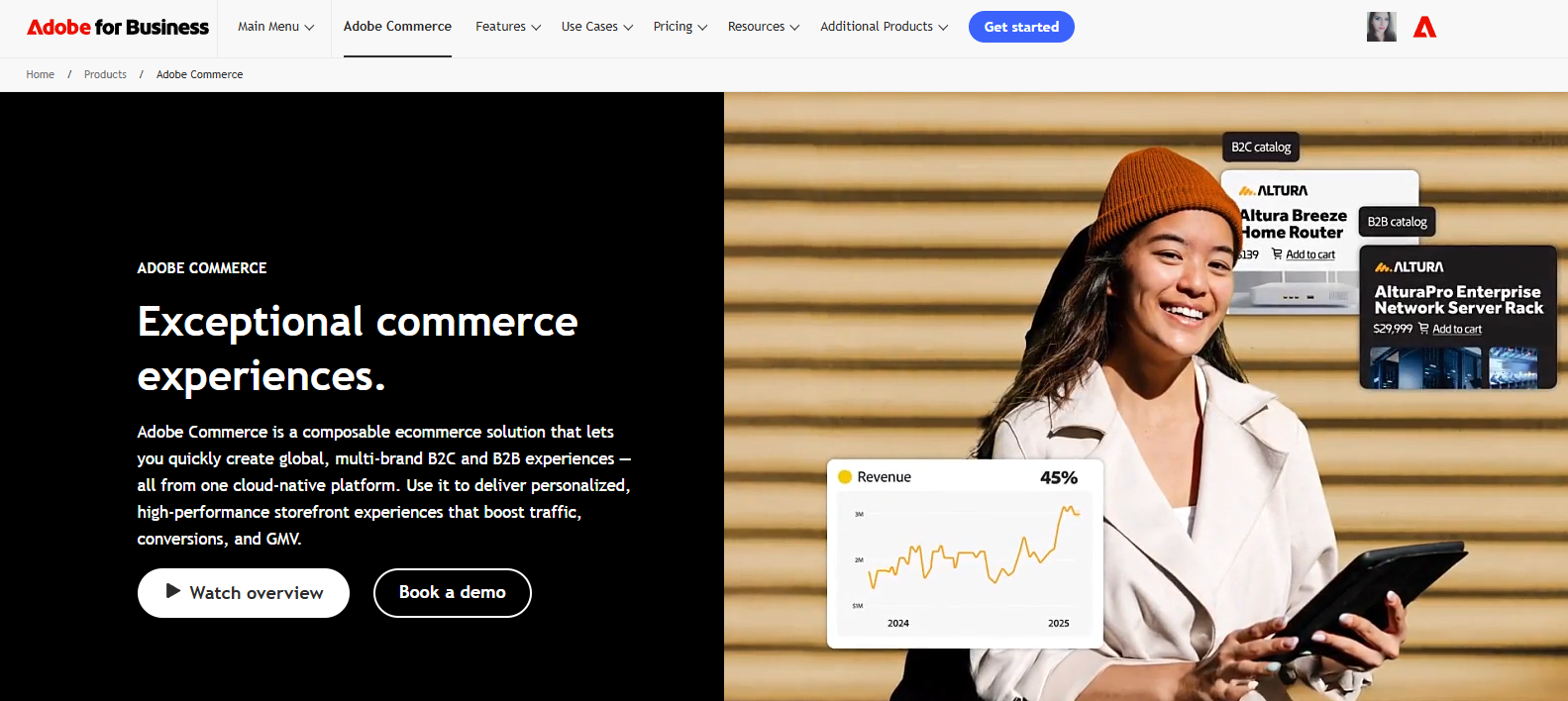
Not every eCommerce platform is built for the same type of business. What works for a direct-to-consumer brand managing a simple online store won’t cut it for a manufacturer handling hundreds of buyer accounts with complex pricing and procurement rules.
When you’re evaluating Adobe Commerce competitors for B2B, these are the criteria that matter.
| Criterion | B2B Requirement | Key Considerations |
| Pricing flexibility | Support for custom pricing, tiered structures, contract-based discounts, and distinct prices for different customer segments | Platforms limited to a flat catalog price can’t support real B2B pricing complexity |
| Account management | Multi-buyer accounts, approval workflows, purchase orders, and delegated buying authority | Buyers expect the same structured procurement controls they have in offline purchasing |
| AI | AI tools that work with live commercial data, such as contract pricing, inventory permissions, and account-specific catalogs. | Most platform “AI” is chatbots reading FAQs. Real B2B AI sees contract pricing and processes 700-line POs in seconds |
| Native B2B workflows | RFQ, quote negotiation, approval chains, and purchase order flows built into the platform | Platforms that treat these as add-ons force you to pay for capabilities that should exist by default |
| Multi-site, multi-brand, multi-geo | Run multiple regions or brands from one backend with shared data where needed, separated where required | Azelis runs 150 portals on one instance. Most platforms force you to duplicate everything or lose control |
| ERP, CRM & PIM integration | Seamless integration with existing business systems without heavy reliance on third-party solutions | Evaluate native connectors vs. custom middleware. See OroCommerce’s ERP integration as a benchmark |
| Catalog complexity | Large SKU counts, configurable products, and customer-specific assortments | Strong product catalog management is essential; most B2C-oriented platforms handle this poorly |
| Self-service buyer portals | Portals that let buyers reorder, manage accounts, and track shipments independently | Self-service capabilities drive repeat purchases and reduce sales team overhead without adding headcount |
| Total cost of ownership | Full five-year cost including licensing, implementation, development resources, and maintenance | Consult the TCO guide before shortlisting. Licensing is only one line on the invoice |
Adobe Commerce Competitors at a Glance
The table below gives you a quick read on all five platforms. Each entry reflects the platform’s primary strength and B2B fit.
| Platform | G2 Rating | Best For | Top B2B Feature | Starting Price |
| OroCommerce | 4.3/5 | B2B manufacturers, wholesalers & distributors | Embedded payments, workflows, CRM, CPQ, AI, invoicing capabilities, granular roles & permissions controls. | Custom (contact sales) |
| Shopify Plus | 4.4/5 | B2C brands expanding into wholesale | User-friendly B2B storefront | From $2,300/month |
| Salesforce B2B Commerce | 4.4/5 | Salesforce-native enterprise teams | CRM-connected commerce | Custom |
| BigCommerce B2B Edition | 4.2/5 | Mid-market B2B sellers | Open API + headless flexibility | Custom (enterprise add-on) |
| Commercetools | 4.6/5 | Tech-forward enterprises | MACH composable architecture | Custom |
5 Top Adobe Commerce Competitors in 2026
Each platform on this list takes a different approach to commerce, and the right choice depends entirely on how your B2B operation is structured. Here’s a quick read on all five before we get into the details:
- OroCommerce: purpose-built for B2B from the ground up, with every core feature (CPQ, RFQ, account hierarchies, ERP connectors) available under a single license and no third-party extensions required. Get a demo of OroCommerce to see it in action.
- Shopify Plus: a suitable option for brands that sell to both B2C and wholesale buyers and want a fast, accessible platform with a large app ecosystem.
- Salesforce B2B Commerce: built for enterprise teams already running on Salesforce who want to extend their CRM investment directly into digital commerce. (B2B-specific platforms with Salesforce connectors offer an alternative.)
- BigCommerce B2B Edition: a flexible, API-first platform for mid-market B2B sellers that need more customization without committing to a fully composable build.
- Commercetools: a headless, MACH-architecture platform for tech-forward enterprises that want complete control over their commerce stack and have the engineering team to build it.
Here’s what you need to know about each one.
1. OroCommerce
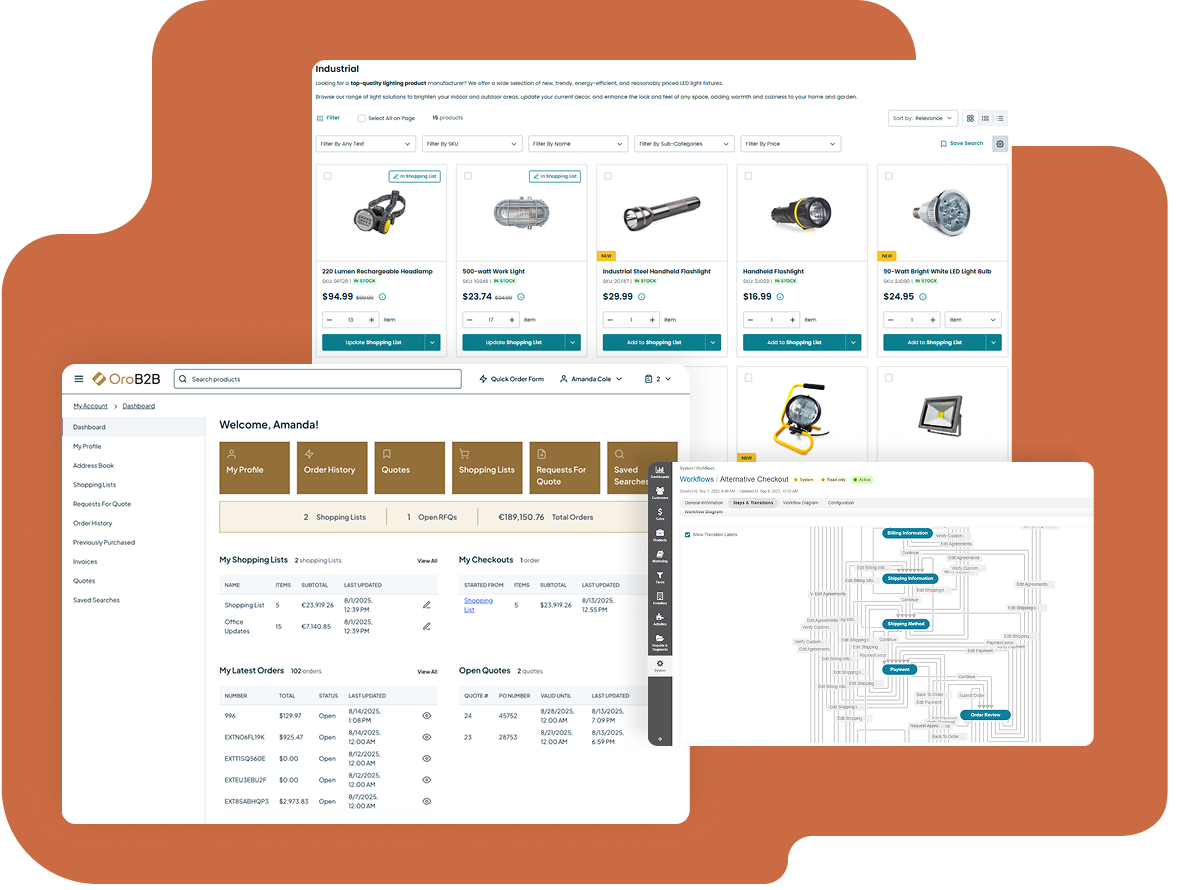
Built specifically for complex B2B operations, OroCommerce, a unified B2B eCommerce platform for manufacturers, distributors, and wholesalers, is one of the leading B2B solutions on the market.
While many platforms adapt B2C architectures to serve B2B buyers, OroCommerce was built from day one around the pricing complexity, buyer relationships, and procurement workflows that B2B commerce demands.
Every essential B2B capability (CRM, CPQ, workflow automation, AI, payments, and invoicing) ships under a single license.
Every one of those features is delivered as capabilities natively rather than through bolt-on extensions, giving organizations an all-in-one eCommerce platform that removes the integration overhead that drives up costs in competing solutions.
Get a demo of OroCommerce to explore how it handles your specific B2B workflows.
Best for
Mid-market and large enterprises with genuine B2B complexity: custom pricing, multi-tier account hierarchies, approval-driven purchasing, RFQ and CPQ workflows, high-SKU catalogs, multiple brands or regional storefronts, and deep ERP integration requirements.
See how manufacturers and distributors like Azelis and Lactalis put OroCommerce to work.
Key features
- Corporate account hierarchies with buyer roles and approval workflows built in as core capabilities
- Flexible price list engine supporting customer-specific, tier-based, contract-based, and location-aware custom pricing
- Native RFQ (request for quote) and embedded CPQ workflows within the same license
- Built-in CRM with account and opportunity management, functioning as a native customer data platform across the full sales cycle
- Native ERP connectors for SAP, Microsoft Dynamics, NetSuite, and Oracle, with no third-party middleware required
- Strong product catalog management and PIM capabilities for complex product data at scale
- Out-of-the-box AI capabilities designed specifically for B2B use cases
- Multi-website, multi-warehouse, and multi-organization support for global markets and multiple brands
- Open API and headless commerce readiness for composable architecture builds
- SaaS cloud or self-hosted deployment for regulated industries, with no per-transaction fees
Pricing
OroCommerce uses tiered pricing based on GMV transacted through the platform and deployment model.
Its one-platform, one-license approach (combining commerce, CRM, and CPQ) delivers a highly competitive total cost of ownership compared to platforms that require separate licensing for each capability.
That single-license model is one of OroCommerce’s sharpest differentiators from Adobe Commerce, where B2B functionality often means stacking extensions and their associated costs.
Ready to see OroCommerce in action? Explore how it handles your specific B2B workflows
2. Shopify Plus B2B
Shopify Plus is the enterprise tier of Shopify, one of the most widely deployed eCommerce software platforms globally. It gives large-volume online businesses a user-friendly platform for managing high-volume transactions, multiple brands, and B2B wholesale channels alongside their B2C operation, all under one roof.
Read our guide on Shopify Plus alternatives to learn more.
Best for
B2C-first brands that want to sell online to both direct consumers and wholesale buyers on the same platform. You’ll get easy setup, fast time-to-market, and access to many third-party tools right away.
Teams without deep technical expertise benefit especially from Shopify’s drag-and-drop editor and user-friendly interface for storefront customization. That said, if your B2B requirements include complex approval flows or multi-tier pricing across hundreds of accounts, you’ll likely hit its limits.
Key features
- Native B2B wholesale portal with account-specific custom pricing and customer group management
- Drag and drop storefront editor enabling customization without technical expertise or custom coding
- Built-in loyalty programs, marketing tools, and point of sale integration through the Shopify app marketplace
- Multi-currency and multi-region support for serving global markets across a single eCommerce store
- Analytics tracking average order value, conversion rates, and customer lifetime trends across accounts
- Headless commerce readiness via Storefront API for custom front-end builds using third-party tools
Pricing
From $2,300/month on a 3-year term, or $2,500/month on a 1-year term. High-volume merchants above $800,000/month in sales move to variable, revenue-based pricing. Enterprise plans are negotiated directly with Shopify.
3. Salesforce B2B Commerce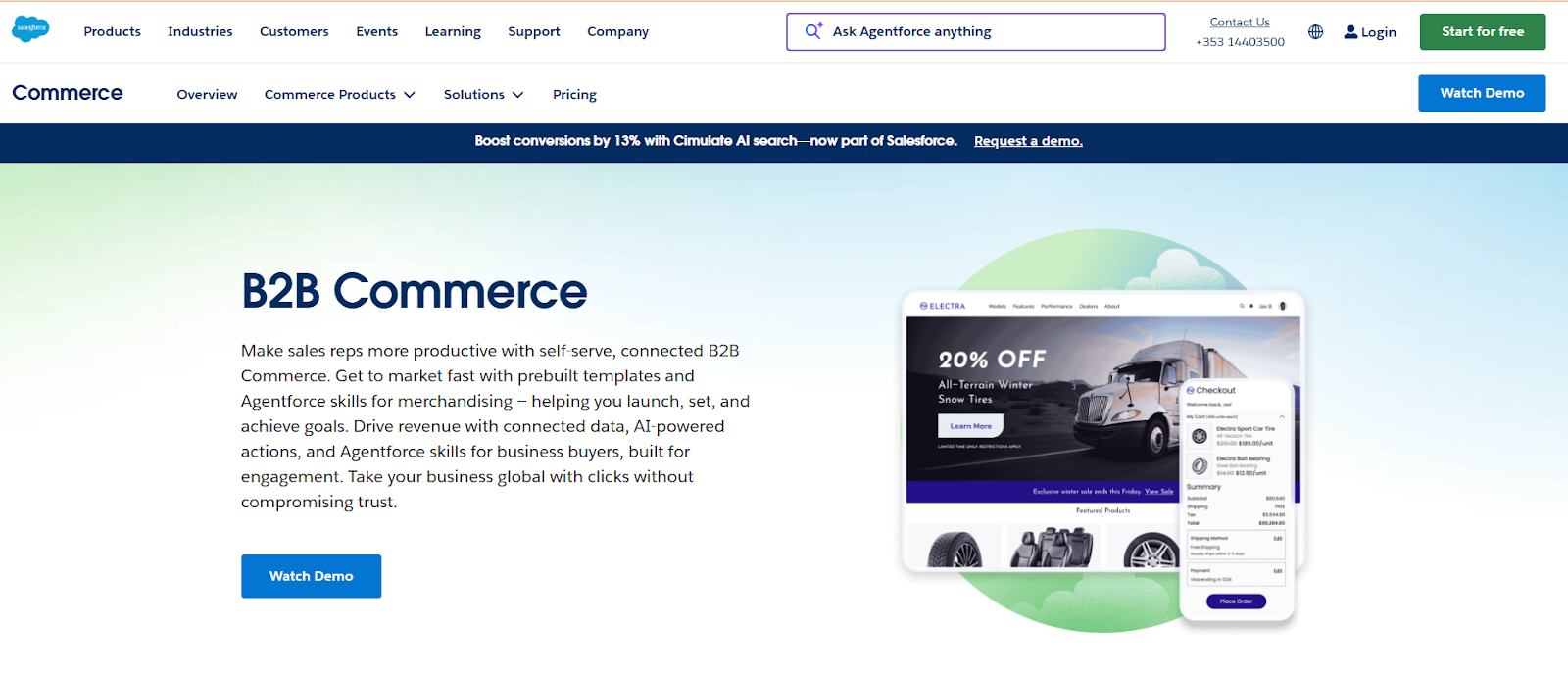
Salesforce B2B Commerce is part of the wider commerce cloud suite within the Salesforce platform.
Built for enterprise businesses already operating in Salesforce, it connects commerce data with Sales Cloud and Service Cloud. Revenue teams get real-time data on customer journeys, purchase history, and account health, all in one place.
Salesforce B2B Commerce and Salesforce B2C Commerce are separate products with distinct technology foundations, though both sit within the Salesforce ecosystem.
Teams managing both buyer types will typically need both products, but they can share CRM, reporting, and customer data on the same platform.
Best for
Organizations that have invested heavily in Salesforce CRM and want to extend that into digital commerce.
It’s well-suited for teams coordinating marketing efforts, personalized messages, and marketing campaigns across the full buyer lifecycle, with unified data flowing between sales, service, and commerce operations.
Key features
- Native CRM integration with Sales Cloud and Service Cloud for unified data across all revenue functions
- Account-based pricing and customer-specific catalog configurations for distinct customer segments
- Self-service B2B customer portal with reorder capabilities and full order management tools
- AI-based predictive insights via Einstein for individualized campaigns, mobile push, and web push communications
- Real-time customer data sync that powers targeted marketing messages and customized outreach across accounts
- Customer loyalty tracking and customer lifetime value measurement built into the platform
Pricing
Custom enterprise pricing applies, and implementation costs vary widely depending on scope. Budget carefully, as Salesforce projects often run well above initial estimates without an experienced partner.
4. BigCommerce B2B Edition
The BigCommerce platform is a SaaS-based eCommerce solution that has made a deliberate push into B2B commerce with its B2B Edition.
Its open API architecture makes it a flexible choice for businesses that need custom integrations without committing to a fully headless build from scratch.
Among SaaS platforms in the mid-market B2B space, it sits between the simplicity of Shopify Plus and the complexity of an enterprise composable build.
Read our article on BigCommerce alternatives to learn more.
Best for
Mid-market eCommerce business operations that need more flexibility but don’t need a full enterprise B2B platform. BigCommerce suits companies with a developer-friendly culture and the in-house capacity to extend basic features through its API and partner network.
Key features
- Tiered pricing and customer-group discounts for distinct customer segments across large buyer accounts
- Quote management and custom pricing workflows supporting high-value B2B order management
- Headless-ready open API architecture for building custom front-end experiences across multiple channels
- Native ERP integration with NetSuite, SAP Commerce Cloud, and major third-party systems via seamless integration connectors
- Built-in SEO tools to drive organic traffic growth without requiring additional third-party apps
- Multi-storefront support for managing multiple brands or regional ecommerce stores from a single admin
Pricing
BigCommerce B2B Edition is a custom enterprise add-on that bundles BigCommerce’s Enterprise plan with the B2B Edition app. Enterprise base plans start from approximately $1,000/month; B2B Edition pricing is negotiated on top of that based on GMV and business requirements.
5. Commercetools
Commercetools is a composable commerce platform built on MACH architecture (Microservices, API-first, Cloud-native, and Headless).
It operates as a platform-as-a-service for large enterprises that want complete control over their commerce architecture without being locked into a monolithic system.
For online businesses that have outgrown packaged platforms and need a fully custom commerce stack, Commercetools offers a flexible foundation.
Best for
Tech-forward large enterprises with dedicated engineering teams who want to design a commerce experience entirely from composable components.
Commercetools supports global markets, multiple brands, and omnichannel deployments at scale for businesses with the technical expertise and development resources to leverage that flexibility.
It’s not the right fit if your team doesn’t have strong in-house engineering capacity.
Key features
- Composable API-first architecture giving enterprise teams complete control over the entire commerce stack
- Configurable product and pricing APIs supporting custom pricing rules and account-level catalog structures
- Multi-tenant and multi-region infrastructure built for consistent operation across global markets
- Headless front-end separation for unified deployment across web pages, mobile, and in-store channels
- Composable integration layer for connecting third-party tools and custom-built services without monolithic dependencies
- Platform as a service delivery model with usage-based scaling and no forced upgrade cycles
Pricing
Custom enterprise pricing based on transaction volume, usage tier, and support level.
How OroCommerce Compares to Adobe Commerce for B2B
When comparing OroCommerce directly against Adobe Commerce for a B2B operation, the table below covers the criteria that tend to drive the decision.
| Criterion | OroCommerce | Adobe Commerce |
| Architecture | B2B-first, purpose-built | B2C-first, adapted over time |
| Native B2B features | RFQ, CPQ, approval workflows, and account hierarchy (all available natively) | Extensions required for most B2B workflows |
| Price management | Customer-specific, contract, tiered, volume, and negotiated pricing out of the box, synced with ERP data | Built-in customer-specific lists, tiered/volume with units of measure individual contracts, negotiated rates |
| AI for B2B | OroIQ connected to live pricing, inventory, and account permissions; enables intelligent self-service and back-office automation | AI-powered search and recommendations available; not connected to B2B account data by default |
| ERP/CRM integration | Built-in connectors; SAP ERP, Microsoft Dynamics, NetSuite, Oracle, and others via documented connectors | Integration Starter Kit for Dynamics/SAP |
| Total cost of ownership | Lower for pure B2B; all core tools included | High and growing (extensions, dev, support) |
| Scalability | Enterprise-ready scalable eCommerce platform architecture | Enterprise-ready at a significantly higher cost |
The key difference is architectural. OroCommerce was made for B2B from day one. Adobe Commerce started as a B2C platform and layered B2B capabilities on top through extensions and acquisitions, which added complexity, licensing overhead, and maintenance risk over time.
OroCommerce’s unified B2B solutions bring catalog management, CRM, workflow automation, and self-service tools into one environment.
Adobe Commerce typically needs Adobe Experience Manager for content, Adobe Analytics for reporting, and extra paid extensions for B2B workflows. Each addition means more licensing costs and more integration to maintain.
That Adobe Experience Cloud dependency adds up fast. Teams building on Adobe Commerce are effectively committing to a growing stack of products, and the total cost of ownership gap versus OroCommerce widens significantly.
See how OroCommerce handles your specific B2B requirements.
Migrating from Adobe Commerce: What B2B Teams Should Know
Migration from Adobe Commerce is becoming more common. Three triggers come up again and again: rising maintenance costs, end-of-life risk on older Magento versions, and persistent B2B feature gaps. Teams dealing with any of these are usually maintaining a fragile stack of extensions and custom code just to keep things running.
Data migration scope
A full migration covers products, customer accounts, order history, pricing rules, and CMS content. For B2B operations, migrating account hierarchies and customer-specific pricing rules is often the most technically demanding workstream.
How well your team executes this directly affects conversion rates during and immediately after the transition period.
SEO considerations
Migrating your eCommerce website without a thorough plan for URL mapping, 301 redirects, and canonical tags can significantly harm organic traffic. SEO planning should run in parallel with the platform build, not as a post-launch cleanup task.
Preserving your existing URL structure and page performance protects the ranking value your current web pages have accumulated.
Integration re-mapping
Every ERP, CRM, and PIM connection needs to be rebuilt on the new platform. OroCommerce’s ERP integration documentation is a good place to start. You’ll also want to check which third-party systems relied on Adobe Commerce-specific extensions, as those will need alternatives.
Phased migration vs. big-bang cutover
A phased approach is lower risk but means running two systems in parallel for a while, which costs time and money. A big-bang cutover is faster but puts everything on a single go-live date.
For most B2B organizations managing complex customer segments, multi-tier pricing rules, and large account structures, a phased approach is the lower-risk path. Your business model, particularly how critical uninterrupted order flow is, should drive this decision.
Conclusion About Adobe Commerce Competitors for B2B
All five platforms are solid options, but they’re built for different situations:
- OroCommerce is the strongest purpose-built B2B option, delivering native capabilities for complex buyer relationships, catalog depth, workflow automation, and self-service without requiring a layer of extensions. Its unified B2B solutions make it the platform of choice for manufacturers, distributors, and wholesalers with serious B2B requirements.
- Shopify Plus suits online businesses that want to sell across B2C and wholesale channels on an accessible, high-performance platform with limited B2B complexity.
- Salesforce B2B Commerce fits organizations deeply embedded in the Salesforce Commerce Cloud environment that want to extend their existing CRM investment into digital commerce with tight customer data alignment.
- BigCommerce serves mid-market B2B sellers who need open API flexibility and developer-friendly customization without the overhead of a fully composable build.
- Commercetools is the right choice for tech-forward enterprises that need complete control over their commerce architecture and have the engineering capacity to build and maintain it.
Before shortlisting any platform, thoroughly audit your B2B requirements: catalog complexity, account structure, integration scope, and total cost over a three-to-five-year horizon.
Customer loyalty, business growth potential, and the ability to serve new markets all depend on choosing a platform that matches your actual business needs. Don’t settle for one that asks your team to work around its limitations.
The best eCommerce platform for a B2B operation is the one that best matches your buying model.
If your business needs are rooted in B2B complexity, see what a purpose-built B2B platform enables.
FAQs About Adobe Commerce Competitors
What is the biggest difference between Adobe Commerce and purpose-built B2B competitors?
Adobe Commerce built its B2B features on top of a B2C foundation, which means limited features are available natively for the workflows B2B teams actually need. Platforms like OroCommerce ship RFQ, approval workflows, account hierarchies, and contract pricing as core capabilities from day one. That keeps implementation costs down and reduces long-term maintenance overhead.
Is Shopify Plus a good fit for B2B eCommerce?
Shopify Plus works well for brands that add a wholesale channel alongside their B2C channel. However, companies with complex account hierarchies, approval-based procurement, or granular pricing needs will require custom development or third-party apps, which raises the total cost of ownership over time.
How does Commercetools differ from Adobe Commerce?
Commercetools gives enterprises complete control over their commerce stack through a headless, API-first architecture. The advanced features and flexibility are real, but so is the engineering investment. It takes significant development resources and ongoing technical support to run, which is a different proposition from Adobe Commerce’s more packaged approach.
What should B2B companies prioritize when evaluating eCommerce platforms?
Focus on native B2B features, such as custom pricing, account management, and RFQs, along with depth of ERP and CRM integration, catalog management, and total cost of ownership over multiple years. Platforms that handle B2B requirements natively reduce your reliance on custom coding and keep long-term costs in check.
How complex is migrating from Adobe Commerce to another platform?
It depends on your catalog size, the number of customer accounts, and the number of live integrations you’re running. The main workstreams are data migration, SEO preservation (URL mapping, 301 redirects), and integration re-mapping.