
navigation

Wholesale, manufacturing, and distribution teams sell across multiple channels. At the same time, they manage inventory, orders, and customer data. When your systems don’t sync, you get outdated info, frustrated customers, and costly errors.
A unified commerce platform pulls sales channels, customer details, and pricing rules into one centralized platform. It also links to inventory, warehouse, and ERP systems, so the whole business stays on the same page.
Done right, this comes down to three things for your stakeholders: accuracy, efficiency, and scalability. Every team works from the same data, spends less time reconciling it, and the platform grows with you instead of adding complexity.
This article covers how unified commerce platforms work, the benefits of unified commerce, and what a unified commerce strategy does for B2B companies.
You can also read more on what unified commerce means for B2B if you want the fuller picture before diving in.
Key Takeaways
- A unified commerce platform runs pricing, inventory, orders, and customer data from one system instead of syncing separate tools.
- The goal is accuracy, efficiency, and scalability: consistent data, less manual reconciliation, and a platform that grows without added complexity.
- Unified commerce differs from omnichannel because it removes the reconciliation layer entirely, rather than just connecting separate systems.
- Getting there takes executive sponsorship, disciplined vendor selection, and a phased rollout, not a rip-and-replace.
OroCommerce is built for exactly this kind of unification. It runs a single source of transactional truth across CRM, Quote-to-Cash, PIM, and order management, so sales, service, operations, and finance all work from the same data at the moment decisions get made.
That’s what lets manufacturers and distributors cut manual work, speed up order cycles, and scale into new markets without rebuilding their tech stack each time.
See how it fits your workflows and book a demo today.
The Basics Of The Unified Commerce Platform
Most setups patch together separate tools. A unified commerce platform works differently: it’s a single platform, a unified system for your entire operation.
It centralizes commerce logic. Pricing, inventory, and approvals get calculated in one place, so the buyer experience stays consistent whether an order comes through a web portal, a sales rep, or physical stores.
This unified approach touches every part of the entire business, not just the storefront.

Why disconnected systems break down
B2B buyers expect accurate contract pricing, real-time data on stock levels, and self-service order management. These rising customer expectations are exactly why unified commerce matters more today than ever.
Here’s the problem. When customer and sales data sits in the CRM, pricing lives in the ERP, and inventory runs separately, your customer service teams end up checking three systems just to answer one question.
Orders stall because nothing verifies credit limits, contract terms, or availability in one place.
The breaking point comes during growth
- Acquisitions drag for years because of incompatible backend systems and tech debt
- New markets launch slowly because every region rebuilds the same experience from scratch
- Leadership can’t get accurate inventory and financial reporting across the operation
According to Gartner’s research on infrastructure technical debt, enterprises typically spend around 40% of their IT budget maintaining and working around technical debt in aging, disconnected systems. That’s the tech debt tax a unified platform eliminates.
A unified commerce solution runs pricing, inventory, sales, approvals, and the customer journey from one platform. Reconciliation disappears, and improved operational efficiency becomes the default.
Why best-of-breed backfires
Buying separate tools for each need (a storefront, an RFQ process, an approvals system) feels flexible at first. You pick the “best” of multiple tools for each job.
Over time, though, those tools stop running as one system. You end up stitching them together with APIs or middleware that break on every vendor update. Data syncs fall behind and real-time accuracy starts to slip.
Implementing unified commerce instead means your whole team works from the same consistent data:
- Customer service sees what sales promised
- Warehouse teams fulfill orders based on real-time inventory
- Finance closes the books faster with automatically structured transaction data
This is why unified commerce is becoming key for B2B operations today.
Download this short self-assessment to to get an objective read on your commerce tech stack.
Unified commerce vs. omnichannel
| Omnichannel | Unified Commerce | |
|---|---|---|
| Data | Separate systems, synced via integrations | One real-time source of truth |
| Consistency | Channels connected, but can drift out of sync | Every channel reads and writes the same data |
| Maintenance | Ongoing middleware upkeep | No reconciliation layer to maintain |
Unified commerce vs omnichannel is the comparison B2B buyers ask about most. Omnichannel commerce connects channels so customers can move between them, but the underlying systems often stay separate.
So how does unified commerce differ?
A unified commerce experience runs across every channel, including self-service portals, sales rep orders, mobile apps, and any in-store or will-call interaction, off a single real-time data layer.
There’s no batch sync. There’s no risk of a counter rep quoting a price that doesn’t match the portal.
For companies weighing unified commerce vs omnichannel, the deciding factor is operational. Unified commerce eliminates the reconciliation work that omnichannel setups still require.
For more details, see a full breakdown of unified commerce vs. omnichannel.
The Orchestration Layer: One Set of Rules, Everywhere
The unified commerce platform acts as the orchestration layer between customer experience and ERP. All data flows through it in real time:
- Corporate account hierarchies
- Product catalogs and specs
- Pricing rules and contract terms
- Inventory levels at every location
- Order history and status updates
Because unified commerce integrates teams onto the same source, this is effectively a unified data model: one schema for accounts, pricing, and inventory that every channel reads and writes to.
This unified data model is what improves sales performance across every channel.
You can explore unified commerce architecture in more depth to see exactly how this data layer holds together.
Business rules apply everywhere automatically:
- Volume-based pricing tiers
- Customer-specific discounts
- Multi-level approval workflows
- Credit limit checks
- Territory restrictions
You configure the rule once. It runs across the web portal, sales orders, and customer service with no extra setup.
Unified B2B Commerce Platform Capabilities at a Glance
| Capability Area | What It Includes | Why It Matters for B2B Buyers |
|---|---|---|
| Unified customer relationship hub | Centralized customer portals for ordering, invoices, and account management | Gives customers one place to manage everything, reducing support requests and improving self-service. |
| Native customer relationship management capabilities built into the platform | Keeps customer details and activity in one system so sales and service always have the full customer history and context. | |
| Conversations tied to customers, quotes, and orders | Helps teams track customer interactions and requests without relying on disconnected email threads. | |
| App for field sales | Enables reps to check pricing, inventory, and customer status on the go so deals move forward faster. | |
| End-to-end Quote-to-Cash connectivity | Quoting, CPQ, and RFQ in one platform | Supports negotiated pricing, complex buying processes, and tailored quotes without extra tools. |
| Integrated order-to-cash from order placement through fulfillment | Reduces handoffs between teams and systems, cutting down delays and order errors. | |
| Invoice portal for customers | Makes it easy for buyers to view invoices, track status, and cut down on payment data disputes. | |
| Built-in B2B payments | Speeds up collections and simplifies payment processing to match how B2B customers pay. | |
| One source for product and brand truth | CMS built in for content and merchandising | Helps teams update product pages, messaging, and brand content without requiring IT support. |
| Integrated PIM plus Digital Asset Management (DAM) | Keeps product data and content accurate everywhere, especially for large catalogs and technical products. | |
| Automation and intelligence across processes | Workflow engine for approvals and process control | Automates tasks like quote approvals, credit checks, and exception handling to reduce bottlenecks. |
| AI-powered order processing | Automatically converts emailed PDFs or images (like old POs) into draft orders, eliminating manual data entry for the sales team. | |
| AI agents for support and operations | Speeds up answers and action on common questions, leading to better customer service on order status, product info, and account requests. | |
| Segmentation engine | Delivers the right catalog, pricing, and experience based on customer preferences for each account type. | |
| Data, reporting, and scale | Shared analytics, dashboards, and reporting | Gives leadership and teams a consistent view of performance, supporting more informed business decisions across sales, ops, finance, and digital. |
| Multi-organization backend | Supports multiple business units and regions without duplicating systems or creating data silos. | |
| API-first, open architecture | Makes integrations cleaner and future-proofs your platform as systems and requirements evolve. | |
| Enterprise security and access control | Protects customer data and pricing with role-based permissions and governance across teams. |
The result: fewer manual steps, fewer errors, and superior customer experiences. These unified commerce capabilities separate a genuinely unified platform from a stack of connected point solutions.
If you’re comparing options, check out our list of unified commerce B2B software.
Business benefits, quantified
- Higher order accuracy: According to Anchor Group’s ERP integration statistics, integrated platforms achieve 99%+ order-to-cash accuracy, compared to mid-90s percent with disconnected systems.
- Faster financial close: automation cuts financial close cycles by 50%, taking a typical 10-day close down to 5 days, per the same ERP integration data.
- Higher sales automation: According to Deloitte Digital’s B2B supplier research, suppliers that integrated their front-office and back-office systems were four times as likely to report highly automated sales processes.
- Stronger sales performance: The same Deloitte Digital study found fully integrated companies exceeded their annual sales goals by 6.3%, nearly double the margin of less-integrated peers
Want the full picture? See the complete list of unified commerce software benefits for more detail on each of these gains.
Consistency across the customer journey
A unified platform keeps pricing, inventory, and order status identical no matter which door a buyer walks through. A self-service order placed at 2 a.m., a rep’s field quote, and a dealer-portal order all read from the same account record.
That’s the consistent customer experience that prevents “the website said one thing, my rep said another” complaints.
B2B Technology Stack Requirements For Unified Commerce

Image source: Unsplash
The right stack breaks down data silos and builds a solid foundation for your business strategy.
Built for B2B
- Native support for organizational hierarchies: Manage account-level customer data (not just individuals) with complete transaction histories for sales reps.
- Granular roles and permissions: Support multi-level approvals and custom access without workarounds for business users across departments.
- Complex contract-based pricing: Handle quotes, custom catalogs, and purchase tracking natively – built-in, not bolted on.
- Product logic complexity: Handle B2B configurations, kitting, and compatibility checks and prevent returns and service calls with built-in product dependencies.
API-first and modular architecture
- A modular, API-first approach keeps your core platform stable while connecting specialized tools. Each component communicates through standard interfaces without needing a full system replacement.
- Your unified platform must sync with existing business systems. Real-time connections between your ERP, CRM, order management, and product info systems eliminate manual data entry. This integration ensures sales data flows straight into financial reporting.
Scalability, performance, and security
- Multi-entity management: The architecture must natively handle multiple brands, regions, and currencies from a single codebase. It enables rapid M&A expansion without complex reconfiguration across sites, warehouses, or organizations.
- Enterprise-grade reliability: Downtime costs orders and strains buyer relationships. Pick systems with a real track record for uptime and strong security protocols.
- Support for growth and peak demand: Your infrastructure should scale as transaction volume grows. If it can’t, you’ll run into higher operational costs and headaches as your business expands.
Headless and frontend flexibility
- Decoupled storefronts: With a headless setup, the core commerce system continues to handle pricing, inventory, and orders, while its capabilities are made available through APIs instead of a fixed storefront. This allows teams to design and iterate on customer-facing experiences independently, without reworking backend logic.
- Emerging channels (ready for AI and agentic): Your platform should be ready for new buying channels as they pop up. API-driven setups built on a modern architecture adapt to AI assistants, automated procurement tools, and whatever else the future throws at buyers and suppliers.
Governance, security, and compliance
Role-based access controls, down to the account and price-list level, keep data restricted to authorized teams. Confirm regional data-residency and privacy requirements are met before rollout.
Ask vendors for proof of certification instead of taking claims at face value. See how OroCommerce meets security and compliance standards for details on its SOC 2 and PCI DSS certifications.
AI tools like SmartOrder and SmartAgent are taking on more of the approval workflow, so governance can’t be an afterthought. Read Oro’s enterprise AI governance guide for a framework that keeps AI-driven actions auditable.
Implementing A Unified Commerce Platform Successfully
Implementing unified commerce platform takes planning and effort. Preparation, smart migration, and team buy-in all matter.
Securing executive sponsorship
Executive sponsorship is the step most projects skip, and pay for later. Unified commerce touches sales, finance, service, and IT all at once, so the project needs a named executive sponsor with the authority to resolve cross-department conflicts and protect budget and timeline.
Evaluating readiness and defining requirements
- Current systems and data audit: Start by mapping every system you use. Write down where your customer data, inventory, and order info live right now. Figure out which systems talk to each other and which don’t. Spotting eCommerce integration gaps early helps you plan smarter.
- Business complexity and future plans: Think about your business needs. How many store locations do you have? What sales channels? How complex is your product catalog? Look ahead three to five years. Your platform should handle today’s volume and tomorrow’s growth.
Selecting a vendor
- Require proof of API-first architecture: ask for live integration examples, not just a slide
- Confirm pre-built connectors exist for your actual ERP, dealer portal, and counter systems
- Request named customer case studies with quantified results
- Score total cost of ownership across a three-to-five-year horizon, not just license price
- Verify security certifications directly: ask for current SOC 2 and PCI DSS reports
Migrating from omnichannel or legacy platforms
- Consolidating data sources: Clean up your data before moving. Get rid of duplicates, fix errors, and standardize formats across sources. Create a master list of which data moves and where they go in the new system. This step cuts confusion and prevents data loss.
- Phased rollout strategies: Don’t flip the switch on everything at once. Start with one channel or location as a pilot. Watch performance and fix issues before rolling out more. This way, you limit disruption and give your team time to adapt. Build an integration and QA checkpoint into each phase, so data accuracy and system connections are verified before the next location or channel goes live.
Change management and internal enablement
- Training employees: Invest in hands-on training for everyone who’ll use the new platform. Different teams need training tailored to their roles. Create simple guides and videos for later reference. Make sure people know where to get help when they get stuck, including store associates who need to answer customer questions on the floor.
- Aligning teams around unified processes: Break down department silos. Sales, marketing, fulfillment, and service should work from the same data and deliver a consistent experience across every touchpoint. Hold regular meetings to tackle concerns and share wins. When teams see how unified commerce helps them, adoption gets a lot easier.
Once you’ve done the groundwork and your teams are aligned, the next step is choosing a platform that can actually deliver unified commerce in practice. OroCommerce is built for B2B complexity and helps connect customer experiences, Quote-to-Cash, and operations on one unified foundation.
When to replatform. How to do it right. What to expect afterward.
Why OroCommerce Is The Best Unified Commerce Platform For B2B
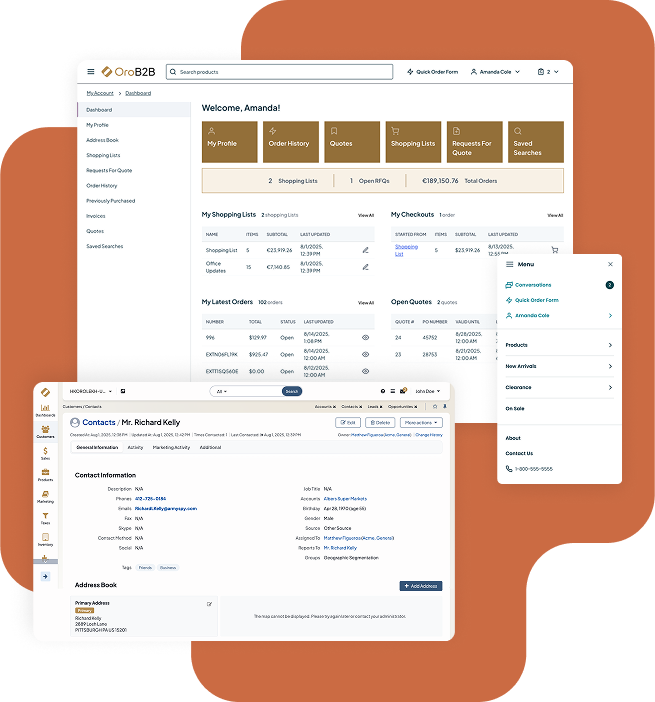
OroCommerce is designed around the three architectural non-negotiables: single source of transactional truth, granular governance, and native multi-entity support. This allows the platform to solve the complexity problems we described earlier.
Teams use one foundation for account hierarchies, contract pricing, approvals, and order workflows, so sales, service, operations, and finance reference the same data and policy at the moment decisions get made.
This shared foundation reduces reconciliation work and prevents the “who has the right number” loop that slows quoting, fulfillment, and support.
That architectural discipline is also why OroCommerce has been recognized for the fifth consecutive year in the 2025 Gartner Magic Quadrant for Digital Commerce.
The structural advantage
- Native CRM and customer portals operate on shared account hierarchies so buyer self-service and rep-managed orders pull identical data
- Built-in Quote-to-Cash runs quoting, ordering, invoicing, and payment reconciliation in one system instead of stitching tools together with middleware
- Integrated PIM, DAM, and CMS maintain product specs and brand content in one place so every customer touchpoint stays current
- Workflow engine and AI tools (SmartOrder for automated PO processing, SmartAgent for natural-language queries) automate approvals within the transaction flow instead of adding external automation layers
OroCommerce delivers the consolidated foundation necessary to transform B2B commerce from a cost center struggling with technical debt into an agile, scalable revenue engine.
Lactalis, a global dairy manufacturer, standardized on OroCommerce across 12 markets and counting. Within two years, that move connected 15,000 customers, drove 230% growth in digital orders, and cut manual processes by 44%.
That’s the kind of result you get when you learn what makes OroCommerce a leading unified commerce company and see how the architecture maps to your own workflows.
See how the unified commerce architecture maps to your workflows and tech stack.
Best Practices And Common Traps In Unified Commerce Platforms
- Data governance first. Clean, standardized product and customer records are the foundation. Cleaning bad data after migration is the most expensive part of any project.
- Standardize workflows. The same rules should apply to order processing, inventory updates, and returns, including a customer’s return in store for something they bought online.
- Think long-term. Choose modular platforms that add features without a rebuild. Legacy systems often can’t handle new channels or scale with demand.
Common mistakes
- Over-integrating instead of unifying: connecting more systems with middleware instead of building one shared data layer
- Treating it as a frontend project: the real value comes from backend integration, which is what actually powers a seamless shopping experience up front
- Ignoring internal users: if service and sales don’t trust the data, they’ll revert to spreadsheets
- Choosing rip-and-replace over a phased rollout: a strangler pattern reduces risk and proves value step by step
Get this right, and you separate the companies that merely connect their payment systems and inventory tools from those building a true unified commerce approach.
Counter Sales, Pickup, and Physical Touchpoints
Many B2B distributors run counters, will-call windows, and showroom floors alongside their core B2B retail operations, including brick and mortar stores and other physical retail locations.
A unified platform keeps inventory management systems current with online purchases in real time, so a warehouse stockout shows up instantly at the counter and on the portal alike.
Counter staff and field reps see the same order, pricing, and payment history a buyer sees online. Unified commerce makes the biggest difference right here, in hybrid operations that mix counters and portals.
Every interaction, whether at a counter, by phone, or through e-commerce, draws from one shared record. Account-based engagement, including contract renewal triggers and reorder automation, replaces consumer-style loyalty programs here.
That keeps customer engagement consistent everywhere a buyer chooses to serve customers through.
Measuring Success: KPIs to Track
| KPI | What It Measures | Review Cadence |
|---|---|---|
| On-time fulfillment rate | Orders shipped or delivered by the promised date | Monthly |
| Order accuracy rate | Orders free of pricing, quantity, or product errors | Monthly |
| Digital order growth or self-service adoption | Share of volume through self-service channels | Quarterly |
If you’re building the internal business case, calculate your platform ROI using these metrics as your inputs.
Conclusion About Unified Commerce Platform
A unified commerce platform gives you a shared record across teams. When your entire business operates from one system, you gain accuracy across all transactions and eliminate costly data conflicts. Your teams make decisions based on the same information at the same time.
Commerce leaders who adopt unified platforms see clear improvements in three key areas:
- Accuracy: Customer data, inventory levels, and order details stay consistent across every channel
- Efficiency: Your staff stops wasting time reconciling information between disconnected systems
- Scalability: Your platform grows with your business without adding complexity
OroCommerce enables businesses to achieve unified commerce through a platform-centric approach built specifically for B2B operations. The system connects your sales channels, order management, customer portals, and back-end systems into one integrated solution.
Enterprise readiness means you can handle complex pricing rules, multiple warehouses, and large product catalogs without performance issues. The platform manages your specific requirements for bulk ordering, custom workflows, and buyer account hierarchies.
OroCommerce delivers continuous innovation focused on B2B commerce challenges. You get regular updates that address real distribution and manufacturing needs rather than retail-focused features that don’t apply to your operations.
Your investment in a unified commerce platform protects your future growth.
Forrester projects that US B2B e-commerce sales will reach $3 trillion by 2027, up from $1.7 trillion in 2021, and the businesses capturing that growth will be the ones running on a single, unified data foundation rather than a patchwork of disconnected systems.
See how OroCommerce can support your long-term growth and modern customer experience goals.
FAQs About Unified Commerce Platforms
What is an example of unified commerce in B2B?
A manufacturer whose sales reps, customer portal, and warehouse all check the same live inventory and pricing before confirming an order. No channel shows different stock or pricing than another.
What is a unified commerce platform?
A single system that combines commerce logic, customer data, inventory, and order management, so every channel operates from one real-time source of truth.
What is the top unified commerce platform for B2B?
OroCommerce, built specifically for B2B complexity. It combines CRM, Quote-to-Cash, PIM, and order management on one platform for manufacturers, wholesalers, and distributors.
What are the top 10 eCommerce platforms for B2B?
OroCommerce, SAP Commerce Cloud, Salesforce B2B Commerce, Adobe Commerce (Magento), BigCommerce B2B Edition, Shopify Plus, commercetools, HCL Commerce, Sana Commerce, and NetSuite SuiteCommerce.
What is the difference between unified commerce and omnichannel?
Omnichannel connects separate systems so customers can move between channels, but each system holds its own copy of the data. Unified commerce removes that separation and runs every channel off one real-time source of truth.
What is a commerce platform?
The underlying software that manages buying and selling, including catalog, pricing, orders, payments, and fulfillment, across one or more channels.
What is the best unified commerce platform?
For B2B manufacturers and distributors specifically, OroCommerce is purpose-built to unify CRM, Quote-to-Cash, and product data on one foundation.