navigation

Shopify Plus B2B is a strong eCommerce platform built for direct-to-consumer retail, and it does that job well. It offers an intuitive setup, a broad app ecosystem, and solid marketing tools, making it a go-to for consumer brands building and scaling online stores.
But if you are running a wholesale, manufacturing, or distribution operation, you have likely noticed it was not designed with your workflows in mind.
Negotiated pricing, contract-based ordering, multi-warehouse fulfillment, account-specific catalogs, and ERP-native workflows are not edge cases in B2B. They are the baseline.
Getting Shopify Plus B2B to handle them typically means stacking third-party apps, custom development, and ongoing workarounds that add cost and complexity as your business grows.
If you are questioning whether this platform is still the right fit, this guide walks you through evaluating your options and compares the five strongest Shopify Plus alternatives for 2026.
Evaluating Shopify Plus for Complex B2B Operations

Shopify Plus B2B has broad adoption across retail and emerging wholesale use cases. Understanding where it performs well and where B2B-specific requirements begin to strain its architecture helps inform the right migration decision.
Assessing Shopify Plus for wholesale and distribution
Shopify Plus delivers genuine value for mid-market brands with straightforward catalog structures and standard B2C-to-wholesale crossover needs.
Its intuitive platform reduces time-to-launch, supports unlimited staff members, and its app ecosystem provides ecommerce features including marketing tools, payment solutions, and SEO tools.
When assessed against dedicated wholesale and distribution requirements, some operational gaps emerge:
- Account-level pricing complexity: Shopify Plus supports price lists via catalogs, but lacks a centralized pricing engine. When multiple price lists apply, it defaults to the lowest price rather than allowing rule-based prioritization. Supporting sophisticated pricing models, such as tiered, contract-based, or location-specific pricing, often requires duplicating catalogs, manual workarounds, or third-party apps, making it difficult to scale and maintain.
- Order management at scale: Shopify lacks native support for advanced B2B order workflows (e.g., quoting, approvals, ERP-aligned processes). As order complexity increases, businesses rely on draft orders, custom logic, and third-party apps, making large-scale or multi-step order management difficult to scale and maintain.
- ERP integration depth: Connecting to SAP, Oracle, or Microsoft Dynamics often requires middleware, not just for connectivity, but to work around API rate limits, rigid data models, and real-time sync limitations with ERP systems.
- Limited B2B-native features: Quote management, requisition workflows, and credit limit enforcement require additional eCommerce add-on solutions, each carrying its own licensing fees and limitations.
- Transaction fees: Unless using Shopify Payments exclusively, transaction fees apply at scale, which represents a material cost for high-value B2B orders.
- Multi-entity scalability: Multi-org, multi-brand, and multi-locale deployments can push against platform constraints, sometimes requiring separate store instances, fragmented customer data and duplicated operational flows.
These gaps do not make Shopify Plus unsuitable for every B2B use case, but they are worth evaluating carefully as your business scales.
Signs it’s time to migrate to a B2B-first platform
If you recognize several of the following indicators, your current eCommerce software may be limiting revenue and operational efficiency.
- Your sales team manually processes orders that should be self-service
- ERP and commerce data are frequently out of sync, requiring reconciliation
- Customers cannot view negotiated pricing, credit terms, or order history without contacting a rep
- Your catalog size or concurrent users regularly strain platform performance
- You’re spending more time and money stitching systems together than scaling your business
- You cannot segment the customer journey by account, location, or buyer role
- Your team is managing an inventory stock buffer manually because platform automation is insufficient
- Pricing logic is becoming hard to control, audit, or explain.
- You need centralized control across brands, regions, or entities without duplicating data and operational logic.
- B2B eCommerce is no longer just a channel, it’s your core operating model
The hidden cost of tech debt in B2B commerce is cumulative. For a full breakdown of the costs migration delays impose on your operations, see our analysis.
What To Evaluate In A B2B eCommerce Platform
Choosing the right eCommerce solution requires a structured framework, particularly when evaluating enterprise platforms with significant implementation and licensing implications. Apply weighting based on your operational priorities before shortlisting platforms.
| Evaluation Criteria | Why It Matters for B2B |
| Strategic B2B Focus | Platforms where B2B is secondary to B2C will deprioritize the features, roadmap investments, and R&D your business depends on. A platform built around B2B as its core use case ensures product development stays aligned with enterprise buyer complexity as you scale. |
| Deep ERP Integration (SAP, Microsoft Dynamics, NetSuite, Oracle) | ERP is the system of record for pricing, inventory, and orders. Native connectors reduce middleware cost and sync latency. |
| CRM Integration or Built-In CRM | Account-based selling requires shared customer data across commerce and sales. |
| PIM Compatibility for Complex Product Data | Unified and standardized product data is foundational for manufacturers and distributors managing thousands of SKUs. |
| Payments and Invoicing | B2B requires net terms, purchase orders, ACH, and credit limit enforcement beyond standard multiple payment methods. |
| Open API / Headless Commerce Readiness | Composable architectures integrate with existing systems and future-proof the tech stack. |
| Deployment Flexibility (SaaS, self-hosted, cloud, hybrid) | Regulated industries with data residency requirements often cannot use pure SaaS. |
| Platform Scalability | Peak-season performance, large catalog support, and high concurrent users must be validated, not assumed. |
| Multi-Entity Scalability | Multi-website, multi-warehouse, multi-org, multi-locale capabilities and order volume directly determine enterprise viability. |
| Implementation Timeline and Complexity | Enterprise platforms with steep learning curves carry a higher launch risk and cost. |
| Total Cost of Ownership | Add licensing fees, implementation, third-party apps, and ongoing maintenance. The monthly fee rarely reflects the actual cost. |
| Vendor Lock-In Risk and Data Portability | Can you export customer data, product catalog, and order history cleanly? Proprietary data models create switching costs. |
| Developer Community and Documentation Quality | Strong community forums and technical documentation reduce custom development risk. |
| Ongoing Support, SLAs, and Upgrade Path | Enterprise B2B operations require clear SLAs and structured upgrade paths. |
For a deeper look, read our article on unified commerce architecture.
5 Best Shopify Plus Alternatives For B2B At A Glance
The table below provides a quick-reference comparison of the five platforms reviewed in this guide. Use it alongside the criteria matrix above to prioritize the platforms best aligned to your operation.
| Platform | G2 Rating | Best For | Top Feature | Starting Price |
| OroCommerce | 4.3/5 | Complex B2B commerce, unified multi-website and multi-organization operations | Embedded payments, CRM, CPQ, AI, invoicing capabilities, granular roles & permissions controls. | Medium |
| Adobe Commerce | 4.0/5 | Mid-to-large enterprises with B2B as a complementary channel. | Open-source flexibility + PIM | Medium |
| Salesforce B2B Commerce | 4.4/5 | Salesforce CRM-native enterprises | Native CRM/Sales Cloud integration | High |
| SAP Commerce Cloud | 4.3/5 | SAP ERP ecosystem enterprises | Deep SAP ERP integration, powerful B2B functionality | High |
| BigCommerce | 4.2/5 | Growing B2B businesses scaling from small to mid-market | No transaction fees + open API | Medium (lower end) |
Each platform is reviewed in depth below.
5 Top Shopify Plus Alternatives in 2026
Here are the five best B2B eCommerce platforms in 2026, reviewed against the criteria that matter most for complex B2B operations.
OroCommerce
OroCommerce is purpose-built for complex B2B commerce and has grown into one of the leading unified commerce platform solutions on the market.
Unlike platforms built on B2C foundations, OroCommerce was designed from the ground up around the workflows, pricing models, and buyer relationships that define true B2B operations.
With all essential B2B capabilities built-in, OroCommerce gives organizations an all-in-one platform that eliminates traditional B2B friction through embedded CRM, marketplace management, AI, CPQ, payments, and invoicing under a single license.
Best for
Mid-market and large enterprises with true B2B complexity: negotiated pricing and contracts, multi-level customer accounts, approval workflows, RFQ and quote-driven sales, large product catalogs, multiple brands or regional storefronts, and heavy ERP integration requirements.
See the impact for Azelis and Lactalis.
Key features
- Native B2B account management
- Corporate account hierarchies, buyer roles, and approval workflows
- Flexible price list engine supporting customer-specific, tier-based, contract-based, and location-aware pricing
- Built-in CRM with account and opportunity management
- Native ERP connectors for SAP, Microsoft Dynamics, NetSuite, and Oracle
- Embedded CPQ and invoicing capabilities within the same license
- Out-of-the-box AI capabilities designed specifically for B2B use cases
- Open API and headless commerce readiness for composable architecture
- Multi-website, multi-warehouse, and multi-organization capabilities
- Robust PIM capabilities for complex product data at scale
- SaaS cloud or self-hosted deployment for regulated industries
- No per-transaction fees
Pricing
OroCommerce offers tiered pricing based on GMV (general merchandise volume) transacted through their system, and deployment model.
OroCommerce’s integrated approach, one platform with one license, delivers a highly competitive total cost of ownership compared to platforms that require separate licensing for CRM, CPQ, and commerce.
Ready to see OroCommerce in action? Explore how it handles your specific B2B workflows
Adobe Commerce
Adobe Commerce (formerly Magento) is a widely deployed enterprise eCommerce platform, now available as a fully managed SaaS through Adobe Commerce as a Cloud Service or as a traditional PaaS deployment.
It integrates natively with Adobe Experience Cloud, making it a natural fit for organizations already invested in the Adobe ecosystem.
Best for
Mid-to-large enterprise businesses with in-house development capacity, complex catalog requirements, and existing Adobe stack investments.
Key features
- Flexible architecture available as open-source PaaS or fully managed SaaS
- B2B module with shared catalogs, company accounts, purchase orders, and requisition lists
- Native integration with Adobe Experience Manager, Adobe Marketo Engage, and Adobe Analytics
- An extensive third-party apps ecosystem via Adobe Marketplace
- GraphQL API for headless deployments
- Multi-store, multi-language, and multiple currencies support
- Advanced features for promotions, brand identity management, and customer journey personalization
Pricing
Adobe Commerce pricing is custom and scales with GMV and organizational complexity.
According to some sources, license fees range from approximately $22,000 to $190,000+ per year, depending on GMV tier, with the total cost of ownership typically running 2 to 3x the license fee when implementation, hosting, and extensions are included.
No free plan is available for B2B.
Salesforce B2B Commerce
Salesforce B2B Commerce Cloud is the commerce layer within the Salesforce platform, integrated with Sales Cloud, Service Cloud, and Marketing Cloud through native, no-middleware connectivity.
B2B commerce, CRM data, and AI capabilities all operate within the same platform, making it a strong fit for enterprises already invested in the Salesforce ecosystem and in need of a B2B eCommerce website connected to account and opportunity data out of the box.
Best for
Enterprises where Sales Cloud or Service Cloud is already the system of record for accounts and opportunities, and where sales-assisted and self-serve ordering need to share account data.
Key features
- Native integration with Salesforce CRM, no middleware required
- Account-based pricing, buyer entitlements, and negotiated catalog management
- Agentforce skills for merchandising, guided buying, and order management, including a dedicated Buyer Agent for B2B self-serve ordering
- Headless B2B Commerce APIs for cart, checkout, catalog, account, and wishlist customization
- Dashboards covering top-performing products, inventory, and buyer behavior
- PCI, GDPR, and HIPAA-compliant security features
- Global scale across 84 countries and multiple currencies
Pricing
Custom, based on GMV and organizational complexity.
Salesforce restructured its B2B Commerce pricing into two editions: Commerce Cloud Growth and Commerce Cloud Advanced, both using a GMV-based model rather than per-order fees.
Publicly listed rates are not available; pricing requires a direct quote from Salesforce, but third party resources estimate ground costs of $100,000+ per year, depending on GMV.
Total cost of ownership should account for Success Plan tiers, Order Management add-ons, and any additional Salesforce Cloud licenses required by your configuration.
SAP Commerce Cloud
SAP Commerce Cloud is the enterprise-grade ecommerce solution that operates natively within the SAP ecosystem.
For organizations running SAP S/4HANA or SAP ECC, it offers deep integration fidelity with shared master data and direct inventory management synchronization across systems.
Best for
Large businesses with significant SAP ERP investments. Manufacturing and distribution companies in regulated industries require tight ERP-commerce synchronization and global compliance capabilities.
Key features
- Native integration with SAP S/4HANA, SAP ECC, and SAP CX suite
- Omnichannel commerce across ecommerce sites, sales channels, and field sales
- Advanced product content management for complex industrial catalogs
- Deployed on Microsoft Azure via SAP’s cloud infrastructure, with SAP Business Technology Platform (SAP BTP) as the integration and extensibility layer
- Advanced tools for B2B account management, contract pricing, and quote management
Pricing
Custom pricing as part of a broader SAP enterprise agreement.
SAP does not list prices; third-party estimates place typical annual costs in the range of $150,000 to $300,000+, depending on edition, order volume, and implementation complexity.
Implementation requires certified SAP partners and represents a significant investment.
BigCommerce
BigCommerce is a cloud-based eCommerce platform with a growing B2B feature set delivered through its B2B Edition, powered by the BundleB2B application.
It is a good option for mid-market operations that need more than entry-level eCommerce solutions without the complexity of tier-one enterprise platforms.
Best for
Mid-market B2B businesses with multichannel selling requirements across major marketplaces and social platforms, particularly those transitioning from DTC into B2B or running relatively straightforward wholesale operations.
Key features
- No transaction fees, regardless of the payment gateway
- B2B Edition with corporate account management, customer-specific pricing, and an invoice portal
- Open API and headless architecture for composable deployments
- Native integrations with major marketplaces, including Amazon, eBay, and Walmart, as well as Facebook and Instagram
- Built-in analytics for tracking key metrics across the ecommerce store
- Free and premium themes available, with B2B Edition including six B2B-optimized storefronts
- Multiple payment methods and payment processing options natively supported
- Address verification, tax calculation, and inventory management via integrated tools
Pricing
B2B Edition is a separate add-on package available only to Enterprise customers; it is not included automatically with the Enterprise license and carries its own custom pricing.
Third-party estimates place the starting rate at approximately $1,000 per month for the Enterprise version alone, scaling with GMV and feature requirements.
No free plan is available at this tier.
Why OroCommerce Is The Best Shopify Plus Alternative For B2B
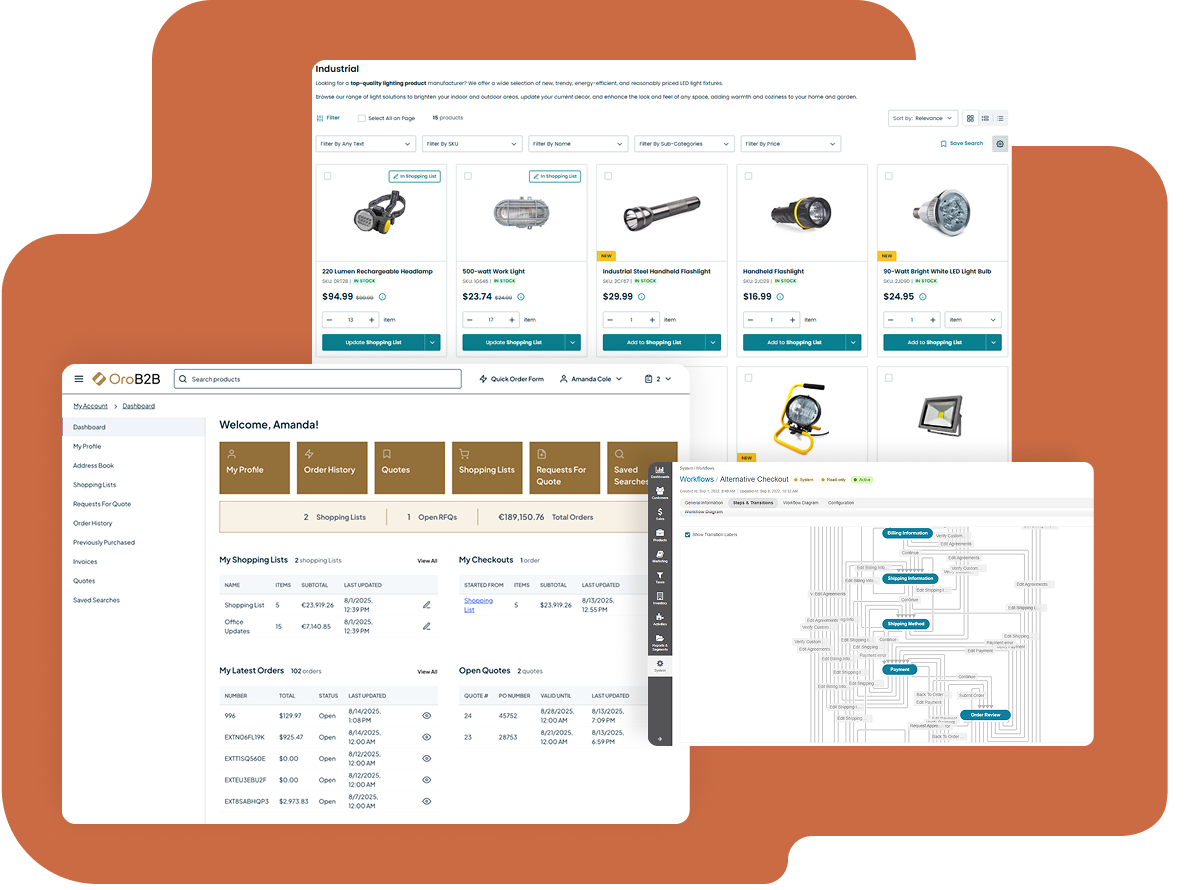
Shopify Plus B2B suits companies leading with B2C at SMB and lower mid-market scale. OroCommerce is built for mid-market and enterprise B2B operations: manufacturers, distributors, and organizations with negotiated pricing, multi-level accounts, approval workflows, RFQ-driven sales, and deep ERP requirements.
The key difference is architectural.
Shopify Plus started as a B2C platform and has added B2B features over time. OroCommerce was built exclusively for B2B from day one with CRM, CPQ, payments, invoicing, and AI capabilities all included under a single license and built to support B2B-first workflows.
Feature comparison
| Capability | OroCommerce | Shopify Plus |
| Platform focus | Built specifically for B2B | Historically B2C, B2B added later |
| RFQ / quote workflows | Native | Limited, requires apps or custom workflows |
| Customer account hierarchies | Native multi-level company hierarchies fully modelling how B2B businesses operate (parent, child, sub units) | Flat structures with limited hierarchy (organizes accounts, does not model organizations) |
| Contract pricing | Native price lists and contracts, full rule-based pricing engine to support complex pricing strategies | Supported via catalogs and simple pricing rules, pricing strategies not supported |
| Tiered pricing | Native | Supported via catalogs |
| Buyer roles and permissions | Highly configurable | Basic pre-defined role management |
| Approval workflows | Built-in | Requires apps or customization |
| Quick order by SKU | Native | Requires apps |
| Order by spreadsheet upload | Native | Requires apps |
| Multiple shopping lists | Native | Limited support |
| Sales rep assisted ordering | Native | Requires apps or custom work |
| Multi-website management | Unlimited sites in one instance | Separate expansion stores |
| Multi-brand management | Native, full customization freedom | Extension stores with limited personalization capabilities |
| ERP integration | Core design principle | Requires middleware or apps |
| Payment provider flexibility | Any gateway, no platform penalties | Shopify Payments preferred; fees for others |
| App ecosystem | Smaller but B2B-focused | Largest ecosystem in ecommerce |
| Time to launch | 4 to 6 months | Faster |
| Developer availability | Smaller ecosystem | Very large |
| AI capabilities | OroIQ layer: product discovery, recommendations, conversational commerce, AI-powered order entry automation, generative AI for content | Sidekick AI, Shopify Magic: content generation and storefront and backoffice AI assistants. |
| Hosting | Cloud, self-hosted, on-premises, or hybrid | SaaS only |
Shopify Plus is built for simplicity and speed. OroCommerce is built for the scale and complexity of enterprise B2B operations.
See OroCommerce's full B2B capability set firsthand.
Migration Checklist: Moving From Shopify Plus To A B2B Platform
Platform migration is more than a data transfer. Organizations that treat it that way consistently run into integration gaps, data inconsistencies, and costs well above what they projected. Use this checklist to plan the transition properly.
Data migration essentials (products, customers, orders)
Before migration begins, audit and clean your existing data. Gaps in product attributes, customer hierarchies, and order records that were manageable on a simpler platform can create real problems in a B2B-first architecture.
- Products: Export all variants, attributes, images, and metadata. Map product attributes to the target platform’s PIM schema before migration begins. Budget time for catalog enrichment after launch, particularly for technical attributes common in industrial or distribution contexts.
- Customers: Export contact hierarchies, address books, and payment terms. Identify customers with account-level pricing, credit limits, or approval workflows, as these require manual mapping. Make sure customer data and sales history are fully portable before you exit your current contract.
- Orders: Define your historical retention window (typically two to three years). Map order statuses, payment records, and fulfillment states to equivalent concepts in the target platform. Validate tax, shipping, and discount logic before go-live.
Thorough data preparation at this stage significantly reduces your post-migration support burden.
Integration mapping and timeline planning
Integration complexity is the most common reason migrations run over time and over budget. Map every dependency before committing to a go-live date.
- Check all active integrations on your existing platform, including third-party apps, webhooks, and API connections
- Treat ERP integration as the critical path: it drives pricing accuracy, inventory availability, and order routing
- Map the fulfillment flow end-to-end: order capture, ERP order creation, warehouse management, shipping notification, and invoice generation
- Assign integration ownership for each connection in the new architecture
- Account for data residency, security, and compliance requirements throughout
For further reading on B2B omnichannel integration, see strategies for B2B omnichannel.
Reducing risk and downtime during the switch
A phased approach consistently outperforms a hard cutover for B2B operations with complex account and order structures.
- Run both platforms in parallel for four to eight weeks before full cutover
- Migrate a subset of accounts or product lines first, validate, then expand
- Define rollback criteria and procedures before the go-live day
- Train all internal users, buyer-facing and back-office, before launch, not after
- Monitor key metrics post-launch: order conversion rate, cart abandonment, ERP sync error rate, and support ticket volume
- Confirm launch-period SLA coverage with your new vendor before you go live
A well-planned migration protects your existing customer relationships while unlocking the B2B capabilities your operation needs.
Final Words About Shopify Plus Alternatives For B2B
Shopify Plus works well for brands that sell directly to consumers. However, if your business focuses on wholesale, manufacturing, or distribution and deals with complex pricing, account structures, ERP connections, or high order volumes, a B2B-first platform is usually a better fit and can save you money in the long run.
The best platform should fit your business processes, not force you to change them. By 2026, B2B buyers will want the same easy self-service options they get as consumers. Platforms designed for B2B needs are better able to provide this experience.
OroCommerce, Adobe Commerce, Salesforce B2B Commerce, SAP Commerce Cloud, and BigCommerce all offer a solid foundation for B2B needs. Compare your options using a criteria matrix, focus on your top priorities, and ask vendors for a proof-of-concept before making a decision.
Shopify’s B2B features have gotten much better since 2023, but they are still add-ons to a B2C platform. OroCommerce, on the other hand, was designed for real B2B workflows like multiple buyer roles, contract pricing, approval steps, and negotiated orders.
OroCommerce includes CRM, CPQ, AI, payments, and invoicing all in one license. This makes things simpler because you don’t have to piece together these features with extra apps or middleware.
Choose the best Shopify alternative that was made specifically for B2B from the start.
FAQs About Shopify Plus Alternatives For B2B
Who is Shopify's biggest competitor?
For general ecommerce, BigCommerce is a close mid-market rival, and Adobe Commerce leads at the enterprise level. For dedicated B2B operations, OroCommerce and SAP Commerce Cloud are the most direct competitors, as both address use cases that consumer-oriented platforms were not primarily designed to serve.
Is Shopify Plus better than BigCommerce?
Shopify Plus B2B offers faster time-to-launch and a broader consumer app ecosystem. BigCommerce eliminates transaction fees, provides a more open API, and delivers a stronger native B2B feature set through B2B Edition. It suits growing businesses with multichannel selling requirements and high-value order volumes.
Do I need Shopify Plus?
Shopify Plus works well for a B2C-led business model with a growing wholesale channel, straightforward catalog structures, and standard pricing logic. If your online business involves complex account hierarchies, deep ERP dependencies, or significant multi-entity scalability requirements, evaluating dedicated ecommerce platforms from the outset will likely deliver stronger long-term ROI.
What is the best free alternative to Shopify?
For small businesses, WooCommerce and Square Online are widely used free-to-start options, though both require hosting setup and ongoing management. For B2B specifically, OroCommerce’s community (open-source) edition is a no-licensing-cost path for teams with development resources.