
navigation

Picture a buyer at an industrial distributor. They need a part to keep a line running, so they type “3/4 inch brass fitting 200 PSI” into the search bar. The page loads 400 search results. None of them are right. The buyer sighs, closes the tab, and emails their sales rep.
Your organization just spent a serious IT budget trying to replace manual orders. Instead, you built a portal that forces a phone-first experience.
The business case for AI search for eCommerce has never been more obvious. The search bar is the front door of B2B self-service. When it fails, the entire case for digital commerce fails with it.
Here is a look at what AI-powered search engines do, why B2B operations require entirely different search solutions than consumer retail, and what highly relevant product discovery looks like in production.
Why Traditional Search Breaks in B2B and How AI Helps
Did you buy a basic search engine upgrade two years ago, but buyers still complain they can’t find anything? To understand the failure mode, you have to look at the mechanics of basic keyword matching.
Traditional site search relies on character matching. It looks for matching letters, not matching meaning. If a shopper searches for a “saltwater pump,” but your product catalog categorizes it as a “corrosion-resistant marine-grade centrifugal pump,” they get zero results.
It’s the exact same product. There is simply no string overlap. This string-matching problem creates friction on every eCommerce site. But in B2B environments, where products live behind highly specific industry terminology, it completely ruins the customer experience.
Your Buyers Search in Three Different Modes
Industrial buyers don’t browse. They hunt. They rely on three specific types of search queries to do their jobs, and traditional search engines fail all of them.
- Part number mode: A technician types “P/N 6205-2RS1.” If they transpose a single character or miss the dash, the engine blanks. Traditional search has zero tolerance for typos.
- Spec combination mode: High-intent shoppers search for “316 stainless, 2-inch, NPT thread.” They just combined three separate database filters into one natural language sentence. Basic engines can’t parse those requests.
- Application mode: The buyer knows the problem they need to solve, not your internal brand name. They search “pump for saltwater exposure.” The engine needs to map user intent to physical product attributes. Without a direct keyword match, it returns nothing.
What Scale Does to a Broken Search Experience
Below 50,000 SKUs, a well-structured taxonomy covers a lot of sins. Above that, it breaks down fast.
Picture a 250,000-SKU industrial catalog. A buyer searches “bearing.” How many results come back? Potentially 43,000. Three filter selections later – still 1,000 options. Their product discovery process drags on for 14 minutes. Long before they find the part, you suffer a 30% drop in conversion rates.
Where Those Buyers Go Instead
Bad search doesn’t just frustrate buyers. It routes them out of your channel entirely.
Industry-average zero-result rates for traditional keyword-based site search sit between 10–15%. Algolia’s platform data puts abandonment after a failed search experience at around 81%. Your buyer arrived with a specific part in mind and purchase intent already formed. That’s not a cold lead you lost. That’s a warm buyer you handed to someone else.
Keyword search has a ceiling. Most B2B catalogs hit it well before the search logs get ugly. What clears it is processing queries at a fundamentally different level – which is what AI-powered eCommerce search does.
How AI-Powered Search Processes a Messy Query
If you ask a vendor how their AI tools generate relevant results, you usually get a slide full of buzzwords. But under the hood, artificial intelligence in eCommerce isn’t a single magic widget.
The key features that make it work are four distinct architectural layers designed to understand search intent.
Natural Language Processing (NLP)
This handles the interpretation. NLP catches the typos, understands industry synonyms, and parses complex requests. When a shopper searches “pump for saltwater exposure,” NLP translates that intent into your catalog’s “corrosion-resistant” label.
Vector Search
This converts every product and search query into a mathematical vector. Concepts with similar meanings cluster together physically. A query for “3k psi” and “3,000 PSI” maps to the exact same place. This is the structural fix that kills the exact-string matching problem.
You can see how it works in the video below
Retrieval-Augmented Generation (RAG)
The system pulls relevant products directly from your live index first, then uses a language model to synthesize the response. RAG ensures the model answers using your hard product data, preventing it from hallucinating specs it learned on the internet.
Hybrid Search
B2B requires both precision and interpretation. Hybrid search combines keyword search (critical for exact part numbers) with semantic vector matching (critical for loose requests). It blends both methodologies in a single query.
Giving Buyers New Ways to Ask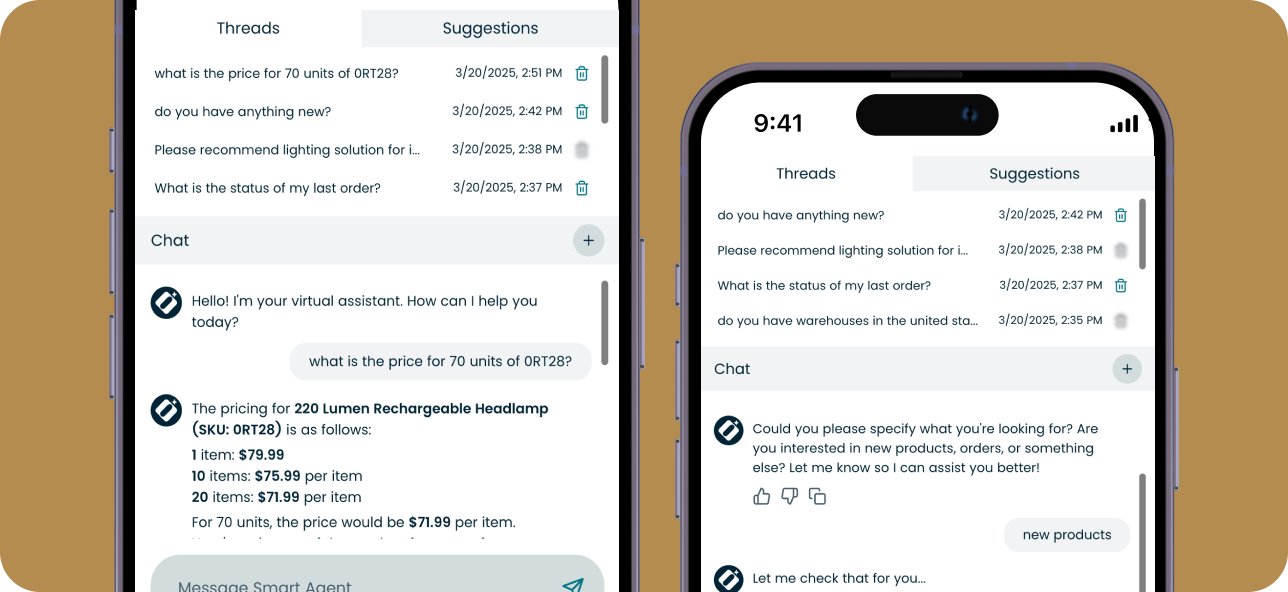
Once those four layers retrieve the right parts, the machine refines the display. A learning-to-rank model monitors real time behavior. If high intent shoppers search for a specific valve and consistently buy the fourth item on the page, the system learns to rank that product first tomorrow. It gets smarter with every click.
Beyond the traditional search bar, this foundation unlocks two specific workflows highly relevant to industrial operations:
- Visual search. A maintenance tech standing on a shop floor holding a snapped fitting doesn’t always know the name of the component. They upload a photo. The system runs image similarity and returns matching SKUs instantly.
- Conversational search. Buyers interact with an AI shopping assistant instead of scrolling category pages. A contractor types, “Do you have a marine-rated centrifugal pump that ships from Dallas today?” and gets a structured, actionable answer instead of a list of blue hyperlinks.
See how conversational search works with OroCommerce’s AI SmartAgent
These AI search solutions don’t rewrite your product data. They simply translate how a buyer naturally speaks into the highly technical way your catalog is filed.
Translating what customers type solves the linguistic challenge. But if you take a standard search algorithm designed for retail and drop it onto an industrial portal, the system breaks for a completely different structural reason.
Why B2B Search Has a Problem Most AI Tools Weren’t Built For
In consumer retail, any shopper can search the full product catalog and pay the public list price. Recommending the wrong t-shirt is a minor inconvenience. In wholesale, serving up irrelevant results or an incorrect pricing tier to an enterprise account is a direct commercial liability.
B2B purchasing runs on strict, account-level guardrails. A basic eCommerce platform assumes a one-size-fits-all model. To make intelligent search function properly, the engine has to instantly recognize who is querying the system and apply their corporate rules dynamically.
- Contracted catalogs: Many accounts are legally restricted to purchasing from an approved subset of SKUs.
- Negotiated pricing: Buyers expect to see their specific net rates and volume breaks instead of public list prices.
- Buyer role permissions: You must separate the procurement managers authorized to spend money from the floor engineers just checking specs.
- Location restrictions: A regional franchised buyer needs inventory sourced exclusively from their designated warehouse.
If your commerce search ignores these entitlements, you actively damage your accounts in three ways.
Scenario A: The unauthorized item
A floor technician runs complex queries to track down a replacement valve. The engine recommends an out-of-contract SKU. They click add-to-cart and hit an immediate checkout failure. You just turned a standard self-service workflow into an angry escalation email.
Scenario B: The list-price shock
A buyer runs a standard part lookup. The engine displays the exact item, but shows the retail list price instead of their negotiated volume discount. They assume you hiked your rates overnight. They immediately abandon the portal and call their sales rep to complain. The software generated the exact manual interaction it was supposed to prevent.
Scenario C: The visibility breach
A junior employee reviewing specs accidentally gains visibility into sensitive pricing tiers that their own procurement executives explicitly wanted hidden. This isn’t just bad UX. It is an active compliance breach on your site.
The Fix Isn’t Cosmetic
When executives realize their standalone search tools cause these issues, the instinct is to build a quick workaround. They try to filter out restricted items after the results load.
It never works. Filtering after the fact scrambles your category page counts. Restricted products still bleed into the autocomplete suggestions the second the customers type.
To deliver context-aware results safely in a B2B environment, the search index must read your live commerce rules the exact moment a buyer hits enter. It must instantly evaluate the role, the pricing tier, and the territory.
Yet, even when you perfectly align your search tool with your business logic, AI deployments still routinely crash. An intelligent engine completely falls apart if it has to rely on a messy product catalog.
Why 62% of Pilots Die on Dirty Catalog Data
Our 2026 AI Benchmark report shows 62% of B2B companies are currently stuck piloting AI search. Only 24% have made it to production. The primary roadblock holding teams back sits right inside the product catalog.
Point a modern AI site search tool at messy product data, and the system simply generates incorrect recommendations faster. If your item descriptions lack critical dimensions, the algorithm scales those errors everywhere. That missing data immediately derails the buyer’s shopping journey.
Take a look at the data reality of one global industrial distributor. They manage 750,000 SKUs sourced from thousands of suppliers. Before their latest tech upgrade, the IT team maintained 30,000 manual backend rules to squeeze out acceptable search relevance. Those rules acted as a massive patch. They existed solely because the physical items lacked clear descriptive data.
When the IT team cleaned up the underlying taxonomy and unleashed the AI, those 30,000 manual rules vanished. Null searches plummeted by 47%. The cleanup effort directly helped increase conversions.
Tune in: Why Product Data is a Distributor’s Biggest Problem with Jason Hein
What Your Data Needs Before You Buy Software
An algorithm can perfectly understand user intent. That intelligence means nothing if the underlying database is blank. Before you spend budget on new software, your catalog has to meet four prerequisites:
- Complete attributes across the whole catalog. Most companies maintain clean data for their top sellers while ignoring the rest of the list. You have to populate the blanks because long tail queries expose those gaps instantly.
- Technical specs in structured fields. A bearing’s load rating and material grade might exist securely inside a linked PDF. The search system can’t read those attachments to deliver accurate results.
- Deduplicated SKUs with clear parent-child records. Your inventory software might display the exact same physical product under three different internal part numbers. That fragmentation completely breaks the math behind a semantic search.
- Buyer-driven taxonomy. Your internal inventory code “HYD-FITTINGS” means nothing to a mechanic typing out industry specific terminology. You must build your query categorization around how customers find parts, not how the warehouse files them.
You can run a diagnostic on your operational readiness today. Pull your last 90 days of search logs. Find your highest-volume queries that return zero results. Isolate the sessions where buyers got a page of parts but immediately bounced.
The distance between what your buyers type and how you label your products dictates your exact catalog cleanup roadmap. Fixing those data gaps is the only way to make AI search work reliably.
Once your catalog data is clean and your business rules are wired into the engine, you earn the right to deploy the final layer of AI search: behavioral targeting.
What AI-Powered Personalization Means in B2B Search
Consumer sites build a personalized search by looking at a shopper’s casual browsing history. That approach is useless in wholesale. To maximize conversions, a B2B search engine ignores casual clicks and runs entirely on hard commercial signals, like order frequency and account roles.
Here is how AI search engines use those signals to change the discovery experience:
Predictive Reordering
If a facility manager runs more searches for the same four consumable parts every month, they shouldn’t have to scroll through a navigation menu. The AI analyzes that user behavior and pins those exact SKUs to the top of the autocomplete window the moment they click the search bar. The engine predicts the reorder before they finish typing.
Account-Level Affinity Boosting
Wholesale buyers usually have strict brand preferences or localized standardization requirements. If an account has a historical 90% purchase affinity for Festo pneumatics, the search engine remembers. When that buyer types a generic term like “actuator,” the system relies on machine learning to automatically rank Festo products above competing brands. It personalizes the feed based on corporate buying habits, not just string matching.
Search-Driven Average Order Value
Intelligent models analyze past customer behavior to spot hardware relationships. The engine then embeds compatible parts directly into the primary search result. If a buyer searches for a specific industrial pump, the search feed instantly surfaces the required gaskets and flanges right beside it.
Capturing that cross-sell seamlessly inside the search experience pushes your average order higher without relying on obnoxious pop-up recommendations.
The Next Wave: When Buyers Search Outside Your Portal
All of these investments aim to keep the buyer inside your portal. But you need to prepare for the reality that the B2B shopping journey is migrating outward.
Procurement professionals already use external language models to run discovery. They prompt external tools like ChatGPT to “find an industrial bearing supplier with net-30 terms and same-day shipping to Ohio.” That evaluation happens entirely off your site.
This shift is accelerating. By early 2026, massive retail platforms began syndicating their merchant catalogs directly to external AI agents. The next immediate frontier isn’t just ranking higher in your own site’s search bar. It is ensuring your catalog is machine-readable so these autonomous agents can negotiate on a buyer’s behalf.
The data cleanup you run today to fix your internal search is the same foundation you need for this external visibility. When you build a clean, unified B2B commerce architecture, you guarantee the algorithms find your products, no matter where the buyer is searching.
Conclusion: Bad Search Trains Bad Buyer Behavior
A broken search bar turns your highest-paid account executives into an expensive IT help desk. When a buyer can’t find an exact brass fitting on your site, they revert to the path of least resistance. They email their rep to do the digging for them.
You fix this by treating your search bar like an extension of your commercial logic. The index has to know your product attributes cold, and it has to evaluate the buyer’s contract rules the second they hit enter.
When the platform parses a complex technical request and delivers the exact compatible parts on the first try, you break the cycle. Buyers trust the portal to do the heavy lifting. The stock-check phone calls disappear. You stop paying experts to read from a catalog and give them the hours back to hunt for new business.
Build a B2B eCommerce and search experience that works