
navigation

Every proposal on your desk claims AI. Your commerce platform, your CPQ tool, your OMS, your ERP vendor’s new storefront module – all of them. The label has become so universal it tells you nothing about what’s actually been built underneath it.
The label being noise doesn’t make artificial intelligence optional for your eCommerce strategy. According to the 2026 B2B Commerce AI Benchmark, wholesalers are already putting AI-powered e-commerce to work.
Over the next 24 months, the investment shifts straight into complex revenue functions. Operators are prioritizing guided buying and decision support, dynamic pricing optimization, intelligent search and product discovery, and automated quote-to-cash.
You’ll have to evaluate AI in your platform selection, whether you specifically ask for it or not.
This guide provides the framework to interrogate B2B commerce software vendors offering AI, expose missing security layers, and spot the platforms built specifically to protect your commercial data.
AI in eCommerce: Where Each Capability Sits Before You Evaluate It
Most vendor evaluations treat every eCommerce AI capability as if it’s at the same stage of development. A roadmap item gets the same weight as a production system.
A pilot that ran on a clean demo environment gets presented alongside a feature backed by 18 months of live transaction data. That conflation is how teams end up mid-implementation with capabilities that were announced, not shipped.
The deployment data from the 2026 B2B Commerce AI Benchmark maps to four distinct tiers, and each tier requires different evaluation questions.
Proven in Production: Evaluate Depth, Not Existence
These capabilities have cleared the pilot phase and are running as operational infrastructure across many B2B eCommerce businesses. The evaluation question is not whether the vendor has them. It’s how deeply they’re built.
PO & Document Automation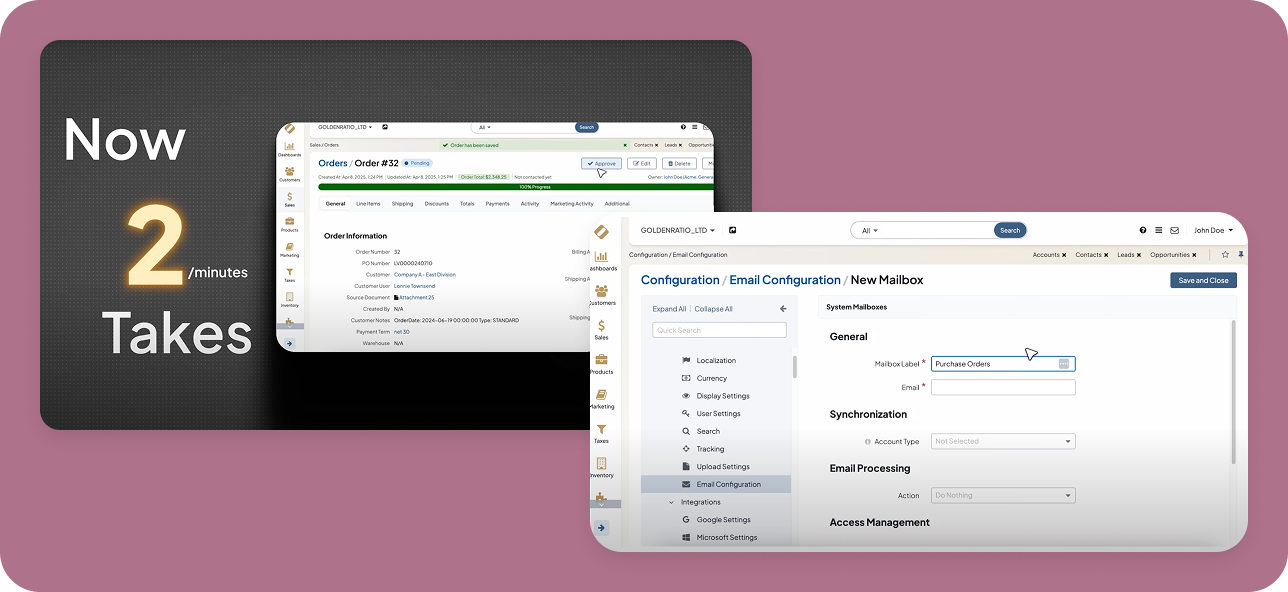
Machine learning extracts line items from emailed PDFs, faxes, and unstructured purchase orders, validates them against live inventory and customer purchase history, and generates structured draft orders.
For distributors managing high order volumes, this is the highest-return AI use case in the stack. The key benefits show up immediately in rep time saved and reduced error rates. DiversiTech, for example, achieved a 20% productivity gain with AI order intake.
Ask the vendor:
- Run a demo on a real PO from one of our accounts, including non-standard formats or handwritten fields.
- How does the system handle customer part numbers that don’t match your internal SKUs?
- When the AI can’t match a line item, does it flag it, skip it, or guess?
- Does it validate against live pricing at the moment of processing, or against a snapshot?
Check out our guide for a more in-depth look at AI-powered tools for sales order automation.
eCommerce Customer Service Automation
AI-powered routing and auto-resolution handle the repetitive customer interactions that consume support capacity: order status, pricing queries, and availability checks.
Connected to live account data, these systems answer using the buyer’s actual contract terms and help enhance customer service.
Disconnected, they generate generic responses that damage customer satisfaction faster than no automation at all.
The deployment rate is high. The sophistication range underneath it is wide.
Ask the vendor:
- Does the AI read from the same live data source as your storefront, or from a synchronized copy?
- What does a buyer on a negotiated contract see when they ask about pricing?
- When a question exceeds the AI’s defined scope, what’s the escalation process?
- Can it process a transaction (reorder, add to cart) or does it only answer questions?
Active Piloting: Evaluate Whether the Demo Matches Your Environment
This is where most B2B AI technology investment is concentrated right now, and where the gap between what vendors show and what they’ve shipped is widest.
AI Search & Discovery
Natural language processing (NLP), semantic search, and AI-powered visual search interpret customer queries in human language: part number synonyms, application descriptions, cross-references to competitor SKUs.
Ecommerce natural language processing closes the gap between how a buyer describes a product and how your product data is cataloged in the PIM. Smart search on a large industrial catalog reduces the dead ends that push buyers to call a rep instead of completing the order online.
Ask the vendor:
- Demo it on our actual catalog, including incomplete records, missing attributes, and non-standard descriptions.
- Do search results reflect what each buyer is authorized to see and buy at their contracted price?
- How does it handle a search using a competitor’s part numbering system?
- What’s the fallback when no match exists – alternatives or zero results?
Conversational Commerce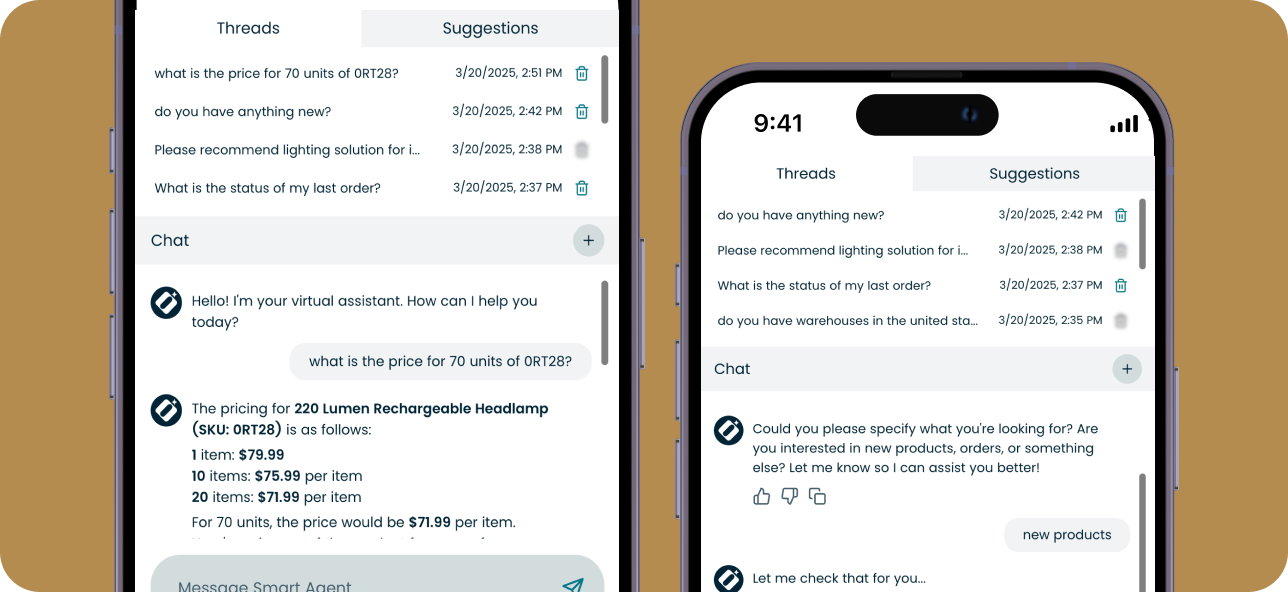
AI-powered chatbots and virtual assistants built on generative AI models handle product discovery, configuration questions, and customer engagement through natural conversation.
High piloting rates (68%) reflect genuine customer needs from B2B buyers expecting efficient, personalized shopping experiences similar to what major online retailers provide. Low deployment rates (26%) reflect the data prerequisite.
An assistant disconnected from real-time pricing and user behavior delivers wrong answers dressed as facts. You will never improve customer satisfaction with a blind chatbot.
Ask the vendor:
- Does the conversational layer read directly from the live commerce data model and customer data, or from a synchronized copy?
- What does a buyer with a restricted catalog or credit hold see when they interact with the assistant?
- What happens when a buyer tries to order something they aren’t authorized to buy?
- Show us a live demo with a complex pricing query, not a product availability question.
Demand Forecasting & Inventory Optimization
Machine learning algorithms analyze historical sales data, seasonal patterns, market trends, and supplier lead times to predict demand and optimize stock levels across warehouses.
When the data foundation is in place, predictive analytics shifts inventory management and supply chain planning from reactive safety stock to data-driven decision making. When it isn’t, the model averages inconsistent inputs and produces plausible numbers built on bad data.
Ask the vendor:
- What transaction history does the model require, and what’s the minimum data quality threshold to generate reliable recommendations?
- How does it handle SKU inconsistencies across branches? If Dallas logs a part differently than Chicago, what happens to the forecast?
- What happens to model accuracy when a human overrides a recommendation?
- How does it account for supplier lead time variability, not just historical averages?
Fraud Detection & Anomaly Detection
Deep learning and ML systems identify patterns in transaction data to flag unusual order behavior, credit risks, and anomalies in real time. For high-volume distributors, this narrows thousands of daily transactions to the handful requiring human judgment.
The AI establishes what normal looks like per account and escalates the exceptions. The value depends entirely on whether those alerts land where decisions get made.
Ask the vendor:
- Does anomaly detection integrate with your credit management workflow, or does it generate alerts in a separate system?
- How does the model establish baseline behavior for a new account with limited transaction history?
- What’s the false positive rate, and how are those resolved without creating alert fatigue?
High-Stakes, Low Deployment: Evaluate the Foundation, Not the Feature
These capabilities carry the highest commercial risk in B2B commerce. The gap between a convincing demo and a live deployment on real contract data is exactly where these projects stall.
AI-driven Dynamic Pricing Optimization
AI-driven dynamic pricing strategies optimize prices by dynamic customer segments, SKU, and contract tier using historical data, demand elasticity, and competitive benchmarks.
Pricing optimization at scale secures a competitive advantage and represents the highest revenue growth potential of any capability in wholesale distribution. Documented margin improvements run 2–6% of sales for large operators looking to maximize revenue.
Low deployment (15%) reflects organizational complexity rather than a lack of vendor claims. Pricing in B2B is political. Handing margin decisions to algorithms requires executive alignment before any model touches a live contract.
Ask the vendor:
- What guardrails prevent the algorithm from quoting below our margin floor?
- How does the system handle accounts with negotiated contract terms? Does it automatically exclude those from AI-driven dynamic pricing?
- What’s the human override policy, and how is it enforced in the system?
- Show us the pricing engine running on a real account with a real contract, not a demo dataset.
CPQ & Quote Automation
AI algorithms configure complex products, generate quotes, and route approval workflows. 87% of companies plan to invest here. 5% have it running. The deployment gap reflects data requirements: configuration rules, pricing logic, and approval chains need to be structured and connected before any AI can act on them reliably.
Most organizations have that data, spread across three systems maintained by teams that have never compared notes.
Ask the vendor:
- Show us the system handling our specific approval hierarchy, not a simplified demo version of it.
- How does it handle configuration rules that depend on conflicting product attributes?
- What data needs to be structured and connected before the AI can generate a reliable quote?
- When configuration logic can’t be resolved, does the system escalate or generate a best guess?
Experimental: Evaluate Foundation Readiness for Agentic AI
AI agents that autonomously discover products, process orders, and transact without human review represent the furthest-reaching shift in B2B commerce operations.
Gartner projects 40% of agentic AI projects will be canceled by 2027, most because the data foundation couldn’t support autonomous decision-making at commercial speed.
For most B2B operations, agentic AI is an 18–24 month horizon. The platform decision you make now determines whether you can reach it.
Ask the vendor:
- What audit trail does the system maintain for every action an agent takes?
- Can an AI agent exceed the permission level of the human user it’s acting on behalf of?
- What’s the current GA status of agentic features versus what’s on the roadmap?
- When the agent encounters a scenario it wasn’t designed for, what’s the defined failure mode?
How to Integrate AI in Wholesale Commerce: The Strangler Pattern Approach
The Must-Haves for B2B Commerce Intelligence
The environment AI is walking into at most B2B distributors wasn’t designed for it. An ERP that expanded into the commerce role through years of customization. Pricing that lives across multiple systems.
Customer hierarchies that made organizational sense internally do not map to how orders flow today, severely limiting your ability to deliver a modern customer experience.
In our 2026 B2B Commerce AI Benchmark, 53% of B2B leaders cited legacy system integration as a top-three barrier to AI adoption. The vendor’s job is to work within that architecture, not the one they wished you had.
These are the lines to draw before you sign.
Platform-level permissions
An AI operating with elevated application-level access is a massive liability. The intelligence has to natively inherit the exact permissions of the user logged in. If a buyer has a credit hold and restricted catalog view, the AI can’t bypass that just because it queried the main database.
Prompt-level instructions don’t solve this. The platform’s native access control layer has to block the AI from seeing the data before it can surface it.
Domain-specific data models
This is the other side of the coin. Even if the AI respects permissions, it still needs to understand the structure of your business. A general-purpose language model doesn’t know the difference between a ship-to address and a corporate billing hierarchy. It treats a national account placing orders across 10 locations like 10 disconnected buyers.
That context must live securely inside the platform’s data model. If you expect a public algorithm to figure out your contracted volume tiers from unstructured text, you’ll generate errors.
A three-part guardrail architecture
Vendors talk about guardrails like a single on/off switch. You actually need three distinct mechanisms.
- Domain lockdown keeps the AI strictly focused on its specific commercial task.
- Out-of-domain handling defines exactly what happens when someone asks a quoting bot an irrelevant question.
- Jailbreak prevention stops a user from actively manipulating the prompt to expose your underlying logic.
These are separate technical problems that require separate engineering solutions.
A defined escalation path
The intelligence will eventually hit a wall. When it encounters a scenario outside its guardrailed scope, it shouldn’t try to guess an answer using whatever context it can scrape together. It needs a strict failure mode. It routes the inquiry to a human rep, drops a draft in a review queue, or simply declines the prompt. You need to know exactly how the machine fails.
Unmodifiable core security
You will eventually write custom instructions for different customer segments. The catch is that those configurations must sit on top of the base guardrails. If a custom instruction can override the AI’s core security rules, your flexibility just became a vulnerability. The foundational guardrails must remain permanently locked.
Deterministic logic for transactional tasks
Probabilistic guessing works fine when you want to write product descriptions, test personalized marketing campaigns, or deploy AI-generated content. It causes absolute chaos in order processing.
Any tool touching quoting workflows or purchase order intake needs strict, zero-temperature settings. The machine processes the exact data in front of it. Guessing is an unacceptable feature in wholesale distribution.
Want to compare B2B commerce vendors’ AI capabilities? Read our breakdown of the top platforms.
Before You Choose a Vendor, Choose an Architecture
Selecting the right AI for eCommerce brings you to the most consequential architectural decision in the evaluation. You must determine who is responsible for the foundation the AI runs on.
Composable AI offers genuine advantages: specialized tools for specific workflows, no single-vendor dependency, freedom to swap components as better options emerge. What most evaluations don’t price in is what comes alongside them.
When you assemble AI capabilities from multiple vendors, your team inherits the governance layer.
- Who ensures each component respects your user permissions?
- Who verifies that when Vendor A updates their model, it doesn’t change how it interprets data from Vendor B?
- Who owns the policy that defines what each AI component can and can’t access?
These are ongoing responsibilities that require dedicated capacity to maintain.
Native AI transfers that ownership to the vendor. The guardrails, the permission inheritance, the commercial context are the vendor’s problem to solve within their defined scope. You might lose some of the flexibility. You don’t lose sleep over governance.
That distinction shows up in outcomes. MIT’s NANDA research tracked 300 public AI deployments and found vendor-led implementations succeed twice as often as internal builds – 67% against 33%. The more your team has to build and govern the AI layer itself, the closer you get to the lower number.
The trade-off: OroIQ is scoped to B2B commerce workflows. If the AI work you are prioritizing centers on commercial operations and generating actionable insights from your order data, that defined scope is an asset. If you need a general-purpose AI layer that spans the business well beyond commerce, that's outside what OroIQ was designed for.
What Nobody Budgets For
AI in eCommerce carries a fundamentally different cost structure than traditional software. The license fee is simply the cover charge. The true cost of ownership reveals itself around month eighteen. That financial reality usually looks very different from the original budget approval.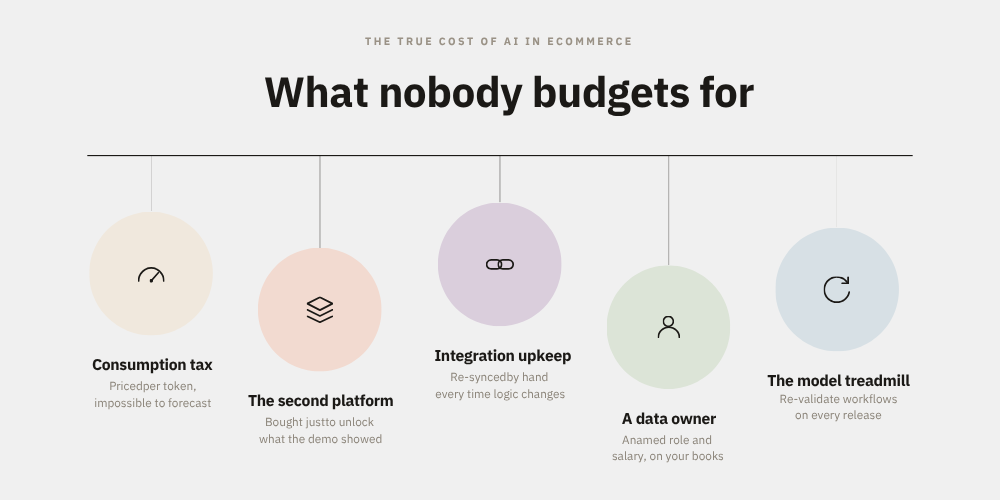
The unpredictable consumption tax
Many vendors price their AI tools by the action. You pay per token consumed or query processed. This model looks entirely reasonable during a limited proof of concept. Wholesale distribution scales differently.
Running real-time data queries for pricing optimization against thousands of complex contract permutations burns through tokens rapidly.
One major enterprise platform uses currency units that expire annually regardless of your usage. They also keep the consumption rates per eCommerce AI feature completely undocumented. Your financial forecasting becomes a total guessing game.
The secondary platform requirement
Vendors frequently demo AI capabilities that don’t exist in your base license. The intelligence you want often requires buying a secondary data platform you don’t need.
Practitioners deploying eCommerce platforms consistently report this secondary purchase doubles total implementation costs. You must force the vendor to state exactly which license tier is required to access every single feature shown on the screen.
The permanent integration penalty
AI systems connected via a custom API bridge do not update themselves. Your commercial logic changes constantly. Every time you adjust an account hierarchy or alter dynamic pricing strategies, your team must sync that change across the integration.
This is an ongoing expense that eats into your operational efficiency. The burden compounds as your business evolves, yet it never appears anywhere in the original license proposal.
The unbudgeted headcount
Executives tend to treat AI technology strictly as a software purchase. Keeping your historical sales data and customer purchase history accurate requires constant human oversight. We are not talking about a one-time data cleanup.
You need a named owner with ongoing responsibility for data governance. Most organizational charts lack this specific role today. If you choose a composable architecture, your company absorbs this salary entirely.
The model update treadmill
Public language models change constantly. When the underlying model updates, someone has to verify your workflows still behave correctly. If you buy a native embedded platform, the vendor owns that testing cycle.
If you build a composable stack with external tools, your internal engineers assume the burden. Most companies forget to budget for the heavy engineering cycles required to validate behavior after every major release.
You shouldn’t avoid investing in AI solutions. You simply need to put these line items in the original approval document. Vendors who dodge questions about consumption billing or integration maintenance during the sales process are the ones guaranteed to introduce these surprises after you sign the contract.
The Red Flags in a Vendor Pitch
Watch for these observable behaviors. They tell you exactly what is missing under the hood.
The pitch opens with a name that isn’t theirs
“Powered by OpenAI” features prominently on their opening slide. A vendor leading with a public model’s brand tells you exactly where their perceived value lives. The model isn’t their product. They are just licensing it.
When that specific model gets superseded by a cheaper version next year, their core differentiator vanishes. You want a vendor whose value lies securely in the B2B data architecture they built underneath the model.
They don’t know where your data goes
A sales engineer passing a deep technical question to a specialist is standard practice. It becomes a red flag when they dodge basic data governance.
Ask them where your query data goes. Ask them if the model natively respects your custom user roles. If they promise to loop in the security team to answer those, the system is flying blind. A vendor shipping production-grade intelligence has those answers memorized.
A separate license usually means a separate architecture
The intelligence capability lives in a separate module requiring its own license. This structure demands heavy scrutiny. A separate module typically indicates a separate data access model and an isolated permission architecture.
Ask how that segregated bot inherits buyer constraints from your base commerce platform. If the answer involves extensive custom API work, their architectural limitation just became your IT budget problem.
Twenty minutes of vision, two minutes of reality
They spend twenty minutes walking you through a visionary roadmap slide detailing future trends like autonomous agents revolutionizing the online shopping journey. Then they show a production reference using a basic semantic search bar.
You’re being asked to buy futures. The gap between a tightly controlled pilot and a live transactional system is exactly where most artificial investments die. Pay attention to what they ship, not what they sketch.
The one question that tests their guardrail architecture
Ask the rep what happens when a buyer tries to force the quoting bot to ignore minimum order quantities. This directly tests their out-of-domain handling. If they haven’t considered deliberate user redirection, they haven’t built the necessary fences. The bot is running unsupervised.
Conclusion: The Foundation Is the Only Durable Asset
You probably walk into these demos wondering if the software you buy today becomes obsolete the second a new language model drops. The answer brings us straight back to the central thesis: an algorithm is only as reliable as the platform underneath it.
The model itself is a commodity. A vendor charging a premium for a chat window taped to a public algorithm offers you nothing permanent.
Durability lives entirely inside the data model. An off-the-shelf algorithm doesn’t know a specific buyer’s credit limit. It can’t decipher a negotiated volume discount for a regional branch or know complex customer preferences. That heavy commercial context has to exist securely inside the platform long before the intelligence gets to work.
Algorithms will keep evolving. The models will get cheaper. The vendors worth your IT budget are the ones who built a deterministic foundation that explicitly tells the machine how your business makes money. If a vendor expects the AI to figure that out on the fly, close the laptop and end the demo.
Put OroIQ through the questions in this piece