navigation

If a distributor’s field sales rep gives one price at a job site but the customer portal shows a different one, someone loses. Either the profit margin or the customer relationship.
When a manufacturer’s warehouse shows 200 units available online but the actual count is 43 because three disconnected systems haven’t reconciled overnight, orders get canceled, and customer satisfaction takes a hit.
These situations aren’t rare. For large wholesalers, manufacturers, and distributors, they happen all the time.
The real problem isn’t a faulty ERP system or a lack of training. It’s the way everything is set up.
Most B2B companies have grown by bolting systems together over decades: an order entry platform here, a CRM there, an eCommerce storefront added during COVID, and a quoting tool the sales team swore they needed in 2019.
Each system fixed a specific issue, but together they created a bigger problem.
A unified commerce architecture is the real solution. It’s not just another integration or a temporary fix. It’s a new way to organize how your business handles orders, serves customers, manages inventory, and supports your sales teams.
This article explains what unified commerce architecture is, why it’s important for large B2B companies, and how you can make the switch without disrupting your business.
The Evolution from Fragmented B2B Systems to Unified Architecture
If you’ve been in distribution or manufacturing long enough, you’ve lived through each of these phases, probably simultaneously across different parts of your business.
- The legacy era: Separate systems for web orders, sales rep quotes, phone orders, and manual paperwork. Or worse, an ERP customized beyond recognition that technically “does everything” but requires inside knowledge to operate. Legacy systems ruled because they were the only option. Order entry happened via fax, phone, or a green-screen terminal. Many businesses rely on these setups to this day and pay the price in operational inefficiencies and slow response times.
- The integration phase: Companies recognized the silo problem and started connecting systems. EDI fed piped orders into the ERP. APIs linked the CRM to the eCommerce platform. A data warehouse attempted to stitch together six sources using nightly batch jobs. The systems were connected, but every connection required constant reconciliation. The technology stack kept growing, but the problems didn’t shrink. They just moved.
- The unified commerce era: True architectural unification, where field sales, inside sales, customer self-service, and fulfillment operate from a single system that owns both the experience layer and the commerce logic. The unified commerce system is the single source of truth. Your customer relationship management data, product catalog, pricing matrices, and inventory counts all live in one place.
Modern B2B buyer expectations driving architectural change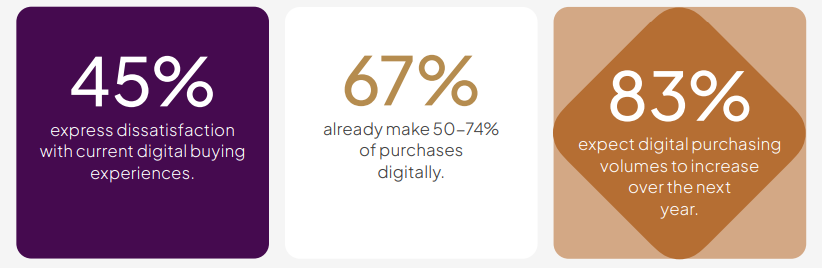
Your B2B buyers don’t grade you on a B2B curve anymore. Customer expectations have been permanently reshaped by digital commerce, but what buyers actually want is more nuanced than “more digital.”
In a 2025 study by OroCommerce and B2B Insights, 67% of B2B buyers already make over half their purchases online, and 83% expect that share to grow. Yet 45% say the digital experiences their suppliers provide are still disappointing.
When asked what stood out most about a supplier interaction, only 19% mentioned a digital tool. A full 38% described a moment involving a real person who offered advice, spotted an issue early, or proactively suggested a better option.
The lesson: when digital tools work well, they fade into the background. When they fail, they become the villain. Buyers expect real-time inventory visibility, instant pricing across contract tiers, quick reordering via mobile apps or saved carts, and consistent information whether they’re ordering through a portal or calling a rep.
But when customer data sits in one system, pricing rules in another, and inventory management runs separately, your customer service teams check three screens to answer a single question, and your sales reps lose the context they need to be consultative.
Disconnected systems don’t just create operational drag. They undermine the human interactions buyers remember most, and that’s a sign your tech stack is holding you back.
Full Survey Report: B2B Buyer Perspectives on the Future of Online Purchasing
What is unified commerce architecture?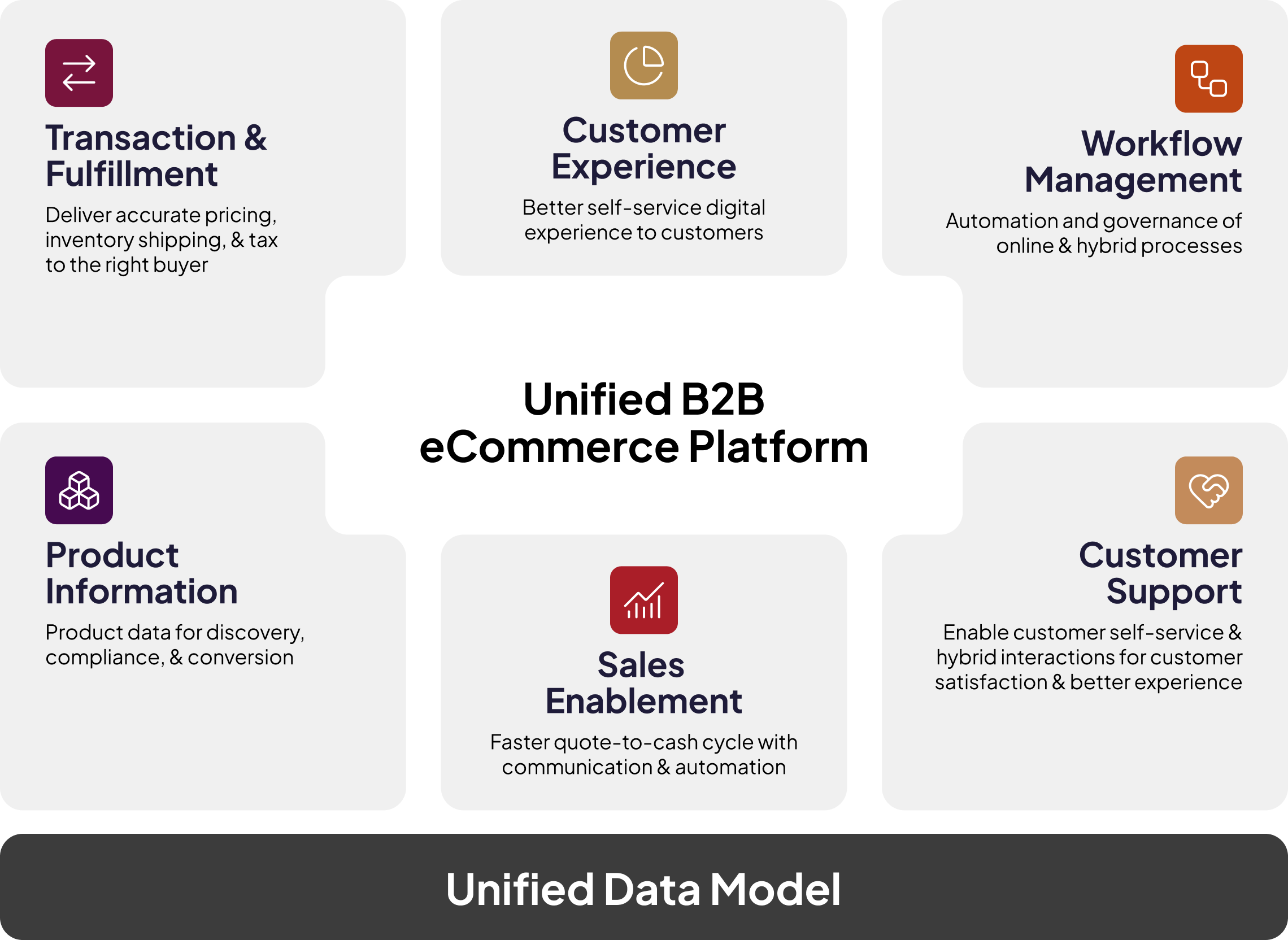
A single platform with a unified commerce architecture connects sales reps, customer portals, eProcurement channels, and back-office operations into one system where data flows natively, not through batch syncs or middleware.
Unlike traditional B2B setups where the ERP “owns” pricing, the CRM “owns” customer data, and the eCommerce platform “owns” the storefront, a unified commerce platform centralizes these functions. Your field rep in Denver and your customer logging into the self-service portal at 11 p.m. see the same pricing, inventory availability, and order history.
This is not omnichannel commerce with better branding.
Unified commerce and omnichannel share the goal of a consistent customer experience, but their approaches differ significantly.
Omnichannel focuses on making multiple channels look consistent to the buyer. Unified commerce integrates backend systems to enable consistency. One is cosmetic; the other is structural.
Read our guide to learn more about unified commerce vs omnichannel.
Key Benefits of Unified Commerce Architecture
Unified commerce architecture delivers measurable advantages across operations, margins, and speed to market.
- Faster scalability and market expansion. For distributors expanding to new regions or manufacturers absorbing acquisitions, a unified commerce model means you’re not rebuilding the customer experience from scratch every time. New locations, new brands, and new business units plug into the existing platform.
- Pricing error elimination. When sales quotes and online orders pull from the same pricing engine, the margin erosion caused by mismatched quotes disappears. Dynamic pricing rules apply consistently whether the order comes from a rep’s tablet or the customer’s desktop.
- Single platform maintenance versus multi-system overhead. The hidden cost of tech debt in B2B commerce is staggering. Every separate system needs its own maintenance, upgrades, security patches, and dedicated support. A centralized platform consolidates costs and resource allocation into a single line item.
- Quote-to-cash automation. Automated workflows from quote generation through approval, order placement, fulfillment, invoicing, and payment collection reduce order processing costs and accelerate cash flow. When the entire business runs on unified data, there’s no manual handoff between systems that introduces delays.
Together, these benefits compound: lower costs, faster execution, and a foundation that scales with the business instead of against it.
More on the benefits of unified commerce in our free guide
Empowering field sales teams with unified customer intelligence

This is where unified commerce architecture changes the game for revenue teams, not just operations.
In a fragmented environment, your field sales rep walks into a customer meeting armed with whatever they last updated in the CRM, a printed price list that may be two weeks old, and a vague sense of what the customer ordered last quarter. If they need real-time data on inventory or account status, they’re calling the office back or texting the warehouse.
With unified commerce software, your sales reps gain instant visibility into customer online browsing behavior, abandoned carts, complete order history, payment status, open quotes, and accurate inventory levels. They don’t have to double-check information in spreadsheets or call warehouse staff. The customer profiles they see on their mobile device are the same ones the customer sees in the portal.
This transforms sales conversations. Instead of “Let me get back to you on that,” the rep says, “I see you were looking at the 400-series last week. We have 600 units across three warehouses, and your contract pricing puts them at $14.20 per unit.”
That’s a service experience that drives customer loyalty.
Supporting complex distribution and manufacturing requirements
Enterprise-scale B2B isn’t simple commerce on a bigger scale. Unified commerce architecture needs to handle:
- Multi-warehouse inventory allocation with real-time visibility. Distributors with dozens or hundreds of locations need to see and allocate inventory across the network. Real-time inventory data means the customer portal shows what’s actually available, not what was available at midnight.
- Branch-specific pricing and catalog management. Different regions may carry different product lines, offer different promotions, and operate under different regulatory requirements. Unified systems support this variation without fragmenting the platform.
- Contract-based pricing matrices with volume tiers and customer-specific SKUs. A manufacturer selling to both OEM customers and aftermarket distributors needs pricing logic that handles tiered discounts, negotiated contracts, and rebate programs, all from one engine.
- Support for both direct shipments and drop-shipping scenarios. When an order can be fulfilled from your warehouse, your supplier’s warehouse, or a combination of both, the order management system must route intelligently without manual intervention.
Unifying B2B customer touchpoints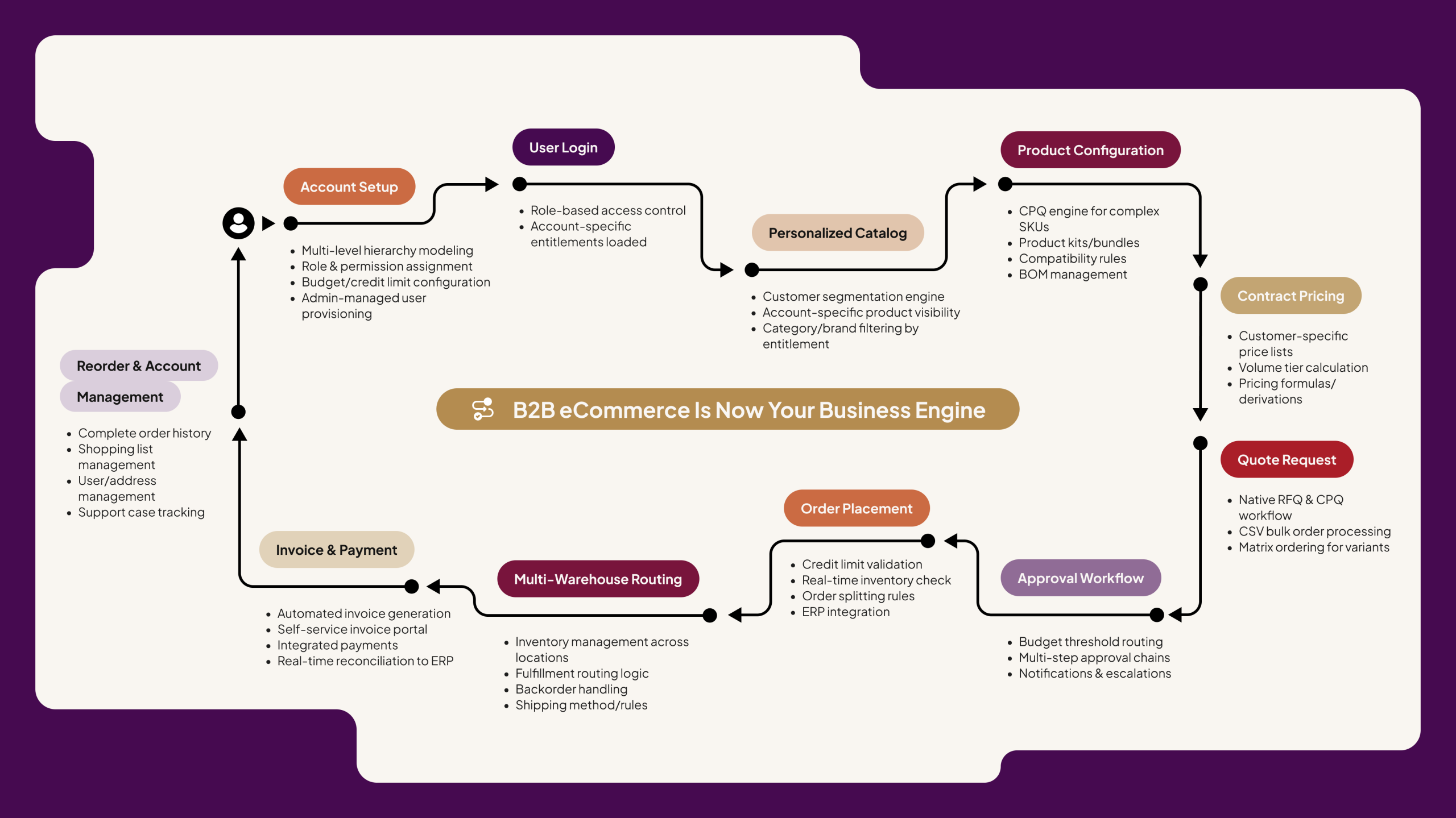
Think about every touchpoint in a complex B2B transaction:
- Initial product research
- Technical spec comparison
- RFQ submission
- Quote approval
- Purchase order placement
- Shipment tracking
- Proof of delivery
- Invoice reconciliation
- Repeat ordering
In a traditional setup, each stage might touch a different system.
A unified commerce strategy ensures that field sales, inside sales, and customers see identical information at every stage. Sales data, order data, and fulfillment data live in one place.
For multi-location distributors or manufacturers with regional divisions, unified architecture delivers pricing consistency, inventory accuracy, and brand standards across the entire business while still allowing branch-specific catalogs and local promotions.
A single platform can serve customers in 30 markets with localized experiences without 30 separate deployments. This is where the concept of unified commerce takes the customer journey beyond what omnichannel strategies alone can achieve.
It’s not just about letting customers buy online after browsing in-store. B2B commerce leaders are recognizing that it’s about creating digital and physical experiences that share a single operational backbone, so store associates, sales reps, and self-service portals all operate from the same truth.
Most B2B commerce platforms started in retail and were later adapted for wholesale. OroCommerce was built the other way around, for manufacturers, distributors, and wholesalers from day one, with all of the above working out of the box.
Core Components of a Unified B2B Commerce Platform
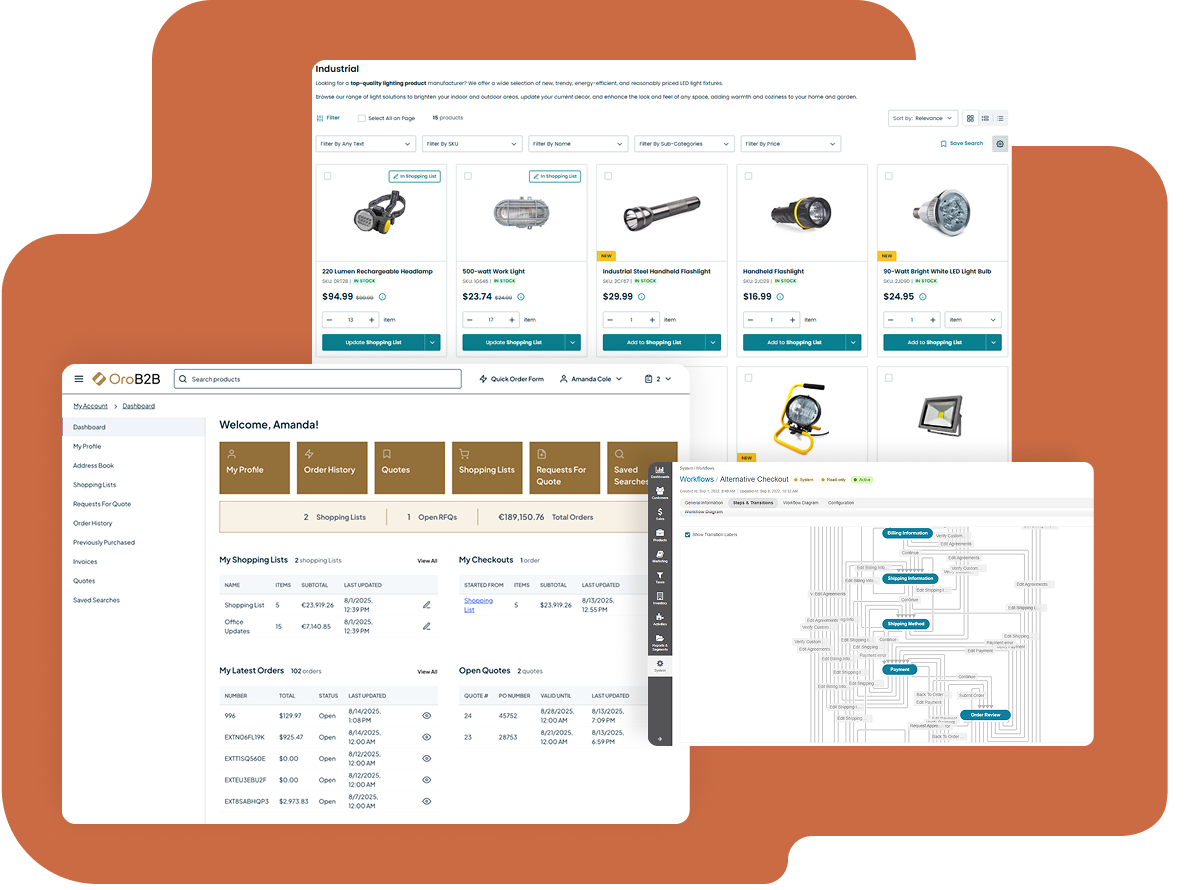
OroCommerce is a strong example of what this looks like in practice: a single platform that unifies eCommerce, CRM, marketplace management, invoicing, and payments so that sales, service, operations, and finance all reference the same data at the moment decisions get made.
One foundation for commerce and customer management
Unlike platforms that bolt CRM on as a separate product, OroCommerce runs commerce and customer relationship management on shared account hierarchies. Buyer self-service and rep-managed orders pull identical data. Quotes, orders, invoicing, and payment reconciliation flow through one quote-to-cash process with no middleware in between.
Native B2B workflow engine
Complex B2B transactions require approval chains, budget controls, and role-based permissions. OroCommerce’s visual workflow builder lets business teams design and automate these processes by customer, role, or rule, without waiting on developers. Gartner named it a standout feature for a reason.
Multi-org and multi-site without limits
OroCommerce supports multi-organization, multi-site, and B2B2X models from one instance. Azelis runs 150 localized portals on a single installation. Lactalis expanded digital commerce to 12 markets using one OroCommerce instance. That’s unified platforms at enterprise scale.
Deep ERP integration, not replacement
OroCommerce connects with SAP, NetSuite, JD Edwards, Dynamics, Infor, and others, keeping your ERP as the system of record for financials while owning the commerce and experience layer that sits on top. Pricing, inventory, invoices, and transactions stay aligned across both systems.
Open architecture for future flexibility
With full API access and open-source code transparency, OroCommerce supports headless, composable, and hybrid deployments. No transaction fees, no hidden costs, and no lock-in. Customize freely while staying upgrade-safe.
Learn more about our unified solutions for B2B eCommerce.
A Practical Implementation Blueprint for B2B
Understanding the value of unified commerce architecture is one thing. Implementing unified commerce across a running enterprise without disrupting revenue is another.
Here’s a phased approach that helps you manage operations through the transition while minimizing risk and building momentum.
B2B tech stack assessment phase
Before selecting a platform, you need an honest audit of your current state. Document every system that touches commercial transactions: your ERP, CRM, eCommerce platform, order management systems, warehouse management, Point of Sale systems, quoting tools, and any back-end systems running custom logic.
Map the data flows. Where does product data originate? How does pricing get from the ERP to the sales rep’s quoting tool? Identify every point where data is manually re-entered, reconciled, or corrected. These are your highest-ROI targets for unification.
Assess your commerce operations. How many separate logins does your team use to process an order? How often does sales data in the CRM conflict with financial reporting in the ERP? How long does it take to onboard a new customer across all systems?
The answers reveal the true cost of fragmentation and build the business case for a unified commerce solution.
Phased migration strategy minimizing disruption to sales operations
- Phase 1: Foundation. Establish the unified platform and migrate customer hierarchies, product catalog, and contract pricing. Clean data migration is non-negotiable. As integration best practices show, the most expensive part of any project is cleaning bad data after migration. Getting this right sets the tone for the entire unified commerce implementation.
- Phase 2: Pilot. Launch with one sales region or product line, running in parallel with legacy systems. This allows you to validate the platform against real transactions, train a manageable group of users, and identify issues before they scale. Informed decisions about the full rollout come from real pilot data, not vendor demos.
- Phase 3: Sales team migration. Migrate the field sales team onto the unified platform and enable the customer self-service portal. This is where reps start seeing digital sales channels activity alongside their traditional relationships. Revenue growth follows when reps can act on real-time customer behavior.
- Phase 4: Legacy retirement. Retire legacy order entry systems. This is the phase where the organization stops paying double and begins realizing the full operational and financial benefits of unification.
Change management for sales teams and customer adoption
- Training field sales reps on how unified data improves their efficacy. Don’t lead with “here’s a new system to learn.” Lead with “here’s how you’ll close deals faster and never have to call the warehouse to check stock again.” Show reps how customer preferences, browsing history, and order patterns make them more effective, not more supervised.
- Incentivizing customer migration to the self-service portal. Offer tangible benefits: faster order processing, the ability to place orders outside business hours, and quick reorder functionality. Customers who can serve their own needs (checking order status, downloading invoices, reordering from history) don’t need to wait on hold. That’s improved customer satisfaction by design.
- Providing white-glove onboarding for strategic accounts. Your top 20% of customers by revenue deserve personalized migration support. Assign dedicated resources to walk them through the new portal, migrate their saved orders and favorites, and ensure zero disruption to their procurement workflows.
- Maintaining phone and email support during the transition. Not every customer will adopt digital self-service immediately. Keep multiple channels open and let adoption happen organically.
KPIs for Distribution and Manufacturing Operations
Unified commerce architecture should deliver measurable results across three domains. Track these metrics to validate your investment and guide unified commerce strategy.
Sales and operational efficiency metrics
| KPI | What It Measures | Target |
|---|---|---|
| Order entry time | Minutes from customer intent to order in system | ↓ Reduce |
| Sales rep quote generation speed | Time from pricing request to delivered quote | ↓ Reduce |
| Orders requiring manual intervention | % of orders needing human correction | ↓ Reduce |
| Customer service call volume | Inbound calls for order status, pricing, inventory | ↓ Reduce |
| Same-day shipment rate | % of orders shipped within 24 hours | ↑ Increase |
Customer experience and retention metrics
| KPI | What It Measures | Target |
|---|---|---|
| Portal adoption rate by segment | % of accounts actively using self-service | ↑ Increase |
| Repeat order frequency | Average reorder rate per active account | ↑ Increase |
| Customer churn in competitive categories | Account losses where alternatives exist | ↓ Reduce |
| Ordering experience NPS | Net Promoter Score specific to purchasing | ↑ Increase |
| After-hours order percentage | Orders placed outside business hours | ↑ Increase |
Financial and inventory performance indicators
| KPI | What It Measures | Target |
|---|---|---|
| Pricing error rate | Margin-impacting discrepancies across channels | ↓ Reduce |
| Inventory turn rate | Speed of movement with better demand visibility | ↑ Increase |
| Days Sales Outstanding (DSO) | Average collection time on receivables | ↓ Reduce |
| Cost per order across all channels | Fully loaded processing cost per transaction | ↓ Reduce |
| Average order value | Revenue per transaction across the customer journey | ↑ Increase |
These KPIs connect unified commerce platform to outcomes leadership cares about: margin protection, working capital efficiency, and revenue growth. Real-time visibility into these metrics gives you the data to prove ROI and justify further investment in the unified commerce system.
Next Steps to Unified B2B Commerce Transformation
Making the move to unified commerce architecture is a business strategy decision that will shape your company for the next decade. Getting it right requires the right technology partner and the right implementation approach.
When evaluating B2B platforms, look beyond feature checklists. Ask whether the platform was built for B2B complexity from the ground up or retrofitted from a retail solution. Ask how it handles account hierarchies, contract pricing, approval workflows, and multi-organization structures natively, not through customization or add-ons.
Look for system integrators with proven experience in distribution and manufacturing verticals, an understanding of ERP integration complexity, and change management expertise for transitioning sales teams and customers to unified platforms.
OroCommerce was built by eCommerce veterans specifically for the complexity that wholesalers, manufacturers, and distributors face every day. It’s recognized by IDC and Gartner, with enterprise customers running hundreds of portals and billions in transaction volume on the platform.
If your current technology stack is holding you back, if your teams are spending more time reconciling data than serving customers, if pricing inconsistencies are eroding margins, it’s time to see what unified commerce architecture looks like in practice.