navigation

Wholesalers, manufacturers, and distributors are facing the same problem. The modern retail landscape has shifted, and systems built for a different era are now getting in the way.
Disconnected storefronts, siloed inventory data, and order management tools that don’t share information drive up shipping costs, increase the risk of incomplete or incorrect orders, and deliver a customer experience that falls short of what B2B buyers now expect.
There’s a better way to operate. eCommerce consolidation brings fragmented digital commerce infrastructure into a single platform, enabling organizations to reduce costs, streamline fulfillment, and build deeper customer relationships.
This guide explains what consolidation looks like in practice, the benefits it offers, and how to make the transition so your business is ready for long-term growth.
eCommerce Consolidation In B2B: A Strategic Overview
eCommerce consolidation in B2B is the shift from managing multiple disparate web stores, legacy systems, and manual processes into a unified platform that serves as a single source of truth for every commercial interaction.
For a manufacturer selling products across several acquired brands, this might mean migrating five separate ecommerce store instances into one system.
For a distributor operating across multiple regions, it could mean replacing a patchwork of homegrown tools with a purpose-built ecommerce platform capable of handling regional pricing, local tax rules, and multilingual catalogs from a single backend.
Consolidation also changes the way orders are handled.
Order consolidation addresses a constant pain point in B2B fulfillment: the inefficiency of managing separate order streams from different channels.
When a buyer places a purchase through your website, a sales rep enters another via phone, and a procurement system submits a third through EDI, a consolidated approach groups these into a single workflow.
Rather than split shipments departing from different systems at different times, the business can coordinate fulfillment so that items headed to the same location are bundled into consolidated shipments, reducing packaging waste and transit times.
For organizations ready to explore this shift, unified solutions for B2B ecommerce offer a purpose-built foundation for bringing every channel, brand, and workflow under one roof.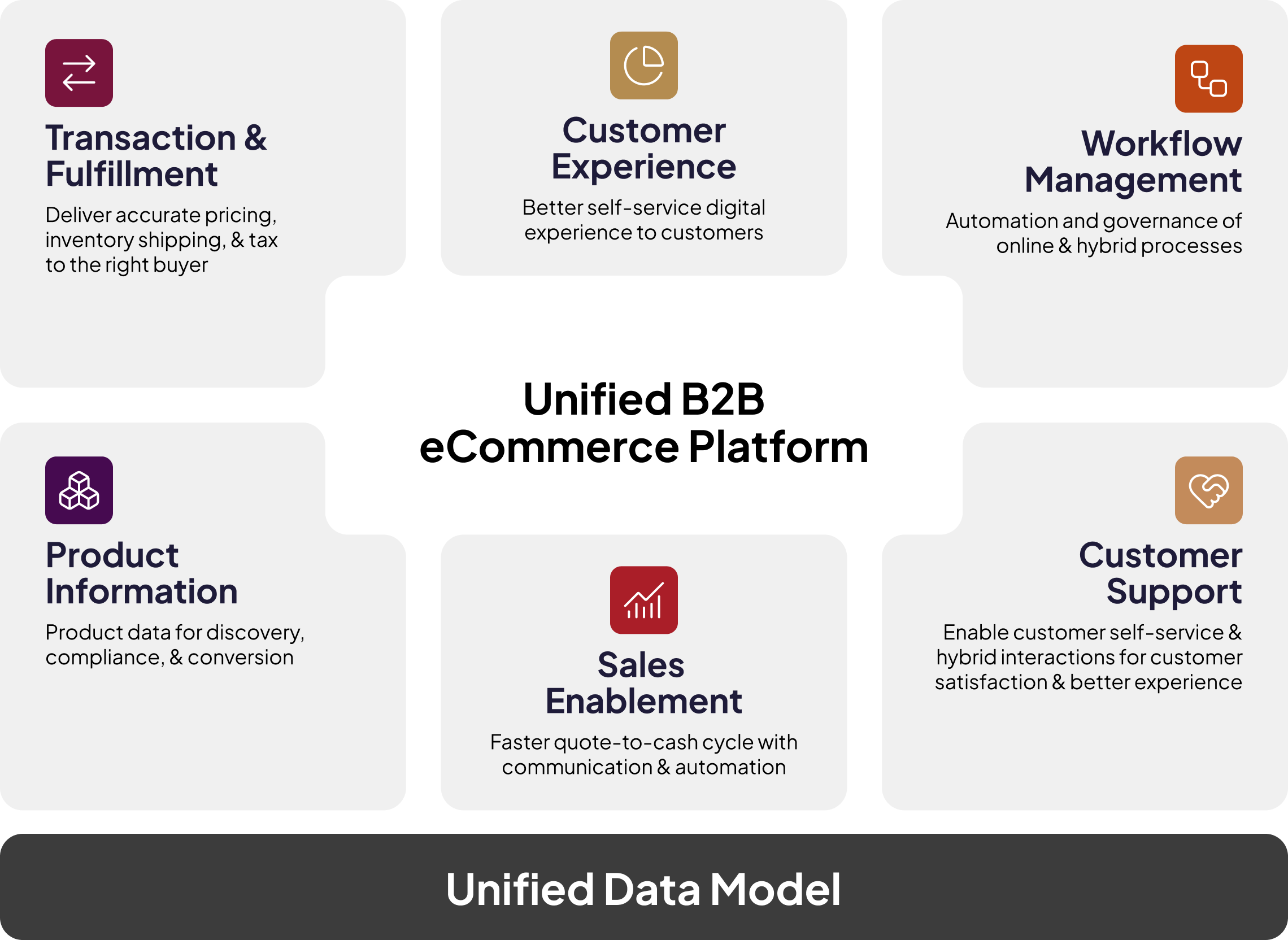
Why modern B2B businesses are moving away from fragmented systems
Most B2B organizations are working with systems they didn’t design themselves. Instead, they inherited them.
M&A activity, regional expansion, and years of short-term fixes have created a patchwork of mismatched ERPs, legacy code, and B2C platforms bent into handling B2B complexity.
As a result, basic needs like seeing global inventory or managing accounts in one place become much more expensive to provide.
Three main challenges are making it impossible to keep things as they are:
- Redundancy is eating up the budget. If every region or acquired brand has its own storefront, customer records, discount rules, and integrations, the company ends up paying for the same things over and over, but still gets uneven results. Ecommerce businesses with this kind of technical debt often find that just keeping things running uses up money that could be spent on innovation and new tools.
- Scattered data leads to real risks. In fields like chemicals or medical devices, keeping compliance and product data in separate systems means teams must handle exceptions manually. This can cause shipping delays, rejected orders, and even regulatory issues. A single, unified system centralizes data, removes blind spots, and ensures compliance steps are always followed.
- Buyers have moved on, but legacy systems have not. The influence of retail eCommerce has permanently raised expectations: online shoppers want real-time order status updates, self-service portals, and personalized catalogs, whether they are buying for themselves or for a corporation. Fragmented infrastructure cannot deliver this consistently.
Each new acquisition makes things harder. Leaders want to cross-sell products from the combined catalog quickly, but disconnected systems force IT to build quick, fragile connections just to process sales. These fixes end up as ongoing maintenance headaches.
Without a standard way to bring new companies on board, every deal just adds more technical debt instead of solving the problem.
If your teams spend more time finding workarounds than focusing on growth, it may be worth evaluating whether your B2B commerce tech stack is holding you back.
The Strategic Benefits: Cost Savings And Customer Satisf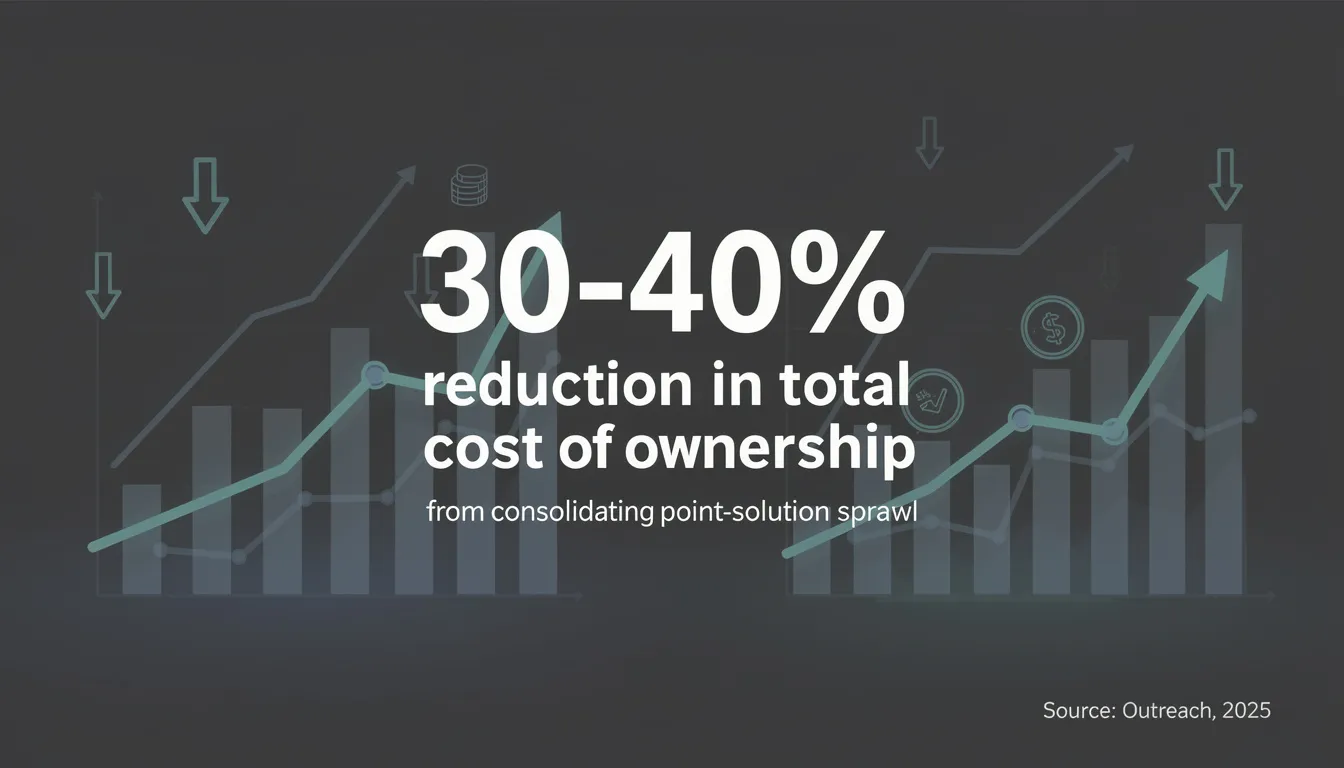
The most immediate benefit of tech stack consolidation is saving money. Companies running separate tools for quoting, order management, CRM, and storefronts pay for each one independently and then pay again in engineering time to keep them talking to each other.
For mid-market and enterprise B2B companies, this often means significant cost savings on annual technology expenses. Many organizations don’t realize how much inefficiency is costing them. Recognizing these hidden costs in B2B commerce often pushes companies to make the move to consolidate.
The second category is market expansion costs. Lactalis found that launching each new regional market required a custom IT project from scratch. Once they consolidated onto a single platform, deployments that previously took years started completing in months. That’s a meaningful shift in what growth actually costs.
Consolidating your tech stack also helps save money in other parts of your business. For example, combining multiple orders for the same buyer into a single shipment means lower shipping costs and less packaging.
How unified data improves the B2B buyer experience
A consolidated system provides buyers with a seamless experience that fragmented architectures cannot match. When all touchpoints feed into the same backend, a buyer can log in and see their full order history, negotiated contract pricing, and custom catalogs without switching between portals.
They can track transit status in real time, reorder with a few clicks, and manage approvals within their corporate hierarchy, all from one interface. This is the promise of unified commerce: a single connected ecosystem where every customer interaction informs the next.
This level of convenience directly influences purchasing behavior. When the buying process is frictionless, conversion rates improve because buyers encounter fewer barriers between intent and purchase.
When order accuracy is consistently high, trust builds. And when customers trust your digital channel, they shift more data and more spend to it, increasing average order values and deepening the relationship over time.
Helping your customer-facing teams serve customers better
Consolidating systems also makes work easier for sales and support teams. Without it, a sales rep helping a customer from a newly acquired brand has to look up pricing in one system, then switch to another for a customer ordering from the main catalog. Each switch wastes time and increases the chance of mistakes.
With the right unified commerce B2B software, there’s no need to switch between systems. All pricing, order history, and account details for every brand and catalog are in one place. This lets your customer-facing teams focus on what matters most: building relationships, finding upsell opportunities, and finding ways to enhance customer satisfaction.
Comparison: fragmented vs. consolidated systems
| Feature | Fragmented Systems | Consolidated Platform |
|---|---|---|
| Maintenance Cost | High (multiple vendors/updates) | Lower (single vendor/unified updates) |
| Data Accuracy | Low (syncing required) | High (single source of truth) |
| Customer Experience | Inconsistent | Seamless and personalized |
| Scalability | Difficult and expensive | Built-in for rapid growth |
Using A Future-Proof eCommerce Tech Stack For Consolidation
Most B2B organizations end up with a fragmented tech stack by following one of two common paths.
The first is stretching systems beyond their design, forcing an ERP to serve as an ecommerce platform or a customer service interface.
The second path is the opposite: choosing so many specialized tools that you end up with a collection of loosely connected solutions that often overlap.
Both approaches result in a system that is costly, fragile, and hard to update.
A good ecommerce tech stack for B2B avoids both of these problems. It manages complex account structures, multi-level approvals, and role-based permissions in one system, and includes multi-site and multi-organization features from the start.
For eCommerce companies working in different regions, the platform should handle multiple currencies, languages, and local rules without needing separate systems.
Choosing a unified commerce platform that meets these needs from the start means you won’t have to connect separate modules later.
A future-proof tech stack should grow with your business, so you don’t have to replace it as you expand.
Key integrations: ERP, CRM, and PIM
No eCommerce platform works alone. If you’re new to this, start by learning what eCommerce integration means and how it links your main systems.
The three most important integrations are:
- ERP integration: Keeps financial data, contract terms, and inventory levels updated in real time. When a buyer places an order, the ERP updates instantly, including accounts receivable and any needed credit checks or approvals.
- CRM integration: Gives sales and service teams real-time insight into customer behavior. For example, if a rep sees a key account browsing new products or ordering less often, they can respond quickly.
- PIM integration: Centralizes product details so descriptions, specs, images, and prices stay consistent everywhere you sell. This helps manufacturers and distributors avoid sending buyers mixed information across different storefronts.
Organizations that invest in unified and standardized product data see measurable improvements in catalog accuracy and buyer confidence.
Core Strategies For Consolidating Orders And Inventory
A clear benefit of ecommerce consolidation is having all orders, whether from your website, eProcurement, mobile, or sales reps, show up in one dashboard. This unified workflow helps cut down on errors and duplication, making it a key part of any B2B omnichannel strategy.
It’s important to remember that consolidation doesn’t mean moving all your data into the eCommerce platform. The ERP, which often acts as the order management system, should still handle financial and inventory data.
The ecommerce system should serve as the experience layer, showing and managing data through real-time integration. Get this division right, and both systems do what they were built for. Get it wrong, and you recreate the exact fragmentation that consolidation is supposed to fix.
What moves to the commerce layer is everything customer-facing: catalog visibility, pricing display, account management, order intake, document access. Many companies have let ERP creep into that territory over the years. Consolidation is partly an exercise in walking that back.
Consolidating CRM data is more nuanced. If your sales team manages quotes, accounts, and orders within the commerce platform, a separate CRM creates duplicate records. If your CRM carries years of pipeline history, removing it creates different problems. Neither approach is automatically wrong, but the decision needs to be deliberate.
For companies that grew through acquisition, this gets more complicated. DiversiTech entered consolidation managing 12 ERPs. Rather than attempting a full ERP consolidation first, they placed a commerce layer on top, giving customers one coherent experience while the ERPs stayed as systems of record. Inventory truth stayed in the ERP. The commerce layer consumed it without duplicating it.
Achieving real-time inventory management and order accuracy
Good inventory management is essential for reliable order fulfillment. Without real-time insight into stock across a distributed network of warehouses, it’s hard to make delivery promises you can keep.
With the ERP as the system of record and the ecommerce platform as the experience layer, a consolidated architecture delivers:
- A complete view of inventory, so you can route orders in a way that shortens delivery times and lowers costs based on where the buyer is and what’s in stock.
- Automated reorder alerts that help prevent running out of stock when inventory drops below set levels.
- Automatic data flow from your storefront to the warehouse, which cuts down on manual steps that can cause picking and packing mistakes.
If your company has grown through mergers and acquisitions and now uses several ERPs, data lakes are becoming essential. They bring together inventory and financial data from different systems, so your ecommerce platform can show a single, clear view.
Without this, every new acquisition just creates another data silo.
For ecommerce retailers handling thousands of products from multiple sources, real-time visibility makes a big difference. It leads to faster delivery, fewer mistakes, and a buying experience that helps customers trust your digital channel.
Read Free Guide: Mastering eCommerce ERP Integration for B2B Organizations
Implementation Roadmap And Effective Change Management
A successful consolidation strategy starts with careful planning and realistic and transparent expectations for your timeline.
Before you start, take time to look at unified commerce strategies and solutions that have helped other B2B organizations make similar changes.
Here are the recommended phases:
- Discovery: Review your current technical debt and list all systems, integrations, and data flows. Decide what the new platform needs to do right away and what can wait until later. Learn more about unifying B2B commerce operations.
- Data cleaning: Make sure product catalogs, customer records, and pricing tables are consistent, free of duplicates, and accurate before you move them. If you skip this step, you risk bringing old problems into the new system.
- Pilot launch: Start by introducing the new platform to just one region, brand, or business unit. Ecommerce brands that do this usually find that their full rollout goes more smoothly.
- Full migration: Move all other business units to the new system, making sure to coordinate closely with your business partners and logistics providers.
Overcoming internal resistance and training your team
Technology changes work best when your team is on board. Here are three ways to help everyone adapt:
- Find team members in sales and operations who know the current challenges and see the benefits of the new system. These people can help explain the value of consolidation to their coworkers.
- Offer training that fits each role. For example, a warehouse manager needs different information than an account executive. Everyone should know not only how the system works, but also why the change is important.
- Set realistic timelines and transparent expectations about how long it will take to learn the new system. Keep reminding your team of the long-term benefits. When people see that consolidation removes extra work, they are more likely to support the change.
Measuring Success: Key KPIs For Your Consolidated Platform
To track your progress, measure the consolidation process using clear benchmarks:
- Manual order entry time: If your team used to re-enter orders between systems, the hours you save now are direct labor savings.
- Time to value for new acquisitions: This measures how fast you can bring a new brand, segment, or region onto the platform and start doing business. With a reusable setup, this process should take weeks instead of months.
- Order Cycle Time (OCT): This is the time from when an order is placed to when it’s delivered. Shorter cycle times show your ecommerce operations are more efficient.
Data analytics is also important. When all your data is in one system, you get better insight into bottlenecks, demand trends, and supplier performance. This helps you keep improving.
Customer retention and lifetime value (CLV)
| KPI | What It Measures | Why It Matters After Consolidation |
|---|---|---|
| Self-service portal usage | Buyer adoption of digital channels | Reduces cost of sales interactions |
| Average Order Value (AOV) | Revenue per transaction | Indicates cross-selling effectiveness |
| Net Promoter Score (NPS) | Customer satisfaction with the digital experience | Validates that consolidation is improving the buyer journey |
When buyers can easily find what they need, buy without hassle, and trust their orders will arrive correctly and on time, their lifetime value increases. This is how consolidation moves from just an IT project to a real revenue strategy.
Why OroCommerce Is The Premier Solution For B2B Consolidation

Built with deep expertise in B2B commerce, OroCommerce is a purpose-built platform designed to unify customer data, complex transactions, and enterprise operations in a single system.
A single view of the customer relationship
OroCommerce unifies eCommerce and CRM into a single platform, giving every team a complete, real-time view of each customer. Sales, service, and finance work from a single source of truth, eliminating silos and inconsistencies. Built from the ground up for B2B, it supports complex account hierarchies, contract pricing, and multi-user buying teams out of the box.
Connect the entire Quote-to-Cash cycle
Separate quoting and order management tools are one of the most common sources of data inconsistency in B2B. In OroCommerce, RFQ, CPQ, ordering, invoicing, and payments run inside one system, so every transaction is traceable without reconciling across tools.
One source for product and brand truth
Managing product data across multiple storefronts or acquired brands in separate systems produces catalog inconsistencies that erode buyer confidence. Built-in PIM and DAM means product data is maintained once and surfaces correctly everywhere.
Automation and intelligence across processes
Fragmented stacks survive on manual intervention. OroCommerce’s workflow engine automates approval chains and order routing without custom code. Native AI capabilities handle the rest: converting unstructured order intake, resolving routine buyer questions, and surfacing operational insights all inside the platform your team already works in.
Data, reporting, and scale
Shared dashboards provide role-based insights from one unified data foundation. Its API-first architecture ensures seamless integration with ERP, WMS, and other enterprise systems, supporting growth without replatforming.
Book a demo today to see how OroCommerce can consolidate your B2B operations into one powerful platform.
Conclusion: Adopting The Future Of B2B Digital Commerce
Ecommerce consolidation is changing the way B2B businesses work. Wholesalers, manufacturers, and distributors who still use separate systems may find it harder to keep up with customer expectations, protect market share, maintain operational efficiency, or grow over time.
Consolidating systems brings clear benefits. It lowers costs, speeds up and improves order accuracy, builds stronger buyer loyalty, and creates a solid base for future growth. It also reduces environmental impact by cutting down on duplicate shipments, reducing packaging waste, and making logistics more efficient.
Platforms like OroCommerce are designed to help with this change. OroCommerce brings together CRM, commerce, product data, quoting, payments, and workflows in one place. This lets B2B companies work from a single, reliable system and connect easily with ERP and other business tools.
To move forward, review your current technology, create a step-by-step plan for consolidation, and choose a platform built for the needs of B2B businesses.
Schedule a demo to learn how OroCommerce can help you bring your systems together, simplify your operations, and grow your business with confidence.
FAQs About B2B Ecommerce Consolidation
What is consolidation in commerce?
Consolidation in commerce means bringing together different systems, platforms, or workflows into one integrated setup.
In B2B ecommerce, this typically means migrating several storefronts, order management tools, and data systems into one platform that serves as the central hub for all commercial activity.
It also includes order consolidation, which means grouping and shipping several orders together to save money and make fulfillment more efficient.
What are the 5 C's of eCommerce?
The 5 C’s of eCommerce are Content, Commerce, Community, Context, and Customization.
In B2B, this means sharing detailed product information, making transactions easy, encouraging buyer interaction, giving experiences that fit each account, and offering custom catalogs and prices.
What are the 4 types of eCommerce?
The main types are B2B (business-to-business), B2C (business-to-consumer), C2C (consumer-to-consumer), and C2B (consumer-to-business).
B2B ecommerce, where companies like wholesalers sell to retailers or manufacturers sell to distributors, has the most transactions and benefits the most from consolidation.
Is eCommerce still profitable in 2026?
Absolutely. B2B ecommerce keeps growing as more buyers move online and companies invest in digital self-service tools.
In 2026, the main difference is not if you sell online, but how efficiently you do it.
Companies with unified, well-integrated platforms are seeing bigger gains because they can offer better prices, faster shipping, and better service than those still using separate systems.