
navigation

Enterprise businesses selling across multiple channels often struggle with disconnected systems that don’t share data. The result: fulfillment delays, inventory errors, and inconsistent customer experiences that decrease buyer trust.
Unified commerce software solves this by replacing fragmented tools with a centralized platform that syncs pricing, stock levels, and order data in real time.
Unlike omnichannel commerce, which connects different systems with extra software, unified commerce uses a single database. This eliminates data silos and lets all teams, from sales to warehouse to finance, access the real-time data when they need it.
For wholesalers, manufacturers, and distributors, this business approach simplifies how you manage B2B transactions, coordinate retail operations, and serve buyers across digital and physical customer touchpoints without the operational chaos of juggling multiple disconnected tools.
This article explains the hidden costs of using separate systems, outlines 10 key benefits the unified commerce brings to enterprise businesses, and offers tips on choosing and setting up the right platform for your company.
The Hidden Costs of Fragmented Systems

Running operations on disconnected systems racks up expenses that most businesses don’t see coming. The issues start small but can snowball fast. If you spot signs your tech stack is holding you back, it’s time to act.
Direct financial costs
Each additional system brings its own licensing fees, maintenance needs, and security updates. You’ll also need more support staff. Rather than working on new features, your IT team spends time managing integrations.
Manual reconciliation takes up a lot of time each day. Employees spend hours transferring data between platforms, checking inventory, and updating customer details in multiple systems.
Multiply that by every warehouse, and you see how the labor costs pile up.
Revenue leakage and customer impact
When your prices don’t match across systems, you lose money. Customers notice when your online price doesn’t match what your field rep quotes. These mismatches push customers away faster than most B2B businesses expect.
Over time, tech debt builds and becomes increasingly expensive to resolve. The more your back-end systems drift apart, the harder and more costly it becomes to stitch them back together later.
Operational inefficiencies
Every extra platform opens another door for security breaches. Managing multiple systems increases compliance risks and possible penalties.
Training gets more expensive, too. Employees have to learn several platforms, which slows down onboarding. Your team struggles to get a single view of customer data or inventory levels.
Time-to-market slows to a crawl when your tech stack holds you back. Rolling out new products or promotions turns into a complicated project if you have to update several systems each time.
10 Key Benefits of Unified Commerce Software
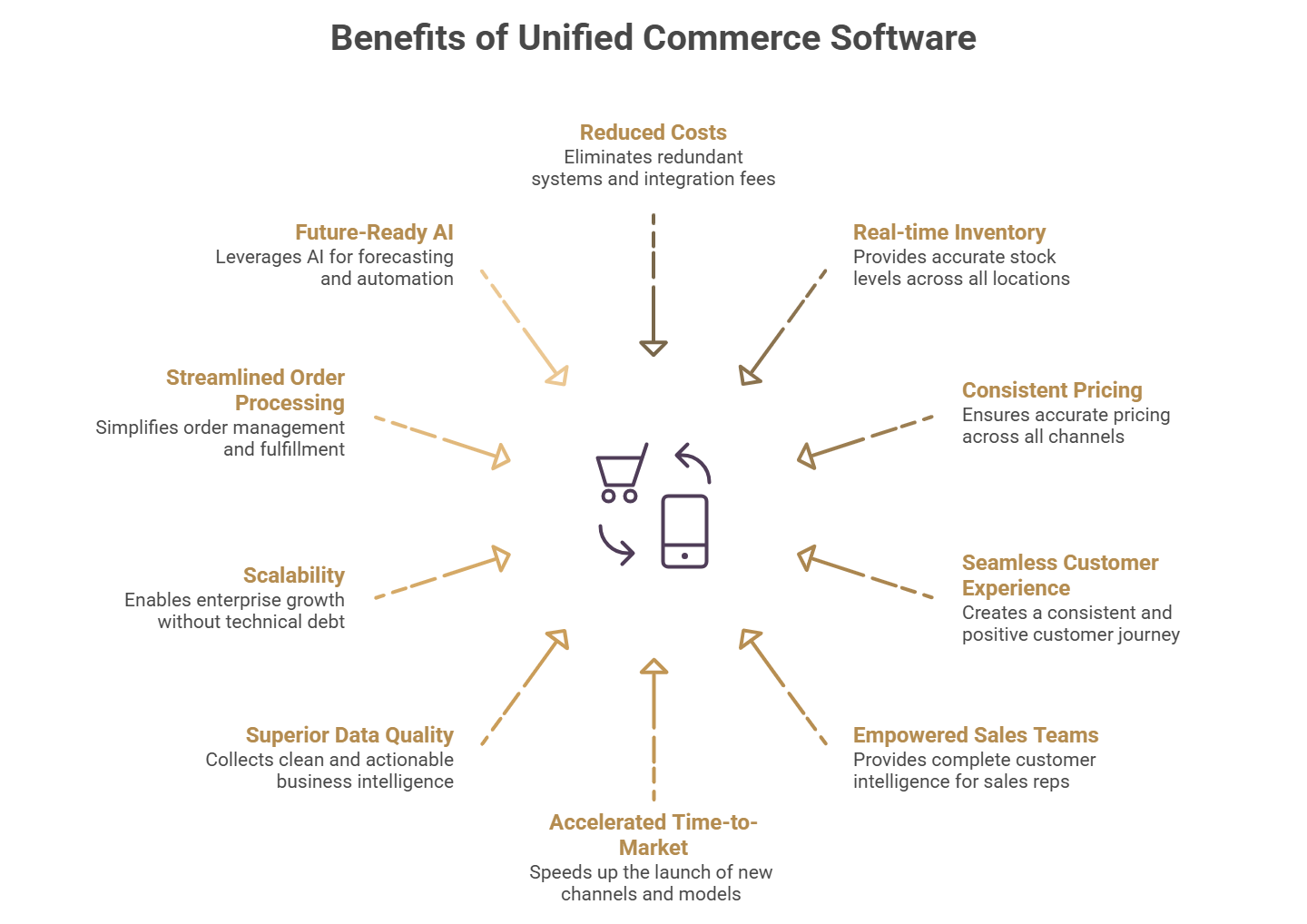
Unified commerce brings real improvements to enterprise operations by tearing down data silos and connecting every sales channel through a single platform. Here’s what that looks like in practice for wholesalers, manufacturers, and distributors.
Benefit 1: Dramatic reduction in operational costs and IT overhead
Every disconnected system in your stack carries its own licensing, maintenance, and technology integration costs.
A unified commerce platform consolidates all of that into one system. You eliminate redundant inventory management systems, middleware fees, and duplicate data storage.
Your dev team stops patching connectors and starts building features that drive revenue. As you scale and add channels, costs stay flat instead of multiplying with every new integration.
Benefit 2: Real-time inventory visibility across all locations and channels
When your quoting tool, eCommerce storefront, and customer service platform each keep their own ERP connection, no two tools show the same stock numbers. A unified platform acts as a single commerce layer that sends and receives real-time inventory updates to and from your ERP.
Every channel pulls availability from one source, so when a distributor buys a pallet through your B2B portal, the updated count shows immediately for sales reps, self-service buyers, and customer service teams alike.
Stockouts drop, excess inventory shrinks, and your ops team stops wasting hours on manual reconciliation.
Benefit 3: Consistent pricing accuracy and eliminated revenue leakage
Tariffs shift. Supplier costs spike. Without a unified system, pushing price updates across thousands of SKUs can take days, and every delay eats into margins.
With a single database, you change a single field, and contract pricing, volume discounts, promotions, and currency conversions update across all channels at once.
Manual entry errors vanish, and unified and standardized product data keeps everything aligned.
Benefit 4: Seamless customer experience across every touchpoint
A purchasing manager places routine orders on your website, negotiates a quote via email, and then calls to check on delivery for a large order. Unified commerce ties these interactions to one record.
When your rep picks up the phone, they see open quotes, recent orders, and full history. They can respond based on actual customer preferences instead of asking the buyer to repeat themselves.
That consistent customer experience builds trust at every step of the customer journey and gives you a real edge over competitors still running fragmented systems.
Benefit 5: Empowered sales teams with complete customer intelligence
Field reps walk into meetings blind when customer data is scattered across platforms. Unified commerce changes that through integrated customer relationship management, which merges online activity, order history, support tickets, and account status into a single view.
Your team pulls this up on mobile apps mid-visit, spots cross-sell opportunities in real time, and solves issues before they stall a deal. Access to unified sales data means reps make informed decisions backed by real customer insights, not guesswork.
Benefit 6: Accelerated time-to-market for new channels and business models
Legacy stacks make every new channel a full integration project. With a unified commerce strategy, the foundation already handles inventory, pricing, and order routing.
Adding a B2B2C portal, launching marketplace integrations, opening direct-to-consumer alongside wholesale, or building partner portals with custom approvals all become lighter lifts.
Each new channel plugs into what’s already there, rather than requiring months of custom development.
Benefit 7: Superior data quality and actionable business intelligence
When transaction data is spread across disconnected tools, your analytics team spends more time cleaning than analyzing. Unified commerce collects everything in one place from the start.
Reports pull from a single source with no channel-to-channel discrepancies. You spot patterns like multichannel buyers delivering higher lifetime value, identify your fastest-moving products, and adjust distribution strategy based on complete, trustworthy data rather than stitched-together exports.
Benefit 8: Scalability for enterprise growth without technical debt
Old platforms accumulate technical debt every time you bolt on a customization. Implementing unified commerce on a modern, API-first architecture changes the equation.
You add new regions, currencies, and tax rules without rebuilding. You connect best-of-breed apps through standard interfaces. This business strategy enables businesses to expand globally while keeping their core commerce engine stable and clean.
Benefit 9: Streamlined order processing and fulfillment workflows
Disconnected order management systems mean customer service teams can’t see order origins and warehouses receive inconsistent picking instructions. Unified commerce puts every order into a single standardized queue regardless of source.
Whether it came from your website, a field rep, or a partner portal, processing follows the same workflow. This enables better customer service, faster fulfillment, and fewer errors across your distribution network.
Benefit 10: Future-ready AI and automation capabilities
AI tools are only as good as the data they run on. As automation reshapes the retail landscape, unified commerce platforms are uniquely positioned to capitalize on it.
Clean, unified view powers demand forecasting, fraud detection, automated customer support, and intelligent product recommendations.
For wholesalers and distributors processing high volumes of repeat orders, this translates directly into measurable operational efficiency gains that compound over time.
How to Choose the Right Unified Commerce Software

Choosing the right unified commerce software starts with a close look at your operations and technology needs. Look for a solution that can manage complex B2B transactions, handle multiple inventory pools, and work well with your ERP and warehouse management systems.
Start by checking these key factors:
- Make sure the software offers real-time inventory and order management, syncing stock across warehouses, sales channels, and distribution centers right away.
- Look for native integrations with your ERP, PIM, and supply chain tools to avoid problems with extra middleware.
- Check that the platform includes B2B features such as quote management, bulk ordering, custom pricing, and net terms.
- Find an API-first architecture that lets your developers build custom workflows without limitations.
- Consider the full implementation timeline and total cost of ownership, including not just license fees but also integration, training, and ongoing support.
Watch out for platforms that promise unified commerce but actually just glue together separate modules.
Real unification means one database, one customer record, and one source of truth for pricing and inventory. Many enterprise ecommerce systems started as retail tools and were adapted for B2B, which can cause friction you’ll regret later.
Pay extra attention to data migration. You’re moving years of customer history, pricing deals, and product specs. A platform with dedicated migration support can save you months of headaches during the switch.
Core Unified Commerce Platform Capabilities You Cannot Compromise On
Looking at unified commerce software for distribution, manufacturing, or wholesale? Understanding how unified commerce helps you serve customers and handle tricky B2B transactions is essential when evaluating your options.
A true unified commerce system should support your business model right from the start. You want native B2B features built in, not add-ons tacked on later.
Your platform must deliver the following.
| Capability | Why It Matters |
|---|---|
| Native B2B functionality (account hierarchies, contract pricing, approval workflows) | Supports complex buyer relationships and purchasing rules |
| CRM integration or built-in customer management | Tracks every customer interaction in one place |
| Real-time ERP connectivity with bidirectional data flow | Keeps backend systems synchronized without manual data entry |
| Mobile-responsive customer portal and sales rep tools | Enables ordering and account management from any device |
| Advanced search and product configuration capabilities | Helps buyers find technical products quickly across large catalogs |
| Flexible pricing engine supporting complex B2B rules | Manages volume discounts, customer-specific pricing, and contract rates |
| Multi-warehouse inventory visibility with ATP support | Applies availability rules and calculations using real-time inventory data fed from your ERP |
| Quote-to-cash workflow automation | Streamlines the entire sales cycle from quote to payment |
| Comprehensive reporting and analytics | Provides unified data for better business decisions |
| Open API for custom integrations | Connects specialized tools without rebuilding your tech stack |
| AI OOTB tools and AI infrastructure | Automates routine tasks and provides intelligent recommendations |
| Proven enterprise implementations in your industry | Confirms the vendor understands your operational challenges and compliance needs |
| Transparent pricing with no hidden fees | Watch for charges beyond licensing, such as per-API-call fees, overage costs, or surcharges tied to order volume |
Your platform should have real-world enterprise implementations in your industry. That proves the vendor actually gets your operational headaches and compliance needs.
OroCommerce checks every box on this list. Purpose-built for B2B manufacturers, wholesalers, and distributors, it delivers all of these capabilities natively in a single platform, without stitching together third-party add-ons.
Why OroCommerce Delivers the Most Complete Unified Commerce Solution

OroCommerce stands out because it packs everything your business needs into one platform. You get eCommerce, CRM, PIM, DAM, CPQ, and payment processing, with no need to juggle a bunch of vendors or wrangle messy integrations.
What makes OroCommerce different:
- Built-in CRM connects customer data across every sales channel, supporting exceptional customer experiences
- Native CPQ and quoting tools with no separate systems required
- Integrated payment processing with OroPay for easier reconciliation
- AI-powered automation for order processing and customer support
Most platforms make you cobble together different tools or rely on third-party add-ons. OroCommerce was built with B2B manufacturers, wholesalers, and distributors in mind, businesses that need unified solutions for B2B eCommerce.
The platform handles complex account hierarchies, contract pricing, and multi-organization structures right out of the box. You can also connect your existing ERP, WMS, or other backend systems thanks to the API-first architecture.
Companies like DiversiTech, Azelis, and Lactalis use OroCommerce to replace patchwork systems with one platform. They’ve reported big improvements in order volume, process efficiency, and customer adoption.
See how OroCommerce can give your team a single source of truth.
Security, Compliance, and Data Governance in Unified Commerce
A unified commerce environment pulls together customer data, sales info, and transactions from all your channels. That’s powerful for insights, but it also ups your security game.
Centralizing data means that if there’s a breach, sensitive info across multiple operations could be at risk. Strong security protocols protect customer data while also enabling you to deliver faster, more accurate service.
Regulatory requirements like GDPR and CCPA become more complex when data moves between warehouses, storefronts, and distribution centers. Look for platforms with SOC 2, ISO 27001, and PCI DSS certifications.
Data governance frameworks spell out who gets access to what, and when. Sales teams need demand patterns. Customer service needs order histories. A solid framework segments access by role and tracks every data movement.
Implementation Strategy for Enterprise-Scale Deployment
To roll out unified commerce in wholesale, manufacturing, or distribution, you need a clear plan. Moving too quickly can cause problems with order processing, inventory, and customer relationships.
Begin by testing unified commerce in just one division or product line. This lowers risk and lets your team spot problems early. List out how your ERP, warehouse management, and customer portals depend on each other to decide which systems to connect first.
It’s important to connect your systems in the right order. While you switch over, keep both old and new systems running to make sure orders continue smoothly. Most B2B companies need 6 to 12 months to fully roll out new systems.
A solid omnichannel strategy helps guide this phased rollout.
Make sure your testing covers real business situations, like bulk orders, custom pricing, and checking inventory at different locations. Involve team members from sales, operations, and customer service in user acceptance testing.
Build role-specific training for warehouse staff, sales reps, and customer service. Pick change champions in each department to support colleagues through the transition.
Future-Proofing Your Investment: Avoiding Platform Lock-In
When you put money into unified commerce software, you’ve got to look past just getting it up and running. Platform lock-in can leave you stuck with one vendor, unable to adapt as customer expectations evolve or your market shifts.
Open standards and flexible architecture are key. Your system should support standard APIs and microservices so you can swap out components when needed. Modular systems let you bolt on new warehouse management tools, ERPs, or B2B portals without rebuilding everything.
Data ownership matters too. You should control your customer records, order history, inventory, and transaction logs. Look for platforms that let you export data in common formats like CSV, JSON, or XML.
Many companies go hybrid with proprietary platforms built on open standards, getting vendor support while still keeping options open.
Conclusion About Unified Commerce Software
Unified commerce software gives your B2B operation the power to sync inventory, orders, and customer data across every channel in real time. You’ve seen how it reduces the total cost of ownership, speeds up fulfillment, and builds stronger customer relationships through connected experiences.
The key benefits covered include:
- Real-time inventory visibility across warehouses and sales channels
- Unified customer profiles for better account management
- Automated order routing and fulfillment optimization
- Lowered operational costs through eliminating middleware
- Faster implementation times compared with traditional systems
- Better data validity for procurement and forecasting
- Seamless B2B payment and credit term management
- Scalable architecture that grows with your distribution network
For manufacturers, wholesalers, and distributors, choosing the right platform means finding one that handles complex B2B requirements. You need support for bulk ordering, custom pricing tiers, account hierarchies, and ERP integration built for your industry.
OroCommerce delivers unified commerce capabilities designed specifically for B2B operations. The platform handles your unique workflows while connecting your sales teams, warehouse systems, and customer portals on one foundation.
Your next step is understanding how unified commerce fits your specific operation.
See how the platform can reduce your costs and improve your order accuracy.
FAQs About Unified Commerce Software
What is unified commerce?
Unified commerce brings together all your sales channels, inventory, and customer records in one real-time database. Pricing and stock levels update instantly everywhere. Instead of using middleware, unified commerce puts everything on one platform, so there are no data delays or inventory mistakes. This gives every team one reliable source of information.
What is the difference between unified commerce and omnichannel?
Unified commerce uses one database. Omnichannel commerce focuses on several systems linked by middleware, which can cause delays and incomplete customer records. With unified commerce, every interaction is saved in one place and is easy for all teams to access. Check out our guide on unified commerce vs omnichannel to learn more.
How does unified commerce support evolving customer expectations?
B2B buyers want a seamless shopping experience on every channel. Unified commerce delivers this by linking POS systems, online stores, and sales tools on one platform. This helps build customer loyalty and supports long-term business growth.
What does unified commerce mean for in-person and counter transactions?
Your point-of-sale terminals connect to the same database as your online store. This means sales reps in brick-and-mortar stores see the same prices, inventory, and customer history as online. Customers can switch between channels without any hassle.