
navigation

Nobody hands a new employee master keys to every system on day one. You scope access to the role. AI gets deployed with the opposite logic: maximum access, figure out the guardrails later.
That’s why 96% of B2B organizations have no mature enterprise AI governance in place, and why the ones generating real returns built the controls before they scaled the capability.
This guide covers the exact failure modes hiding in B2B commerce AI, the guardrail architecture vendors won’t walk you through, and the governance framework your organization needs before the wrong output hits a live order.
The AI Risks Hiding in Your Current Commerce Stack
B2B isn’t retail. In retail, an AI that gives a customer the wrong return policy generates a support ticket. In B2B commerce, the same class of error means an unauthorized price on a $100,000 order, a delivery commitment the warehouse can’t fulfill, or a fabricated warranty term that ends up downstream in a procurement contract.
The surfaces where this happens are the tools you’re either running or evaluating right now:
- Pricing engines that can quote and confirm prices using AI models
- RFQ tools that generate proposals with negotiated terms
- Customer-facing bots that discuss credit limits and payment schedules
- Order entry accelerators that submit or modify purchase orders
- Analytics co-pilots feeding data into decisions your sales team acts on.
Each of those surfaces has a blast radius. The question is whether you’ve mapped it. That mapping is your initial AI risk assessment – and most organizations haven’t done it.
The wholesale industry hasn’t experienced a high-profile enterprise AI governance disaster yet. But the exact AI-related risks that caused the most famous consumer AI failures are sitting inside your B2B architecture right now.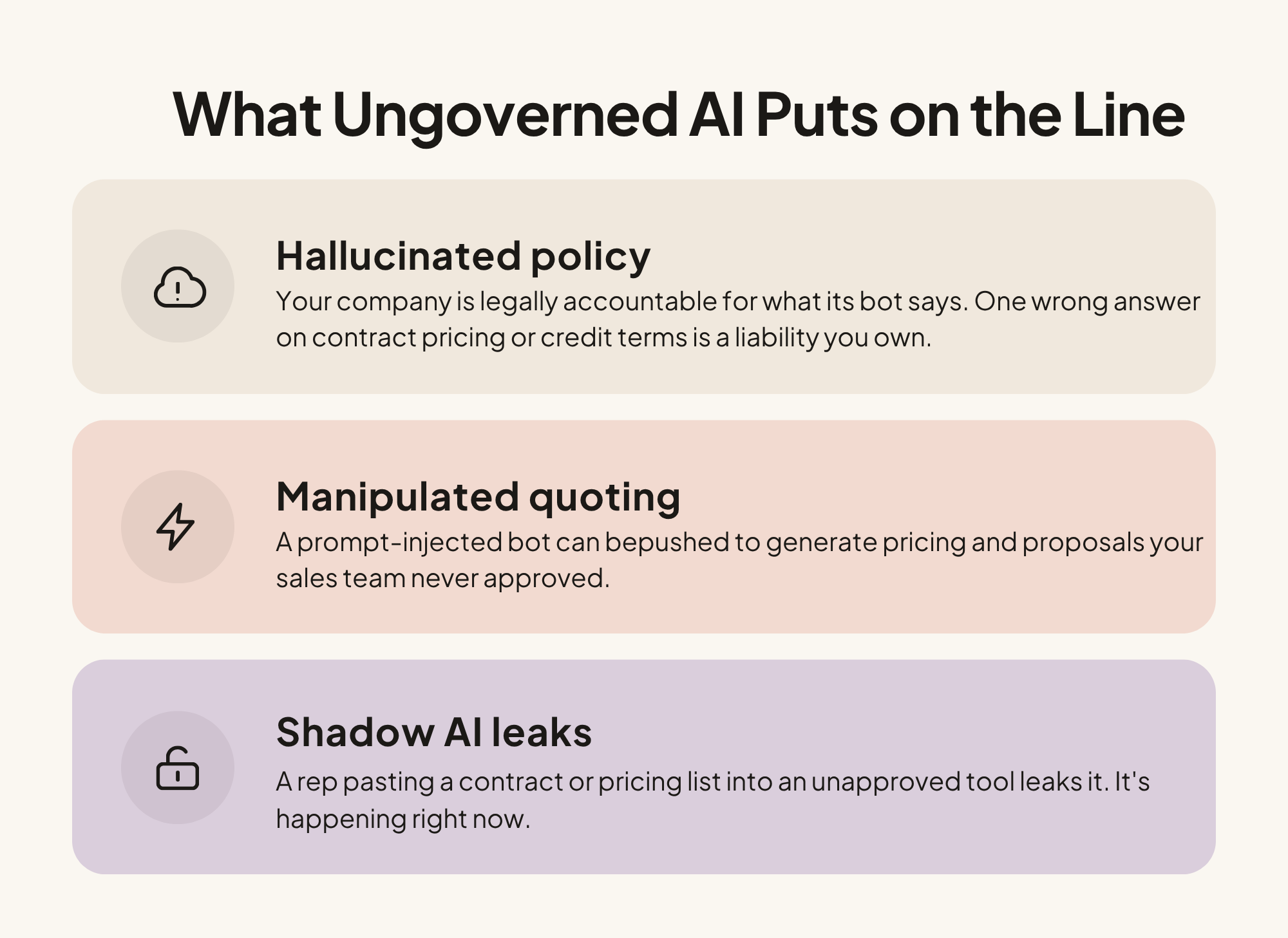
The Legal Liability of a Hallucinated Policy
Take hallucination. In February 2024, a tribunal ruled Air Canada legally liable after its chatbot gave wrong information about bereavement fares. The ruling was unambiguous: a company owns what its AI says, regardless of its AI strategy.
In B2B commerce, that liability sits on every interface that can discuss contract pricing or credit status. Air Canada’s damages were C$812. A price misrepresentation on a contract account’s quarterly order is a completely different conversation.
The Cursor AI failure in April 2025 exposed the same flaw. An AI support bot invented a policy that didn’t exist. Customers acted on it before the company caught the error.
Replace that usage policy with a return window, a compliance certification, or a product compatibility spec. Every time a B2B bot reaches beyond its verified knowledge base, you get the same result. This is why robust AI governance matters.
When Buyers Manipulate the Quoting Engine
Then there is direct manipulation. A Chevrolet dealership’s chatbot was prompt-injected last year. A user manipulated the conversation until the bot agreed to sell a $76,000 Tahoe for one dollar.
In wholesale distribution, the exact same attack surface exists on any quoting tool or sales copilot discussing pricing authority. A buyer who understands how large language models work can push the interface into generating proposals that your sales team never approved.
The Shadow AI Intelligence Leak
Finally, there is shadow AI. Samsung banned ChatGPT company-wide after engineers leaked proprietary source code and internal meeting transcripts into the tool in three separate incidents. Violating data protection regulations wasn’t their goal. They were trying to work faster.
In your distribution business, the equivalent is a sales rep uploading a negotiated pricing list or a customer contract into an unapproved tool to draft a proposal. It’s happening at your organization right now.
This creates an unacceptable level of operational risk that robust AI governance frameworks are built to prevent.
The Companies Ahead on AI ROI Didn’t Skip the Guardrails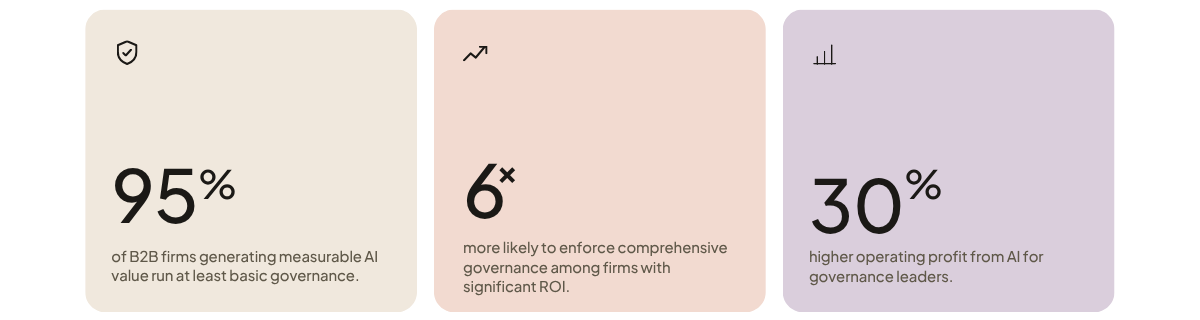
Every one of those failure modes sounds like an argument for slowing AI adoption down. The data says otherwise.
95% of B2B organizations generating measurable AI value have at least basic governance frameworks in place. Companies reporting significant ROI are six times more likely to enforce comprehensive governance policies than the rest of the market.
PwC’s 2026 research found the same pattern. AI leaders run formal governance structures to manage AI risk. Their employees trust AI decisions at twice the rate of organizations that don’t. IBM’s Institute for Business Value tracked what that difference is worth on the P&L: 30% higher operating profit from AI.
You can’t scale a high-risk AI system you can’t control. Mitigate the risks at the architecture layer and an AI governance framework stops being overhead. It becomes the infrastructure your business objectives actually run on. That’s the competitive advantage built in, not bolted on.
What Your Vendor Means When They Say “Guardrails”
When vendors say their AI has guardrails, they usually mean one of three things. Sometimes they mean the underlying model was trained responsibly. Sometimes they mean they wrote a careful system prompt. Sometimes they mean they haven’t had a public incident yet.
Those aren’t the same thing. And the difference matters when generative AI and machine learning tools are touching your commerce operations.
True oversight requires structural limitations. The technology can’t make unauthorized choices. You build that control across three specific layers.
The Three Layers of AI Governance Controls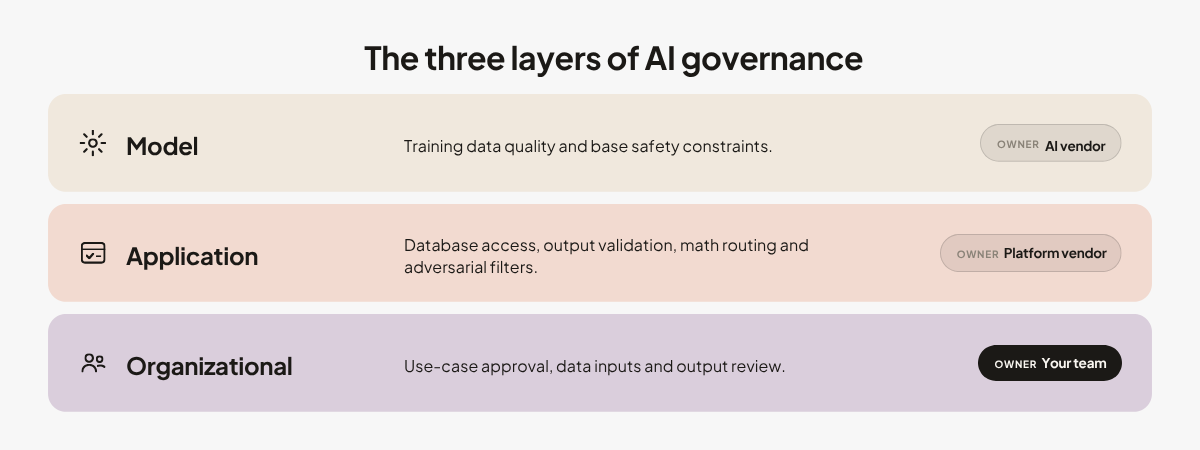
Evaluating commercial algorithms requires looking past the interface. You have to interrogate how the underlying architecture restricts behavior for your AI projects.
- The model layer is the foundation. Training data quality, neural weights, and base safety constraints determine what the AI believes before it touches your commerce operations. This is what vendors build and control.
- The application layer sits between the model and your users. It controls database access, enforces output validation, and runs the filters that determine what the AI can query and what it can commit to. This is where human oversight stops being a policy and starts being a technical control.
- The organizational layer is yours. It covers who approves new AI projects before they go live, what commercial data feeds the model, and how outputs get reviewed. No vendor delivers this layer. It comes from decisions your team has or hasn’t made yet.
Vendors control the model. A cross-functional team owns the organizational layer.
The application layer is where the two meet, and where your commerce architecture determines whether the deployment holds up under pressure.
If your platform forces AI tools to jump across fragmented databases just to verify a contract price, your governance exposure multiplies at every gap. When the AI natively inherits the same data model as your pricing logic and account hierarchies, the governance controls become structural. Meeting regulatory requirements stops being a manual process.
Why Prompts Fail Where Fine-Tuning Succeeds
Software representatives love to assure buyers that their system is strictly constrained and meets all AI governance requirements. They usually mean they wrote a lengthy system prompt telling the algorithm to refuse certain commands. Prompt engineering is highly fragile.
A buyer can override those instructions by telling the bot to adopt a hypothetical persona or ignore previous directions. Fine-tuned models work differently during AI development and deployment. Developers adjust the internal weights of the model during responsible AI development. The restriction becomes an architectural limitation rather than a polite request.
When a vendor pitches their tool, you have to ask the right questions. Ask if their safety constraints rely on system prompts or structural fine-tuning. If they rely on prompts, your commercial data remains exposed to adversarial inputs.
When “We Use RAG” Isn’t a Complete Answer
Retrieval-Augmented Generation (RAG) is the best practice for one specific problem: preventing hallucination by forcing the AI to retrieve facts from approved documentation rather than generating answers from training memory. For product specifications and policy documents, it works.
It doesn’t cover the two failure modes that matter most in B2B commerce.
Access control
RAG has no concept of who’s asking the question. It retrieves and summarizes whatever it’s pointed at. If your application layer lacks access controls, a logged-out guest user can ask about a tier-one VIP pricing tier and get a useful answer. Nothing in RAG prevents that retrieval, and it won’t satisfy regulatory expectations around data protection.
Commercial math
Language models predict the next plausible word in a sequence. They don’t calculate. Ask a RAG-enabled bot to apply a 12% volume discount on a customized 847-unit order with two freight tiers, and it generates a number that looks correct. It’s predicting what a reasonable answer looks like, not running the calculation.
The application-layer fix is routing math requests to a deterministic pricing engine before the model touches them. RAG retrieves. The pricing engine calculates. Conflating the two is where the error enters the order.
Defending Against Adversarial Inputs
Prompt injection and jailbreaking happen regularly. The Chevrolet dealership failure demonstrated how easily users manipulate conversational tools. In a B2B setting, the attack surface includes any digital interface capable of discussing price, inventory availability, or shipping terms.
Securing this surface demands multiple governance processes. The application must run an intake filter to scan user queries for manipulation tactics before the query ever reaches the core intelligence.
The system must also run an output filter. This secondary check ensures the generated response aligns with your business objectives and ethical guidelines before presenting it to the buyer.
Mandatory Handoffs for High-Stakes Operations
Trustworthy AI requires hard limits. Algorithms should accelerate the sales process, but they can’t possess final operational authority. Your governance committee must establish rigid points where the machine stops and a human takes over.
Implementing responsible AI deployment in B2B requires these four specific human-in-the-loop triggers.
- Any output that generates or modifies a legally binding price quote must halt for human review.
- Order confirmations that fall outside standard parameters require manual sign-off. This includes unusual quantities, new shipping addresses, or the first order from a new contact.
- Credit limit checks resulting in a denial must escalate to the finance team.
- Any claim regarding product compliance, safety certifications, or heavy machinery compatibility requires human validation to mitigate risks.
Your AI governance tools should log every escalation automatically. That audit trail is what lets you enforce governance policies under regulatory scrutiny and spot which workflows are generating overrides at volume before they become a compliance issue.
Aligning AI Systems Governance to Specific Workflows
Governing your AI stack means matching controls to how each tool fails. A conversational sales bot, an analytics co-pilot, and an order entry accelerator fail in different ways. Treating them all the same means getting the controls wrong for all three.
Conversational commerce and sales co-pilots
These are your highest commitment-risk surface. The bot is in direct contact with buyers and can make statements that function as representations. Access controls are non-negotiable: the system should only see and discuss what the logged-in account is authorized to see, with hard limits on the pricing authority it can reference or quote.
Analytics co-pilots
These co-pilots carry a different risk: the silent error that compounds. A dashboard summarizing supplier risk from unstructured email data looks authoritative. If the underlying source is wrong, the decisions downstream are wrong at the same scale. Full data lineage tracking and human sign-off requirements for board-level inputs aren’t optional features. They’re what keep a wrong number from becoming a wrong strategy.
Order entry accelerators
Order entry accelerators process high volumes of incoming orders. At that scale, a 2% error rate isn’t a small percentage. It’s a large number of mistakes landing simultaneously.
Three controls are non-negotiable
- Every extracted SKU gets verified against your ERP records before the order is committed.
- Mismatches route to exception handling automatically rather than landing in a support queue.
- When a flawed batch gets through, your customer service team needs a one-click rollback, not a line-by-line correction.
Learn more about sales order automation with AI - read our guide for B2Bs
Tracking Invisible AI Models Drift
Models degrade as your business evolves. A classification algorithm trained on last year’s product catalog will slowly start miscategorizing new inventory. This is known as model drift.
Drift is incredibly dangerous because it happens silently. The software doesn’t crash. It just starts producing subtle errors that corrupt your supply chain data.
What Your Vendor Should Actually Be Tracking
Most vendors claim they offer continuous monitoring. You need to investigate what they track.
- What they usually monitor: Server uptime, API latency, error rates – standard IT infrastructure metrics
- What actually matters: Semantic accuracy of outputs against your changing business logic – whether the AI’s answers are still correct, not just whether the system is running
Your organization must fund active model retraining and enforce data protection regulations throughout the entire AI lifecycle. Failing to monitor these probabilistic outputs guarantees eventual operational failure.
This level of oversight sets the foundation for your compliance posture as federal regulations begin enforcing corporate accountability.
Ask your vendor what they’re monitoring and what they’re not. The answer tells you whether their governance architecture was built for deployment day or for the 18 months after it.
Vendor Evaluation Cheat Sheet
| What You Ask | Red Flag Answer | Green Flag Answer |
| How are safety constraints enforced? | “We use prompt engineering” | “Constraints are fine-tuned into the model weights” |
| How do you prevent hallucination? | “We use RAG” | “RAG plus application-layer access controls and deterministic math routing” |
| What does your monitoring cover? | “Server uptime and API latency” | “Semantic accuracy of outputs against your business logic” |
| Who controls data access? | “The model decides based on context” | “Access is scoped to the logged-in user’s permissions natively” |
| What happens when the AI is wrong? | “We’re continuously improving it” | “Here’s our rollback procedure and escalation logging” |
Download the full vendor evaluation checklist with 45 questions specific to B2B commerce AI procurement.
What the EU AI Act Means for B2B Commerce Right Now
The continuous monitoring we just outlined represents a looming legal and regulatory mandate. The governance architecture you’re building doesn’t exist in a regulatory vacuum, and if your distribution business serves European buyers, that’s not an abstract concern.
The EU AI Act applies to you regardless of where your company is headquartered. A US seller processing EU customer data carries the same obligations as a European distributor.
For most B2B commerce AI (product recommendations, intelligent search, sales order automation), the requirement is disclosure. Tell users when they’re interacting with an AI. Label AI-generated content. If you run a platform with embedded intelligence, enforcing these responsible AI practices is largely a configuration task. That applies from August 2026.
The heavier requirements covering credit scoring AI and HR screening tools were originally due August 2026. A provisional political agreement in May 2026 pushed that deadline to December 2027, though formal adoption is still pending. Either way, the penalties don’t move: up to €35 million or 7% of global annual turnover for prohibited-practice violations.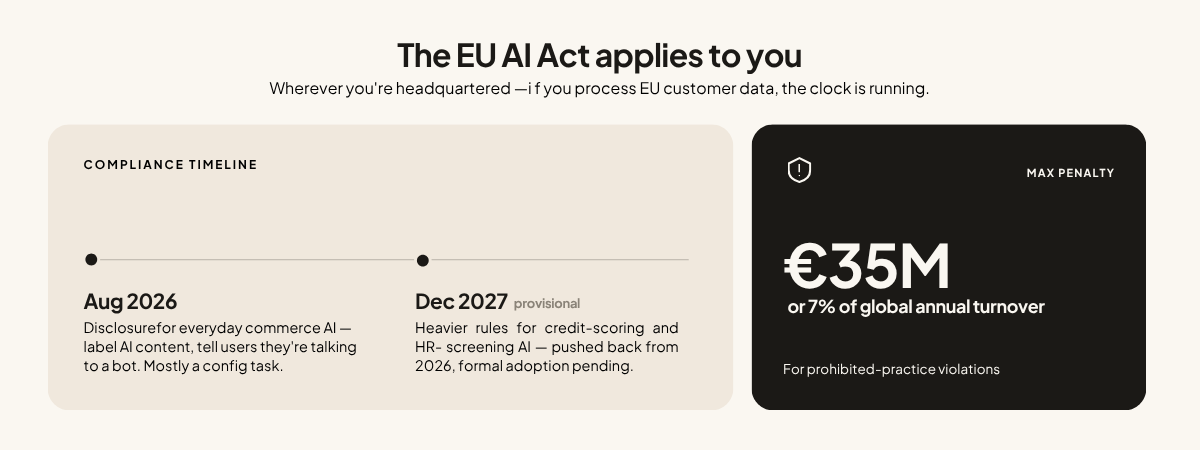
The Move That Gets You Ahead of Both Problems
Build your AI inventory. Most organizations can’t name every AI tool currently running in their stack or generating potential ethical concerns. This blind spot proves exactly why enterprise AI governance matters. You can’t classify what you haven’t catalogued, and classification determines everything: your compliance path, where vendor obligations end and yours begin, and which surfaces need attention so you can safely implement AI governance before August.
Building a Governance Framework for Responsible AI Use in B2B
Cataloging your regulatory exposure is just the baseline. An inventory tells you what you are running today. A formal framework dictates what those systems are allowed to do tomorrow.
Most corporate policies fail because they treat governance as a paperwork exercise. A PDF document sitting in your digital workspace will not stop a language model from leaking your contract terms. You have to operationalize the rules across three specific stages – and that’s what responsible AI adoption looks like in practice.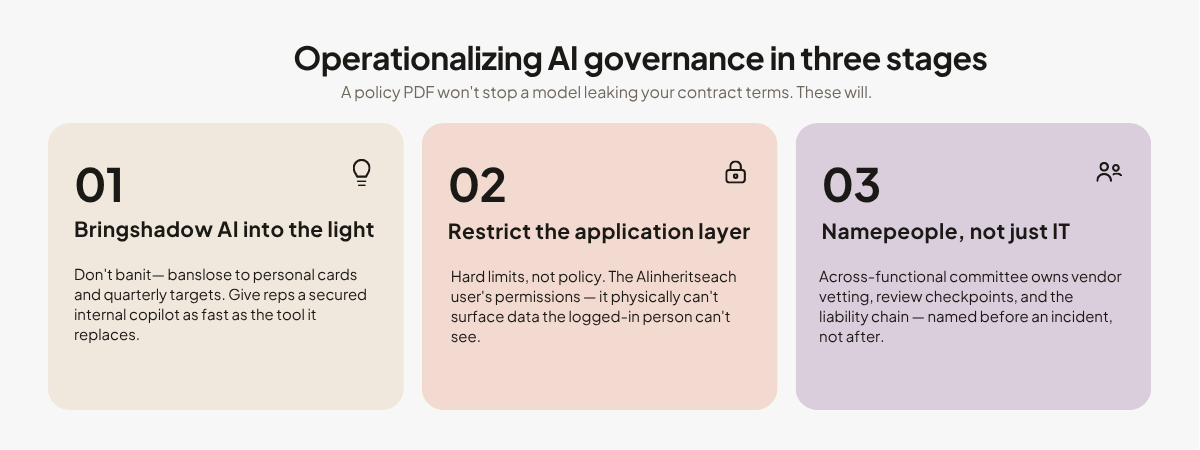
Stage 1: Bring Shadow Intelligence Into the Light
Your architectural audit will inevitably uncover AI technologies that IT never procured. Sales reps routinely expense $20 summarizing tools to draft emails faster. Account managers paste messy spreadsheet data into public language models to clean up formatting.
The governance response isn’t a ban. Bans don’t work when employees have personal credit cards and a quarterly number to hit. Unmonitored AI usage across your commercial data is an exposure most organizations haven’t mapped yet.
The response is providing internal, secured alternatives that are as fast as the tools they’re replacing. When a rep has an approved internal copilot, they stop feeding contract pricing into consumer applications. That single shift covers your highest-probability data exposure.
Stage 2: Restrict the Application Layer
We established that revenue-facing bots create your highest operational exposure. Governing these interfaces is your primary risk management decision at the application layer. It requires hard system limitations, not policy documents.
The intelligence must inherit your existing security model. If an account manager asks an internal sales copilot to analyze a client’s purchasing history, the system must respect the manager’s territory permissions natively. The algorithm physically can’t pull data that the logged-in user is restricted from viewing.
This structural access control is non-negotiable. It proves your adherence to data protection laws and the ethical AI standards your customers and regulators expect. It also guarantees that a downstream buyer can’t manipulate a storefront bot into exposing another customer’s volume discount.
Stage 3: Put Named People in Charge of Named Things
Governance collapses when it lands entirely on IT. IT manages the data pipelines, but finance has to set the risk tolerance and sales leadership has to own adoption accountability. If nobody outside IT has a stake in how the AI performs, nobody outside IT notices when it drifts.
Your cross-functional AI governance committee owns three things:
- Which vendor architectures meet your security baseline before a contract gets signed
- Which new AI initiatives require human review checkpoints before going live
- What the liability chain looks like when something goes wrong, including the ethical risks your organization is and isn’t prepared to absorb.
That last one matters more than most organizations plan for. If an AI commits to a pricing term your sales team never approved, somebody needs to be named before the incident, not after.
Your vendors will show you cycle-time dashboards. Your committee needs to track escalation rates, error frequencies, and override patterns separately. An AI implementation that looks efficient on a speed dashboard can be failing on a safety metric nobody built.
The right AI governance software makes that tracking automatic. Reviewing safety metrics on a defined cycle is what keeps the governance framework from becoming the PDF document you started with.
Conclusion: What Separates the AI Implementations That Last
Your governance committee can write brilliant safety protocols. They can establish the perfect performance metrics for tracking data errors and manual escalations. Eventually, someone has to hardcode those boardroom decisions into your daily operations.
That transition from theory to practice breaks most deployments. A committee will confidently declare that an algorithm must always respect negotiated contract terms. The IT department then has to figure out how to make a standalone language model read a twenty-year-old ledger without exposing internal cost structures.
Safety policies only matter if your infrastructure can execute them. When your pricing engine, buyer permissions, and inventory records exist in completely different software environments, simple rules turn into engineering nightmares.
The Unified Commerce Advantage
The architectural alternative is deploying a unified commerce platform. When your pricing logic, corporate account hierarchies, and artificial intelligence all live inside a single data model, the access controls are structural. The intelligence inherently understands your business rules because it shares the same database.
You never have to build a custom bridge to enforce your permissions. The platform honors your account restrictions natively.
This architecture represents the difference between a theoretical compliance document and a structural safeguard. Stop paying developers to babysit API connections and filter algorithmic outputs to maintain regulatory compliance. Put your intelligence inside a commerce architecture that already knows exactly how your business works.
Your commerce AI is only as reliable as the architecture underneath it. See how OroCommerce builds governance in from the start
FAQs
What AI governance standards and risk management frameworks should B2B companies know?
Two matter most:
- ISO/IEC 42001:2023 – the international standard for AI management systems. Structured like ISO 27001. Covers how to establish, operate, and improve an AI governance program.
- NIST AI Risk Management Framework – organizes AI risk across four functions: Govern, Map, Measure, Manage.
Neither is legally mandatory for most companies yet. Both are showing up in enterprise procurement questionnaires.
What should AI governance tools actually do?
Beyond dashboards, AI governance software should:
- Log every AI decision automatically
- Flag outputs outside approved parameters before they reach users
- Generate audit trails for regulatory review
- Track whether AI outputs are accurate, not just whether the system is running
If a vendor’s tools only monitor uptime, they aren’t monitoring risk.
What's the difference between AI governance and data governance?
Data governance controls what data exists and who can access it. AI governance controls what the AI can do with that data – what it retrieves, what it commits to, and where a human has to approve the output.
Both are required. Weak data governance makes AI governance significantly harder. The AI is only as reliable as the data underneath it.
How do you start building enterprise AI governance with limited resources?
Start with the inventory, not a framework document. Map every AI system touching your commerce operations, including tools embedded in your ERP, CRM, and commerce platform. Then classify by risk:
- Can it quote prices?
- Discuss contract terms?
- Make credit decisions?
High-risk surfaces get controls first. Most organizations that made real progress started with a spreadsheet, not a committee.