
navigation

Every technology cycle introduces a fresh way to rack up technical debt. Right now, companies are doing it by taping external intelligence tools to the outside of their stacks.
The market treats artificial intelligence like a standalone appliance you can just plug into a wall. Finding the best B2B eCommerce platform with AI requires understanding that the exact opposite is true. If the machine can’t query your tailored pricing or naturally navigate your existing business systems, you simply built an expensive barrier between your company and your buyers.
Let’s ignore the marketing brochures and evaluate what seven major B2B eCommerce platforms are shipping today.
What AI Needs to Survive Wholesale
Retail AI has it incredibly easy. A consumer views a pair of boots and swipes a credit card. That basic history provides plenty of data to power a decent product recommendation.
B2B commerce plays by a rougher set of rules. Your intelligence layer needs to pull heavy data directly from your enterprise resource planning software. It requires a hard line to your accounting systems.
This explains why consumer-first tools fall flat in distribution. The algorithm functions perfectly well. The storefront just lacks the commercial context required to make a smart decision.
What to Look for in an AI-Powered B2B eCommerce Platform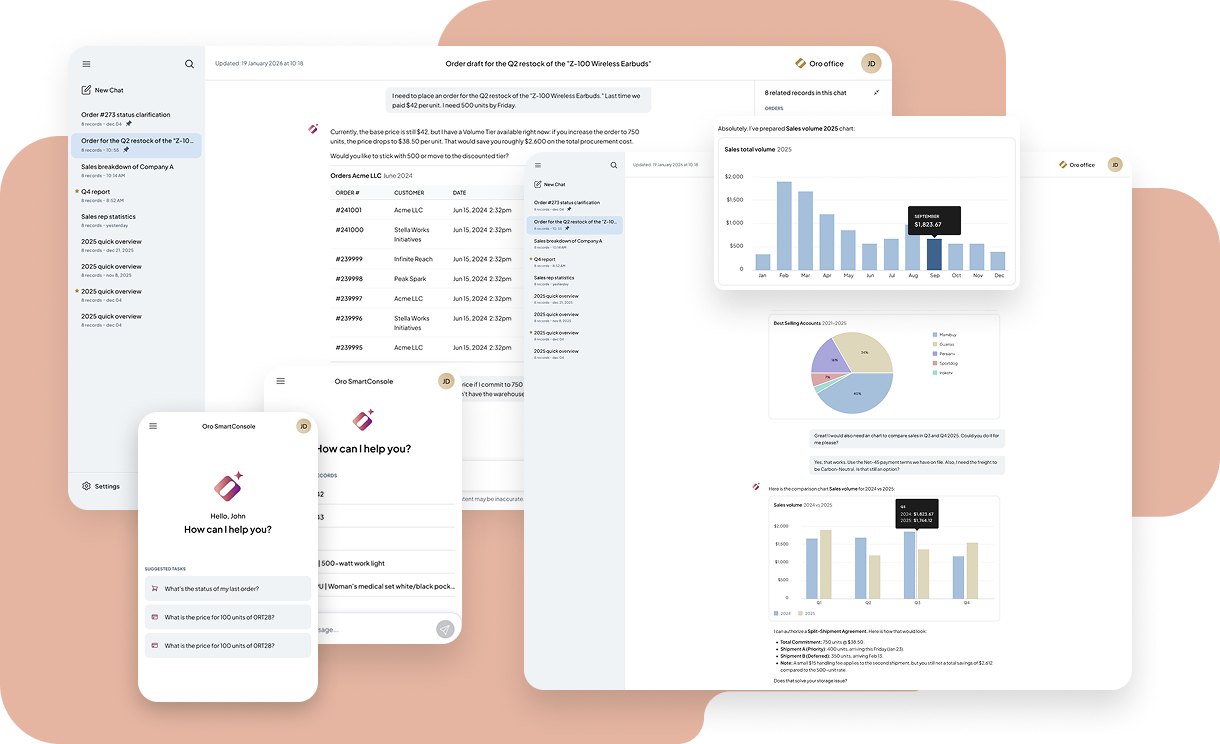
Evaluating artificial intelligence in B2B eCommerce platforms using a standard feature checklist is a dangerous game. A tool that generates brilliant marketing copy offers zero value to your heavy business operations. You must evaluate the architectural foundation beneath the algorithm instead of judging the conversational user interface.
Use this framework to separate the retail prototypes from enterprise-grade intelligence before you sign a contract.
| Criteria | What to ask | Why it matters |
| Commercial context | Does the AI access your custom pricing, account hierarchies, and catalog restrictions by default or through configuration after the fact? | Configured access requires maintenance every time your commercial logic changes |
| Order automation | Can the platform process an offline purchase order and validate it against live inventory and negotiated pricing natively? | Most platforms handle digital orders well. The offline gap is where manual work lives |
| Entitlement-aware search | Do search results reflect what each business buyer is authorized to see and buy, at their contracted price? | Generic search that ignores entitlements creates pricing errors and erodes buyer trust |
| Approval workflows | Are approval chains enforced within the commerce platform or dependent on a backend ERP integration? | ERP-dependent approvals break when the integration breaks |
| Audit trail | When the AI acts on something, where does that get logged and by whom? | Distributed audit trails across multiple systems create reconciliation problems |
| AI pricing model | Is AI included in the license or billed separately by action, token, or consumption? What does the cost look like at scale? | Consumption-based pricing is hard to forecast across large B2B order volumes |
| Roadmap transparency | Which features are GA today and which are in pilot or planned? Can they demo what you need with your data? | The gap between announced and shipped varies significantly across vendors |
| B2B workflow depth | Does the platform handle bulk order management, quoting, and customer-specific catalogs natively or through third-party apps? | Third-party dependencies add integration cost and maintenance overhead |
The Hidden Cost of Integration Middleware
When intelligence lives natively inside your commerce platform, it shares a database with your pricing rules. It inherits your commercial context by default.
Connecting an external AI tool via API forces your team to build a custom bridge. Every time you alter a price list or adjust an account setting, that change must synchronize across the integration. You’re adopting a permanent operating cost.
A bolt-on tool might survive a simple storefront. Once wholesale businesses need real-time inventory visibility across multiple warehouses, custom payment terms by account, and quote management tied to customer-specific catalogs – that’s where standalone AI breaks down. The integration debt compounds faster than the productivity gains.
When you evaluate a platform’s AI capabilities, the first question isn’t “which features does it have?” It’s “what can the AI see?” – and whether that access is inherited or integrated.
Further reading: Two architectural solutions to building B2B commerce AI
The 7 Best B2B eCommerce Platforms with AI Compared
Here is how seven major platforms position their artificial intelligence today.
| Platform | Best For | AI Pricing Model | Core AI Focus | Top Live Features |
| OroCommerce | Manufacturers and distributors automating heavy workflows. | Included in the Enterprise license. | Embedding secure intelligence directly into your commerce workflows. | AI SmartOrder (PO automation)
OroIQ: Acts as the unified orchestrator powering storefront agents and internal back-office assistants. |
| Salesforce | Enterprises deeply entrenched in the Salesforce CRM ecosystem. | Separate Agentforce pricing; per-user and consumption-based options. | Connecting buyer self-service directly to CRM and sales data. | Agentforce Buyer: Automates routine reordering.
Guided Shopping: Assists with catalog navigation. |
| SAP | Enterprises running SAP end-to-end. | Premium features can consume AI Units; unused units expire after 12 months. | Enriching massive catalogs and translating emails into system quotes. | CX AI Toolkit: Generates bulk product descriptions.
Quote Agent: Converts email requests into quotes. |
| Adobe Commerce | Content-rich B2B and B2C hybrid operations. | Core AI (Live Search and Product Recommendations) included; advanced AI separately licensed. | Driving top-of-funnel product visibility and behavioral engagement. | Live Search: Surfaces products based on intent.
Product Recs: Matches visual and behavioral signals. |
| Shopify Plus | Straightforward wholesale operations requiring basic retail functionality. | Core AI features included; usage limits vary by plan. | Accelerating consumer marketing and daily store administration. | Shopify Magic: Generates marketing copy and emails.
Sidekick: Provides a chat interface for administrators. |
| commercetools | Development-heavy teams wanting to construct custom interfaces. | AI capabilities sold as add-ons or standalone products; contract pricing applies. | Providing backend infrastructure for third-party bots to connect. | AI Hub: Connects external agents to commercial data.
MCP Server: Standardizes data access for outside tools. |
| Shopware | Mid-market B2B, strong in European markets. | Basic tools included; advanced agentic features require a paid add-on. | Making administrators faster at merchandising and storefront setup. | Shopware Copilot: Executes multi-step administrative and selected B2B tasks.
Data Insights: Answers business questions using store data. |
The Top 7 AI-Powered B2B eCommerce Platforms in 2026
The market is moving fast, and every vendor is loud about AI. Here is a breakdown of what the major B2B eCommerce platforms deploy today, what lives on their roadmaps, and where their architecture hits a wall.
OroCommerce
OroCommerce is a purpose-built B2B eCommerce platform for manufacturers, distributors, and wholesalers managing complex B2B sales processes. The native intelligence layer, OroIQ, works directly with the commercial data, business logic, and permissions already managed in OroCommerce. This gives the AI access to pricing, account, and workflow context as it works.
What’s live today
- OroIQprovides a single natural-language interface for back-office AI. It routes requests between SmartInsights for analysis and SmartAssistant for actions, while following existing OroCommerce permissions.
- AI SmartOrder converts uploaded or emailed purchase orders into draft orders. It can map Customer Part Numbers (CPNs) to internal SKUs, validate order data against existing system records, and process documents with 700+ line items in about 30 seconds.
- AI SmartAgent provides a natural-language buying assistant for the storefront. It handles product discovery and quote management while automatically enforcing role-based access controls for every logged-in buyer.
- AI SmartAssistant operates beneath OroIQ to equip your internal sales teams with a back-office copilot. Representatives can create quotes, build customer segments, and retrieve customer data using simple text commands.
- AI SmartInsights turns complex reporting into a simple conversation routed through OroIQ. Users query business data in plain English, and the system generates charts, KPIs, and tables on demand while respecting data permissions.
- Semantic search understands intent, handles typos, and surfaces relevant products even when buyers don’t know exact SKU names.
- Product recommendations trained on your transactional data surface relevant products to buyers based on purchase history and customer behavior.
- AI content generation helps produce product descriptions and catalog content via OpenAI or Google Vertex AI.
- MCP Server gives external AI clients standardized, permission-controlled access to OroCommerce data and operations.
Core OroCommerce AI capabilities are included with the Enterprise license. Third-party AI services can carry their own costs. For example, AI Content Generation requires an OpenAI or Vertex AI account with sufficient provider credits, while Google Retail Recommendations is offered separately.
See OroIQ in action:
What’s on the roadmap
- UCP support (2027+) will enable external buyer agents to discover and transact with OroCommerce storefronts through the Universal Commerce Protocol.
- SmartSales Co-Pilot is planned to analyze active opportunities and help sales teams identify where to focus next.
- SmartTrends is planned to monitor changes in customer behavior, sales volume, and buying patterns.
OroCommerce keeps people in control of AI-driven actions. OroIQ follows existing roles and permissions, and SmartAssistant requires confirmation before making changes to business records.
Honest limitation
The platform prioritizes back-office automation and the native storefront experience over third-party retail integrations. Native support for the Universal Commerce Protocol and tokenized agent payments sits on the future roadmap rather than the immediate release schedule.
OroCommerce handles your heavy commercial logic naturally. See the engine for yourself.
Salesforce Commerce Cloud (Agentforce Commerce)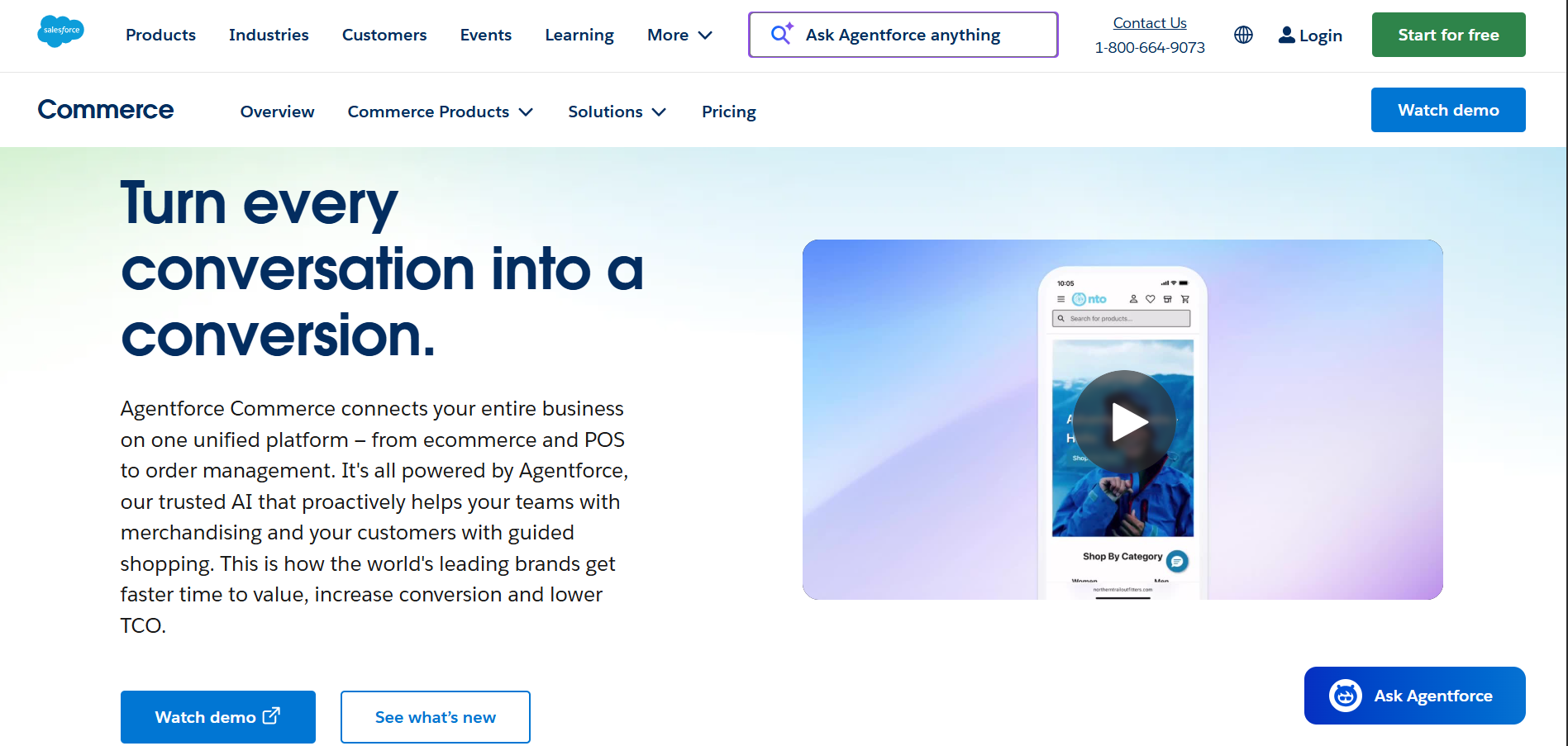
Salesforce rebranded Commerce Cloud to Agentforce Commerce in late 2025 with highly ambitious artificial intelligence messaging. The foundation relies on rebuilding their 2018 CloudCraze acquisition onto the central Salesforce core platform. This migration tightly binds their artificial intelligence to the existing customer relationship environment.
What’s live today
- Agentforce Buyer Agent handles product finding, reordering, order tracking, and responsive customer support for logged-in B2B buyers, operating against their customer-specific pricing and approved catalogs.
- Guided Shopping for B2B deploys AI agents that understand buyer permission rules, tiered pricing, and order management history to guide business customers through purchasing decisions.
- Einstein recommendations and predictive sort are mature, production-ready, and included in the base license.
- Agentforce Localization enables AI agents to interact with buyers in their preferred language and locale; useful for manufacturers selling across multiple channels and regions.
- Generative product descriptions are available for catalog content at scale.
- Agentic Commerce Search is built on technology from the Cimulate acquisition, and uses buyer intent to improve product discovery beyond traditional keyword search.
- Universal Commerce Protocol (UCP) support is generally available, allowing external AI agents to discover products and complete transactions through supported AI surfaces.
What’s on the roadmap
- Carter for Buyers (January 2027) will extend conversational B2B purchasing, allowing buyers to reorder, confirm purchases, and pay at contract pricing directly within WhatsApp or SMS.
For companies already running Salesforce CRM, the B2B commerce AI starts with more context than most competitors can match. For companies not in the Salesforce ecosystem, that advantage disappears, and the pricing complexity becomes the conversation.
Honest limitation
The platform doesn’t include agentic AI capabilities in your base commercial license. Agentforce is priced separately from core Commerce Cloud and uses several pricing models, including Flex Credits, conversation-based pricing, and per-user licensing. That makes AI costs harder to compare upfront because the final price depends on how the agents are deployed and used.
SAP Commerce Cloud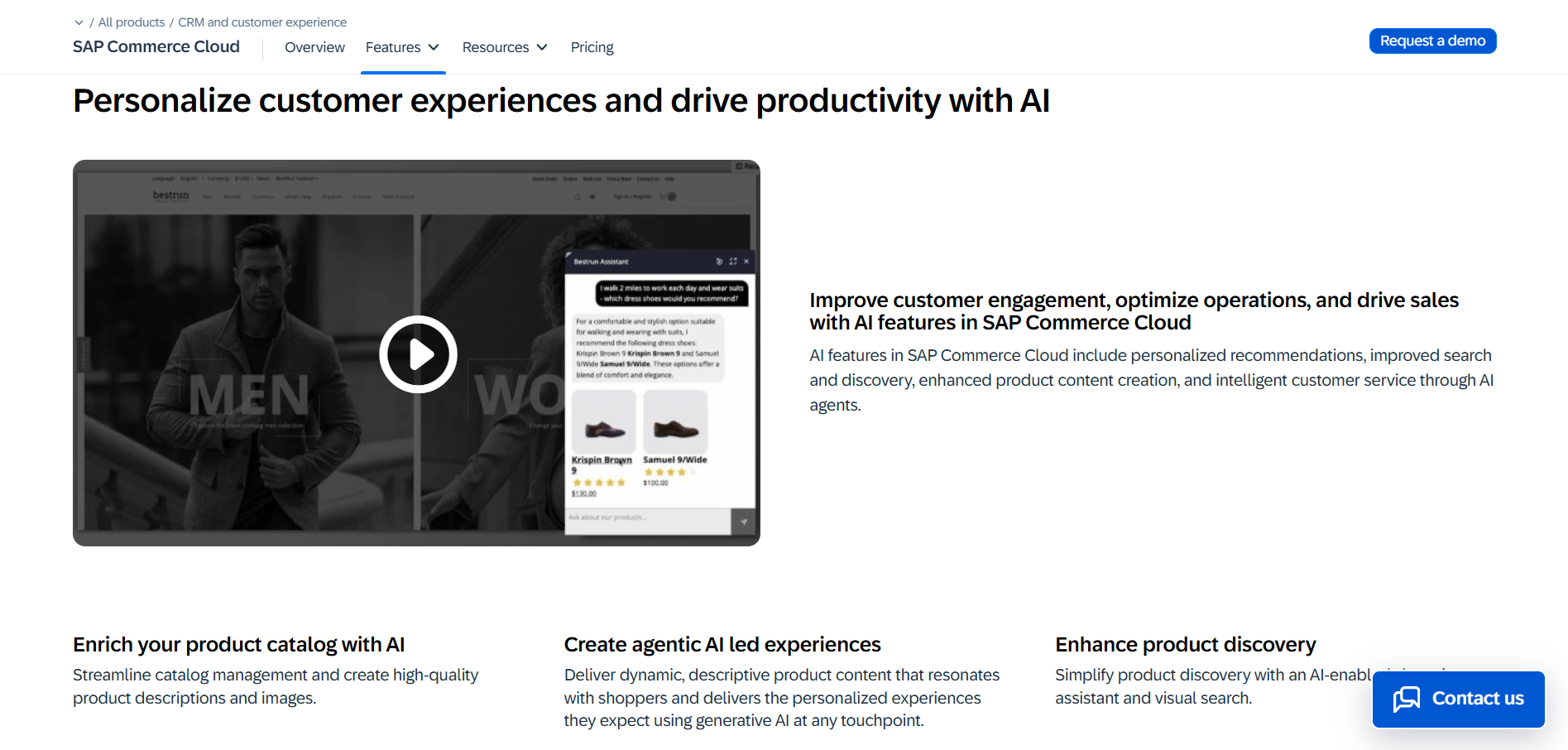
Decades of enterprise ERP experience are baked into SAP’s customer-specific pricing, multi-org structures, and tiered pricing logic. For organizations running SAP end-to-end, the AI inherits that commercial depth without integration work. Outside that environment, the picture is more complicated.
What’s live today
- CX AI Toolkit is SAP’s commerce-specific AI layer, covering AI product description generation in bulk across multiple languages, Visual Search, a RAG-based AI Shopping Assistant, a Product Image Designer, and an “Ask About This Product” feature for natural language queries on product pages. It requires AI Units to access and is not included in base licensing.
- Intelligent Selling Services (ISS) delivers ML-powered product recommendations with A/B testing, but only on Professional or Enterprise editions.
- Joule Base is SAP’s cross-platform AI copilot, included at no extra cost across all cloud subscriptions. It handles general tasks and interfaces; distinct from the commerce-specific CX AI Toolkit.
- Joule Studio hit GA in Q1 2026, letting teams build custom AI agents on top of the SAP stack.
- Quote Creation Agent converts email-based pricing requests into draft quotes, cutting the manual handoff that typically lands on sales teams.
- Storefront MCP Server connects SAP Commerce Cloud with external AI agents, giving them access to product information, inventory, carts, and transactions through conversational interfaces.
What’s on the roadmap
- Catalog Optimization Agent is currently in beta. It analyzes product catalogs and recommends or generates improvements to attributes, descriptions, and translations.
Honest limitation
Premium SAP AI capabilities can require AI Units on top of the underlying SAP products. Consumption varies by capability, and unused AI Units expire after 12 months. That adds another cost model for teams to account for when planning AI adoption across SAP Commerce Cloud.
Adobe Commerce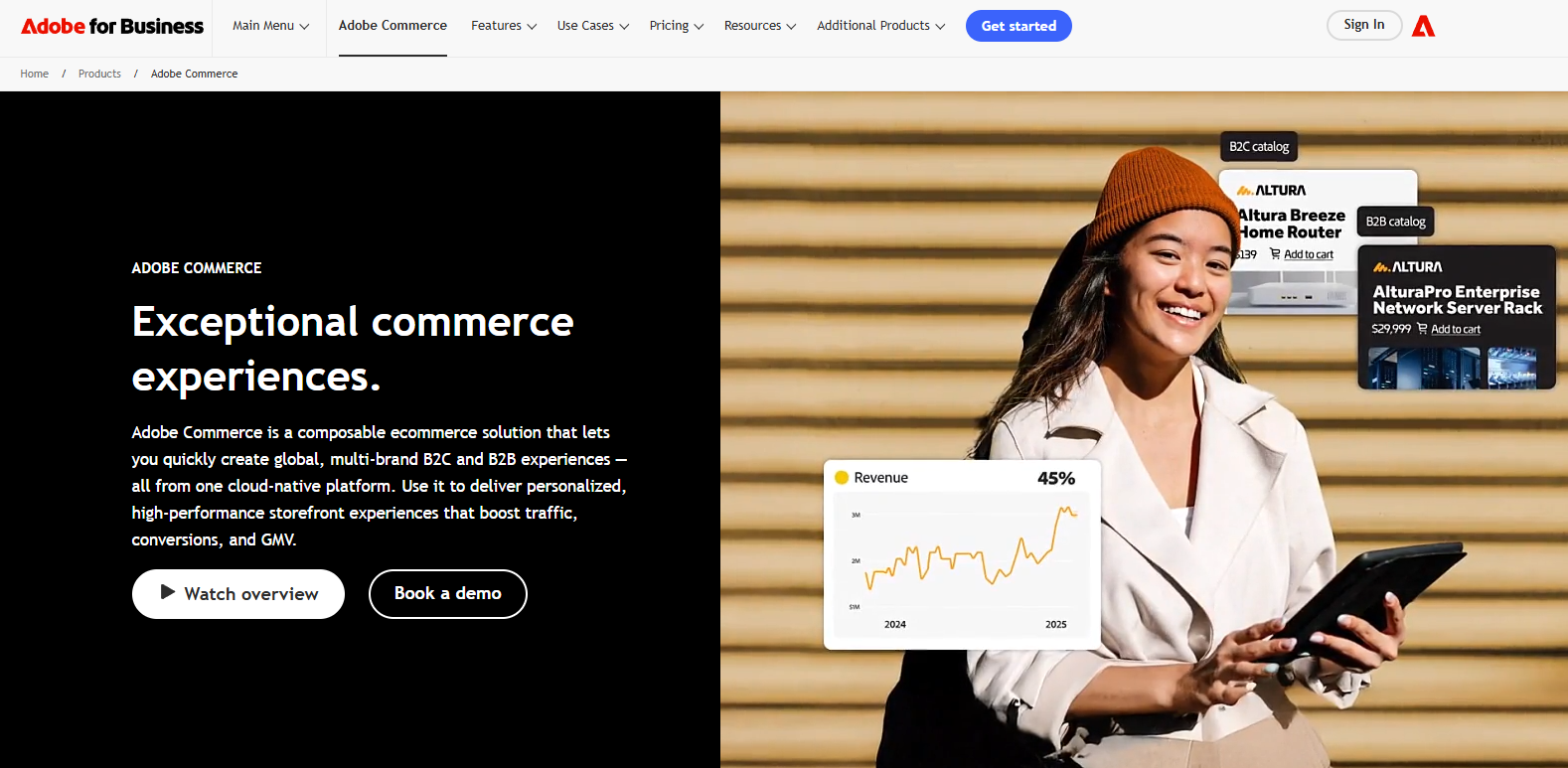
Adobe Commerce’s strongest AI is on the discovery and content side: Live Search and Product Recommendations are production-ready and included in the base license. Adobe has also expanded into conversational commerce with Brand Concierge, which is licensed separately.
What’s live today
- Live Search delivers AI-powered search with intelligent re-ranking, NLP intent understanding, dynamic faceting, and synonym handling across B2B storefronts. Included in the base license.
- Product Recommendations covers 13 recommendation types including Visual Similarity, behavioral, and popularity-based signals. Also included in base.
- Intelligent re-ranking ships alongside Live Search at no additional cost, improving customer engagement with more relevant results on every search.
- AI content generation runs via Adobe Sensei and Firefly, covering marketing tools for product descriptions and custom catalogs at scale.
- Brand Concierge provides conversational product discovery, comparisons, recommendations, and guided buying for B2B and B2C customers. It can be purchased separately from Adobe Experience Platform, although AEP can provide additional customer data for personalization.
What’s on the roadmap
-
UCP, ACP, and AP2 support was committed in February 2026 and described as being progressively expanded throughout 2026.
Honest limitation
Adobe’s AI is still more focused on discovery and the buying experience than on B2B operational workflows such as order intake, account-specific processes, and back-office execution.
Shopify Plus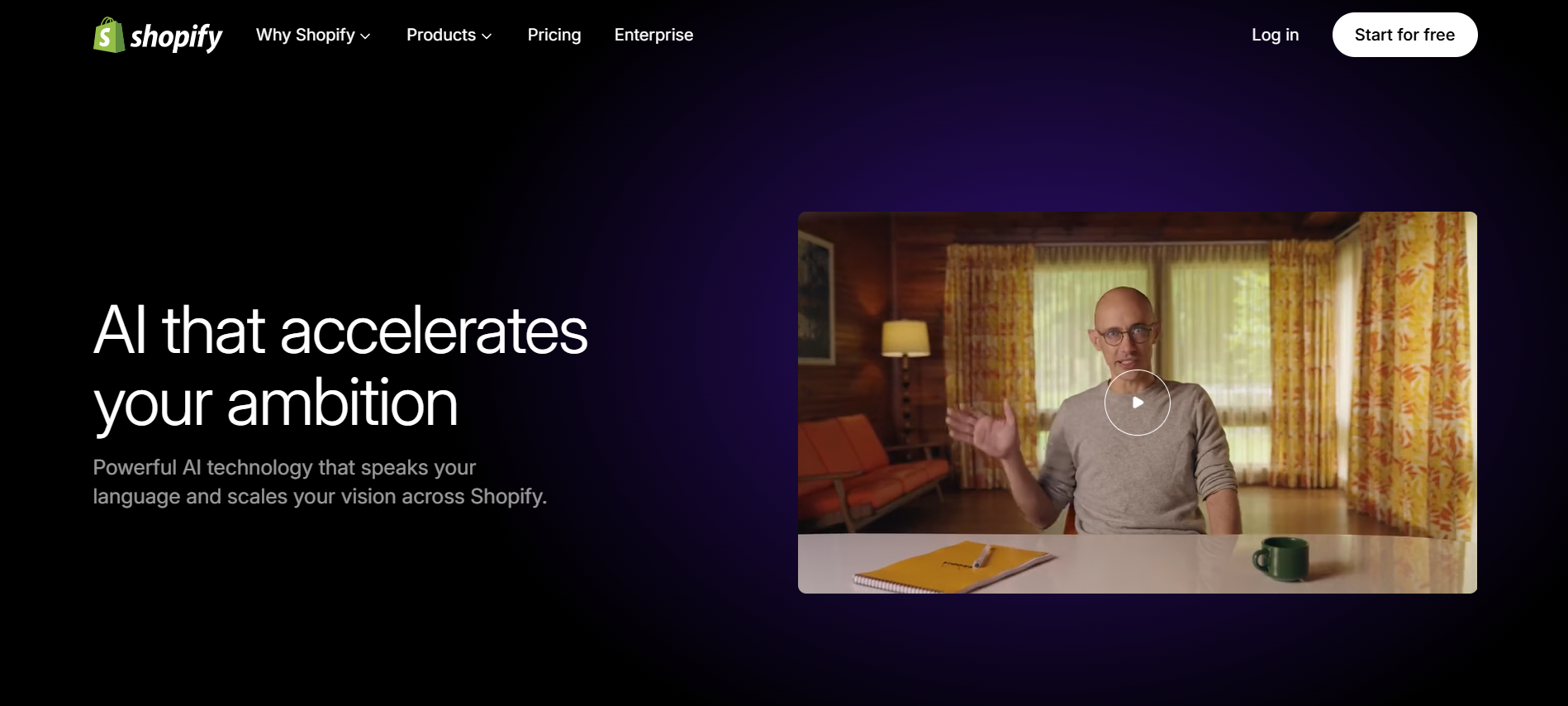
Shopify made one of the most inclusive bets in this category: every AI feature ships free on every plan. Its buyer-facing agentic commerce capabilities, however, are currently limited to D2C sales.
What’s live today
- Shopify Magic is the AI engine underneath the platform – a suite of content generation tools embedded across the admin covering product descriptions with brand voice cloning, AI image editing and background removal, email copy, SEO metadata generation, and suggested replies to customer inquiries in Shopify Inbox.
- Sidekick is the conversational layer on top of Magic, accessible via chat in the admin. It handles multi-step tasks through natural language: building reports, setting up Flow automations, analyzing sales data, editing themes, and generating content on demand. Shopify expanded it significantly in Winter ’26 from a reactive chatbot to a more proactive store management assistant.
- Semantic search via the Search & Discovery app understands buyer intent beyond keyword matching.
- Agentic Storefronts activated by default for eligible stores by late March 2026, automatically syndicating products to AI channels including ChatGPT, Microsoft Copilot, Google AI Mode and Gemini, and Meta.
What’s on the roadmap
There is no publicly confirmed B2B AI roadmap from Shopify.
Honest limitation
There’s no concept of negotiated pricing, account-specific entitlements, or approval rules in the AI layer. Distributors and manufacturers with complex account structures will need third-party tools to fill gaps.
commercetools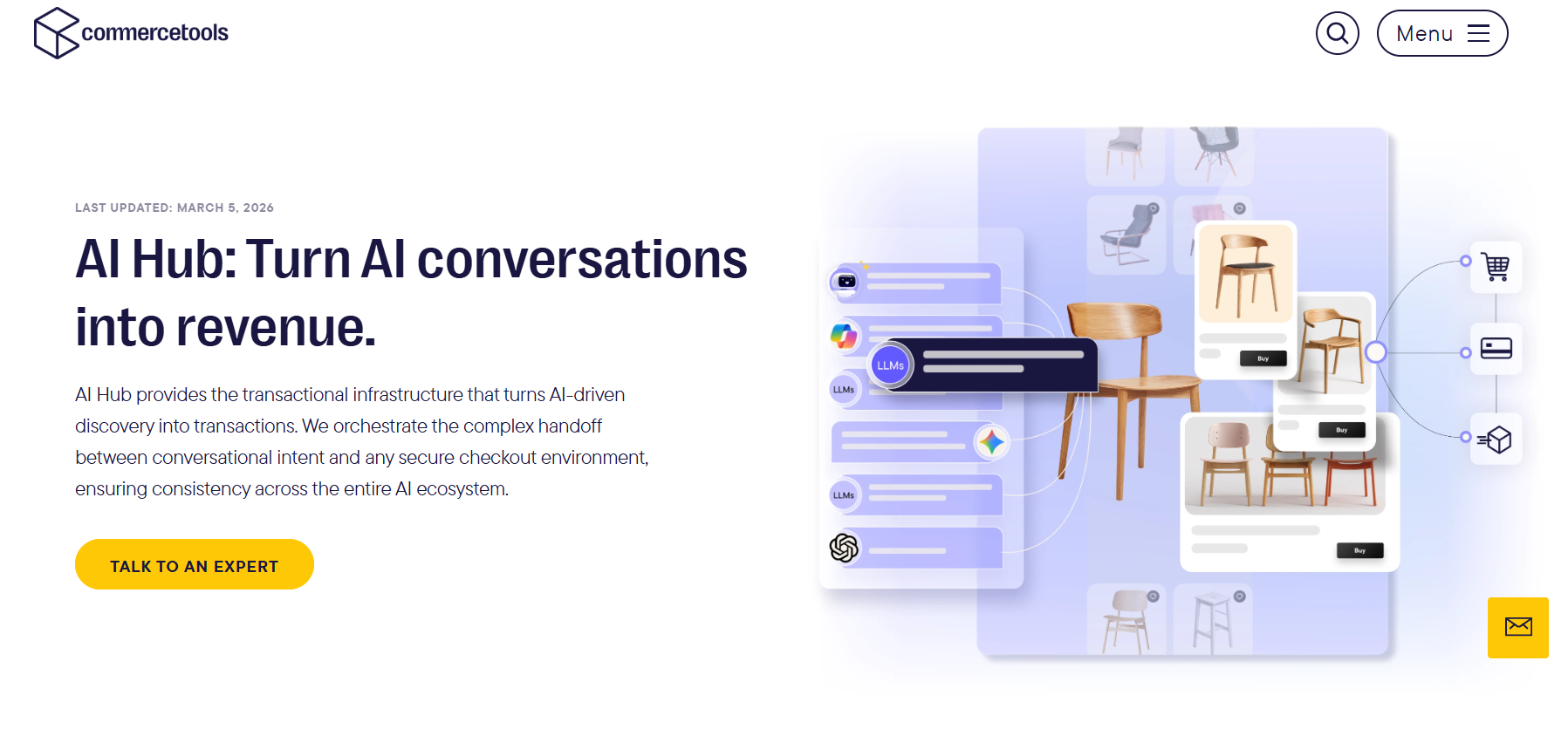
commercetools made a different architectural bet than anyone else on this list. Instead of building AI features into the platform, it built the infrastructure for AI to access the platform. Whether that’s the right call depends entirely on what you need AI to do for your business.
What’s live today
- AI Hub gives external AI platforms secure, real-time access to product data, pricing, inventory, and order logic. It now supports UCP for agent-led product discovery and checkout, while Agent Gateway controls access and applies business rules.
- Commerce MCP Server was among the first production MCP servers in commerce, making backend services accessible to external AI agents without custom integration work.
- Agentic Jumpstart helps enterprises connect to AI commerce channels, like ChatGPT, Copilot, Perplexity, Gemini, through AI Hub.
- AgenticLift is a standalone product for enterprises not currently on commercetools, connecting existing legacy stacks to agentic commerce channels without replatforming.
- Stripe Agentic Commerce Suite integration enables AI agent discovery, checkout, and payment processing through a single connection to AI Hub.
What’s on the roadmap
- commercetools Cora is an AI-native shopping companion that maintains context across channels. Currently in preview.
- UCP support is referenced in roadmap context, details are sparse.
If your B2B buyers are increasingly starting procurement through AI assistants, commercetools has built the infrastructure to be visible and transactable in those environments faster than most.
Honest limitation
commercetools is currently stronger at connecting commerce infrastructure to external AI agents than providing its own buyer-facing AI experience. Cora is designed to fill that gap, but it remains in preview.
Shopware
Shopware’s AI has recently expanded from content generation into agentic store operations. Copilot can now analyze data and carry out multi-step tasks across Shopware, including selected B2B capabilities.
What’s live today
- Shopware Copilot ships in all commercial plans. It handles content generation across product descriptions, category texts, and translations, plus image keyword assignment, product property recommendations, review summaries, customer classification, contextual search, image-based product search, and an AI Image Editor that generates product scenes with realistic lighting.
- Advanced Copilot Skills allow it to carry out multi-step tasks across Shopware and selected B2B features, including Budget Management and Advanced Product Catalogs.
- Data Insights Skill answers plain-English questions about sales performance with charts.
What’s on the roadmap
- Shopware plans to extend Copilot deeper into orders, B2B entities, and user accounts, including actions such as updating B2B account permissions through natural-language requests.
- Project Nexus is a no-code orchestration layer currently in early release, connecting PIM, ERP, CRM, and Shopware through natural language rules, enabling businesses to automate business processes like inventory reordering through plain-English triggers.
Honest limitation
Shopware has started bringing agentic AI into B2B operations, but coverage is still limited to selected features. Deeper actions across orders, B2B accounts, and user management remain on the roadmap.
What Makes OroCommerce the Best AI-Powered B2B Platform
If you want to know what makes OroCommerce the best B2B eCommerce platform with AI, you have to look at the architecture. The platform delivers practical AI use cases built directly into your daily operations.
It runs on unified data from every touchpoint to ensure the algorithms understand your specific rules. We enforce strict guardrails so your proprietary data never leaks out to train a public model.
We also keep the billing incredibly boring. You get native AI features included in your standard license, free from surprise token taxes. When the intelligence knows your business rules, the operational relief happens immediately.
- Organizations report a 95% reduction in manual order entry.
- The system processes a 700-line-item purchase order in under one minute instead of thirty.
- Sales teams drop 30% of their administrative work, and service departments gain a 20% productivity boost.
AI also plays a role outside the day-to-day commerce experience. OroMomentum, OroCommerce’s AI efficiency program, applies AI to implementation, customization, and upgrades, reducing the development work involved in launching and maintaining a tailored B2B application.
OroCommerce AI in Action
DiversiTech knows exactly what this looks like in the wild. As North America’s largest manufacturer of HVAC components, years of acquisitions left their IT team wrestling with twelve different ERP systems.
Their European division was juggling nine separate legacy environments while attempting a migration to Microsoft Dynamics 365. Back in North America, customer service reps were manually typing faxed purchase orders into the system line by line.
They deployed OroCommerce to serve as their central commercial layer. That shared foundation created a highly secure environment for artificial intelligence. They turned on AI SmartOrder to read their unstructured email attachments. In North America, this immediately eliminated the manual data entry bottleneck.
The European rollout highlighted the advantage of a native architecture. The intelligence intercepts the incoming PDFs and normalizes the data across all nine legacy ERP systems. It then routes the clean information directly into their new Dynamics 365 fulfillment flow.
DiversiTech ignored the autonomous buying hype. They deployed a unified foundation that absorbed the backend complexity for them.
OroCommerce handles your heavy commercial logic naturally. See the engine for yourself.
7 Patterns That Explain the AI-Powered Commerce Market
Looking across these vendors, seven distinct patterns explain where the enterprise software market is heading.
#1 Release status matters more than announcements
AI roadmaps move fast. Features that were pilots earlier in 2026 are already generally available, while others remain in beta or preview. Comparing them as if they are all production-ready gives buyers the wrong picture.
Ask vendors to separate what is generally available from what is still being tested or planned. Then ask them to demonstrate the capabilities you intend to use.
#2 B2B search needs commercial context
Natural-language search is becoming common. The harder B2B problem is making sure results reflect customer-specific catalogs, negotiated pricing, and buyer permissions.
A relevant product shown at the wrong price or to the wrong account is still a bad search result. For manufacturers and distributors, commercial context matters as much as understanding the buyer’s query.
#3 The useful AI work happens inside workflows
Storefront assistants get plenty of attention because they are easy to demonstrate. For many B2B companies, the bigger opportunity is reducing manual work around purchase orders, quotes, and order management.
That can mean turning a PDF purchase order into a draft order, creating a quote from an email, or helping an operator resolve a fulfillment issue. These use cases sit closer to the work manufacturers and distributors deal with every day.
#4 AI pricing is getting harder to compare
There is no common pricing model for commerce AI. Vendors mix included features with separate licenses, usage credits, and paid add-ons.
That makes the starting price a poor guide to long-term cost. Ask what triggers a charge, which capabilities sit outside the commerce license, and how the bill changes as usage grows.
#5 Buyer-facing AI is growing, but B2B depth varies
More platforms now offer buyer agents, conversational shopping, or access through external AI channels. The important question for B2B teams is what those experiences can do once the buyer is identified.
Can the AI apply negotiated pricing and respect account permissions? Can it work within purchasing rules and complete an order? That is where the differences between platforms become more important.
#6 B2B AI has less room for error
Showing the wrong contract price or letting a buyer take an action they aren’t authorized to take can create an expensive problem. The more AI can do inside the commerce platform, the more important its controls become.
Look at how the platform applies existing permissions and where people are asked to review or approve an AI action.
#7 Protocol support is a starting point
MCP and UCP give external AI agents a standard way to connect with commerce platforms. As more purchasing moves into AI channels, that connectivity will become increasingly useful.
For B2B companies, the value depends on what the agent can access and do after it connects. Protocol support means much more when the platform can carry its existing B2B rules into those interactions.
Your Digital Architecture Sets Your Operational Ceiling
The AI-powered eCommerce platform you choose today will shape what you can do tomorrow. A point solution may solve an immediate problem, such as manual bulk ordering, but it can also create limits as your needs grow.
Those limits become more obvious as AI advances. If every new capability requires another external tool or custom integration, adding it takes more time and development work. Your developers end up maintaining connections between systems instead of improving the buying experience.
AI features will keep changing. Your platform will be around much longer. Choose a unified commerce architecture that can apply new AI capabilities to the customer data and B2B processes already running your business. The architecture you choose now will determine how much of the next wave of AI you can put to work.
OroCommerce handles your heavy commercial logic naturally. See the engine for yourself.