navigation

Enterprise B2B eCommerce software is a purpose-built category of digital commerce platforms designed for the complexity of wholesale distribution and manufacturing commerce.
Manufacturers, distributors, and wholesalers at scale need platforms that handle account hierarchies, contract-based pricing, multi-site catalogs, and deep ERP connectivity.
Lightweight SMB tools simply weren’t built for this.
What separates an enterprise eCommerce platform from a standard one isn’t just size. It’s integration depth, multi-site support, complex pricing logic, customization flexibility, and the ability to process high transaction volumes without buckling under the load.
If your team is spending hours manually reconciling orders or maintaining pricing spreadsheets, you’ve likely outgrown your current stack.
This article compares the 5 best enterprise e-commerce software B2B options in 2026: OroCommerce, Adobe Commerce, SAP Commerce Cloud, Salesforce B2B Commerce, and HCL. Each is evaluated on B2B-native features, integration depth, scalability, and total cost of ownership.
What to Look for in Enterprise B2B eCommerce Software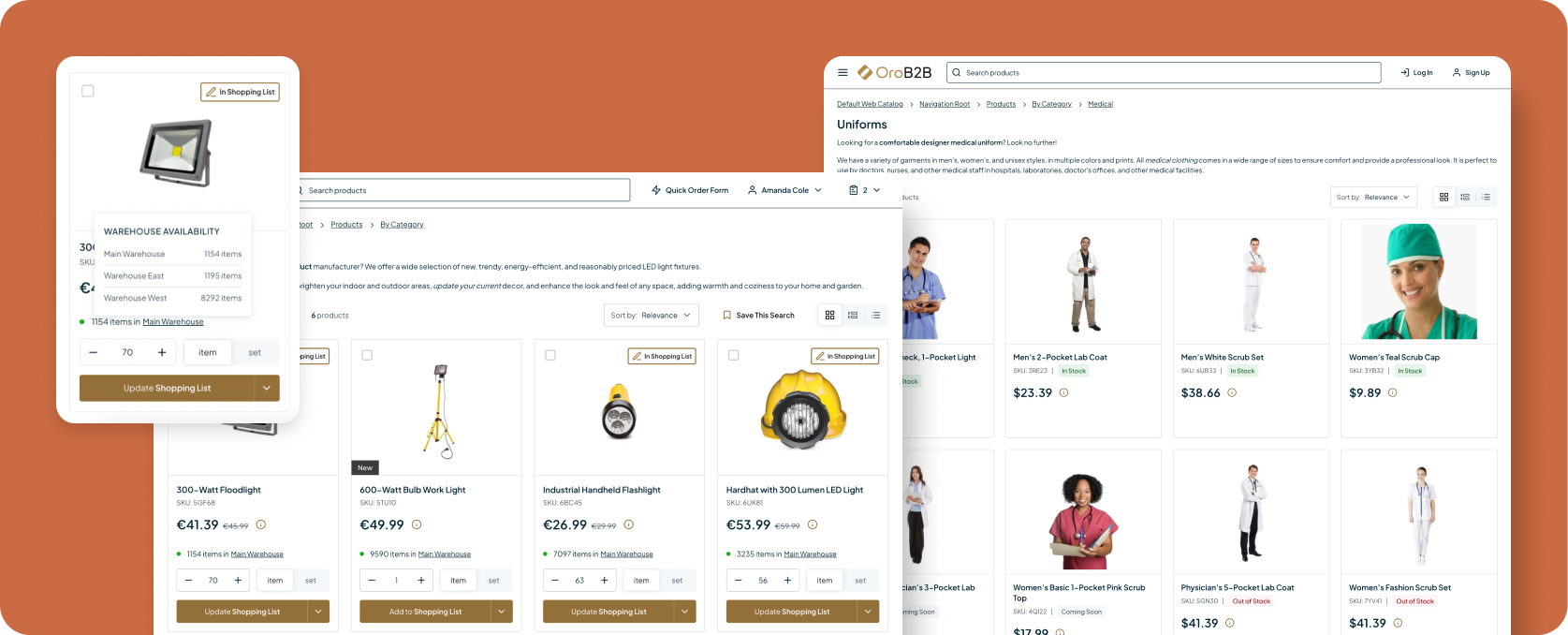
Not every platform that calls itself an enterprise actually handles B2B well. Here’s what to put on your checklist before you shortlist anything.
- B2B-native functionality. Purpose-built B2B platforms handle account management, complex pricing, and buyer portals as core architecture. Adapted B2C tools require significant development or a patchwork of third-party plugins and workarounds for the same workflows.
- Quoting and order negotiation. Buyers and sales reps should be able to initiate, revise, and approve quotes directly within the platform. Native RFQ workflows, line-level negotiation, and quote-to-order conversion eliminate the email chains and manual entry that slow down enterprise deals.
- Configurable products, kitting, and bundling. B2B catalog complexity often means products that are assembled to order, sold as kits, or bundled with services. Your platform should handle configuration rules, component-level pricing, and bundled SKU management natively, not through workarounds bolted onto a B2C product model.
- Complex pricing rules. Contract pricing, tiered volume discounts, and custom pricing at the account level are non-negotiable at enterprise scale. Your platform needs to support location-aware price lists and deliver customer-specific pricing to thousands of accounts without manual overhead.
- Account management depth. Multi-buyer accounts with approval workflows, delegated purchasing authority, and purchase order support are the backbone of B2B transactions. Self-service account management keeps business buyers in control of their own procurement.
- ERP and CRM integration. Native connectors to ERP and CRM systems eliminate the middleware that creates data latency and sync errors. Robust integration capabilities between inventory management systems, pricing engines, and order management are among the most critical factors to evaluate. Our enterprise B2B eCommerce guide covers integration benchmarks.
- Scalability. A scalable platform handles high traffic volumes, large SKU catalogs, and demand spikes without degradation. Ask vendors for production references at your catalog size.
- Multi-site and multi-brand management. Enterprise brands need a single backend that centralizes commerce operations across multiple brands, regions, and channels while keeping storefronts differentiated.
- AI connected to real B2B data. AI drawing on live pricing, inventory, and customer behavior is meaningfully different from AI that only generates product recommendations. The former automates buyer journeys and back-office workflows.
- Self-service capabilities. Buyer portals that handle reorders, quote requests, and account management without sales team intervention directly impact sales performance and average order value over time.
- Support for complex sales processes. Enterprise B2B transactions often involve multi-step approvals, quote negotiations, and contract renewals. Your platform needs to handle these natively, including structured RFQ workflows, configurable product ordering, and quote-to-contract conversion, not through bolted-on workarounds.
- Total cost of ownership. License fees are rarely the largest cost. Implementation, custom integrations, and ongoing maintenance over a 3-to-5-year horizon determine the real number. See our total cost of ownership for eCommerce calculator before you evaluate pricing.
Best Enterprise B2B eCommerce Software at a Glance
Here’s a quick-reference summary of each platform covered in this article.
| Platform | G2 Rating | Best For | Top B2B Feature | Pricing Model |
| OroCommerce | 4.3/5 | Large manufacturers, wholesale distributors, managing multiple brands, websites, orgs. | Unified B2B architecture with native CRM + CPQ | GMV-based, all-inclusive |
| Adobe Commerce | 4.0/5 | Enterprises with B2B + B2C and Adobe stack | Shared catalogs + Adobe Experience Cloud integration | Per-year PaaS + extensions |
| SAP Commerce Cloud | 4.3/5 | SAP-centric large enterprises | Native SAP S/4HANA integration | Custom enterprise, additional BTP and Accelerator fees |
| Salesforce B2B Commerce | 4.4/5 | Salesforce CRM-heavy organizations | Unified sales and commerce data via Salesforce | % of GMV + per Cloud licenses |
| HCL Commerce | 4.0 / 5 | Enterprises needing extreme transaction scale, B2B + B2C | B2B, B2C, B2B2C, and marketplace models on one platform | Custom (predictable pricing model) |
5 Best Enterprise eCommerce Software for B2B in 2026
The five platforms below cover the primary architectures in enterprise B2B ecommerce: purpose-built B2B, open-source with enterprise cloud, ERP-native, CRM-native, and cloud-native within a broader suite.
- OroCommerce: Purpose-built B2B with unified architecture
- Adobe Commerce: formerly Magento Commerce, an enterprise cloud with Adobe Experience Cloud integration
- SAP Commerce Cloud: ERP-native commerce for SAP-centric organizations
- Salesforce B2B Commerce: part of Salesforce Commerce Cloud, extending the Salesforce CRM into digital channels
- HCL Commerce: Enterprise eCommerce platform for B2C, B2B, B2B2C, D2C use cases.
Each profile covers what the platform does well and where it fits best.
1. OroCommerce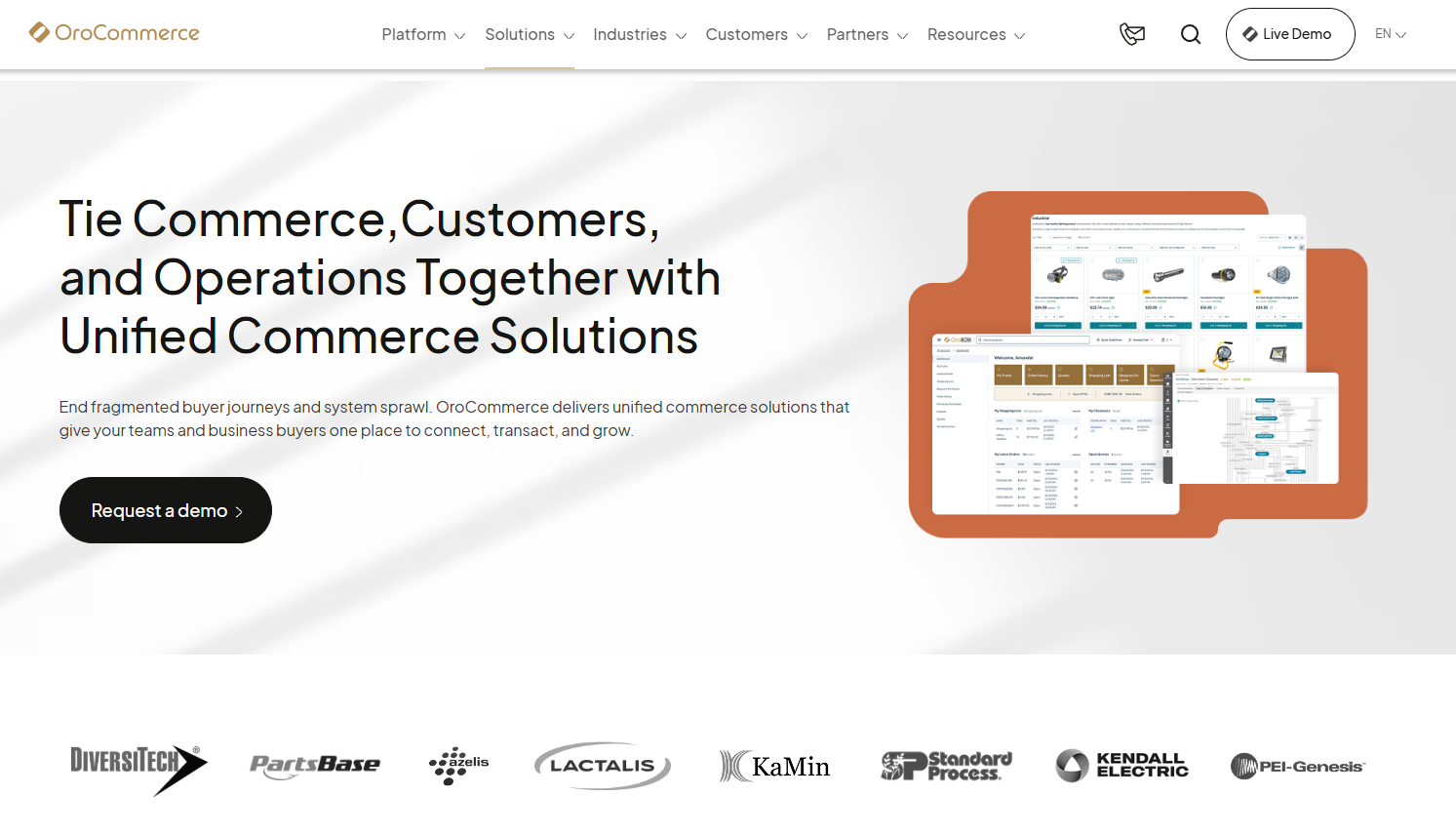
OroCommerce is the only platform on this list designed exclusively for B2B commerce from day one. Every module, including ecommerce, CRM, CPQ, invoicing, and AI, ships under one license. That means you don’t need to assemble third-party apps to handle core B2B workflows.
If you’re running multi-tier distribution, managing thousands of corporate accounts with distinct pricing structures, or operating across multiple warehouses and regions, OroCommerce is worth a close look.
For a full breakdown, see OroCommerce unified solutions for B2B eCommerce.
Best for
Mid-market to large manufacturers, distributors, and wholesalers with complex B2B requirements, managing or expanding to multiple business units or organizations.
Key features
- Corporate account hierarchies with granular buyer roles, permissions, and delegated purchasing authority
- Flexible price list engine supporting customer-specific pricing, tiered, contract-based, volume, and location-aware rules
- Native RFQ and CPQ with multi-round quote negotiation and approval routing
- Built-in CRM with 360-degree customer view across the full sales cycle, no separate crm systems required
- OroIQ AI layer connected to live pricing, inventory, and customer data for self-service capabilities and back-office automation
- Native ERP connectors for SAP, Microsoft Dynamics, NetSuite, and Oracle, seamless integration with no middleware required
- Built-in PIM for catalog management of complex, configurable products and large SKU sets
- Multi-website, multi-warehouse, and multi-organization management from a single backend
- Supports B2C or D2C on the same platform
- Marketplace capabilities for multi-vendor B2B and B2B2X use cases, available natively
- Headless commerce readiness and open API for composable builds
- SaaS, private cloud, and on-premise deployment under the same license
Pricing
GMV-based tiered model. A single license covers all core modules with no per-site fees, which is a meaningful TCO advantage over platforms that charge separately for each add-on.
See how OroCommerce performs against your specific requirements
2. Adobe Commerce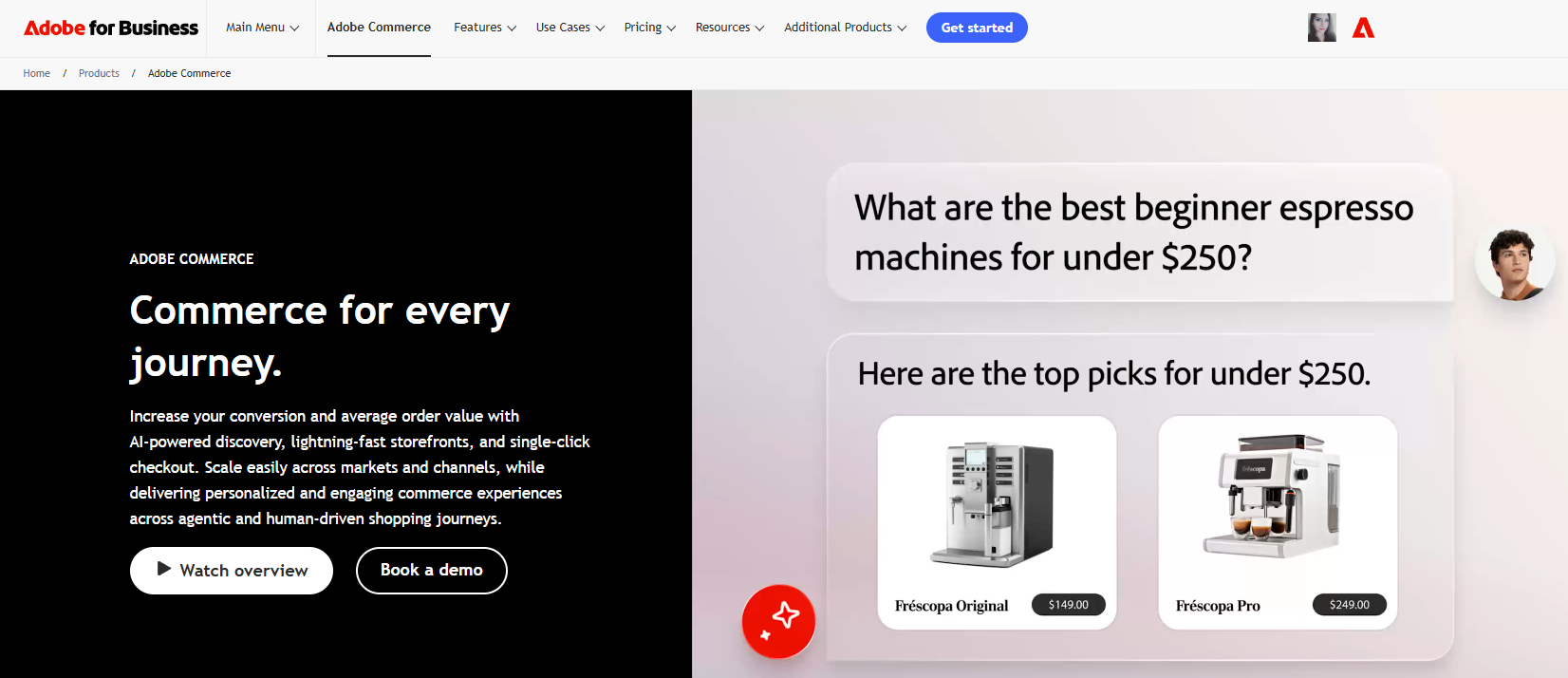
Adobe Commerce, formerly Magento Commerce, is an open-source platform with an enterprise-grade cloud layer and tight integration with the Adobe Experience Cloud. It enables businesses to run both B2B and B2C operations from a single installation, which is a genuine advantage when your direct and wholesale channels overlap.
Learn more about Adobe Commerce competitors.
Best for
Enterprises running meaningful B2C volume alongside B2B that already use AEM, Marketo Engage, Adobe Analytics, or Real-Time CDP.
Key features
- Company accounts, requisition lists, purchase order workflows, and credit limits available out of the box
- Customer group pricing, shared catalogs, and account-level price books for customer specific catalogs
- Extensive customization through the open-source foundation and Commerce Marketplace extensions
- Native integration with Adobe Experience Manager, Marketo Engage, and the marketing cloud ecosystem
- Managing online stores across multiple brands from a single installation
- Multi-source inventory management with backorder handling
- Headless commerce via GraphQL API for custom front-end builds
- Built-in marketing tools and CMS for SEO and landing pages
- Support for multiple payment methods through integrated payment extensions
Pricing
Adobe Commerce costs depend on license fees, your deployment model (on-premises vs on Cloud), and yearly GMV. Pricing is not publicly available.
3. SAP Commerce Cloud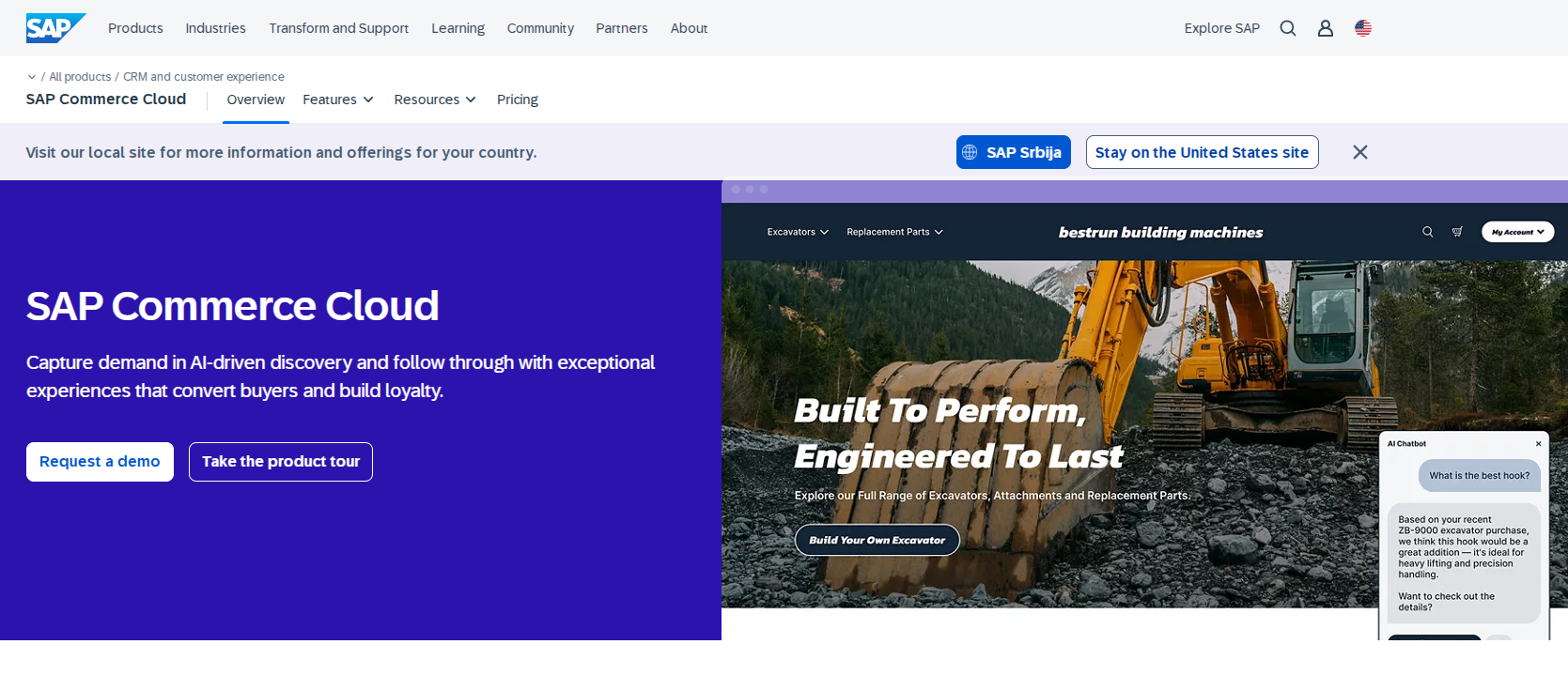
SAP Commerce Cloud is the digital commerce layer built on top of the SAP ecosystem. It extends SAP ERP and S/4HANA into online commerce for both B2B and B2C, making it the natural fit for large enterprises where pricing, customer data, and inventory all live within SAP ERP.
That said, if SAP ERP isn’t already central to your operations, the implementation cost and complexity are hard to justify.
Learn more about SAP Commerce Cloud competitors.
Best for
Large enterprise businesses with SAP at the center of operations, particularly where real-time sync between commerce and the ERP is non-negotiable.
Key features
- Seamless ERP integration with SAP S/4HANA and SAP ERP for real-time pricing, inventory, and order data
- Contract pricing, account hierarchies, and approval workflows for complex B2B procurement
- Catalog management across multiple channels for large, complex product structures
- Omnichannel support across web, mobile, and POS from a single platform
- CPQ capabilities for configurable product scenarios
- Multi-site, multi-language, and multi-currency support for global operations
- Advanced order management with available-to-promise logic tied to SAP inventory management
- Cloud-native deployment on SAP BTP, a cloud service built for enterprise-grade reliability and modular architecture
Pricing
Custom and complex enterprise pricing with additional integration (BTP) fees, AI Units costs, Accelerators costs, etc. Implementation through certified SAP partners typically runs well into six figures.
4. Salesforce B2B Commerce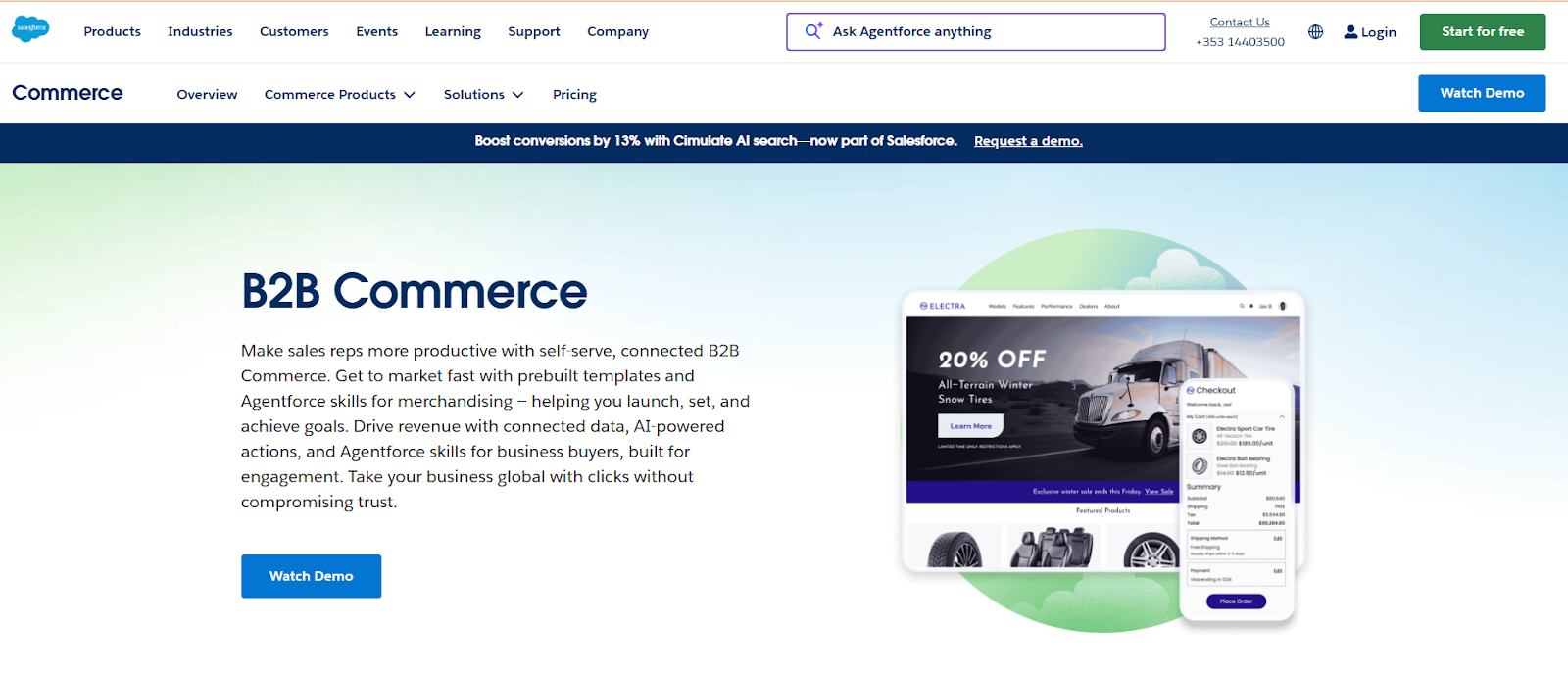
Salesforce B2B Commerce sits natively inside the Salesforce platform alongside Sales Cloud and Service Cloud. Customer engagement, sales data, and commerce activity all flow into the same environment.
For teams focused on Sales Force automation and managing customer relationships at scale, that unified data model removes a real operational bottleneck.
The trade-off is cost and dependency. You’re buying into the Salesforce ecosystem, and project costs frequently exceed initial estimates once the full customization scope becomes clear.
Learn more about Salesforce Commerce Cloud alternatives.
Best for
Organizations with significant Salesforce CRM investment that want to extend into digital commerce without fragmenting their existing data model.
Key features
- Native integration with Sales Cloud and Service Cloud for unified data across revenue functions
- Account-based pricing and customer-specific catalogs for distinct business buyers
- Self-service account management portal with reorder capabilities and full order management
- Einstein AI for predictive insights and personalized buyer journeys, drawing on real customer data
- Real-time customer data sync powering targeted outreach across customer accounts
- Punchout catalog support for procurement system integration via third-party systems like Coupa and Ariba
- Multi-storefront support for managing multiple brands or regional portals
- AppExchange ecosystem for extending capabilities through third-party apps and custom integrations
Pricing
Custom enterprise pricing with hefty additional fees for Clouds (CRM, Commerce, Sales, Experience, Marketing Clouds). Budget carefully, since Salesforce projects may exceed initial estimates once the full customization scope becomes clear.
5. HCL Commerce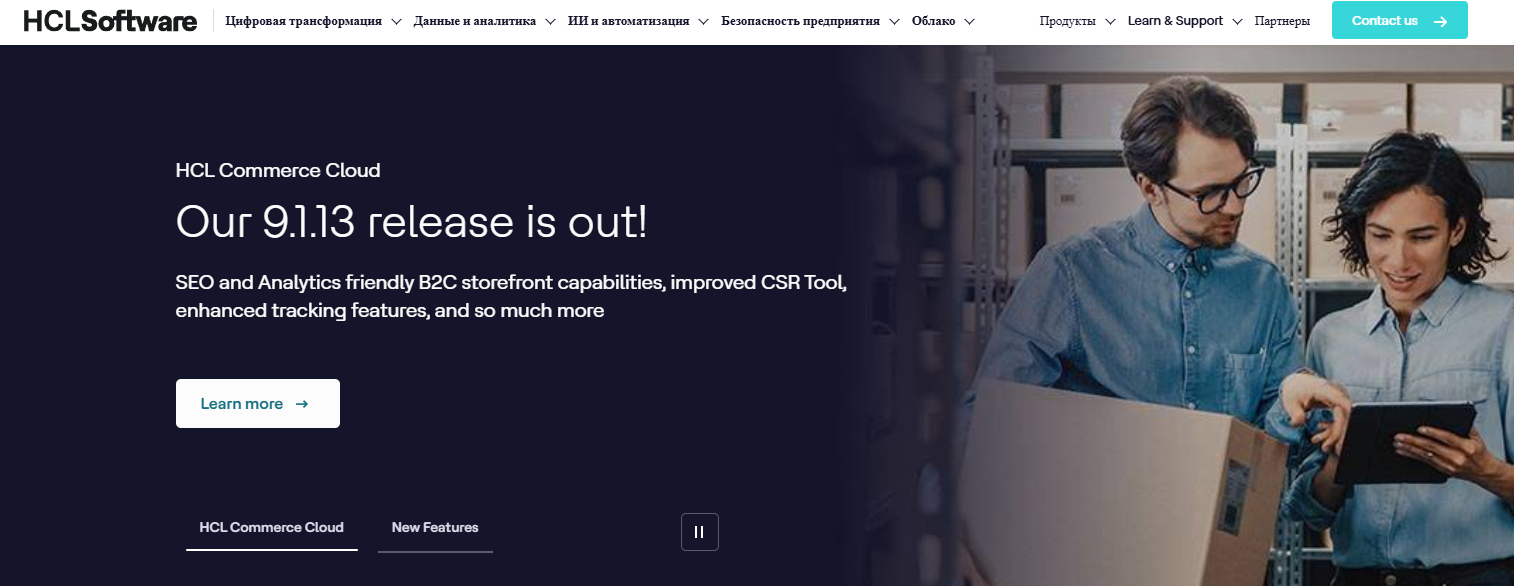
HCL Commerce is an enterprise ecommerce platform from HCLSoftware. It supports B2C, B2B, B2B2C, D2C, and marketplace models on one platform.
The solution combines customizable storefronts, segmented catalogs, role-based pricing, contract management, and workflow approvals.
Unified commerce is built in, with a native clienteling app, click and collect, multichannel promotions, and multi-inventory management and fulfillment.
Best for
Large enterprises in retail, manufacturing, and high tech that need extreme transactional scale and a battle-tested platform supporting thousands of multisites, tens of millions of SKUs, and billions in annual online GMV. Especially organizations in North America and EMEA looking for a bundled, modular suite over an assemble-it-yourself stack.
Key features
- Bundled composability: Base license includes decoupled B2C and B2B storefronts, a CDP, visual page composer, catalog ingestion tool, customer service hub, and marketplace operation application as self-contained modular apps.
- Enterprise-grade scalability: Supports companies with several thousands of multisites, tens of millions of SKUs, and billions of dollars in annual online gross merchandise value.
- Unified commerce: Native clienteling app with extensive capabilities for click and collect, multichannel promotions, multi-inventory management, and fulfillment across channels.
- Deployment flexibility: On-premises or single-tenant SaaS deployment on AWS, GCP, and Microsoft Azure to support data sovereignty and regulated-industry requirements.
Compared with direct competitors, HCLSoftware has a thinner library of prebuilt integrations for search, PIM, OMS, CDP, and personalization, which can extend integration timelines and increase implementation effort. Vertical depth is concentrated in manufacturing and retail, so customers in other industries may find fewer out-of-the-box features and less vendor expertise. AI and automation are also limited today.
Pricing
Final terms are negotiated per contract. Pricing is custom and tied to deployment type, scale, and bundled HCLSoftware products.
How OroCommerce Compares to Other Enterprise B2B eCommerce Software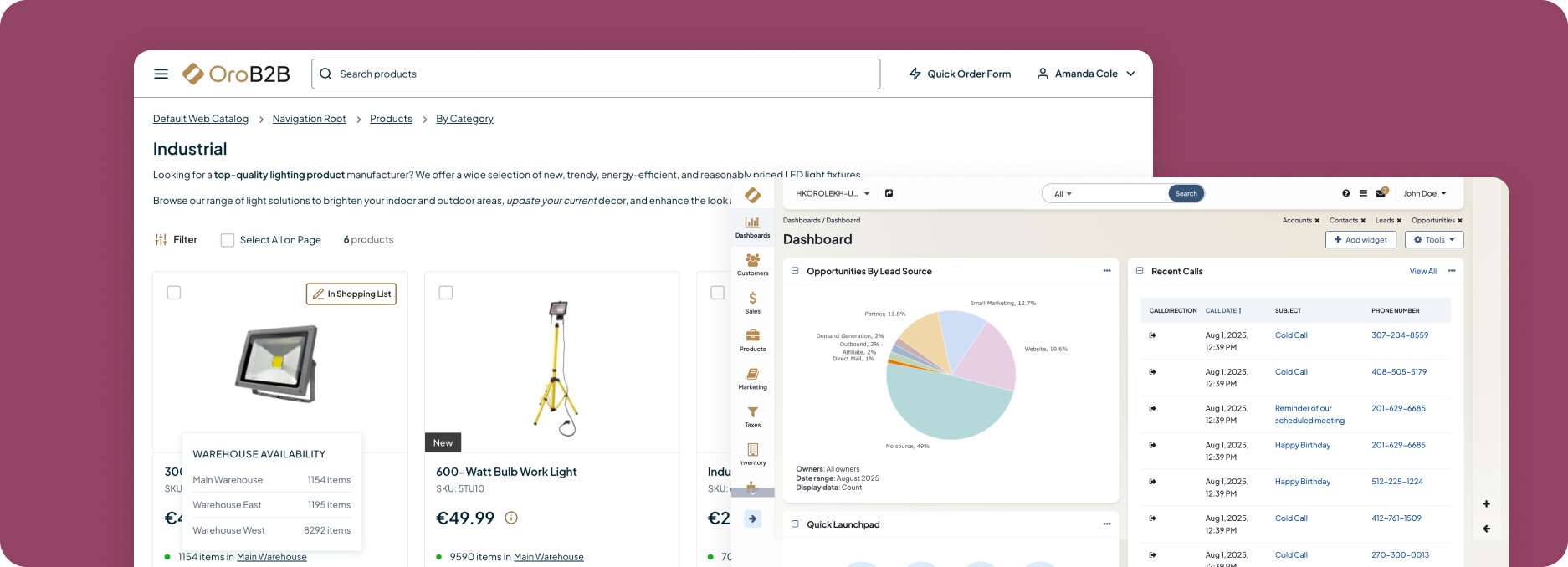
Most enterprise commerce platforms weren’t built for B2B from the start. Each one adds commerce capabilities to an existing foundation rather than starting with B2B as the design principle:
- Adobe Commerce started as a B2C platform and layered B2B capabilities through extensions
- SAP Commerce Cloud extends its ERP ecosystem into digital commerce
- Salesforce B2B Commerce is an add-on to their CRM product
What this means in practice: integration capabilities vary significantly across enterprise platforms. When commerce, CRM, pricing, and inventory live in separate systems, you’re managing data synchronization as an ongoing operational task rather than a solved problem.
Why OroCommerce is different
OroCommerce was built with every B2B function as part of the same product from day one:
- CRM, CPQ, and RFQ built in natively
- Pricing engine, PIM, marketplace, and invoicing under one license
- No integration development between modules
- No dependency on other business systems to make it work
The result is a robust e-commerce platform where pricing, inventory, account data, and commerce capabilities share one consistent data layer. Teams can genuinely streamline operations across the entire revenue cycle without stitching systems together.
How these platforms compare
The table below compares all five platforms across the criteria that matter most in B2B.
| Criterion | OroCommerce | Adobe Commerce | SAP Commerce Cloud | Salesforce B2B Commerce | HCL Commerce |
| Built for B2B natively | Yes | B2C-origin | ERP-origin | CRM-origin | B2C/B2B hybrid |
| Native CRM included | Yes | No | No | Via Sales Cloud | No |
| CPQ and RFQ built in | Yes | Extension required | Partial | Extension required | Partial (Quotes out of box, CPQ via extension) |
| Pre-built ERP connectors | SAP, Dynamics, NetSuite, Oracle | Third-party only | SAP native | Third-party only | Third-party only |
| AI for B2B sales | Customer facing: SmartSearch, SmartAgent Backoffice facing: OroIQ (SmartAssistant + SmartInsights), SmartOrder |
Recommendations only | Limited, ERP-centric AI tools | Einstein AI (Build-It-Yourself AI toolkit) | Merchandising and search AI; no native B2B sales automation |
| Deployment options | SaaS, private cloud, public cloud, on-prem | PaaS / cloud, on-prem possible | SAP Cloud | Salesforce Cloud only | Cloud and on-prem |
| Pricing model | GMV-based, all-inclusive | License fee + extensions | Custom enterprise + BTP, Accelerator, AI Units costs | % of GMV + Cloud licenses, AI fees | Custom enterprise |
Proven results
For enterprises outside the SAP, Salesforce, or HCL ecosystems, OroCommerce delivers what other platforms require multiple products to achieve, under one license and one implementation.
- Gartner has recognized OroCommerce in the Magic Quadrant for Digital Commerce for five consecutive years
- Lactalis achieved 230% year-over-year growth in digital orders after implementation across 12 markets
- Braskem saved over 22,000 internal work hours annually
Those are the kinds of gains you get when customer satisfaction improves because your teams stop fighting fragmented systems.
Check the enterprise B2B eCommerce platform comparison for a detailed side-by-side breakdown. Review the 8 B2B eCommerce capabilities to see live before you replatform to structure your demo requirements.
Let’s review account hierarchy, contract pricing, and ERP sync against your actual use cases.
How to Choose the Right Enterprise B2B eCommerce Software for Your Business
Choosing an enterprise B2B eCommerce platform is a 3-to-5-year operational decision. Get the evaluation criteria right before you talk to a single vendor.
| Evaluation Criterion | What to Assess | Questions to Ask Vendors |
| Requirements audit | Map existing systems (ERP, CRM, PIM) and top 3 B2B workflow pain points | What does your default implementation cover for our use case? |
| Platform architecture fit | Ecosystem platforms (SAP, Salesforce) vs. purpose-built B2B (OroCommerce) | Was this platform built for B2B or adapted from another foundation? |
| Live demo scope | Account hierarchy, contract pricing, CPQ workflow, ERP sync | Can you demonstrate this without customization against our actual product and account structure? |
| Total cost of ownership | License, implementation, integration development, customization, maintenance over 5 years | What does a comparable deployment cost at our scale after year three? |
| Scalability proof | Production references at your catalog size, transaction volume, and account complexity | Which current customers run at our SKU count and order volume? |
| Deployment flexibility | SaaS, private cloud, on-premise options for regulated industries or data sovereignty | What deployment options are available under the standard enterprise plan? |
Helpful resources:
- Use the eCommerce architecture guide to map your current stack before starting vendor conversations.
- The B2B eCommerce trends 2026 report benchmarks what good looks like right now.
- The B2B eCommerce ROI calculator helps you put numbers on the return side.
- And the unified commerce platform guide covers deployment architecture in detail.
The right platform matches how your buyers buy and how your teams operate. It’s rarely the most recognized name in the room.
Conclusion About Enterprise B2B eCommerce Software
Each platform on this list fits a different type of enterprise buyer:
- OroCommerce: Strongest purpose-built option for manufacturers, distributors, and wholesalers; unified B2B architecture with native CRM, CPQ, and ERP connectors under one license
- Adobe Commerce: Best for enterprises with significant B2C volume alongside B2B, or those embedded in the Adobe Experience Cloud ecosystem
- SAP Commerce Cloud: The right choice when the entire technology stack runs on SAP, and seamless ERP integration is the primary requirement
- Salesforce B2B Commerce: Best fit for organizations where Salesforce CRM is central to revenue operations, and commerce data must flow through the same system
- HCL Commerce: Large enterprises in retail, manufacturing, and high tech that need extreme transactional scale.
Before shortlisting, audit your requirements: catalog complexity, account structure depth, integration scope with existing systems, and 5-year TCO. The platforms that look cheapest upfront rarely stay that way.
For manufacturers, distributors, and wholesalers with complex B2B requirements, OroCommerce is built for exactly this kind of complexity, without the add-on stacking.
Bring your hardest B2B workflows to the table and see how we handle them.
What is enterprise B2B eCommerce software, and how does it differ from standard platforms?
Enterprise B2B ecommerce software handles the complexity of wholesale and manufacturing transactions: account hierarchies, contract pricing, purchase order workflows, ERP integration, and large SKU catalogs. It differs from standard platforms in integration depth, B2B-native functionality, and the ability to scale under high transaction volumes without performance degradation.
Which enterprise B2B eСommerce platform is best for manufacturers and distributors?
OroCommerce is the strongest fit because it was purpose-built for B2B commerce. Native CRM, CPQ, RFQ, and ERP connectors ship under one license, which removes the stack-assembly work that other platforms require. SAP Commerce Cloud is the better choice when the entire technology stack runs on SAP.
How important is ERP integration when choosing enterprise B2B eСommerce software?
ERP integration is critical. Without real-time sync between your ecommerce platform and ERP, pricing, inventory, and order data become unreliable. Native connectors are more reliable than middleware-dependent integrations and reduce the overhead of maintaining data consistency across business systems.
What is the typical cost of enterprise B2B eСommerce software?
Adobe Commerce starts at approximately $40,000 per year, with 3-year TCO frequently exceeding $300,000. SAP Commerce Cloud and Salesforce B2B Commerce licensing fees usually start at six figures, and the implementations run well into six figures, too. OroCommerce uses a GMV-based model that covers all core modules, with no per-site or per-feature fees.
How long does it take to implement an enterprise B2B eСommerce platform?
Most implementations take between 6 and 18 months, depending on integration complexity, catalog size, and the number of business processes being migrated. Platforms with native ERP connectors and pre-built B2B workflows reduce timelines compared to platforms requiring significant custom integration development.