
navigation

A few years ago, analysts predicted B2B buyers would soon behave exactly like retail shoppers. Digital channels are definitely table stakes today. But the industry was overly optimistic in claiming enterprise buyers want to handle complex procurement entirely online.
Recent Gartner research shows buyers prefer a hybrid approach. They use digital self-service tools for simple tasks, but they heavily rely on human reps to navigate the hard negotiations. They want the convenience of a portal combined with the expertise of your sales team.
This hybrid reality leaves your team stuck in the middle. Most sales teams spend less than a third of their week engaging directly with accounts because routine tasks consume their schedule. The most successful approach to AI in B2B sales doesn’t try to replace your reps. It points the technology squarely at the administrative friction so your team can get back to consulting.
In this guide, we look at where the technology is working today, where AI-powered tools belong in your tech stack, and the baseline metrics you must track to prove they work.
Get the complete benchmark data on AI in B2B commerce
AI in B2B Sales: What’s Available Today for Industrial Sales Teams
The most profitable application of artificial intelligence doesn’t change how you sell. It strips out the friction that prevents your team from selling in the first place. Here is what is actually delivering value inside existing sales workflows right now.
#1 Sales Order Automation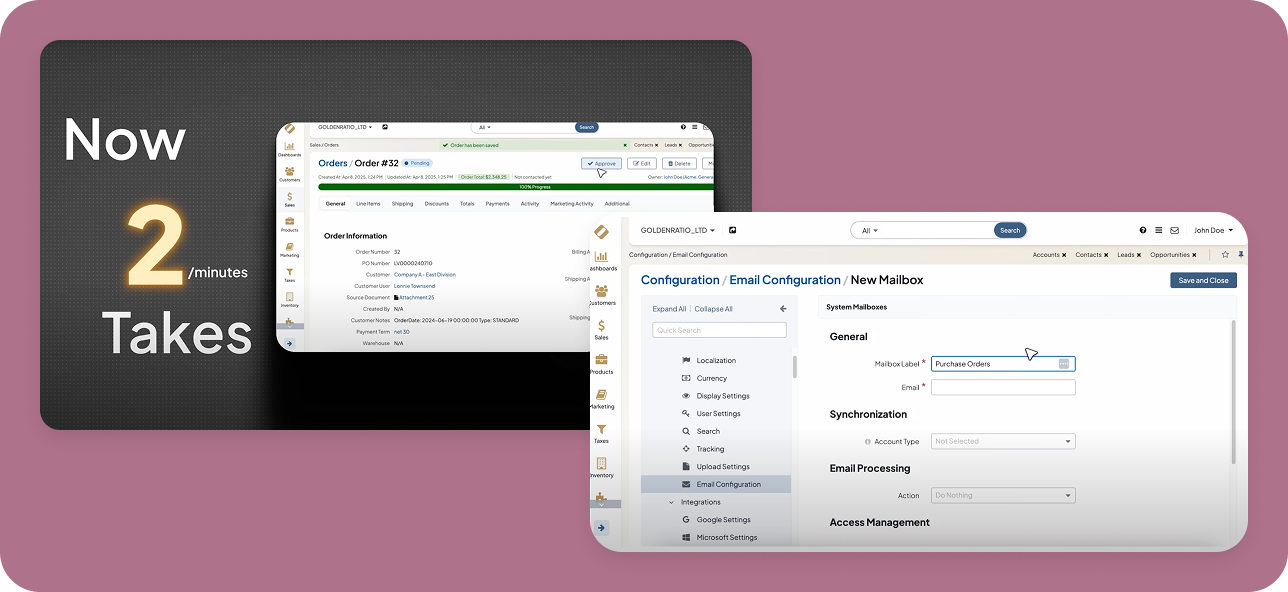
If you want to find immediate returns, look at your order intake. Our recent B2B AI benchmark shows 81% of surveyed companies have already deployed sales order automation, with the remaining 19% actively running pilots. It boasts the highest AI adoption rate of any use case because the operational pain is undeniable.
Consider the human element right before the quarter closes. Your highest-grossing buyer emails a 47-line PDF purchase order. They use their own internal part numbers instead of your official catalog SKUs. Your senior sales reps have to drop everything and manually type those lines into the ERP.
Automating repetitive tasks kills this bottleneck. Technology like OroCommerce SmartOrder processes a 700-line purchase order in about 30 seconds. The software parses PDFs, images, and emails, instantly translating customer part numbers into your internal SKUs. One manufacturing client dropped their order processing time from 30 minutes down to just two, recording an 80% reduction in manual data entry.
See how it works in a short video
You still need strict boundaries around this technology
Total autonomy creates severe financial risk when fulfillment and margins are on the line. The system should draft the order and flag any anomalies, but a human rep must hit approve. This setup keeps your data clean while ensuring your sales professionals maintain absolute control over the customer relationship.
#2 Lead Scoring and Opportunity Prioritization
According to the 2026 Salesforce State of Sales, reps spend just 28% to 34% of their week on direct selling. They lose the rest of their hours filtering noise. Evaluating raw data to figure out who is ready for active sales engagement burns valuable time.
Lead scoring models filter out the window shoppers and rank your buyers based on conversion potential. McKinsey recently tracked an industrial materials distributor that used AI to scan construction permits and unstructured public data. They uncovered over $1 billion in new opportunities, expanding their sales pipeline by 10%.
You still must set clear boundaries around how the system ranks an account. If a rep receives a random numeric score with no context, they won’t trust it. Your sales professionals need to see exactly why the algorithm flagged a prospect.
#3 Eliminating the Dead Time Around Selling
The biggest contribution to productivity involves eliminating the dead time surrounding your customer interactions. Bain estimates that automation can roughly double a rep’s time spent selling.
Here is how the technology removes the administrative drag from a typical day:
- Pre-call briefs: The system pulls a complete account history, open quotes, and recent pricing changes, so your reps aren’t scrambling through five different browser tabs five minutes before a call.
- Post-call updates: It automatically summarizes sales conversations, captures next steps, and updates the CRM record hands-free.
- Between calls: The platform analyzes customer behavior to flag sudden drops in ordering frequency or anomalies in purchasing patterns.
These capabilities demand clean infrastructure. If you point an AI assistant at a fragmented tech stack, it will just hand you confident-sounding wrong answers.
A tool like OroIQ lets reps run plain-English queries against pricing and order history and build performance dashboards directly from live commerce data. Connecting your commercial data gives these tools the exact foundation they need to function.
#4 Conversational AI and Self-Service in B2B Portals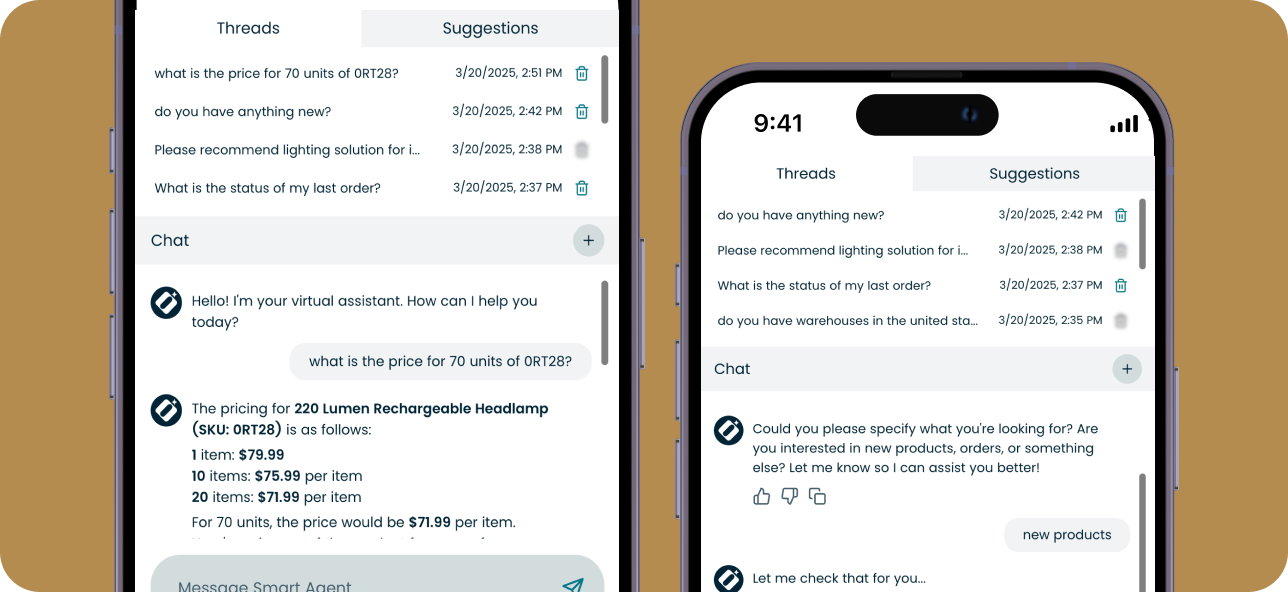
Your buyers are impatient. When a procurement manager is on a job site at 7 AM, they don’t have the time to sit on hold or wait for an email reply just to check a lead time. According to Salesforce, service teams handle 30% of cases via AI today and expect that volume to hit 50% by 2027.
Conversational intelligence tools turn a static web portal into an active catalog. Using an embedded tool like OroCommerce SmartAgent, a customer skips the nested menus and gets straight to the point.
- Context-aware requests: A buyer asks, “Do you have an exact replacement for [Competitor SKU] and can you get 50 of them to the Dallas site by Thursday?”
- Instant verification: The system cross-references your substitute parts and checks live warehouse availability.
- Actionable outputs: It pulls the customer’s specific contract rate, attaches the necessary spec sheet, and drafts the quote.
Our B2B AI Benchmark survey shows 73% of companies have deployed customer service AI. The successful ones tightly constrain the bot. Unmediated quoting turns into a financial disaster the second a bot offers a volume discount that violates the customer’s contract. The architecture only works when the AI relies strictly on your pre-approved pricing rules.
#5 Dynamic Pricing and CPQ
Pricing remains the hardest workflow to automate. Our benchmark data shows that only 15% of companies have deployed AI in their pricing models. McKinsey’s 2025 Agentic AI in Pricing Survey found 65–85% expect to adopt AI tools in pricing within 1–3 years – yet only 5–10% have fully scaled it across any use case today.
The roadblock comes directly from internal politics and fragmented architecture.
- The governance deadlock: Sales reps want to discount to win the deal. Finance wants to hold the floor price to protect margins. If leadership hasn’t defined who owns pricing authority, the algorithm operates in a vacuum.
- The silo trap: Quoting grinds to a halt when approval workflows live in a CRM, contract terms live in the ERP, and the catalog sits on a disconnected storefront.
You can’t drop an AI agent on top of a broken tech stack and expect smart margins. The pricing engine needs immediate access to past deals and real-time inventory from a single, unified database to make profitable recommendations.
#6 Proactive Sales Co-Pilots
McKinsey research shows the negative revenue impact of churn can be twice as significant as the gains from new customer acquisition. Most of it is preventable with earlier signals.
Proactive AI flips the model. Instead of answering questions, it monitors patterns continuously and pushes the insight to the rep before they know to look.
What this looks like in practice:
- Churn early warning: Order volume drops week over week, or a customer starts favoring a competing brand. The system flags it and routes the alert to the account rep with enough context to act on it, not just a score to wonder about.
- Pipeline guidance: The rep asks “What do I need to move my open opportunities from Discovery to Negotiation?” and gets a prioritized action list grounded in their actual sales cycles, not a generic playbook.
- Pattern monitoring: Buying shifts, product lifecycle changes, and forecast anomalies surface automatically. No report request needed.
OroCommerce’s upcoming SmartTrends and SmartSales Co-Pilot handle both sides of this.
SmartTrends runs continuous business monitoring, flagging volume drops, brand-preference shifts, and buying-pattern changes as they happen.
SmartSales Co-Pilot works the pipeline, analyzing deals in progress and pointing reps toward the highest-probability work.
Both run through OroIQ on the same commercial data already powering your pricing, orders, and account hierarchy.
Establishing Baselines and Success Metrics for AI Implementation
OroCommerce’s AI benchmark report found that 48% of leaders report positive but entirely vague results from their AI technology. Only 17% can point to definitive financial returns. The gap between those two groups comes down to establishing harsh success metrics before implementing AI. You simply can’t alter your core sales workflows if you don’t know your starting line.
Sales leaders must measure the operational impact across distinct timelines to prove the value to the wider business. Here is how that deployment schedule maps out for enterprise sales teams:
- Days to weeks (Order capture): Start by calculating your exact cost per order and tracking manual entry errors. If a tool parsing PDFs doesn’t drastically improve your sales productivity in the first 30 to 60 days after launch, your underlying data quality is failing.
- Weeks to months (Portal self-service): Track the drop in routine status emails and inventory calls hitting your service desk, and compare that against the number of quotes drafted directly through the portal. Those diverted tasks deliver an immediate soft AI ROI, giving your reps back the hours they need for relationship building.
- Six to 12 months (Intelligence and scoring): Improving your pipeline management takes a full sales process to measure correctly. You have to measure usage first. Are your sales representatives calling the accounts the AI flagged as high-value prospects, or are they ignoring the tool? If they ignore the AI insights, the algorithm gets no feedback. It never learns which deals actually close, and your sales forecasting stays broken.
Leaders consistently rank productivity and customer satisfaction higher than direct cost savings in the first year. Budget for the entire adoption timeline rather than just the immediate payback period.
Building Your AI Sales Tech Stack
There are plenty of AI solutions on the market, but every use case discussed so far has two outcomes. The algorithm either works, or it produces a confident-sounding wrong answer. The deciding factor is rarely the AI models themselves. It always comes down to the systems feeding them.
Over 53% of B2B leaders cite legacy system integration as their biggest implementation hurdle. Another 67% point directly to inconsistent data formats. IDC analyst Heather Hershey summarized the problem perfectly. She noted you simply can’t drop an LLM on top of five disconnected ERPs. Without strict AI governance, a new AI platform just scales your blind spots.
The table below maps specific capabilities to the platform layer they require. It also outlines the data foundation you must build before turning these tools on.
| Use Case | Platform Layer | Example Tools | The Requirement |
| PO and order capture | eCommerce / ERP | OroCommerce SmartOrder | Live inventory and contract pricing accessible at read time |
| Lead scoring | CRM / Sales Intelligence | Salesforce Einstein, Clari | Over 12 months of clean CRM data and customer data enriched with external signals |
| Account intelligence | CRM / eCommerce | OroIQ | Connected order history combined with customer engagement data |
| Conversational self-service | eCommerce portal | OroCommerce SmartAgent | Contract pricing logic inside the platform instead of a separate silo |
| Dynamic pricing | CPQ / eCommerce | PROS, Zilliant | Centralized contract hierarchies, margin floors, and historical win/loss quote data to train the algorithm |
| AI-powered forecasting | CRM / BI | OroIQ | Clean transaction history alongside consistent pipeline stage definitions |
| Coaching | Call recording / CRM | Gong, Chorus | Analyzing sales calls via conversation intelligence requires reps to log activities in CRM systems |
Most tech stacks grew one application at a time. This created isolated databases that refuse to share information. Buying disconnected tools for sales automation guarantees your team misses the bigger picture.
Bringing that intelligence into a unified commerce system changes the workday completely. Look at how this architecture plays out on the floor for a major industrial manufacturer.
In Practice: DiversiTech’s 20% Productivity Gain
HVAC component manufacturer DiversiTech grew fast through acquisitions. That growth left them heavily fragmented across 12 different ERP environments. Their customer service teams spent hours rekeying fax and email orders just to keep the business moving.
They deployed OroCommerce as a central commercial layer and turned on SmartOrder to handle the PDF intake. The North American team immediately recorded a 20% productivity gain. Their reps stopped acting like data entry clerks and focused their sales efforts on managing accounts.
The deployment in Europe exposed a secondary benefit. The division was navigating a complex migration with nine different ERP systems running at once. Instead of building custom data-mapping workflows for nine different databases, SmartOrder acted as a single front door.
No matter which legacy ERP a customer belonged to, the software translated their incoming PDFs into one standard digital format. Solving a basic data-entry problem gave DiversiTech a unified order intake layer for a highly fragmented back office.
Giving Your Reps Their Time Back with OroIQ
This is what happens when you build a powerful AI solution directly into the platform your sales team already uses. The OroIQ suite runs natively on your existing pricing engines and customer hierarchies in OroCommerce. It never has to guess at your business rules or charge you an extra add-on fee.
See how OroIQ works in a short video
Here is how that architecture shifts the administrative burden off your sales floor:
- Killing the order entry bottleneck (SmartOrder): A 700-line PDF hits the inbox. Instead of typing for an hour, the system reads the file, maps the customer part numbers, and drafts the order in 30 seconds. The rep reviews it, clicks approve, and moves on.
- Deflecting the “Do you have this?” calls (SmartAgent & Semantic Search): Buyers log into the portal and use natural language to find exact substitutes or draft quotes on their own. They find what they need even if they type a broken SKU. Your reps stop acting like human search bars.
- Bypassing the BI backlog (SmartAssistant & SmartInsights): Reps no longer export CSVs or beg data analysts for custom reports. They query the database in plain English to generate actionable insights. A manager types, “Find customers who haven’t ordered in six months and put them in a new segment,” and the system executes it instantly while adhering strictly to your existing security permissions.
Moving from Reactive to Proactive (Coming Soon)
Analyzing historical data only tells you what you already missed. The next phase of OroIQ brings native pipeline intelligence directly to your revenue teams.
- SmartSales Co-Pilot: It analyzes deals in progress to guide sales teams directly toward high-probability work. It translates raw pipeline data into actionable strategies to lift overall sales performance, answering questions like, “What steps do I need to take to move these specific opportunities from Discovery to Negotiation?”
- SmartTrends: A continuous monitor that surfaces market trends before you even ask. It flags when a reliable customer suddenly changes their buying pattern or drops their volume, allowing your team to execute specific sales strategies to intercept a churning account early.
See what happens when your AI understands your catalog and pricing rules
Conclusion: AI Handles the Data, Humans Handle the Deal
All of this native intelligence serves a single purpose. It gets your team out of the administrative weeds so they have time for proactive follow-ups. No buyer wants generative AI and automated outreach for their custom contract negotiations. They expect a senior rep who understands their business.
The technology only works when it acts as a co-pilot, rather than a replacement. Let AI systems map the spreadsheets, fetch the inventory data, and assemble the pipeline reports that support data-driven decision making. Keep your human reps focused entirely on the friction that actually requires a handshake.