
navigation

80% of the B2B manufacturers and distributors we surveyed this year have deployed AI in at least one function. 17% say it’s working well. That’s a 63-point gap between “we bought it” and “it was worth buying.”
To find out what survives in production, we ranked the top 10 AI use cases in B2B commerce. Each includes AI adoption data from our 2026 survey of 100 directors and VPs at manufacturers and distributors ($100M–$10B+ revenue).
Use this breakdown as a diagnostic tool to see where AI in B2B has proven its value for sales teams and back-office operations, and where it’s still science fiction.
AI Use Cases in B2B Commerce at a Glance
Every use case in this guide fails for different reasons and requires different data maturity. The table below ranks all ten by adoption rate from our 2026 survey of 100 B2B manufacturers and distributors. It’s a quick way to see where AI in B2B has proven its value for sales teams and business operations.
| Use Case | Deployed / Piloting | ROI shows up in… | Complexity | Skip if… |
| Order automation | 81% / 19% | Rep time, error rates, order speed | Low | Low volume or orders already digital |
| Customer service AI | 73% / 23% | Support volume, response time | Low | Small buyer base, unreliable pricing data |
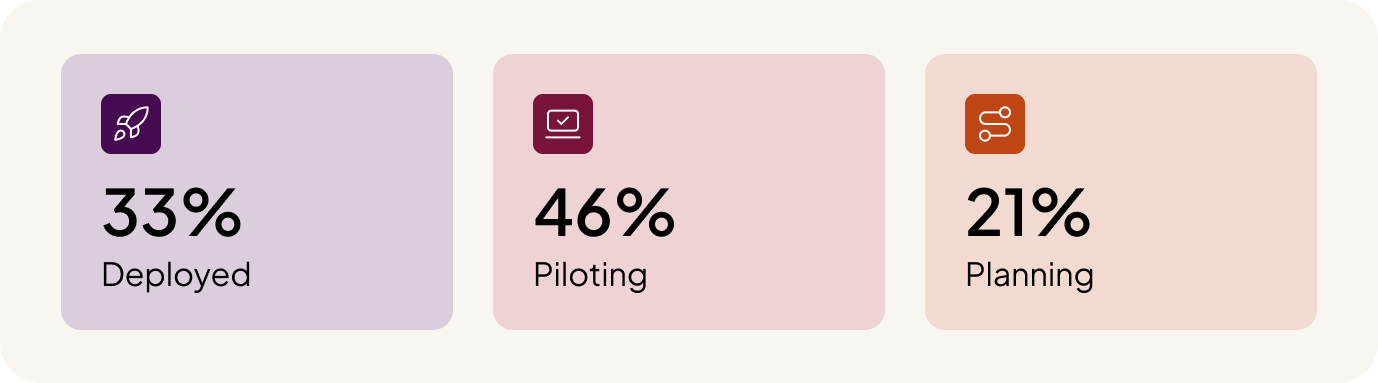
| Demand forecasting | 33% / 46% | Carrying costs, stockout rates, fill rates | Medium | <2 years clean data or small catalog |
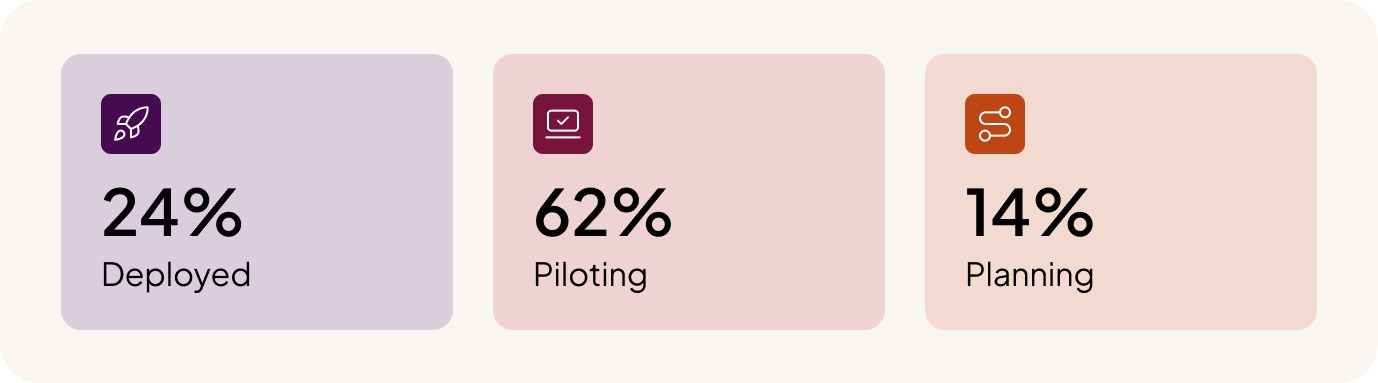
| Search & discovery | 24% / 62% | Conversion, rep dependency, portal adoption | Medium | <500 SKUs |
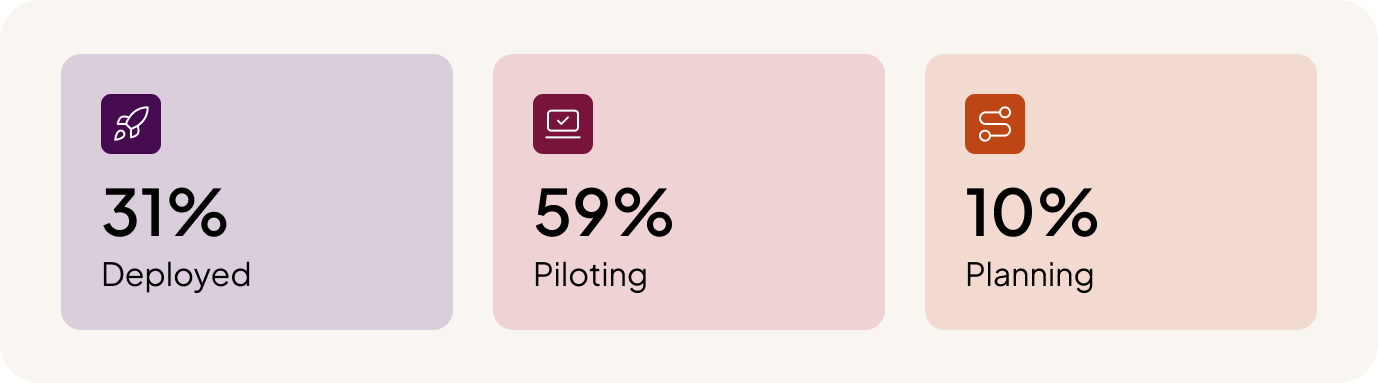
| Sales intelligence | 31% / 59% | Rep focus, pipeline velocity, win rates | Medium | <50 active accounts |
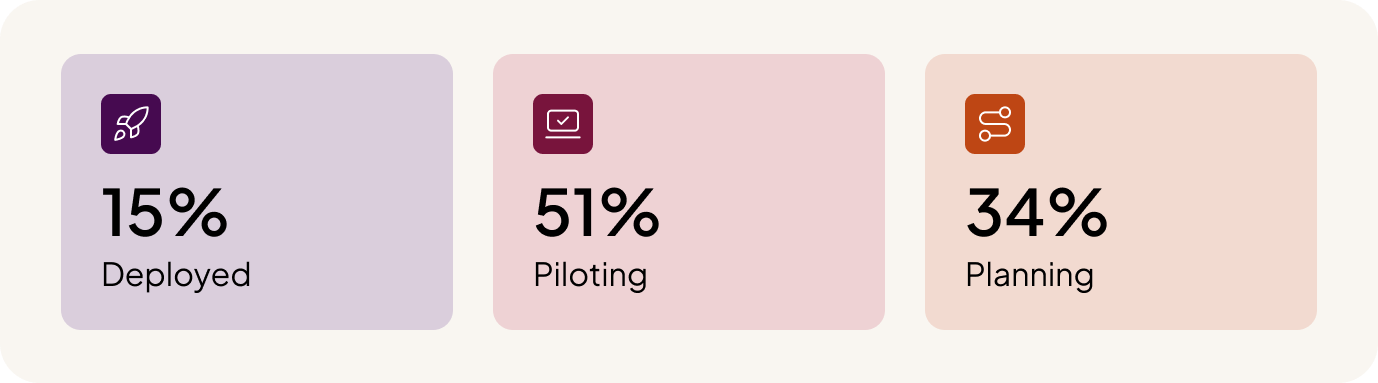
| Dynamic pricing | 15% / 51% | Margins (2-6% of sales), deal consistency | High | No agreement on who owns pricing |
| Content generation | 27% / 47% | Catalog completeness, time to publish | Low | Mature PIM with high data coverage |
| Fraud detection | 19% / 42% | Loss prevention, credit risk | Medium | Low transaction volume |
| Quote processing (CPQ) | 5% / 44% | Quote speed, deal win rate | High | Quoting speed isn’t costing you deals |
| Agentic commerce | 5% / 36% | Too early to measure in production | High | Now, for most companies |
How to Prioritize Your AI Roadmap
High adoption rates hide a lot of failed pilots. Just because the market is buying a specific tool doesn’t mean it belongs in your current IT budget.
We mapped the broader B2B landscape based entirely on operational readiness. Here is exactly where you should point your capital today, and which hype cycles you should let your competitors test first.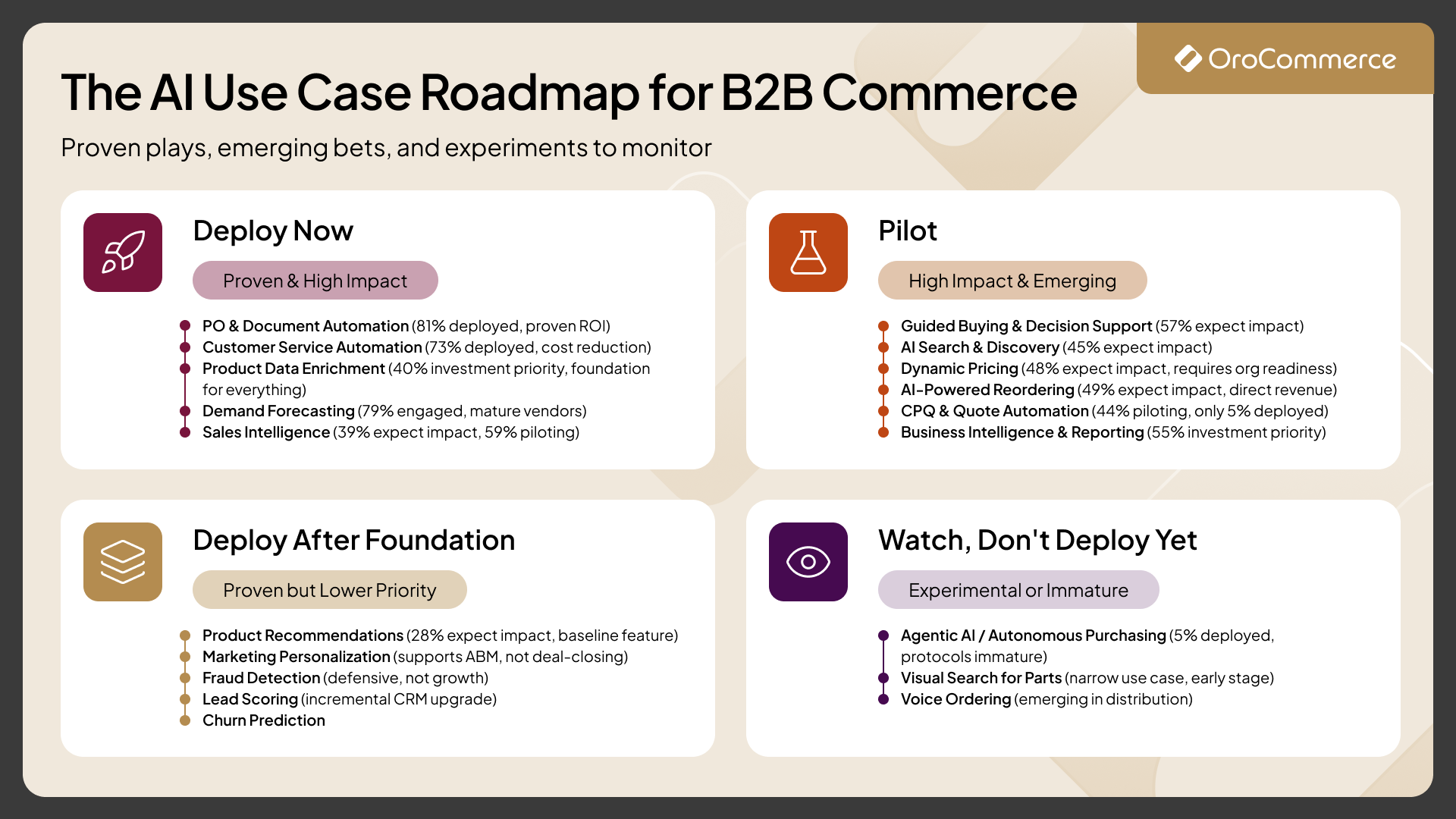
How to navigate the four tiers:
- Deploy Now: Immediate administrative relief. These capabilities target operational bottlenecks and deliver a measurable payoff on workflows your team already controls.
- Pilot: High margin leverage, but heavily dependent on internal governance. The software is ready, but these models fail until your executive team strictly defines the business rules.
- Deploy After Foundation: These capabilities look great in vendor demos but will actively damage customer trust if your underlying taxonomy and data architecture are fragmented.
- Watch, Don’t Deploy Yet: The models here aren’t mature enough to handle wholesale edge cases and complex contract logic. Let the broader market subsidize the R&D.
We isolated 10 specific capabilities your executive team is actively asking about to show you exactly what survives contact with your ERP.
Let’s start with the low-hanging fruit in the “Deploy Now” quadrant.
1. Order Automation & Document Processing
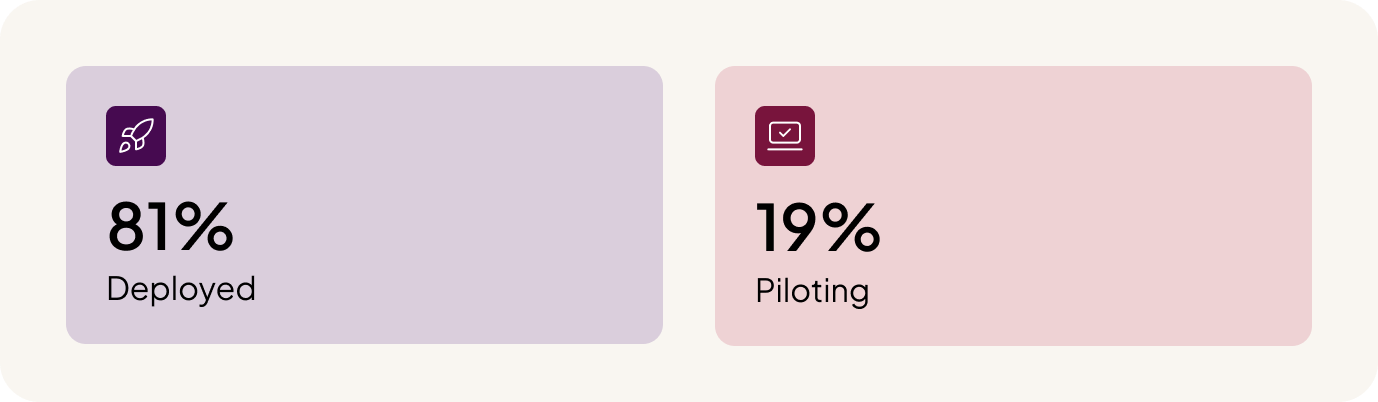 The most adopted AI use case in B2B by a wide margin.
Purchase orders arrive as PDFs, email attachments, sometimes faxes. Somebody has to turn those into structured orders. In most B2B operations, “somebody” means a sales rep retyping line by line, cross-referencing price sheets, and hoping the customer’s part numbers match what’s in the system.
AI does the reading for them. The system scans the document, recognizes text inside images and PDFs, extracts SKUs, quantities, and shipping details, then generates a draft order. The rep reviews instead of recreating.
Where it’s proven
One North American HVAC manufacturer and distributor operating across 12 ERPs deployed this on two continents with two different problems. In North America, reps who rekeyed every email and fax order saw a 20% productivity gain.
In Europe, the same tool normalizes orders arriving from nine different ERP environments during an ERP migration, replacing what would have been an entirely separate data pipeline.
What separates good from bad
Not all order automation is the same. The difference is what the AI can see while it reads.
| Standalone AI tool | AI native to your commerce platform |
| Extracts text from a PDF | Extracts text and matches it to your actual SKUs |
| Reads a quantity | Checks that quantity against live inventory management data |
| Pulls a price from the document | Validates it against this customer’s contract pricing |
| Outputs a draft that needs manual review on every line | Outputs a draft a rep can approve in seconds |
OroCommerce’s SmartOrder works the second way. It processes 700+ line item documents in about 30 seconds because it’s reading against the business logic already in the platform, not guessing at it from the outside.
When to skip this
Your order volume is low, your documents are highly non-standard, or customers already submit digitally through EDI or portal entry.
2. Customer Service & Support Automation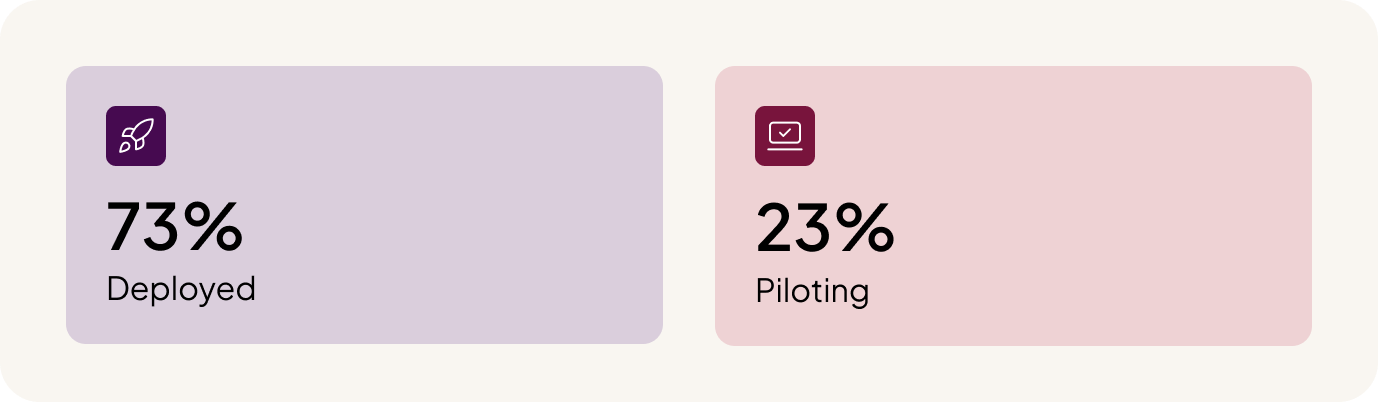
“What’s my price for 50 units?” “Where’s my shipment?” “Do you have this in stock?” B2B support teams hear these questions dozens of times a day. Each one pulls a rep into a lookup that takes two minutes and requires zero judgment.
AI assistants handle the volume. Connected to live account data, they answer pricing, availability, and order status questions using the buyer’s actual contract terms.
The buyer types a question the way they’d ask a rep, using natural language processing to interpret intent. The system responds with an answer specific to their account, not a generic FAQ link.
Not all customer service AI is doing the same job
Our survey shows high deployment, but the range of sophistication is wide. Some respondents described AI that routes tickets and searches a knowledge base.
Others have assistants that check inventory, pull contract pricing, and create orders through conversational AI, powered by generative AI models. One respondent put it plainly: the chatbot reduced response times, but complex pricing questions still escalate to human reps.
That’s the right division of labor. AI handles repetitive customer interactions. Humans handle negotiation, exceptions, and anything that requires relationship context.
Customer satisfaction depends on knowing which questions belong to which side and making sure the AI can enhance customer service on the routine ones instead of getting in the way.
What makes the difference
Same principle as order automation. An assistant disconnected from your commerce data gives generic answers. One reading from live pricing, inventory, and account permissions gives answers the buyer can act on. OroCommerce’s SmartAgent does the latter: it sees what the buyer sees on the storefront, because it reads from the same data.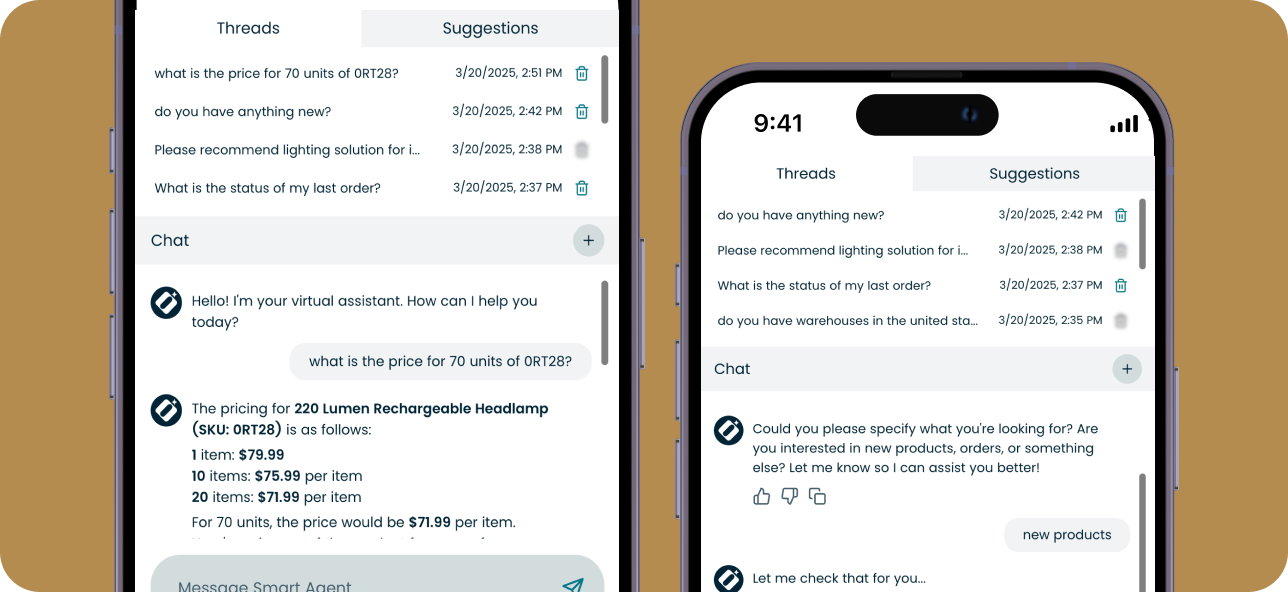
When to skip this
Your catalog is small, your buyer base is concentrated, and your reps already know every account. If your pricing and inventory data isn’t reliable, postpone until it is. An AI giving wrong prices erodes trust faster than a slow human giving right ones.
3. Demand Forecasting & Inventory Optimization
 A warehouse manager overorders because getting caught short costs more than storing the excess. A procurement lead underorders because finance is watching working capital. Both are guessing, just in different directions.
Machine learning algorithms trained on historical sales data, seasonality, and external signals (weather, commodity prices, market trends) use predictive analytics to predict future demand at the SKU and location level. This is traditional machine learning with a long track record.
Why 46% are piloting but only 33% have deployed
Demand forecasting needs at least two years of clean transaction history to produce useful predictions.
Most B2B companies have the historical data but not the consistency: SKU codes that changed during a migration, warehouse transfers logged differently across regions, seasonal patterns buried in spreadsheets nobody migrated.
The companies getting value from this started by cleaning the data, not buying the AI-powered model.
When to skip this
Less than two years of clean data, a small catalog, or a product mix that changes faster than AI models can retrain. If you manage fewer than a few hundred SKUs, a good planner with a spreadsheet still wins.
4. Search & Product Discovery
 A buyer searches “3/4 inch brass fitting 200 PSI” and gets 400 results, none of them right. They give up and call their rep. The portal just lost the only argument it had for existing.
B2B intelligent search is harder than B2C because buyers search in fundamentally different ways: part numbers, technical specs, natural language, or all three in the same query. Keyword search fails at most of these. Smart search powered by semantic models understands intent, handles typos and abbreviations, and improves as it learns from customer behavior.
Why 62% are piloting but only 24% have deployed
Everyone knows their search is bad. The bottleneck is what’s underneath it. Even the most advanced AI search on a dirty catalog just returns confident-looking wrong answers faster.
The prerequisites before AI-powered search adds value:
- Consistent product attributes across the catalog, not just for top sellers
- Technical specs in structured fields, not buried in PDFs
- Deduplicated SKUs with clear parent-child relationships
- Category taxonomy that reflects customer preferences, not how your warehouse is organized
Fix those and you’ve also prepared your catalog for recommendations, AI assistants, and every agentic discovery play on the horizon.
This is one area where the commerce platform matters. Search that reads from the same structured catalog your buyers and reps already use performs differently than a third-party search tool indexing a data export. OroCommerce’s semantic search works this way, but the caveat from above still applies: clean attributes in, useful results out.
When to skip this
For small catalogs, well-organized navigation outperforms AI search. But if poor search is hurting conversion rates or pushing buyers back to calling reps, this is where customer experience improvements show up fastest.
Tune In: Taxonomy Expert Chantal Schweizer on better product data organization and searchability
5. Sales Intelligence & Lead Scoring
 Every sales team at scale has the same blind spot. The customer who emailed yesterday gets attention. The one quietly browsing your catalog at midnight, requesting quotes, and searching for compatible accessories doesn’t. Reps default to gut feel and whoever shouted last.
Machine learning and predictive analytics score high-value accounts by the signals reps can’t track manually: order frequency shifts, quote-to-close ratios, browsing behavior, reorder timing changes.
The results get sharper when scoring pulls from customer purchase history in the commerce layer and not just CRM data. Most CRM systems track activity. Commerce platforms track intent. An account that requested three quotes this week tells you more than one that opened two emails.
Where this is heading
Scoring tells you who to call. It doesn’t tell you what to say when they pick up. The next step is pipeline intelligence that reads your deal stages, flags where sales cycle momentum is stalling, and gives reps actionable insights on which actions move deals forward.
OroCommerce is building this into the platform where the account history already lives, so the recommendation arrives with context, not just a score, giving reps enough to make informed decisions before they pick up the phone.
When to skip this
Fewer than 50 active accounts. At that size, your reps already know who’s buying and who’s stalling. Lead scoring adds value when the portfolio outgrows any single person’s memory, which in most B2B sales happens sooner than anyone admits. It redirects sales efforts from gut feel to signal.
How the next generation of B2B portals connects sales intelligence to the customer journey.
6. Dynamic Pricing Optimization
 This is the only use case on the list where the technology is ahead of the organization.
The models work. Machine learning can analyze historical data, purchasing patterns, market trends, and competitor signals to recommend dynamic pricing strategies per customer or SKU segment. In real-world deployments, these AI models have improved margins by 2 to 6 percent of sales, while keeping existing pricing structures (competitive guardrails, price ladders, volume logic) intact. The math is not the problem.
The problem is that pricing is the most politically loaded decision in any B2B company. Sales wants flexibility. Finance wants margin. The C-suite wants both. And buyers expect customer experience consistency, not prices that shift depending on who they talk to.
Until multiple stakeholders agree on who has authority, any AI recommendation lands in a vacuum. No amount of artificial intelligence fixes a governance gap.
When to skip this
Postpone until your organization has settled who owns pricing decisions. The governance question comes before the algorithm and data driven decisions require someone willing to act on them first.
7. Product Data Enrichment & Content Generation
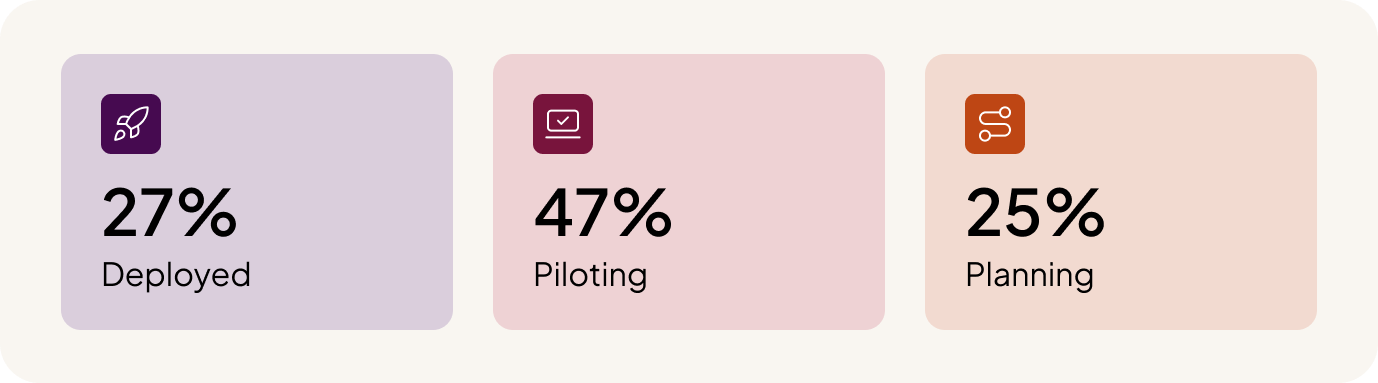 This use case is boring until you realize it’s the prerequisite for almost everything else on this list:
- AI search doesn’t work if half your SKUs are missing attributes.
- Recommendations fall apart when product relationships aren’t structured.
- Dynamic pricing can’t optimize what it can’t categorize.
And IDC analyst Heather Hershey makes the agentic case directly: if your catalog isn’t legible to AI systems, every downstream application breaks at the source. No amount of model sophistication compensates for a product database full of gaps.
Generative AI fills missing attributes, writes product descriptions from spec sheets, standardizes vast data across sources, and generates RFP responses at scale.
For distributors managing catalogs with tens of thousands of SKUs, content creation used to be a permanent bottleneck staffed by a team that was always behind. Now, with generative AI, it’s a workflow.
The same AI-powered tools that handle product descriptions can generate marketing tools like spec sheets, comparison guides, and category landing pages, freeing up resource allocation for work that requires human expertise.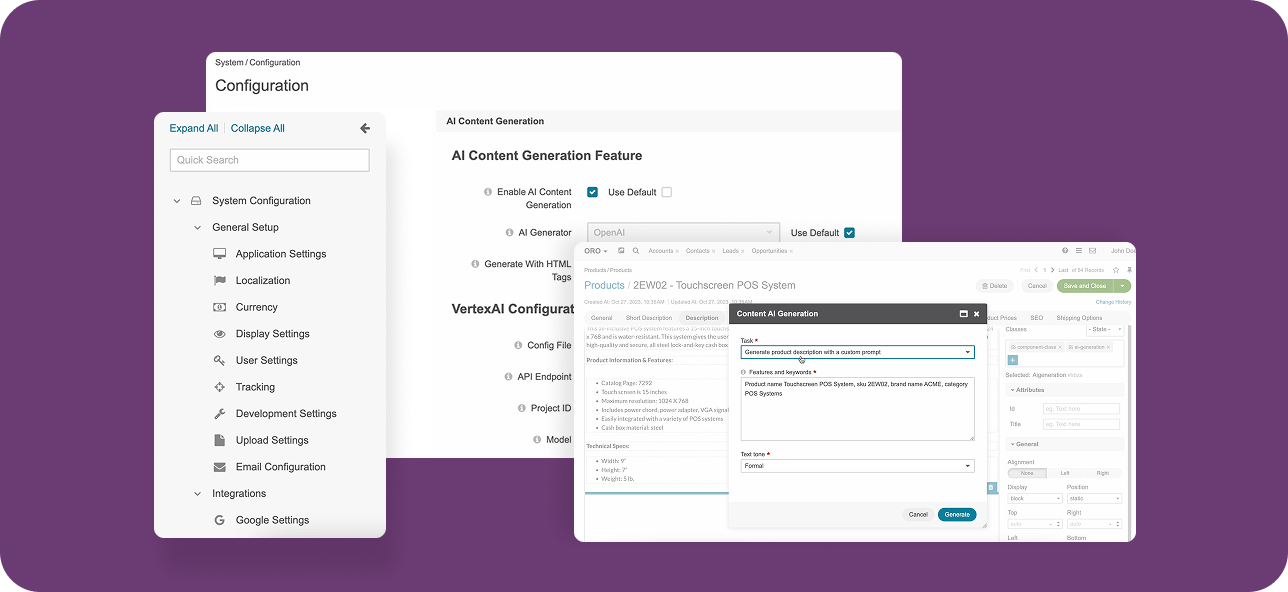
When to skip this
Your catalog is small, rarely updated, and product descriptions don’t change often enough to justify the setup. In regulated industries, approach carefully regardless of catalog size. AI-generated product claims still need human review and legal sign-off before publication.
8. Fraud Detection & Risk Management
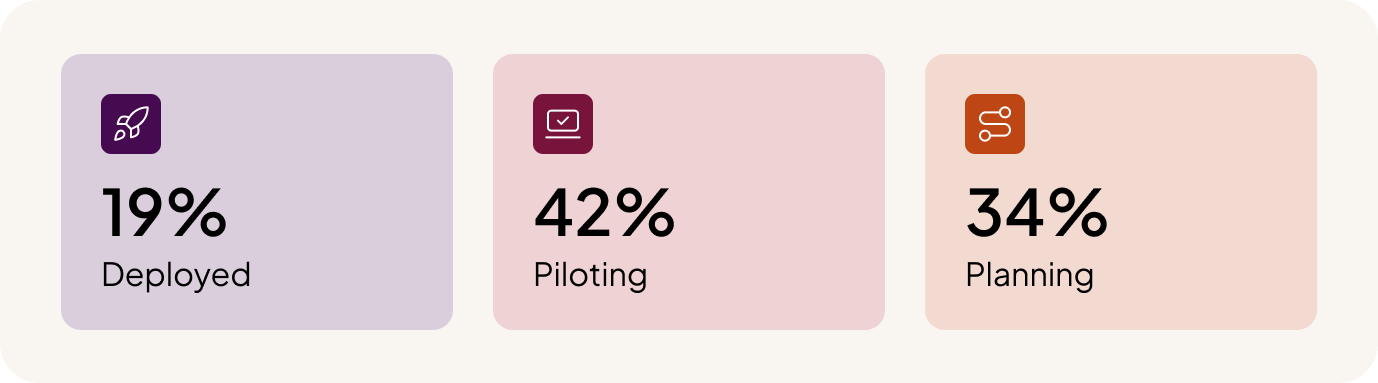 A new account passes credit checks, places three small orders on net-30, pays on time, then submits a $200K order on net-60 to a new shipping address. By the time the invoice goes unpaid, the goods are gone.
Bust-out fraud follows a pattern, but it’s a pattern that spans months and multiple systems. No single person in the organization sees the full sequence.
ML models do. They establish baselines per account and flag deviations across the signals human agents track separately:
- Order volume or value spikes relative to account history
- Shipping address changes, especially to new regions
- Payment timing drift or sudden changes to payment method
- Credit utilization approaching limits faster than historical norms
In our survey, respondents running anomaly detection described it as one of the quietest AI tools in their stack. It uses predictive analytics to learn what normal looks like per account, and escalates the exceptions.
No one interacts with it daily. It just narrows the pile of transactions that need human judgment from thousands to dozens, cutting operational costs and protecting business outcomes across B2B sales operations.
When to skip this
Low transaction volume, or an environment where every order already goes through manual credit review. Fraud detection adds value when the volume of transactions makes it impossible for one person to hold the pattern in their head.
9. AI-powered Quote Processing & CPQ
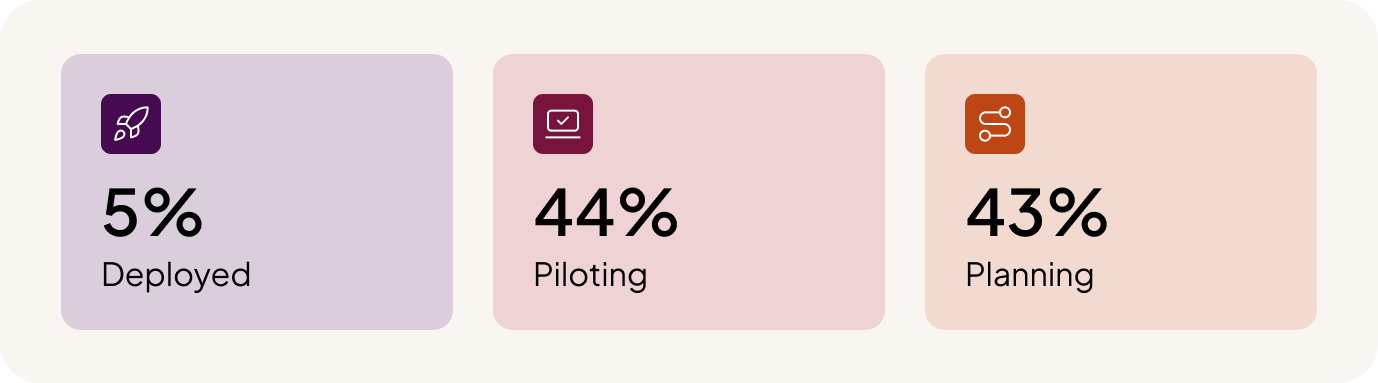 Eighty-seven percent of respondents want this. Five percent have it. That ratio says more about organizational readiness than about AI.
AI-assisted quoting is fast once it has something to work with. The “something” is the hard part. Configuration logic, pricing rules, and approval chains need to be structured, connected, and accessible before any model can touch them.
In most B2B organizations, that data exists but lives in three systems maintained by three teams who’ve never compared notes.
That’s what the 44% piloting this use case are running into. Implementing AI on top of disconnected systems doesn’t shorten the sales cycle. It just automates the bottleneck. The AI integration work comes after the plumbing is fixed.
When to skip this
If quoting speed isn’t costing you deals. Plenty of B2B relationships run on long timelines where a three-day quote is acceptable. Invest here when you’re losing to competitors who respond faster, not because the capability exists.
Slow quotes hurt conversion rates and customer loyalty on accounts where speed signals commitment.
10. AI Agents for Commerce
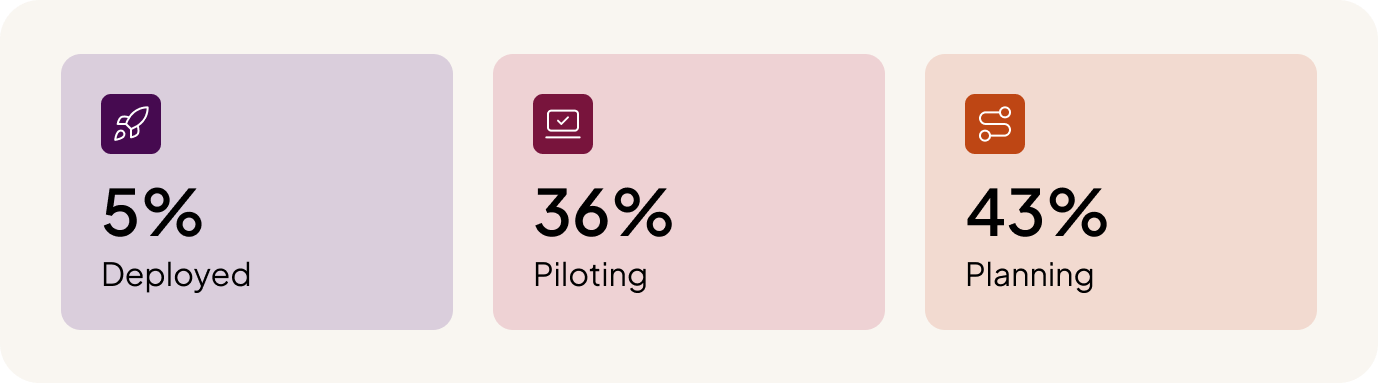 The only use case on this list where most companies are betting on a future that hasn’t arrived yet.
IDC analyst Heather Hershey defines agentic AI in commerce by three conditions:
- autonomous purchase
- autonomous payment
- autonomous fulfillment.
By that standard, almost nothing in production qualifies. Current AI solutions sit at Level 2–3 on IDC’s five-level autonomy framework. They can reason through multi-step workflows, but they need supervision.
What’s worth doing now
The companies who will be ready when agentic commerce matures are doing unglamorous work today:
- cleaning product data so AI systems can read their catalogs
- structuring pricing rules so agents can interpret them
- building approval workflows that could hand off to an AI when the trust is earned.
Every one of those investments pays off now, regardless of whether fully autonomous purchasing arrives in 2028 or 2035. This is the digital transformation work that improves customer experience and business outcomes today while preparing for AI in B2B commerce of tomorrow.
IDC's agentic commerce playbook breaks down what's deployable now versus what's still theoretical.
Future Trends for AI in B2B Sales: Who Owns the Buyer Relationship?
The use cases delivering the strongest results in this guide have one thing in common: AI connected to internal business data.
The next wave looks different.
OpenAI launched its Agentic Commerce Protocol in late 2025. Google followed with the Universal Commerce Protocol in January 2026. Both want buying to happen inside their platforms, with AI agents mediating between buyers and sellers.
IDC’s Heather Hershey flags the tension directly: if enough merchants participate, any early advantage disappears. The platform captures customer engagement. The merchant becomes a fulfillment layer.
Amazon seems to agree with the risk. It has blocked dozens of AI agents from its platform, including OpenAI’s ChatGPT, and in March 2026 won a court order blocking Perplexity’s AI shopping bot from making purchases on its site. The largest commerce company in the world is fighting to keep AI intermediaries out.
Why B2B should pay closer attention
B2B sales aren’t $30 consumer purchases. They’re contract-priced, relationship-driven transactions where customer data, purchase history, and negotiated terms are competitive assets. Handing that context to a third-party AI platform is a different calculation than listing a product on a marketplace.
When you integrate AI on your own systems, your company keeps the customer feedback, the behavioral data, and the account intelligence that makes every other use case on this list work.
This is where the infrastructure work becomes an AI strategy. Clean product data, structured pricing, connected account histories: these prepare you for agentic commerce on your terms. On platforms you control. Governed by rules you set.
The question that should shape every AI tools investment: will your customer journey run through your systems or someone else’s?
FAQs
What are the best AI use cases in B2B eCommerce?
The highest-adoption use cases for AI in B2b in 2026 are:
- order automation
- customer service AI
- demand forecasting
The use cases with the highest future intent are dynamic pricing, quote processing, and AI-powered search — all piloting above 44%.
What are some real-world examples of AI in B2B?
A North American HVAC manufacturer uses AI-powered order processing to normalize orders across 12 ERPs, gaining 20% productivity in North America. In customer service, companies in our survey reported chatbots handling pricing and availability questions using real-time data from the buyer’s actual account, though complex customer needs still route to human reps.
What types of AI are used in eCommerce?
Four main types of AI tools show up in B2B commerce:
- Machine learning handles pattern recognition: demand forecasting, lead scoring, fraud detection, predictive analytics.
- Natural language processing powers search, chatbots, and document reading.
- Generative AI handles content creation, product descriptions, and RFP responses at scale.
- Emerging agentic artificial intelligence aims to make autonomous purchasing decisions, though most deployments today remain at early maturity levels.