navigation

The future of AI in manufacturing got its proof of concept on the factory floor. Predictive maintenance handled maintenance needs before failures turned into downtime. Smarter scheduling started optimizing production schedules in real time. Across the manufacturing industry, improving efficiency stopped being a goal and became a baseline expectation.
The commercial engine is a different story. Pricing, quoting, ordering, customer experience: most of it still runs on infrastructure that predates the AI conversation entirely. That’s where the next wave lands, and it’s moving faster than the factory floor did.
This guide covers where AI is already changing B2B manufacturing commerce, what the implementation challenges look like, and what platform foundation you need to capture the upside.
The State of AI in Manufacturing Today
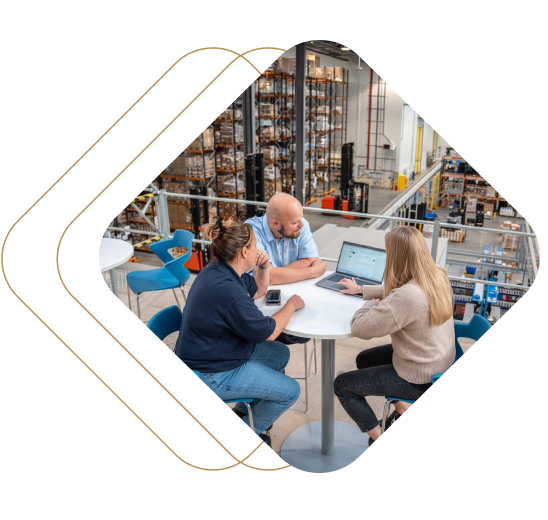
Image source: Pexels
Every step of the manufacturing process is now touched by AI in some way. Understanding the current state is the starting point for planning what comes next.
From the factory floor to the front office
Predictive maintenance, computer vision-based inspection, and industrial robotics are standard practices in competitive manufacturing operations today. AI systems flag equipment degradation, catch defects at line speed, and compress planning cycles that used to take hours.
The shift happening now is upstream and downstream. AI is moving into:
- Engineering workflows: generative design, simulation, and production processes like materials science
- Commercial systems: sales, pricing, service, and B2B eCommerce
The manufacturing sector generates more production data than any other industry. Most of it has historically stayed locked in operational systems, never reaching the commercial layer where it could drive better outcomes for buyers.
Long-term success in manufacturing commerce goes to the organizations that change first.
Why manufacturing eCommerce became the new AI frontier
B2B buyers expect consumer-grade digital experiences: self-service ordering, real-time inventory visibility, and instant quotes.
That expectation collides with the reality of manufacturing commerce, where SKU complexity, multi-site pricing inconsistencies, and contract terms that vary by account create data problems that static rules can’t solve.
Machine learning and deep learning handle account-level pricing complexity at scale. Natural language processing makes massive catalogs searchable by intent, not just part number. Predictive models flag likely reorders before the buyer logs in.
These are exactly the data problems that artificial intelligence is uniquely positioned to solve, freeing your teams for the complex problem-solving that creates real competitive differentiation.
According to McKinsey, B2B companies are making larger budget commitments to generative AI, allocating 11–25% of their eCommerce budgets, more than their B2C counterparts.
According to Deloitte’s 2025 Manufacturing Industry Outlook, generative AI and machine learning deliver the highest ROI among smart manufacturing technologies, second only to cloud and SaaS solutions.
The core AI technologies driving change
Not all AI is the same. Each type carries different costs, maturity levels, and ROI profiles.
| Type | Best-fit use case | Manufacturing example | eCommerce example | Maturity (2026) |
| Large language models | Content, summarization | Technical documentation | Product description generation | High |
| Industrial small language models (SLMs) | Narrow operational tasks | Defect classification, PO parsing | Search ranking, quote generation | Growing |
| Generative AI | Design, recommendations | Generative part design | Catalog enrichment, personalization | Moderate |
| Edge AI | Real-time, on-machine decisions | Inline quality inspection | Stockout prediction at warehouse | Moderate |
| Digital twins | Simulation and optimization | Plant layout modeling | Demand and inventory simulation | Moderate |
For a broader primer, artificial intelligence in B2B eCommerce covers the foundational concepts that apply across every manufacturing use case.
Key Trends Shaping the Future of AI in Manufacturing

These trends aren’t projections. They’re already in motion. Our B2B Commerce AI Reality Check report, which captures the latest industry practices in commercial AI deployment, shows the gap between leaders and laggards is widening fast.
Agentic AI and autonomous commerce
The automation revolution in manufacturing is entering a new phase. Gartner predicts that by 2028, 90% of B2B buying will be AI agent intermediated, pushing over $15 trillion of B2B spend through AI agent exchanges.
In B2B commerce, those agents will:
- Triage inbound RFQs and auto-generate draft quotes for rep review
- Reconcile purchase orders against contracts
- Show reorder suggestions before stockouts occur
The caveat: most “agentic AI” tools today are workflow automation with an AI label. Before you buy, demand clear answers on what decision the AI is actually making, what data trains it, and how the outcome is measured.
Generative design, digital twins, and edge AI
Three technologies are reshaping both production and commerce:
- Generative design creates lighter, stronger, lower-material parts. It pairs naturally with additive manufacturing and is already in production use in aerospace and the automotive industry.
- Digital twin technology simulates product behavior, plant operations, and supply chain dynamics in real time, letting engineers test changes virtually before committing resources on the shop floor.
- Edge AI moves inference onto machines at the point of production. Instead of sending sensor data to the cloud, edge models make decisions locally in milliseconds, which matters enormously for quality inspection on a production line where cloud latency is too slow, and power consumption is a cost factor.
Industrial AI replaces general AI
That’s a fundamental shift: from “chat with your data” to AI embedded inside the workflows that actually move revenue.
General-purpose large language models are giving way to industrial AI: models trained on mechanical, operational, and transactional manufacturing data. Small language models tuned for narrow tasks outperform large general models on cost and latency for manufacturing applications.
The result is AI systems baked into order management, pricing engines, CPQ tools, and supplier portals.
How AI Is Reshaping B2B Manufacturing eCommerce
This is where the future of AI in manufacturing gets commercially concrete. The use cases below are in production at manufacturers today.
Smarter product discovery and search
Industrial catalogs break traditional keyword search. When buyers work around a poor search experience, human error in ordering increases: wrong part numbers, missed substitutions and failed self-service. NLP-powered search understands industrial terminology, maps synonyms, and returns results by intent.
OroCommerce’s SmartAgent takes this further with natural-language queries directly against commerce data, letting buyers and sales reps get structured answers in plain language. The outcome: higher self-service conversion rates and less reliance on inside sales reps for basic lookups.
AI-powered quoting, purchase order conversion, and pricing
- PO automation: AI parses inbound RFQs from PDFs, emails, and spreadsheets into structured data and drafts quotes for rep review, compressing a process that previously took hours into minutes. See how OroCommerce’s AI SmartOrder works.
- Dynamic pricing: Models balance contract terms, current inventory levels, and margin targets in real time, turning static price lists into live signals that reflect actual supply chain conditions.
- Win rate impact: Faster quote cycles directly lift win rates on time-sensitive bids. This is supply chain optimization applied to commercial operations, and it’s one of the clearest drivers of business benefits for manufacturing companies investing in AI.
Personalization at the account-level scale
Machine learning handles B2B personalization complexity that static rules can’t: multi-user accounts, tiered approval workflows, contract pricing, and multi-year purchase history. The outcome:
- Customer-specific catalogs, promotions, and pricing replace manual configuration
- Predictive replenishment flags likely reorders before the buyer logs in
- Sales reps and self-service buyers share an AI-enriched account view
AI-driven features manufacturers should expect from a modern B2B commerce platform:
- Natural-language search with industrial terminology support
- AI product tagging and catalog enrichment
- Automated PO ingestion and parsing
- Smart reorder and predictive replenishment
- Anomaly detection on orders and account behavior
- Conversational analytics and predictive analytics for sales and operations
- Predictive stockout alerts tied to inventory levels
Powering the Intelligent Supply Chain Through Commerce
The supply chain and the commerce platform aren’t separate systems anymore. AI makes them interdependent.
Demand forecasting and inventory optimization
The AI models powering demand forecasting combine order history, seasonality, demand fluctuations, future demand signals, and macro market conditions to forecast by SKU, region, and account.
The commerce platform becomes the real-time data feed that makes this accurate: when order data flows directly from the B2B portal into forecasting models without manual reconciliation, the models improve continuously.
Key outcomes:
- Reduces stockouts and carrying costs, minimizing waste in inventory across multi-warehouse operations
- Delivers measurably higher forecast accuracy than rules-based planning tools
- Reduces waste from overstock and emergency sourcing
Supplier collaboration and sourcing intelligence
AI ranks suppliers by reliability, lead time trends, and price trajectories, finding alternatives automatically when supply chain disruptions appear.
That makes supply chain management proactive rather than reactive. For what needs to be in place before AI can operate on supplier data, the supply chain digital transformation guide is the right starting point.
Supplier portals let vendors update certifications, lead times, and documentation directly, feeding procurement decisions with current information.
Commerce integration with ERP then closes the loop from demand signal to purchase order without manual handoffs.
Logistics, fulfillment, and after-sale service
Route optimization, dynamic ETAs, and predictive delay alerts become visible to buyers inside the portal. AI-driven returns and warranty workflows cut manual case handling.
Post-sale experience: reorders, invoices, service requests, is increasingly where AI retains customers, improving operational efficiency where buyer churn starts.
The Real Challenges: AI Washing, ROI, and Governance
The potential challenges of AI in manufacturing are real, and most don’t appear in vendor pitches.
Spotting AI washing in vendor pitches
Gartner predicts that over 40% of agentic AI projects will be cancelled by 2027 due to unclear value. Most tools marketed as “AI” are rules-based automation with an AI label. Rules-based systems don’t improve with data, don’t generalize to new situations, and don’t deliver compounding returns.
Ask vendors three questions before signing anything:
- What decision is the AI actually making?
- What data trains the model?
- How is the outcome measured?
AI in eCommerce: clearing up the hype is a useful reference for spotting the difference. If a vendor can’t answer all three specifically, the capability is marketing, not engineering.
Data readiness is the real blocker
AI performance is bounded by data quality. Prerequisites for consistent results:
- Clean product data with consistent naming and attributes
- Unified account hierarchies across ERP, PIM, and CRM
- Consistent pricing rules that don’t vary by system
According to Gartner, roughly 49% of companies struggle to show clear AI ROI. Most issues stem from data and integration gaps, not the AI itself.
Our B2B Commerce AI Reality Check report found the same pattern: companies seeing the best AI outcomes invested in data infrastructure before AI features.
Governance, security, and the human-in-the-loop
Every AI integration expands the attack surface. Manufacturers need:
- Role-based access controls and full audit trails
- Private model instances that don’t expose IP to third-party training pipelines
- Human approval authority on pricing, quotes, and fulfillment decisions
Augmented reality on the shop floor shows this principle in practice: the technology assists, but human workers retain judgment.
Virtual reality training environments reinforce it: workers rehearse complex procedures in simulation before touching live equipment. “Co-pilot, not auto-pilot” is the right frame for manufacturing AI in 2026.
AI readiness checklist
| Dimension | Question to ask | Typical gap | Fix |
| Data | Is product, account, and pricing data clean and unified? | Fragmented across ERP, PIM, CRM | Unify into a single commerce data model |
| Integration | Do systems share data without reconciliation? | Point-to-point integrations that break | API-first architecture with native connectors |
| Governance | Are access controls, audit trails, and model policies defined? | No AI governance framework | Define before deployment, not after |
| Talent | Do teams know how to act on AI outputs? | AI treated as a black box | Train on AI reasoning and output validation |
| Vendor evaluation | Can the vendor explain the AI’s decision logic? | Vague answers about “proprietary models” | Require specifics on training data and measurement |
| Change management | Do frontline teams trust AI recommendations? | Skepticism from experienced staff | Start with validated wins and visible reasoning |
Building the Foundation: An AI-Ready eCommerce Stack for Manufacturers
The right platform foundation determines whether AI in manufacturing becomes a competitive edge or a collection of disconnected experiments.
Unify commerce, CRM, and operational data
AI works only when commerce, CRM, CPQ, pricing, and inventory share one source of truth. Stitched stacks create rule drift, reconciliation work, and AI outputs that contradict each other.
A unified commerce platform removes the middleware tax and gives AI clean, consistent inputs, enhancing efficiency at every step and providing the foundation for a data-driven approach to manufacturing commerce.
Without this foundation, AI features underperform. The data model isn’t built for B2B manufacturing complexity: account hierarchies, contract pricing, multi-site inventory, and approval workflows.
The enterprise B2B eCommerce guide covers the architecture decisions that separate scalable platforms from those requiring constant custom integration.
Prioritize integration-first architecture
The software applications manufacturers depend on must share data in real time.
Native or pre-built connectors to ERP systems like SAP, Microsoft Dynamics, and NetSuite, as well as PIM, WMS, and payment platforms, are the difference between AI that gets live operational data and AI that works from stale exports.
API-first, headless-ready architecture means AI services can plug into existing workflows without re-platforming every time a new capability arrives.
Start small, scale deliberately
Build cross-functional ownership as part of your workforce strategies early. Integrating AI into cross-functional teams, rather than siloing it in IT, is what helps manufacturers enhance productivity across the business. Map the skills required for each AI-adjacent role before deployment.
A phased AI-in-eCommerce roadmap for manufacturers
- Months 0-3: Audit data quality, integration architecture, and current vendor AI claims against the three questions above.
- Months 3-9: Deploy quick wins: AI search, smart reorder, automated PO ingestion. Measure outcomes before expanding.
- Months 9-18: Roll out account-level personalization, CPQ automation, and predictive inventory management.
- 18+ months: Agentic workflows, digital twin-driven service, and full enterprise scale.
Why OroCommerce Is Built for the AI-Driven Future of Manufacturing
Platform choice determines how much of the AI opportunity you can actually capture.
A unified B2B platform, not a stitched stack
OroCommerce, a unified B2B eCommerce software for manufacturers, distributors, and wholesalers, unifies eCommerce, CRM, CPQ, CMS, PIM, DAM, invoicing, and payments under one license.
Built for manufacturers from day one, not retail-adapted for B2B, it runs on a single data model where account, product, and pricing data are consistent across every workflow.
That consistency is what makes AI features work.
When SmartOrder processes an inbound PO, it draws on the same account hierarchy and pricing rules used everywhere else in the platform. No reconciliation step, no data sync delay, no version mismatch.
The AI in B2B eCommerce practical use cases guide covers where unified platforms outperform assembled stacks in practice.
Production-ready AI inside commerce workflows
OroCommerce’s native AI layer is called OroIQ. It sits inside the same database as your pricing rules, account hierarchies, and contract terms, which is exactly what makes it useful rather than decorative.
What’s live today:
- SmartOrder: Automates inbound PO processing: parsing documents, matching line items to catalog entries, flagging exceptions, and routing for approval.
- SmartAgent: Lets buyers and sales reps query commerce data in natural language, getting answers on order status, account history, and product availability.
- SmartInsights: Lets managers query business data in plain English and get charts, KPIs, and tables on demand, no custom report configuration required.
- SmartAssistant: Equips internal sales teams with a back-office copilot for creating quotes, building customer segments, and pulling account data by typing a plain-language request.
No per-site or usage-based fees. Everything ships under the standard license, which matters for manufacturing companies managing multiple portals, brands, or regional operations.
Proven at enterprise manufacturing scale
In the automotive industry, just one example of a sector with deep AI adoption, manufacturers use AI across every phase from design to after-sales service. OroCommerce operates at a comparable scale:
- Azelis: 150 portals on a single instance
- Braskem: 12,000+ monthly orders
- PartsBase: A commerce foundation for a $2 billion aviation network
These are the kind of multi-org, multi-site, multi-currency operations where decision-making quality depends entirely on whether the data foundation is right.
Flexible deployment (OroCloud, private cloud, or on-premise) also matters for manufacturers with IP protection requirements and compliance obligations.
How OroCommerce compares to other solutions
| Capability | Retail-first platforms | OroCommerce |
| Account hierarchy | Limited, add-on required | Native, multi-level |
| Contract pricing | Basic, rules-limited | Advanced, per-account |
| Native CRM | Separate tool | Built-in |
| Native B2B AI (OroIQ) | Not available | Included in license |
| ERP integrations | Generic API only | Pre-built connectors (SAP, Dynamics, NetSuite) |
| Deployment flexibility | SaaS only | OroCloud, private cloud, on-premise |
| Per-site fees | Yes | No |
See production-ready AI for B2B manufacturing in action
Conclusion About the Future of AI in Manufacturing
Looking at the years ahead, the biggest AI payoff in manufacturing won’t come from the factory floor. It will come through commerce: faster quotes, smarter supply chains, and personalized buyer experiences that drive innovation in how manufacturers compete.
AI’s impact on manufacturing commerce is cumulative. Manufacturers that want to remain competitive won’t win by adopting AI first. They’ll win by operating on a platform built for the evolving landscape of B2B manufacturing commerce.
Each new AI capability, built on AI innovation and clean, consistent data, compounds advantage every quarter.
Digital transformation case studies show a consistent pattern: the platform decision came first, the AI outcomes followed. Digital transformation in B2B manufacturing is no longer optional.
Long-term success belongs to manufacturers who treat platform and AI strategy as the same decision.
Book a demo of OroCommerce and see production-ready AI for B2B manufacturing in action.
What is the future of AI in manufacturing eCommerce?
Account-level personalization at scale, autonomous quote and PO processing, and AI systems embedded directly in commercial workflows rather than bolted on. As AI technology matures, manufacturers on unified platforms will use AI to compress sales cycles, reduce supply chain disruptions, and improve customer satisfaction through self-service that actually works.
Which AI use cases deliver the fastest ROI for manufacturers?
Predictive maintenance, AI-driven quality control, and automated PO ingestion deliver the fastest returns. Each has measurable outcomes: minimize downtime, lower defect rates and stronger product quality assurance, faster order processing and manageable data requirements. AI-powered search and demand forecasting typically show ROI within 6-12 months once clean data is in place.
How do manufacturers avoid AI washing when choosing a platform?
Ask three questions: what decision is the AI actually making, what data trains the model, and how is the outcome measured. Vendors who can’t answer specifically are selling workflow automation with an AI label. Also, check whether AI capability is native to the platform or a third-party integration: native AI runs on the same data model and doesn’t require reconciliation.
Will AI cause job displacement in manufacturing?
AI is transforming manufacturing roles, not causing job displacement at scale. Human workers are moving from repetitive tasks toward roles that require judgment, relationship management, and complex problem-solving. Manufacturers seeing the best outcomes invest in reskilling alongside their AI deployments.
What makes OroCommerce different for AI-driven manufacturing commerce?
OroCommerce is the only B2B platform where eCommerce, CRM, CPQ, and native AI tools like SmartOrder and SmartAgent ship under one license on a single data model. AI features operate on clean, consistent account and product data from day one, without the integration debt that limits AI performance on stitched stacks. No per-site fees and flexible deployment make it practical for complex, multi-site manufacturing operations.