
navigation

Asking an artificial intelligence to draft a marketing email is easy. Asking it to read a 200-line purchase order and cross-reference a customer-specific price list is a completely different discipline.
When you evaluate an AI-powered B2B eCommerce platform, you’re evaluating a data architecture. The intelligence only works if it understands the business rules it sits on top of.
Leadership has to decide where the AI lives, what commercial context it can access, and how much integration debt their tech stack is willing to absorb to protect their online revenue.
This article examines the practical routes to building that structural foundation.
What “AI-Powered” Means (and How to Spot AI Washing)
AI in commerce is best understood by autonomy level, not marketing terminology. Commerce analyst Heather Hershey, Research Director at IDC, classifies AI into five levels based on what a system can accomplish without a human in the loop, from reactive chatbots to systems that run entire organizations.
Every vendor now sells an AI-powered platform. The terminology is muddy, and words like agentic, generative, and machine learning get thrown around to cover a lack of native capabilities.
Hershey named the problem directly on the B2B Commerce UnCut podcast: “AI is a big, nebulous umbrella that can mean essentially everything and nothing all at once. That’s why it’s horrible as a marketing term.”
The 5 Levels of AI Autonomy in Commerce (IDC Framework)
- Level 1: Chatbots. Reactive tools that answer prompts. They have no memory and no ability to act outside of generating text.
- Level 2: Reasoners / Copilots. Models that use chain-of-thought to solve complex problems. They require a human trigger and cannot execute the plans they recommend.
- Level 3: Agents. Systems that use digital tools to execute multistep plans on their own. This is where true agentic commerce begins.
- Level 4: Innovators. Systems capable of multi-agent collaboration. These can invent new processes and manage other agents.
- Level 5: AGI / Organizations. Systems that operate entire organizations or complex domains completely independently.
As of 2026, most B2B applications today sit firmly at Level 2. The market is aggressively pushing toward Level 3.
Get Free IDC PlanScape: The Agentic Commerce Playbook for B2B Leaders Who Want Clarity
The Alignment Problem Is Architectural, Not Technical
Building a Level 3 agent is a software engineering challenge. Getting it to act reliably within your commercial operations is something else.
IDC’s data makes the gap concrete: Only 11.4% of enterprises worldwide obtain measurable business results from the majority of their AI projects. That success rate barely shifts regionally, sitting at 13.6% in North America and 17.2% in Western Europe.
The models exist. The budgets exist. What’s missing is the ability to govern AI behavior within the specific rules of a commercial operation, like pricing contracts, approval hierarchies, and fulfillment logic.
An agent that approximates those rules doesn’t fail loudly. It produces errors at scale, quietly eroding customer satisfaction and stalling online sales before anyone notices the pattern.
That problem has two architectural solutions.
Path 1: Vendor-aligned AI tools
The first route places AI directly inside your existing enterprise suite, such as a B2B eCommerce platform. Intelligence is native to the system.
Our 2026 survey of B2B manufacturers and distributors confirms this is the dominant market approach. 60% of respondents rely on AI modules embedded within their existing enterprise software.
They choose this path because it eliminates the need to build a custom orchestration layer.
The End of Custom Orchestration
An orchestration layer is the custom middleware your IT team must build to force a generic AI to understand your business. If you buy a standalone AI tool, your developers have to write the code that tells that tool how to query your ERP, how to read your product catalog, and what to do when it finds a discrepancy.
You spend your entire IT budget building the connective tissue instead of finding ways to drive business growth.
Vendor-aligned AI eliminates that burden. The intelligence sits natively inside the commerce platform that already holds your commercial rules. The AI doesn’t need a custom API to understand your custom pricing structure. It already shares the database.
The Hidden Value of Native Business Context
The most obvious benefit of native AI is speed to market. The non-obvious benefit is how it handles B2B complexity by default.
When AI-powered tools are embedded in the core commerce architecture, it inherits the rules of the house. This provides three distinct operational advantages:
- Inherited Permissions: B2B commerce requires strict data silos. A native AI tool inherently knows the access levels of the logged-in user. It will never accidentally expose a VIP corporate discount or customer-specific pricing to a standard buyer, because the platform’s security model governs the AI.
- Zero-Latency Validation: A native AI agent doesn’t have to ping a separate cloud server to validate a 200-line purchase order. It checks the live inventory and customer-specific pricing natively, eliminating API lag and timeout errors.
- Native Audit Trails: Every action the AI takes is recorded in the exact same commercial database your finance and sales teams already monitor. You maintain complete visibility over what the system did and why.
The Trade-Off: Platform Dependency
This approach requires you to accept a trade-off. You’re handing orchestration authority to a single software vendor.
You become dependent on their product roadmap, AI capabilities, and architectural foundation. As Shandra Williams of DiversiTech notes in a panel discussion with Distribution Strategy Group, this dependency requires choosing a vendor capable of acting as a long-term partner. The vendor must be able to absorb your organizational complexity, business models, and account management requirements.
If your core commerce platform forces you to compromise your B2B sales model to fit into a rigid template, the embedded AI will simply inherit those compromises and fail.
The alternative to trusting a software vendor is taking on the burden of orchestration yourself.
Path 2: Enterprise-owned AI
In this model, artificial intelligence originates outside your core commerce platform. Teams generally build this capability through two methods. They layer integrated best-of-breed tools into the stack using APIs, or they deploy isolated point tools for specific use cases.
This approach reflects a highly rational demand for architectural freedom. IT leaders want the flexibility to swap out AI models as the technology rapidly evolves. Building a best-of-breed stack looks like the perfect defense against vendor lock-in. It promises a portable intelligence layer that can coordinate across multiple software boundaries.
The Burden of B2B Context
The theoretical appeal shatters when it hits the complexity of a B2B transaction.
In consumer retail, passing basic order data to a third-party AI is relatively simple. In B2B eCommerce, a single purchase order carries a massive payload of commercial logic. Pushing that heavy payload across cloud environments requires constant synchronization. When you wire an external AI to your commerce engine, your IT team has to build the pipes to carry that logic.
If those connections are weak, the AI stays shallow. If those connections are deep, the integration burden grows.
That’s why best-of-breed can look elegant on a slide and messy six months into production. The first tool may be manageable. The fourth is usually where the team starts swearing.
Best-of-breed AI often wins the advanced feature comparison and loses the operations test.
The Shift in Operational Accountability
Losing that operations test happens because B2B integration is never a one-time project. It becomes a permanent tax.
Wiring an external AI engine to a core commerce database forces you to build a custom translation layer. Every time a sales manager updates a credit limit or alters customer-specific catalogs, your middleware must instantly synchronize that change with the outside tool. Moving heavy pricing rules and customer data across application boundaries creates significant latency.
It also forces a profound shift in operational accountability.
Opting for a best-of-breed stack transfers the entire burden of governance from the software vendor directly to your internal team. Your developers become fully responsible for the guardrails.
- Hallucination Liability: If a disconnected point tool hallucinates a discount and quotes the wrong customer-specific pricing to a distributor, the financial liability falls directly on the custom middleware your team built.
- Maintenance Debt: Continuous integration maintenance introduces immediate infrastructure costs and delays measurable return on investment. This sparks executive tension when boards demand immediate efficiency.
The business set out to automate buying workflows and increase online sales, but accidentally turned their IT department into a full-time AI orchestration firm.
Where Best-of-Breed Makes Sense
Despite the overhead, enterprise-owned orchestration is a valid choice under the right conditions. It has specific applications where the integration tax is justified.
- Closing Platform Gaps: If your commerce platform is fundamentally weak in a specific area, a specialized tool can close the gap faster than waiting for the core vendor to catch up.
- Highly Specialized Workflows: Organizations with highly unusual manufacturing or routing requirements may need proprietary machine learning models that a commercial platform cannot support natively.
- Isolated Tasks: Generating marketing copy or categorizing incoming customer interactions doesn’t require deep transactional context, making third-party tools highly effective for those specific teams.
This approach matters for teams with narrow AI use cases, unusual requirements, or a strict mandate for best-in-class tools. IT leaders simply have to weigh the isolated feature advantages against the long-term cost of maintaining the middleware.
The question is how to make that call before the architecture is already in production.
Mapping the Market: How Vendors Approach AI
Understanding the two paths is one thing. Seeing how the market has implemented them is another. AI eCommerce platform vendors fall into four broad categories, and their AI reflects the architecture they were built on, not the one they’re marketing.
Retail-Origin Platforms
These eCommerce platforms built their AI on consumer problems. AI-powered product recommendations, search personalization, and content generation are genuinely mature and included in base licenses.
The gap emerges when business customers need more than a smart catalog. Customer-specific pricing, bulk order management, and corporate accounts with complex hierarchies require either heavy configuration or separate licenses. The AI-powered capabilities are real. The B2B context they operate in is shallow.
Suite-Origin Platforms
These platforms grew from CRM and marketing automation roots. Commerce was added later, and the AI reflects that history: strong on sales activity, pipeline visibility, and customer engagement, thinner on the transactional complexity B2B runs on.
Agentic AI capabilities are live but sit behind consumption-based or per-user add-ons that can significantly inflate tech stack costs at renewal. Sales reps get powerful tools. Finance gets a surprise.
The deeper issue is that B2B-specific features (tiered pricing, account management, order processing) frequently remain in beta while the marketing runs ahead of the product. Advanced capabilities are coming. They are not always here.
ERP-Origin Platforms
These platforms grew from enterprise resource planning roots. The commercial data is genuinely rich. The buyer-facing layer is where complexity accumulates.
AI deployed here has strong operational context but limited commercial context. It knows what’s in the warehouse. It struggles with what a specific buyer is allowed to see, buy, or pay. Implementation timelines are measured in years, not months, and AI features follow the same pattern – powerful on paper, slow to production.
B2B-Native Platforms
These B2B eCommerce platforms, like OroCommerce, start from a different foundation. Commercial rules are structured into the core architecture rather than configured on top of it. An AI-powered co-pilot deployed here inherits customer-specific pricing, approval workflows, and supply chain logic immediately without a custom integration to carry that context across systems.
See how a B2B-native architecture powers intelligence:
For wholesale businesses running complex wholesale eCommerce operations, having that context built in from the start changes what AI can do on day one.
| Retail-Origin B2B eCommerce | Suite-Origin B2B eCommerce | ERP-Origin B2B eCommerce | B2B-Native eCommerce | |
| AI in base license | Yes (B2C features) | Partial (B2B often extra) | Partial (ERP context only) | Yes |
| B2B-specific AI live today | Limited | Beta / pilot | Limited | GA |
| Order processing automation | Third-party required | Third-party required | Third-party required | Native |
| Customer-specific pricing context | Configured | Configured | Strong internally, weak externally | Inherited |
| AI pricing model | Bundled | Consumption add-on | Separate AI module | Bundled |
| Integration tax | High | Medium-High | Very High | Low |
The constraint is rarely whether AI exists on the platform. It is whether the underlying architecture gives that AI enough commercial context to act on data-driven insights rather than approximations.
A retail-origin platform still requires significant work before that AI understands a business buyer’s negotiated terms. A CRM-driven platform with an impressive agentic roadmap still prices its most capable B2B features as premium add-ons.
The AI capabilities exist. The alignment doesn’t come standard. And without it, even the most sophisticated agent becomes a liability rather than a competitive advantage.
That gap is what the diagnostic in the next section is designed to surface.
Before You Choose a Path: Evaluating Your Starting Point
Most organizations don’t choose between vendor-aligned and enterprise-owned AI deliberately. They default into one based on what they already have. That default decision often costs more than the AI itself.
Before committing to either architecture, your team needs an honest read on three things.
How fragmented is your commercial data today?
Pull up your pricing logic. If a new sales rep couldn’t find a customer’s contracted price without asking someone, your commercial data isn’t structured enough for either path to work without cleanup first.
That cleanup happens regardless of which architecture you choose. The question is whether you do it once inside a unified platform or continuously across every integration point you build.
What does your integration team look like?
Path 2 transfers orchestration accountability entirely to your internal team.
Do you have developers who can build and maintain custom middleware as a permanent operational responsibility, not a one-time project? Multiple decision makers across IT, finance, and operations will all interact with whatever system you build. Someone has to own it when it breaks at 2am during peak order season.
What is your realistic timeline?
Online sales pressure and board-level AI mandates are compressing deployment timelines across every B2B sector. Path 2 done properly takes longer. Building a portable AI layer that handles dynamic pricing, contract hierarchies, and approval processes across multiple sales channels is not a six-month project for most manufacturers and distributors.
If your timeline is aggressive, the integration tax of Path 2 may price itself out before you run a single comparison.
Why Core B2B Workflows Require Native AI
The 2026 B2B Commerce AI Benchmark survey data settles the question for most organizations. The most adopted AI use cases are heavy, practical workflows. Organizations are implementing back-office automation and manual data entry reduction (81%) alongside customer engagement and support (73%).
These are not isolated tasks. Converting a purchase order or answering a business buyer’s pricing question requires immediate access to contract tiers, corporate hierarchies, and real-time inventory.
This exposes the fundamental flaw in deploying standalone AI tools for B2B commerce. If you buy a separate point tool to automate order entry, your IT team must build the data pipelines to synchronize it with your pricing engine and your ERP. You spend your budget teaching an external algorithm your business rules instead of using it to drive revenue growth.
Native AI takes a more pragmatic route. You run the intelligence inside the system that already holds the rules. Watch how native Ai order processing works inside OroCommerce.
Automating from a Unified Foundation
To see how this works in practice, look at DiversiTech. As North America’s largest manufacturer and distributor of HVAC components, the company manages extreme operational complexity.
Continuous growth through acquisitions left them juggling 12 different ERP environments. In North America, customer service teams were manually rekeying orders arriving by email and fax. In Europe, teams were managing nine different legacy ERP systems simultaneously while trying to transition to Microsoft Dynamics 365.
Engineering a standalone AI application to validate incoming order data against a dozen fragmented ERPs is an expensive, fragile undertaking. DiversiTech avoided that integration debt by deploying OroCommerce to act as their central commercial layer.
The platform consolidated their customer relationship management and B2B eCommerce operations. It mapped their customer records, pricing logic, and ERP connections. Because that unified foundation was secure, deploying AI became a workflow configuration rather than a massive integration project.
DiversiTech turned on OroCommerce’s AI SmartOrder, native to the B2B eCommerce platform.
- In North America, the tool reads unstructured, emailed online orders and converts them directly into draft orders. This eliminated line-by-line manual data entry and drove a 20% gain in productivity for sales reps and customer service teams.
- In Europe, the same tool normalizes order intake across those nine different ERP contexts, routing orders into the new Dynamics 365 flow immediately.
The commercial data never leaves the operational workflow. DiversiTech avoided procuring a new intake tool, maintaining a new translation layer, and paying for a separate software license.
When your architecture is unified, AI simply becomes a tool your team uses to get the job done.
When the Foundation Is Right, AI Can Do More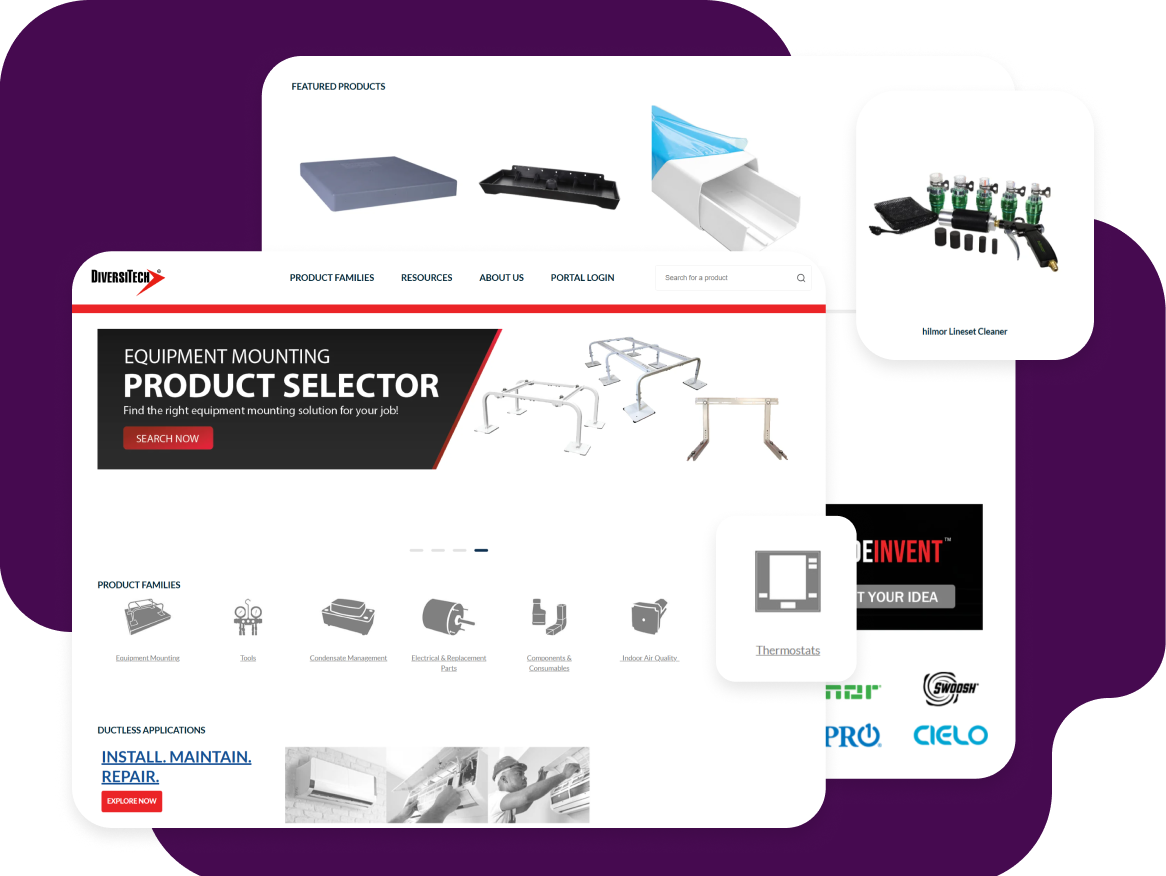
Order automation establishes a baseline. The architectural advantage extends directly to the sales team and your overall customer engagement.
DiversiTech pushes this advantage further. They are testing AI that combines weather forecasts with internal data to generate actionable insights instantly. The system cross-references those external signals with real time inventory.
It alerts sales reps when a freeze is forecast, allowing them to pre-sell heat condensers to specific customer segments before the phones start ringing. This directly captures online revenue through opportunities no human could catch manually.
That is what a unified commerce foundation enables over time. Because each capability shares the exact same commercial context, the intelligence compounds across all your sales channels.
- Demand forecasting runs against live transaction history instead of a stale monthly export.
- AI-powered product recommendations serve results based on strict contract terms rather than the browsing data of individual consumers.
- Monitoring tools watch your supply chain. They surface shifts in customer behavior before they negatively impact customer loyalty or customer satisfaction.
In a fragmented stack, each new AI tool adds an integration contract and a governance problem. An all-in-one platform ensures each new capability adds context to your wholesale operations. The system actively helps you streamline operations and secure a competitive edge, getting more useful the more of your business it can see.
The Foundation Outlasts the Algorithm
Artificial intelligence forces every B2B organization to confront its technical debt. You cannot deploy advanced AI capabilities on top of manual workarounds and disconnected databases. It breaks the architecture.
The market is distracted by the race to buy the smartest algorithm. The winning strategy is building the cleanest commercial foundation for sustainable growth.
When your B2B eCommerce platform natively understands your business logic, AI stops being a massive integration liability. It just works.
See native AI in action - explore OroCommerce's current capabilities and future roadmap
Frequently Asked Questions
What should I look for in an AI-powered B2B eCommerce platform?
Native beats bolted-on. Ecommerce platforms that rely on third-party plugins for AI like Shopify and Adobe Commerce, require significant configuration before the intelligence understands basic B2B context. An all-in-one platform with seamless integration between pricing, accounts, and inventory management gives AI what it needs from day one.
How do AI-powered digital storefronts increase revenue in wholesale eCommerce?
AI-powered digital storefronts built for wholesale eCommerce do more than display products. They surface the right item to the right buyer at the right price, pulling from contract terms and purchase history rather than generic algorithms.
- Accurate wholesale transactions process faster
- Operational efficiency improves across the board
- Average order value rises when buyers find what they need in the online store without friction.
How does AI improve the B2B buyer experience?
Enhanced customer service starts with AI that reads live account data rather than a generic knowledge base. Buyers get a real self-service experience – they find products, check stock, place online orders without calling a rep. The same foundation lets marketing deliver tailored content to the right accounts automatically.