
Most manufacturers and distributors have already taken their first steps toward digital transformation. They’ve invested in new systems, added automation, and explored data tools that promise better efficiency. Yet many still feel the same everyday friction with slow order cycles, scattered information, and customers who find it harder than it should be to buy or get support.
Can you guess what the issue is? It certainly isn’t a lack of technology. It’s that the tools often live in separate corners of the business, never quite working together.
So, how do you get unstuck and start making real progress? This can only happen when operations, sales, and service are connected by clean, reliable data and a shared rhythm of work. That’s when automation actually reduces errors, when eСommerce truly reflects what’s in stock, and when customers get updates before they have to ask.
It’s not about replacing people or chasing every new platform. In fact, all that manufacturers and distributors need to do is to orchestrate the systems they already have so that they move in sync and deliver visible results.
In the sections ahead, we’ll look at where to focus next for your digital transformation: strengthening internal operations, building digital sales channels that feed the rest of the business, and creating a service experience that’s effortless for customers. Each area offers practical moves that shorten cycles, improve accuracy, and make it easier to buy, service, and get paid.
Internal Operations: Where Efficiency Gains Stack
Most manufacturers and distributors hear about digital transformation B2B, and do you know what’s their immediate thought? They believe they should focus on the flashy stuff – robots, AI, and dashboards. The problem is, flashy digital tools don’t matter if the basics are broken.
Paper-based receiving, messy slotting, manual cycle counts, and endless “is this in stock?” phone calls are still everywhere. These inefficiencies slow down the warehouse, and even worse, they ripple through the business, creating delays for sales, errors for customers, and headaches for service teams.
Modernize the Warehouse Core
Establishing a correct diagnosis is the first step. Start with what’s broken:
- Paper-based processes for receiving and picking.
- Inaccurate slotting that causes wasted motion and mispicks.
- Lack of real-time inventory visibility, forcing constant verification calls.
These are the friction points that make even the best technology investments struggle to deliver.
How Do You Get the Warehouse Working for You?
One of the fastest levers to make the warehouse work for you is making sure your core systems operate in harmony. Upgrading or extending your WMS is a solid first move. A WES can orchestrate activity in real time in facilities where humans and automation work side by side.
The WMS plans, the WES directs traffic on the floor, and the WCS communicates with the machines. Keep in mind that more new technologies don’t automatically mean more efficiency, though. The key is to start with the layer that solves the biggest customer pain points, then scale carefully.
What about the day-to-day errors that slow everything down? Sensors, automatic identification, and mobile scanning reduce mistakes dramatically. Enforcing advance shipment notices keeps inbound operations predictable, while dock-scheduling software cuts delays and overtime. Small improvements like these stack up quickly, so you will soon be able to let your teams focus on higher-value work instead of constantly firefighting.
Why is Now the Moment to Act?
According to the 2025 MHI/Deloitte report, 55% of leaders of supply chains are increasing tech investments, with 60% planning to spend over $1 million. Inventory and network optimization, along with sensors and auto-ID, are at the top of the list.
Is the payoff in flashy robots alone? Not quite. Expect smoother flows, improved end-to-end visibility and customer engagement, and better business processes that empower people on the floor. When slotting is optimized, scanning is automated, and docks run like clockwork, orders move faster, errors drop, and audits feel manageable rather than terrifying.
Quick Wins to Start Today
Here’s a quick checklist to start thinking about today:
- Implement a regular cycle-count cadence.
- Enforce ASN compliance on incoming shipments.
- Use dock-scheduling software to reduce delays and overtime.
If you only do three things this quarter, make it mobile scanning, cycle counts, and dock scheduling. Everything else in your existing processes can wait until these fundamentals are solid.
Automate Pragmatically
Are robots worth the hype? They can be, but only if used thoughtfully. Focus on repeatable picks, long walking paths, and ergonomically risky moves. Pilot a cell, measure touches per order, and scale gradually.
Mobile robot forecasts for 2025 have been revised down due to economic pressures, and this is a big reminder that automating processes should be a tool to remove friction in the customer journey, not a quick-fix replacement for human effort.
Even before big automation projects, all you need is some simple wins to make a tangible difference. When you think of digital transformation, don’t get tunnel visioned with technology – the key to digital maturity is putting the right practices in place so the tech actually works.
Sales & Marketing: Digital That Feeds Ops
Most manufacturers treat the sales process and marketing as separate from operations. But let’s ask ourselves: what if your commerce site, marketplaces, and sales reps could make the warehouse run smoother, instead of just chasing orders? That’s the real power of integrated B2B digital transformation that will give your business a competitive edge.
eCommerce as a Front End to ERP
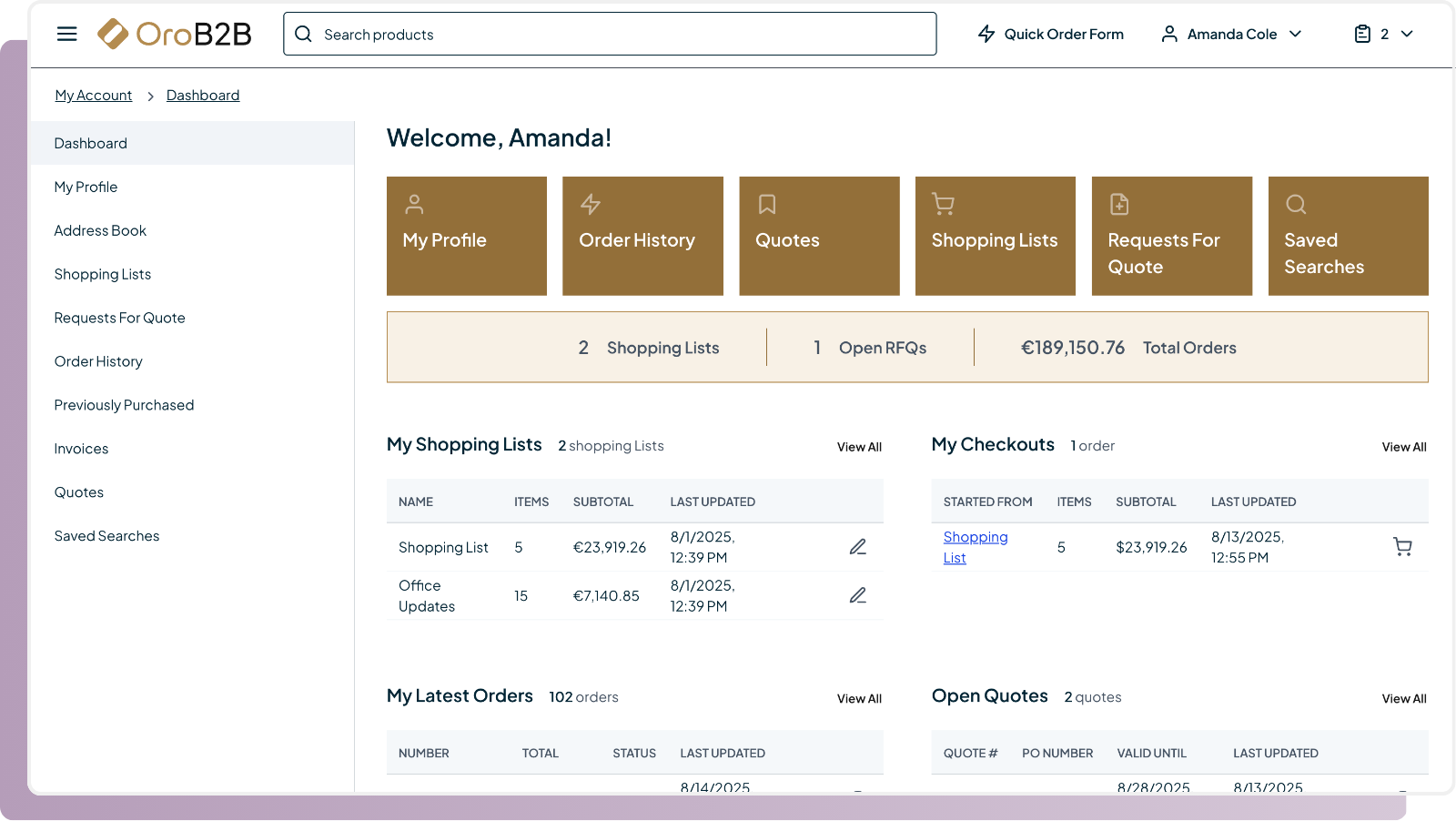
Think of the storefront as the customer-facing layer of your business. The ERP is still the system of record for price, inventory, and order status. The transformation happens when these systems talk directly, feeding accurate, real-time data to the digital front end while keeping rich product content in a PIM system. Without this connection, buyers see outdated inventory, sales representatives chase missing data, and fulfillment teams scramble to fix errors.
What does good execution look like in practice?
- Accurate Contract Pricing: Customer-specific prices should flow automatically from ERP into the portal. This reduces disputes and accelerates ordering.
- Real-time Inventory Visibility: Your site should reflect exactly what’s in stock and when. If an item isn’t available, the system should suggest alternatives, notify the customer, or automatically backorder.
- Customer-specific Catalogs: Different buyers have different purchasing patterns. Your digital commerce platform should enable personalized experiences and show only what’s relevant to each account, including preferred SKUs, bundles, and contract terms.
- Order Status and Updates: Every order should provide real-time visibility, like shipment tracking, expected delivery dates, and any exceptions. Customers shouldn’t need to call – the system should communicate proactively.
Sell Where Buyers Actually Shop
Marketplaces are no longer optional for B2B sales. Amazon Business and industry-specific platforms now capture demand that used to come through traditional channels. Still, your own site is the backbone of your business. That’s where you protect the margins, build relationships, and maintain control over the buying experience. A B2B marketplace should just extend your reach and attract new accounts, not replace your core commerce engine.
Managing multiple channels requires discipline. PIM governance ensures your product content stays accurate and consistent across platforms. SKU and pricing rules protect margins and prevent confusion. Keep a close eye on dependency risk because if a single marketplace generates most of your revenue, any change on their side can disrupt your business.
The goal is to treat marketplaces strategically: use them to reach buyers, support long-tail SKUs, and test new products, but always maintain control over pricing, content, and customer experience.
Tune In: The True Value of eCommerce for B2B Brands with Jason Greenwood
Sales Enablement That Moves the Needle
Most sales teams still operate on PDFs, spreadsheets, and siloed data. This often results in longer cycles, frustrated reps, and avoidable errors. Is it possible to transform your sales productivity through digitization?
Absolutely – with a searchable digital catalog, account context, guided cross-sell, and one-tap quoting on tablets or laptops. Tools like OroCommerce’s mobile sales app put this capability in the hands of the sales representatives in the field.
Artificial intelligence can add leverage, too. It can augment sales enablement in practical ways, from automating repetitive tasks to helping teams act on customer data faster. For example, tools like AI SmartOrder can process unstructured purchase orders and detect errors before they reach fulfillment, while AI SmartAgent can assist buyers and reps with instant answers on pricing, availability, or reorders.
In this model, AI becomes a support layer for efficiency and insight. Sales teams stay in control of the customer relationship management and sales strategy, while automation handles the admin work that slows them down. When the sales process relies on clean, integrated data, the payoff is operational as well as commercial. You’ll see reduced errors, lower costs, and more predictable inventory, while your service teams can focus on value instead of corrections. That’s how the sales teams stay ahead as a driver of efficiency across the business.
Customer Experience & Service: Make It Easy to Buy, Track, and Pay
Many manufacturers and distributors already know that successful digital transformation doesn’t end at checkout. The real test comes after the sale when customers need to reorder, check delivery status, or pay invoices. That’s where a flawless digital experience starts being the reason customers stay.
Digital Ordering for Enterprises
Enterprise buyers don’t want another login – they want you to fit into how they already buy. Most rely on procurement systems like Coupa, Ariba, or Jaggaer to control spend and approvals, so if your catalog isn’t visible in those systems, you might actually be missing orders.
Smart companies like EECO understand this and often adopt a flexible approach and hybrid strategy, such as a webshop for smaller customers and punchout integrations for their enterprise clients. Punchout creates a direct bridge between your eCommerce site and the customer’s procurement platform. They browse your catalog, build a cart, and send a purchase order straight from their system.
If you’re mapping your own path, start by identifying which customers are already on these platforms. Integrate with one or two key partners first, measure order frequency, and track cycle time. Once the process stabilizes, you can expand the model. The goal isn’t to digitize everything at once, but to make the buying experience for your biggest customers seamless and repeatable.
Customer Portals Beyond Checkout
A self-service B2B portal plays the same role for the rest of your customers. It should be the single, reliable point in the sales process where buyers can check order status, view quotes, download invoices, or request RMAs.
However, portals only build trust and contribute to digital transformation when the information is accurate. Customers may stop using it if your ERP updates nightly or pricing rules don’t sync. A good rule of thumb is to audit your data flow before adding new portal features. Clean, synchronized data between your ERP, CRM, and inventory systems will bring a lot of value to your portal.
If your service reps still spend most of their day answering “where’s my order?” questions, that’s your sign that visibility isn’t flowing end to end. Fix that first, and then expand.
Payments That Move as Fast as Orders
The payment stage is often treated as an afterthought, but it’s one of the easiest areas to modernize with digital tools. Digital ACH, same-day transfers, and online payment portals have already become the norm in business-to-business transactions, and they shorten cash cycles dramatically.
ACH adoption is continuously accelerating. In the first quarter of 2025, Same Day ACH volumes and total transaction value grew between 19% and 25% year over year, building on a record-breaking 2024. This is a clear signal for finance and operations leaders to plan for ACH rails in the invoicing and customer portals. Doing so cuts DSO, eliminates manual processes in AR work, and delivers a faster, cleaner payment experience for both sides.
Integrating payments directly into your customer portal or invoicing flow also improves forecasting accuracy and cash visibility. You’ll see fewer check delays, fewer reconciliation errors, and faster DSO improvement, without adding new processes.
Modern customer expectations require paying you to be as easy as buying from you. When ordering, tracking, and paying all happen in one connected flow, you’ve built a customer success experience that earns repeat business.
Conclusion: Lead the Habits, Not Just the Tools
Digital transformation doesn’t fail because of bad software or a lack of new tools, but because of old habits. If you’re ready to take on real, unique challenges, don’t zero in on rolling out new technologies only, but work on reshaping how people work, share information, and solve problems.
As a leader, you should set that tone for growth. Walk the floor, sit in on a dock shift, join a CSR for a morning, and engage to fully understand how orders move. When teams see you learning alongside them, change stops feeling like a memo and starts feeling like progress.
Create a proper change management strategy and make learning visible. Run short Friday demos for sales enablement, brown-bag sessions, or 30-day pilots that anyone can join. Encourage small experiments and let results, not hierarchy, decide what sticks.
And don’t isolate your team from the broader industry. Attend one credible event or training per quarter, host peer roundtables, and swap lessons with those who’ve already solved what you’re trying to fix.
When people see new ways of working modeled, discussed, and celebrated, they adapt naturally. Culture shifts. Systems align. And that’s when technologies finally deliver what they promised – not just efficiency, but momentum.