navigation

If you’re trying to figure out your next commerce move, you’ve probably noticed how crowded the landscape has gotten. Everyone claims to offer “unified” everything. But when you dig past the slide decks, there’s a real and consequential difference between a unified commerce company and a traditional eCommerce vendor bolted together with integrations.
The architecture you pick doesn’t just affect your IT team. It shapes how fast you can open new sales channels, how reliably your reps can serve customers with up-to-date pricing, and whether your buyers actually trust the data they see across multiple channels.
B2B buyers today have been trained by their consumer experiences. They don’t have patience for disconnected systems that show them one price online and another from their rep. And they shouldn’t have to.
Here’s a practical, no-fluff breakdown of both approaches so you can make informed decisions about your commerce strategy based on what actually matters: architecture, features, implementation, cost, and customer experience.
Unified Commerce Company Vs Traditional eCommerce Vendor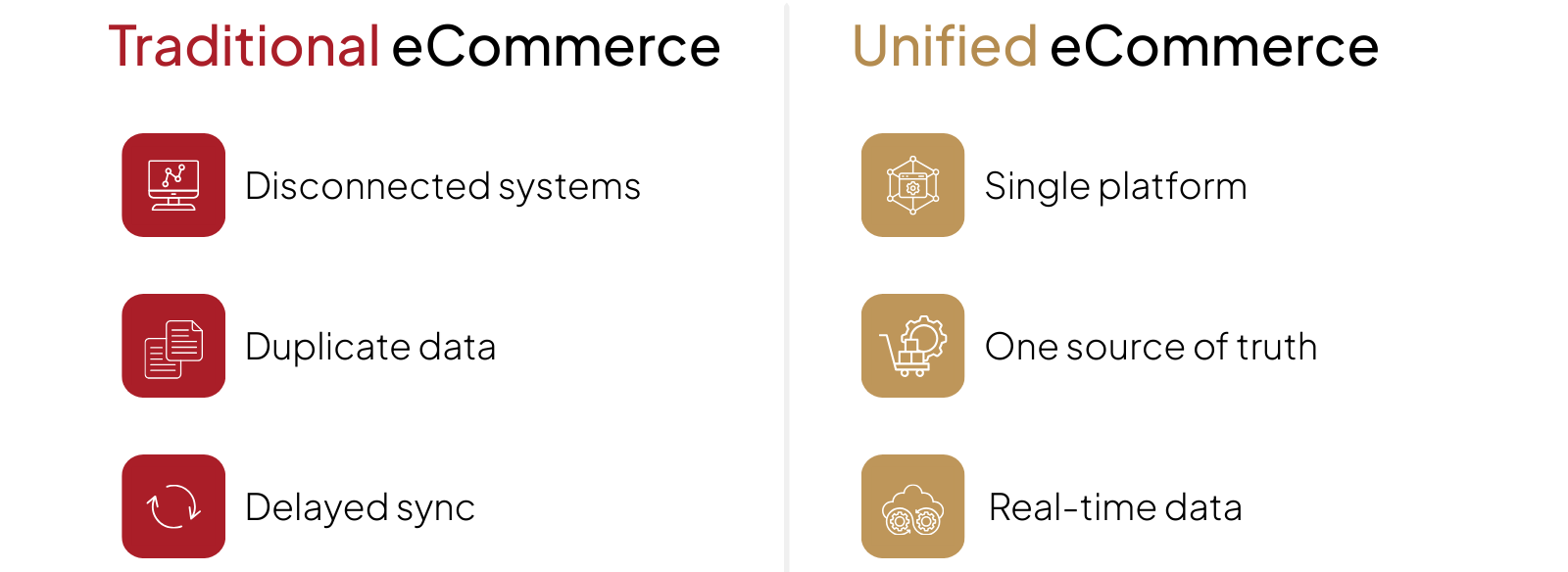
Traditional eCommerce platforms were built to solve a specific problem: listing products on a website and letting people buy them. They do that well. But B2B operations are rarely that simple, and over the years, companies have layered on tools to fill the gaps.
A CRM here for customer relationship management. An OMS there for order management. A PIM for product data. Integrations to glue it all together.
Before you know it, you’re running five or more management systems connected by a tangle of point-to-point integrations, each one maintained by a different team or vendor.
For straightforward retail operations, this can work fine. If your entire business is a single storefront with simple pricing and a manageable catalog, the traditional approach gets the job done.
But here’s where it falls apart: the moment you need multi-entity accounts, contract-specific pricing, or visibility into orders across channels, the whole thing starts to buckle. Customer expectations go unmet because your systems can’t keep up.
The root cause? Data silos.
Your commerce platform says one thing, your CRM says another, and your order system has its own version of reality. That means inconsistent pricing, inventory counts that don’t line up, and customer records riddled with conflicts.
If any of that sounds familiar, these are signs your tech stack is holding you back.
What defines a unified commerce company
A unified commerce platform works differently at a fundamental level. Rather than stitching together separate tools, it handles commerce, CRM, order orchestration, and customer data within a single data model.
That means one customer record. One order history. One pricing engine. Every channel pulls from the same unified system, so there are no integrations sitting in between and no reconciliation lag.
What makes a unified commerce architecture “real” in 2026? Three things: real-time sync across all channels, native (not integrated) account hierarchies that mirror organizational complexity, and a single source of truth for every transaction and interaction.
This isn’t just a tech preference. It’s a business strategy decision that affects how your company operates for years to come.
Why this distinction matters for enterprise B2B organizations
For wholesalers, manufacturers, and distributors, this choice hits the P&L directly. Traditional stacks pile up hidden costs through tech debt year after year: integration maintenance fees, engineering hours spent fixing broken data syncs, and the opportunity cost of being stuck while your competitors move faster.
Then there’s agility. A unified commerce approach lets you spin up new digital channels, tweak pricing rules, or bring on a new business entity in days instead of quarters. That kind of speed matters when markets shift.
And the buyers themselves are telling us what matters.
Recent research from OroCommerce and B2B Insights found that 67% of B2B buyers already make over half their purchases online, and 83% expect that number to grow. But here’s the kicker: 45% say their suppliers’ digital experiences are still disappointing.
What’s more revealing is what actually impresses them. When asked to describe a standout supplier moment, only 19% pointed to a digital tool. A full 38% described a human interaction: a rep who spotted a problem early, suggested a better product, or followed up after delivery.
Buyers don’t want tech for tech’s sake. They want technology that empowers their reps, customer service teams, and account managers to be more consultative, proactive, and responsive.
That’s exactly the case for omnichannel commerce. Your platform needs to support buyers who start a quote with a rep, refine it online, then finalize through a portal, all without friction. Not through a chain of integrations that might break, but through a system built to blend human selling with digital self-service from the ground up.
Survey report: What B2B Buyers Really Want from Digital Commerce
Key Feature Comparison
This table captures what enterprises encounter when they evaluate commerce platforms for complex B2B workflows.
| Capability | Unified Commerce Platform | Traditional eCommerce Stack |
| Customer Data Model | Single record across CRM, commerce, and orders | Separate records per system; requires sync |
| Order Orchestration | Native, cross-channel order management systems | Requires OMS integration + middleware |
| B2B Pricing & Contracts | Contract pricing engine with account-level rules | Basic pricing; complex rules need customization |
| Inventory Visibility | Real time inventory across all warehouses and channels | Delayed sync; accuracy depends on integration quality |
| Workflow Automation | Built-in approval, routing, and notification workflows | Third-party automation tools or custom code |
| AI & Analytics | Native AI with unified data for accurate insights | Siloed analytics; AI limited by fragmented data |
| Integration Dependency | API-first but not API-dependent | Heavily dependent on integrations for core functions |
| Upgrade Complexity | Single platform upgrades | Coordinated upgrades across multiple vendors |
Hidden capability gaps enterprises often discover late
Here’s what catches people off guard: the gaps you don’t notice until you’re already live. Multi-entity account hierarchies, for example. If you’re a distributor managing a parent company with thirty buying locations, each with its own budgets and approval chains, you need hierarchical account support. Most traditional platforms handle flat structures and leave the rest to custom dev work.
Same story with complex approval workflows, contract pricing at scale, and blending rep-assisted quoting with self-service portals. A unified commerce solution handles these natively. And these aren’t edge cases in B2B. They’re table stakes for anyone managing loyalty programs, loyalty points or multi-tiered buyer relationships.
Technology Architecture Comparison
Image source: Pixabay
The integration layer is where traditional stacks really start to hurt. Every system (CRM, OMS, PIM, ERP, commerce frontend) needs its own connector, its own data mapping, its own error handling. When data syncs run hours behind instead of seconds, that’s not a bug. That’s the architecture working as designed.
And it compounds. Every new tool you add creates more failure points. When your eCommerce vendor ships a major update, suddenly every integration needs retesting. Possibly rebuilding.
For complex B2B operations, that can mean months of regression testing and delayed access to features you’re paying for. The hit to operational efficiency is real, and it’s ongoing.
Unified platform architecture and native services
A unified commerce strategy swaps out that integration mess for a shared services layer. Commerce, CRM, and order management all run on the same database, use the same business logic, and share the same API surface.
Data does not move between internal modules through integrations. It is native to the platform.
Here’s an important nuance: there’s a big difference between API-first and API-dependent.
A unified platform offers APIs that let you extend it and connect to ERP and other backend systems. But it doesn’t need those APIs to talk to itself. Unified data moves natively inside the platform, which kills the manual reconciliation problem that haunts multi-vendor setups.
Scalability for enterprise growth and global expansion
When B2B people talk about scalability, they don’t just mean handling Black Friday traffic. They mean running multi-brand, multi-region operations. Keeping performance solid when you’ve got configurable products with account-specific pricing tiers. Absorbing an acquisition without a full replatform.
A single-platform architecture gives growing brands the ability to bring on new entities and still deliver a consistent customer journey in every market.
Think about what that looks like in practice with real world examples.
A manufacturer expanding into Europe or a distributor acquiring a regional competitor can spin up a new storefront, pricing tier, and warehouse configuration without rebuilding integrations. Tax compliance, multi-currency, localized catalogs – all built into the core, not patched in through add-ons.
Deployment Timelines, Risk, and Change Management
Most unified platform rollouts for mid-to-large B2B enterprises land in the three-to-six-month range for initial deployment (depending on catalog complexity and workflow customization).
Traditional stack implementations are a different story. Deploying an eCommerce platform while simultaneously integrating a CRM, OMS, and possibly a PIM, plus connecting all of it to your back-end systems? That easily stretches to nine to eighteen months.
But it’s not just about the calendar. Risk stacks up at every integration point. Each connector is one more thing that can delay your launch, break your customer experience, or introduce data quality issues that erode confidence in the system.
If you’re a distributor with thousands of SKUs and account-specific pricing, the integration testing alone can chew up months. Mapping data between your commerce engine and a separate OMS means endless iteration: partial shipments, split warehouse orders, backorder logic. All of it has to be validated from end to end.
With a unified architecture, those scenarios just work. The commerce engine and order management share the same transactional logic, so there’s nothing to map.
Change management and user adoption
Here’s the part that doesn’t get enough attention: getting people to actually use the thing. For wholesalers and distributors, sales team adoption is where projects succeed or fail.
Your reps have been running on spreadsheets, phone orders, and internal knowledge. They need a system that makes their day easier, not harder. When CRM lives inside the commerce workflow, reps see sales data, order history, and account details in one view. Friction drops. Adoption follows.
On the buyer side, it’s just as important. If your customers log into a portal and find confusing navigation, slow pages, or pricing that doesn’t match their contracts, they’ll go back to emailing their rep.
Implementing unified commerce sidesteps a lot of that because buyers and reps are looking at the same data. And training gets simpler when there’s one system to learn instead of five.
Post-launch optimization and continuous delivery
Once you’re live, the question becomes: how fast can you improve? A unified approach gives you regular release cycles and the ability to expand features without replatforming or wrestling with integration updates.
Roadmap alignment is underrated here. When commerce, CRM, and order management share a single product roadmap, every improvement lands across channels at the same time. No waiting for three different vendors to get in sync.
Personalization, Self-Service, and Omnichannel Consistency
You can’t personalize what you can’t see. When your CRM systems and commerce platform share a single data model, you get real-time segmentation based on customer data such as purchase behavior, contract tier, and account hierarchy.
Buyers log in and immediately see their negotiated catalog, pricing, and approval limits. Blend sales-assisted and self-service channels on that same foundation, and allowing customers to move between a mobile app session, a rep call, or the portal without losing context just works.
True omnichannel execution across every customer touchpoint
Real omnichannel execution means shared carts, shared orders, and shared history across every customer touchpoint: sales reps, ecommerce, mobile, social channels, and portals.
For distributors and manufacturers managing both field reps and online purchases, in-store associates and digital storefronts see the exact same customer. Real-time visibility, no conflicting records.
Whether a buyer wants to buy online and return in store, or start a quote with a rep at a brick-and-mortar stores location and finish it on a portal, the experience stays seamless. This applies equally to direct to consumer channels and complex B2B accounts.
AI and automation capabilities shaping commerce in 2026
The AI features worth paying attention to in 2026 aren’t theoretical. Predictive ordering nudges buyers to reorder before they run low. Streamlined workflows eliminate unnecessary clicks. Conversational commerce lets buyers shop through chat or in-app voice.
Behind the scenes, generative AI is transforming product data enrichment and content management at scale across massive catalogs, AI-assisted quoting is cutting RFQ turnaround times, and intelligent recommendations are pulling from account-level buying patterns rather than generic bestseller lists.
The prerequisite for all of it? Clean, unified data.
Stay up to date - read the 2026 agentic AI guide for B2Bs
How to Choose a Unified Commerce Company in 2026
Not all platforms that claim to be part of the unified commerce group actually are. Before you commit, run through these five checks.
Probe the architecture
Is the CRM native or integrated? Native means one shared record. Integrated means a synced copy that drifts. If connectors sit between CRM and commerce, it’s a traditional stack regardless of marketing.
Pressure-test B2B depth
Contract pricing, account hierarchies, approval chains, and rep workflows should all run natively in the retail platform. Third-party plugins for core B2B features are a red flag.
Evaluate ERP readiness
What’s prebuilt versus custom? Who owns the authoritative record for financial reporting, tax, and order fulfillment? Check whether inventory management, Point of Sale, and POS systems connect cleanly or require heavy integrations.
Demand cost transparency
Integration maintenance in traditional stacks runs 30–40% of ongoing spend. A unified commerce solution should significantly cut that. Calculate five-year TCO, not just licensing.
Run a full demo
Quote → Order → Fulfillment → Invoice → Reorder. Then test cross-channel: start with a rep, modify in the portal, confirm inventory accuracy and pricing carry through. Verify that inventory updates immediately across every touchpoint.
If a vendor can’t pass all five, the “unified” label is marketing.
Why OroCommerce Is a Unified Commerce Leader for B2B Enterprise
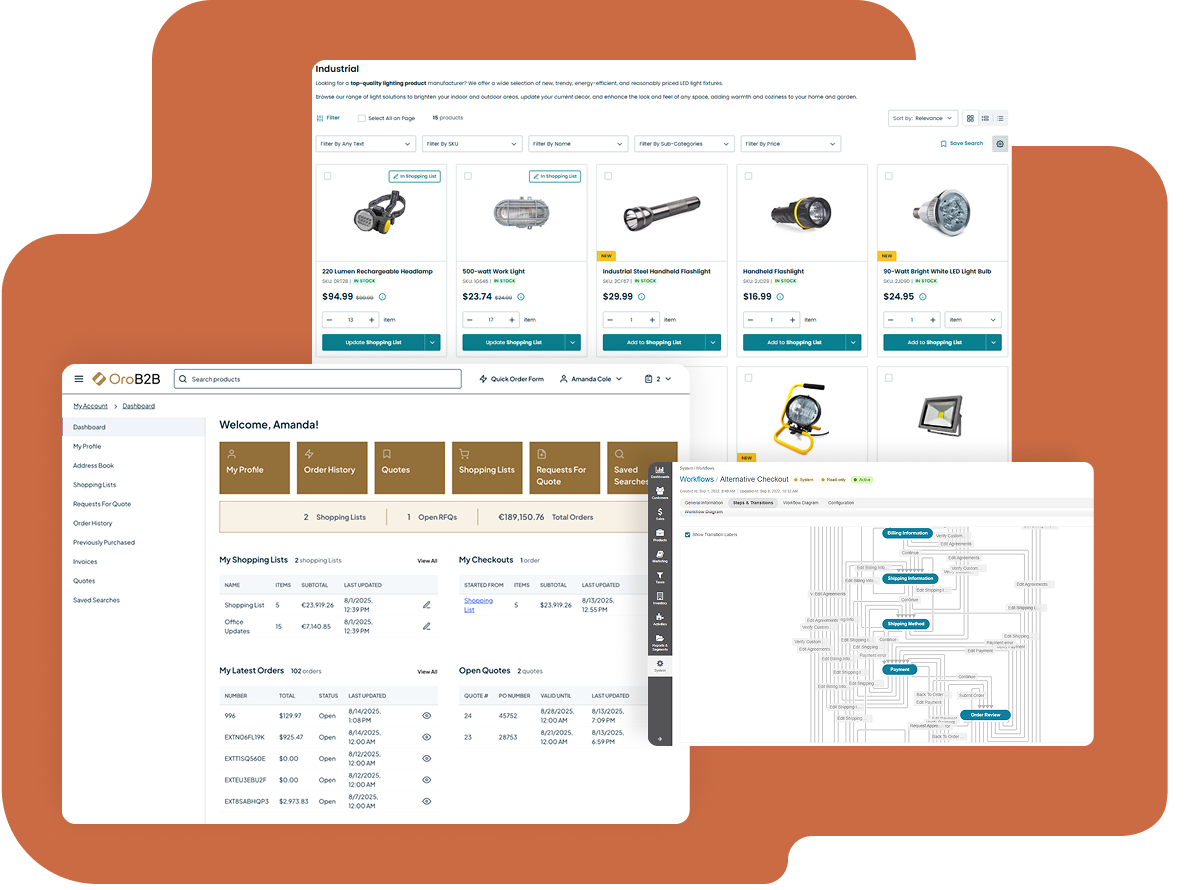
OroCommerce was purpose-built as a unified B2B commerce platform with native CRM, commerce, and order management sharing a single data model. Here’s what that looks like in practice.
A single view of the customer relationship
Built-in CRM and customer portals give buyers direct access to contract pricing, stock levels, and order history while freeing your teams from routine inquiries. This builds lasting customer loyalty by making every interaction faster and more transparent.
A native messaging system keeps conversations tied to quotes, orders, and RFQs so nothing gets lost. And with the Field Sales App, reps access customer and product data anywhere, even offline.
The full quote-to-cash cycle, connected
Quoting, CPQ, and RFQ run natively inside the platform. Every quote flows straight into an order. Invoicing, payments, and reconciliation happen in one system through the Invoice Portal and integrated B2B payments via OroPay, supporting cards, ACH, and invoice-based terms, all connected directly to the ERP.
One source for product and brand truth
Built-in CMS, PIM, and DAM mean you manage content, product specs, and digital assets from a single backend. Run multiple brands, regions, or portals, including physical store operations, without bolting on separate tools.
Automation and intelligence across processes
The Workflow Engine automates approval chains, quoting flows, and post-order processes. AI SmartOrder converts emailed POs into draft orders automatically.
AI SmartAgent lets buyers ask natural questions and get instant, account-specific answers. The Segmentation Engine delivers tailored catalogs and offers from shared data.
Data, reporting, and scale
Shared dashboards draw from unified data. Multi-organization support lets you add brands, regions, or acquisitions without re-architecting.
API-first, open architecture connects ERP, WMS, and marketing systems cleanly. Enterprise-grade security, with role-based permissions and SOC 2 compliance, protects sensitive data across teams and customer hierarchies.
For B2B enterprises moving beyond stitched-together stacks, OroCommerce is a proven unified commerce strategy built for how you actually sell.
See how OroCommerce handles your specific workflows end-to-end.
Conclusion About Unified Commerce Company
This isn’t a theoretical debate anymore. The gap between unified commerce platforms and traditional ecommerce stacks shows up in real numbers: cost, speed, and the quality of the customer experience you can deliver.
For wholesalers, manufacturers, and distributors operating in 2026, the complexity of B2B buying requires a platform that treats commerce, CRM, and order management as a single native capability, not three products taped together.
Today’s conscious consumers and increasingly sophisticated B2B buyers demand consistency across emerging channels, and only a unified approach delivers that competitive advantage. Traditional vendors still have a place for simpler use cases.
But if you’re managing multi-entity accounts, contract pricing, hybrid sales models, and global operations, unified commerce delivers a better total cost of ownership, faster time-to-market, and a customer experience that actually keeps customers coming back.
The real question isn’t whether this is where the market is heading. It’s whether you’ll get there before your competitors do.
Audit your current stack against the framework above, tally the integration costs and data gaps you’re living with today, and build a business case for a five-year TCO. The companies that make this move in 2026 will set the pace for the next decade.
OroCommerce was built for exactly this moment. Native CRM, commerce, and order management on one platform, purpose-built for B2B complexity. If you’re ready to stop patching systems together and start operating on a truly unified foundation, book a demo and see the difference firsthand.