
navigation

Many complex commerce organizations confuse omnichannel commerce with unified commerce and waste time chasing the wrong vendors. The result: lost revenue, operational headaches, and unhappy customers.
Here’s the core unified commerce vs omnichannel difference: Omnichannel connects channels through separate systems linked by APIs, while unified commerce brings commerce logic and customer-facing experiences onto a single platform, showing real-time data across every touchpoint.
Omnichannel lets buyers move between your eCommerce portal, sales reps, and distributor tools, but your backend systems still run independently. Unified commerce merges front-end and backend operations into one commercial source of truth.
This article covers:
- What separates the two models architecturally
- How each one affects customer experience, teams, and cost
- Which model fits your business, and how to move between them
Short Answer: Unified Commerce vs Omnichannel Recommendation
For complex B2B operations with multiple warehouses, contract pricing, or both self-service and sales-assisted ordering, a unified commerce platform is the better model. Unified commerce ensures pricing, inventory, and order data stay accurate across the entire business.
Two scenarios change that verdict. A simple catalog with predictable, high-volume sales can run fine on well-executed omnichannel, and so can a B2C-like wholesale business where self-serve purchasing dominates.
The trade-off: omnichannel is faster and cheaper to bolt together today, while a unified commerce approach is faster and cheaper to run at scale. If your stack can’t keep up, book a demo with OroCommerce to see what a unified system looks like in practice.
Unified Commerce vs Omnichannel: Comparison at a Glance
Here’s what to know about each model at a glance, before the detailed breakdown below.
| Model | Best For | Typical Cost Pattern | Scaling Complexity | One-Line Takeaway |
|---|---|---|---|---|
| Omnichannel | Simple catalogs and high-volume transactional sales | Lower upfront cost, rises with each new integration | Increases with every new channel | Fast to start, harder to maintain |
| Unified Commerce | Complex B2B operations with contract pricing or multiple warehouses | Consolidates subscriptions into one platform fee | Stays flat as channels are added | Costs more attention upfront, less over time |
What Is Omnichannel Commerce?
- Omnichannel connects multiple channels and systems for creating consistent customer experiences.
- It typically links eCommerce, ERP, CRM, and inventory systems through integrations rather than a shared platform.
With B2B omnichannel strategies, buyers switch between your eCommerce sites, sales teams, customer service, and partner networks. They see the same prices and product info everywhere, which builds trust and increases customer satisfaction.
Most setups connect eCommerce, ERP, CRM, and inventory systems through integrations. The real problem hits when workflows spread across multiple tools, like a customer portal and a separate quoting system for sales reps.
It creates the illusion of a connected experience, with real limitations:
- Decreased operational efficiency as teams duplicate work across systems
- Duplicated or fragmented data between disconnected systems
- Syncing delays that leave channels showing different information
- Complex maintenance as more integrations pile up
- Reduced scalability as you add new channels
What Is Unified Commerce?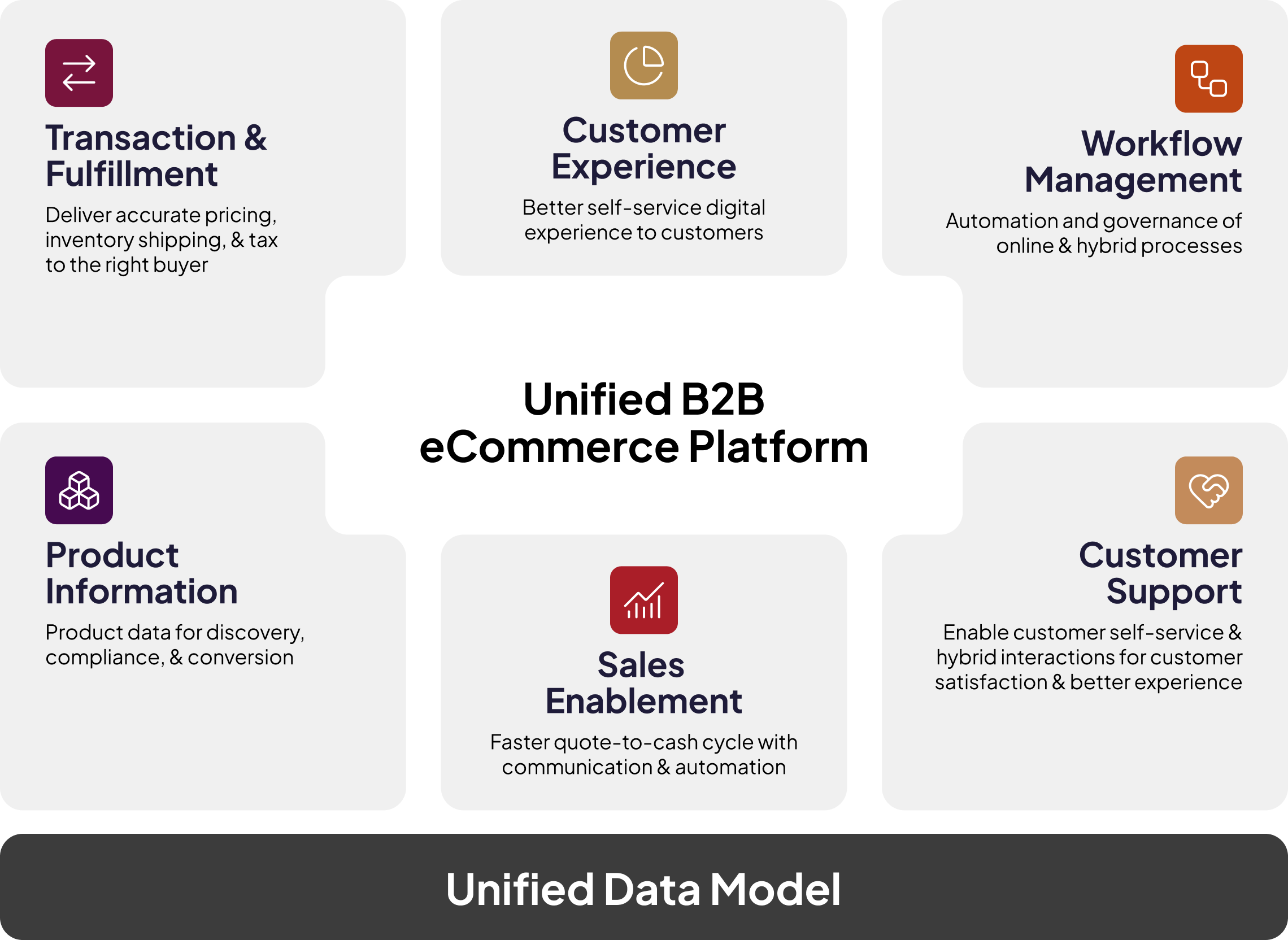
- Unified commerce centralizes commerce logic, like pricing, quoting, and account workflows, on a single platform.
- It connects to the ERP as the system of record while handling the customer- and rep-facing experience itself.
Unified commerce runs everything from one platform, centralizing key commerce logic, like pricing, quoting, and account workflows, across multiple sales channels. It connects to the ERP as the main system of record for finance and inventory and adds a single front-end layer on top, handling all pricing, quoting, and workflows across channels.
It keeps everything in one place and removes data silos and gives you real-time data across inventory, orders, pricing, and customer history, no matter where a purchase happens.
It delivers consistent experiences across self-service ordering, assisted selling, and digital sales rooms. Buyers and sales teams see the same pricing and order details, strengthening customer loyalty over time.
Teams spend less time fixing sync issues and more time improving operations, which is why many organizations choose a unified platform to scale faster and get a competitive advantage.
Unified Commerce vs Omnichannel: Key Differences Side by Side
Unified commerce and omnichannel both connect online and offline selling. The difference is how they’re built behind the scenes.
| Category | Omnichannel | Unified Commerce |
|---|---|---|
| Core setup | Multiple commerce systems connected by integrations | Integrated platform running all channels |
| Architecture | Separate tools for online transactions, order entry, customer service, CRM, invoicing, etc. | Unified system with all commerce-critical functions built from the same codebase |
| Data location | Multiple databases | Single database |
| Updates | Syncing delays are common | Instant data across channels |
| Inventory accuracy | Can show mismatches due to latency | Always current across multiple touchpoints |
| Customer records | Split across systems | Complete customer view in one place |
| Pricing changes | May lag between channels | Updates instantly everywhere |
| Order visibility | Orders tracked across different platforms | One view of orders from every channel |
| Assisted selling & digital sales rooms | Harder to keep aligned with self-service data | Sales teams and buyers see the same info in real time |
| Maintenance | More integrations to monitor and fix | Less ongoing technical overhead |
| Scaling to new channels | Requires more integrations and testing | Faster to add channels without rebuilding connections |
| Reporting & analytics | Often needs manual reconciliation | Cleaner reporting from one source of truth |
| Long-term flexibility | Gets more complex as you grow | Easier to adapt without piling on tools |
Omnichannel can improve the buying experience, but it’s still built on disparate systems that need constant syncing.
With real-time visibility, simpler scaling, and consistent experiences, unified commerce creates a stronger long-term strategy for complex operations that need speed, accuracy, and less system chaos.
Impact on Customer Experience and Engagement
Omnichannel creates consistent experiences through connected systems, but unified commerce gives you a complete view of the customer with far less manual connection.
Consistency across channels
Buyers expect a seamless shopping experience whether they order online, work with a sales rep, or purchase through a partner channel. Unified commerce ensures order history, account details, and inventory availability update instantly across every touchpoint, since everything runs through a single system.
Omnichannel usually means separate systems sharing data, not one shared engine. Syncs tend to be partial, so B2B details like quotes and approvals don’t always stay consistent, and buyers get different answers depending on how they order.
Personalization capabilities
Unified customer profiles give clearer insight into how people buy, tracking activity from the first product view to repeat orders without stitching data together across tools.
Unified commerce also supports granular personalization, like flexible page layouts, warehouse visibility, tailored search, and contract pricing, making role-based access and custom catalogs easy.
ERP provides the single source of truth for product data. Unified commerce uses one engine to apply it, surfacing the right info to the right user at the right time.
Customer trust and loyalty outcomes
Unified commerce cuts pricing disputes and order friction by ensuring consistent data across channels. Buyers trust portal information, like accurate delivery dates, and that reliability drives customer loyalty and repeat business.
Unified commerce wins here: a single data model means the points above happen automatically, instead of depending on how well separate systems stay in sync.
Inventory Management and Order Accuracy
Inventory management and order management are where the difference between the two models shows up fastest, and unified commerce wins decisively.
In omnichannel setups, tools like web portals and sales quoting systems don’t talk to each other:
- A sales rep reserves 50 units in a quote for a major account
- Those units should disappear from the portal’s available count instantly
- In a fragmented stack, the portal ignores the quote and sells the same inventory quantities to a random buyer
- The result: oversold items, backorders, and frustration
Unified commerce fixes it by sharing full commerce logic, not just data, across every channel. According to Clarkston Consulting, a retail and supply chain advisory firm, most retail operations run at just 60 to 70% inventory accuracy.
That means inventory levels are unreliable roughly a third of the time when systems aren’t unified. Real-time visibility closes that gap, though it requires the ERP and front-end platform to agree on what “available to sell” means.
Impact on Customer-Facing Teams’ Experience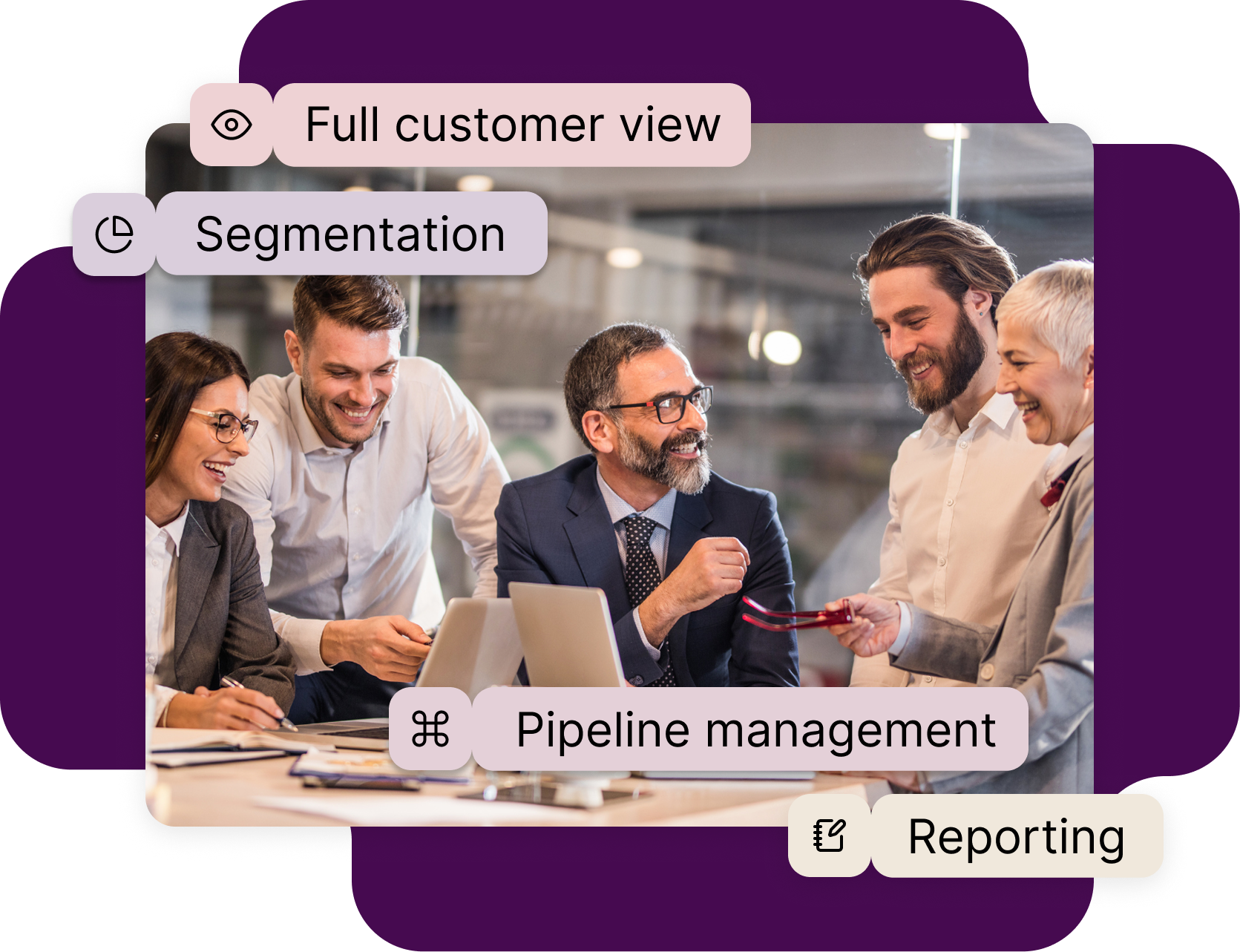
Customer-facing teams work better when they can see accurate inventory synchronized from the ERP. instead of chasing updates across disconnected systems. This matters most in regulated industries, where availability and purchasing permissions vary by market or customer.
A unified platform gives reps three concrete advantages:
- Faster stock checks: Teams confirm stock, holds, or delivery promises without jumping between systems
- First-contact resolution: A rep who sees the same pricing and account history a customer sees resolves questions in one interaction
- Smarter fulfillment: Teams see stock across every warehouse and can split shipments, route from the closest location, and quote realistic delivery timelines
Unified commerce wins for any team handling large orders, custom pricing, or approval workflows, where a rep’s answer needs to match what the customer already saw.
Get Free Report: How Leading Distributors Are Unifying Commerce in a Multi-System World
Cost and Resource Optimization
Separate systems from different vendors create “vendor sprawl,” where overlapping systems deliver only 10-30% of their promised value.
Unified commerce stops this by consolidating everything into a single platform, slashing subscription, maintenance, and integration fees. Most unified commerce solutions replace stacked subscriptions with one predictable platform fee:
- One platform cost instead of stacked subscriptions
- Less IT maintenance and fewer “sync issue” fire drills
- Lower training time since teams work in one system
Legacy systems also scatter data and create hidden costs, as teams waste hours reconciling mismatched numbers.
Time to launch a new channel is another gap:
- Omnichannel: each new channel needs a new integration to build and test
- Unified commerce: a new channel runs on the same platform and logic that already exists, so it launches faster
Unified commerce wins on total cost of ownership over time, though migrating existing integrations takes upfront effort, which is why the transition-planning section below exists.
Learn more:
For B2C and retail-style fulfillment, unified technology makes flexible delivery easier to support, because inventory status and purchase history are shared automatically instead of reconciled after the fact. That delivers a seamless customer experience across the shopping journey, whether in e-commerce or a physical location.
Retail unified commerce typically covers:
- In-store pickup and ship-from-store: needs real-time stock visibility across physical stores, mobile devices, and digital channels at once
- Cross-channel returns: today’s customers, especially customer-centric buyers across the retail sector, expect to buy online and return anywhere without friction
- Consistent stock promises: many retailers can’t promise this reliably, since retail systems that don’t share inventory leave store associates and websites saying different things
Shoppers expect one answer, wherever they ask, which is what an omnichannel retail strategy struggles to close alone.
The B2B equivalent: multi-warehouse order routing, distributor and partner network visibility, and consistent terms across a reseller channel.
Which Model Fits Your Business? Use Cases and Scenarios
Deciding between omnichannel and unified commerce depends on how complicated your business is, how customers make orders, and how quickly you need accurate information.
When omnichannel may still be fine
Well-executed omnichannel works well for B2C and retail, especially high-volume, transactional sales, if your catalog is simple and fulfillment is predictable.
When unified commerce is the better choice
Every business needs a single source of truth for core data. Unified commerce suits high-touch, relationship-driven B2B sales, where account hierarchies and role-based permissions require coordination.
Unified commerce is the better choice when you deal with:
- Contract pricing across multiple accounts
- Multiple product catalogs
- Multi-warehouse fulfillment
- Buyers who move between self-service and sales-assisted ordering
Separate tools will slow you down in any of these situations.
Industry example
DiversiTech grew through acquisitions, ending up with 12 ERPs and a fragmented set of tools. Instead of syncing those systems, they added a unified commerce platform as the top layer, centralizing ordering, documents, and customer data in one place.
OroCommerce, a unified B2B ecommerce platform for manufacturers and distributors, fits this need well. It’s built for the B2B customer journey, with self-service ordering, assisted selling, and multi-warehouse fulfillment in one system.
Businesses not ready for a full platform change can start with a phased approach, covered below.
How to Transition from Omnichannel to Unified Commerce
Moving from omnichannel to a true unified commerce platform works best as a sequence, not a single cutover. Done well, the move to a centralized platform pays off in better service, increased sales, and less firefighting.
- Audit current integrations and data ownership. Know which system is the source of truth for pricing, inventory, and customer records.
- Prioritize the highest-impact pilot use case. Pick the workflow causing the most friction, often order entry or inventory visibility.
- Run a limited pilot connecting the ERP and one channel. Prove the model works before a full rollout.
- Plan a phased cutover with continuous measurement. Move one workflow at a time and track order accuracy and cycle time.
Follow this sequence, and the transition risk drops from “rip and replace” to a series of measured, reversible steps.
Omnichannel and Unified Commerce, Coexistence and Hybrid Options
Not every business needs to move everything onto a central platform at once. A hybrid architecture can be the right call for a while, as long as it consistently meets customer needs.
- When a hybrid setup makes sense: one complex sales motion (contract-based B2B accounts) plus one simple, high-volume side (a small B2C storefront) may unify the complex side first.
- Governance for mixed stacks: whichever system isn’t yet unified still needs one selected source of truth for pricing and inventory, or the same sync problems will resurface.
- Signals you’ve outgrown hybrid: recurring oversells, reps checking two systems for one question, or integration costs exceeding the cost of consolidating.
Hybrid works as a stepping stone, not a destination, so treat it as an intentional phase with a clear exit point rather than a permanent architecture.
Why OroCommerce Is the Best B2B Platform for Unified Commerce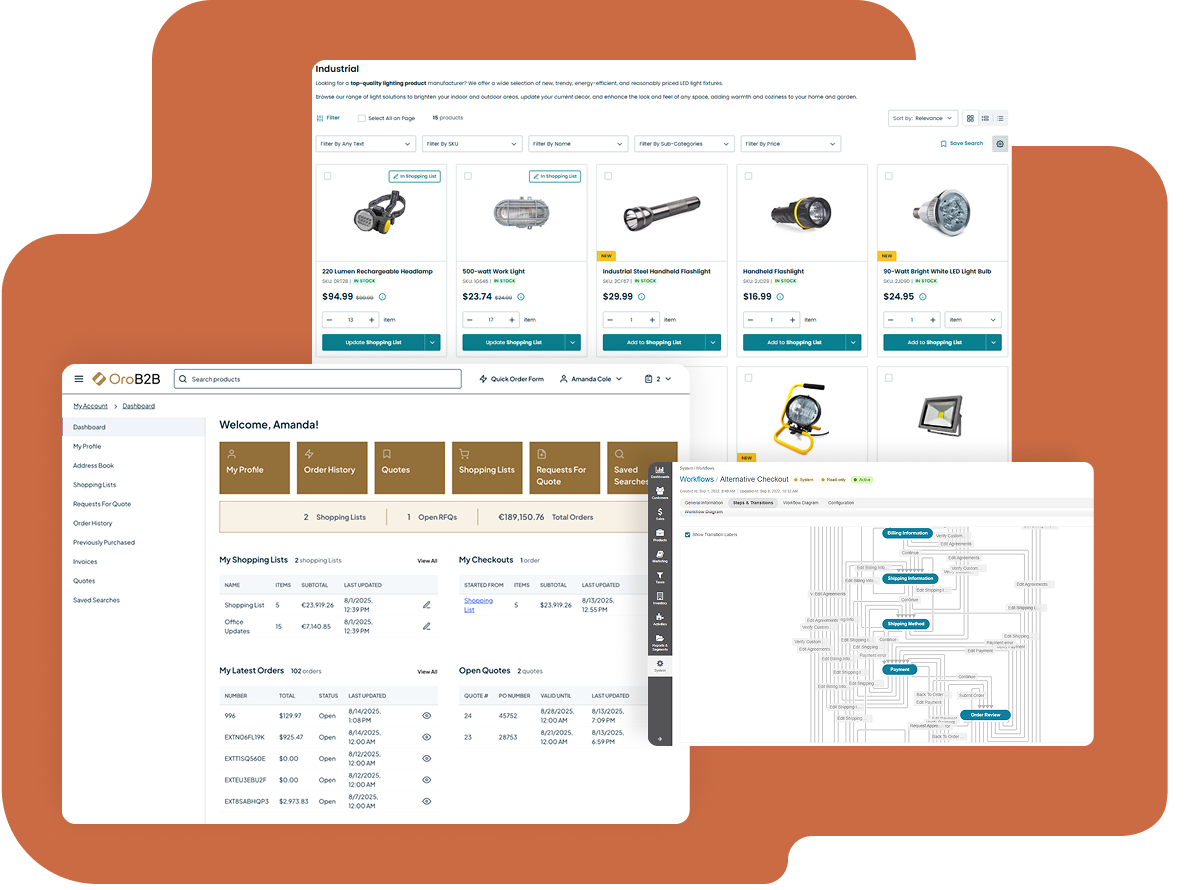
OroCommerce brings all your commerce tools together in one place: eCommerce, CRM, quoting, invoices and payments, case management, and reporting, not scattered across different systems.
Most unified commerce platforms make you start over from scratch. OroCommerce, a unified B2B ecommerce platform for manufacturers and distributors, becomes the connective tissue between your ERP, which stays the source of truth, and your customers and teams.
What makes OroCommerce different:
- Built-in CRM keeps all customer records together
- Native CPQ and quoting flow right into orders
- Integrated payments with OroPay, no outside gateways needed
- AI tools that handle email orders and answer buyer questions automatically
You won’t pay extra to add websites, warehouses, or business units. It’s all under one license, and it handles complex B2B needs like account hierarchies and approval workflows:
- Azelis runs over 100 local portals from a single backend
- Lactalis introduced OroCommerce across 12 markets and achieved 230% growth in digital orders
Your IT team gets an API-first platform that plugs into ERP, WMS, and other business systems, with a modular design so you can add features without breaking the core.
If your stack can’t keep up with your scale, it’s time to see OroCommerce in action.
Conclusion About Unified Commerce vs Omnichannel
Both unified commerce and omnichannel improve how you sell and serve customers. Unified commerce connects all your systems into one platform, while omnichannel links your sales channels to create consistent experiences but often uses separate commerce systems that cause fragmentation.
Unified commerce gives you four key advantages:
- Agility: You respond faster to market changes because all your data lives in one place
- Accuracy: Pricing and inventory stay consistent across every touchpoint by using one shared logic for all sales channels
- Hybrid collaboration: Sales reps and buyers work within the same digital workspace, co-piloting orders without switching to email or phone
- Internal team efficiency: Your staff works from one system instead of switching between multiple tools
The choice depends on where your business is now. Omnichannel works if you need basic channel integration. Unified commerce makes sense when you want complete operational control, deeper customer insights, and the ability to operate complex, multi-entity businesses.
OroCommerce provides the unified foundation you need, combining B2B and B2C commerce with built-in inventory management and customer data tools.
Your competitors are moving towards unified commerce. Brands that centralize their operations now will deliver better experiences and operate more efficiently.
FAQs About Unified Commerce vs Omnichannel
What is the difference between unified commerce and omnichannel commerce?
Unified commerce pulls all business operations into one central system. Omnichannel aims for consistent customer experiences across channels. The real difference?
Unified commerce runs as a single system with no integrations required. It creates seamless experiences for customers and back-office users. Omnichannel connects separate systems loosely for consistent customer touchpoints, but lacks full backend unity.
What does unified commerce mean?
Unified commerce means running everything through one central platform. Sales, inventory, customer service, and data all work together in real time. You get a complete view of operations and customer behavior. No more data silos. Accuracy goes up across your business.
What are the 4 C's of omnichannel?
The 4 C’s are Consistency, Convenience, Connection, and Communication. Consistency means your brand’s message stays the same everywhere. Convenience lets customers shop however they like. Connection ties all your channels together. Communication keeps info flowing between you and customers at every step.
What are the 4 types of eCommerce?
The four are Business-to-Consumer (B2C), Business-to-Business (B2B), Consumer-to-Consumer (C2C), and Consumer-to-Business (C2B). B2C is selling straight to shoppers. B2B is companies selling to other companies. C2C platforms let people sell to each other. C2B means consumers offer products or services to businesses.
What are the 4 pillars of omnichannel?
The 4 pillars of omnichannel are Consistency, Personalization, Accessibility, and Integration. Consistency means your customers get the same quality experience no matter where they interact with you.
Personalization lets you tailor each interaction to fit what someone actually wants. Accessibility is about meeting customers on the channels they like best, such as text, phone, or email.
Integration ties all your platforms together, so customers can move smoothly from one touchpoint to another without hitting roadblocks.