
navigation

Only 17% of B2B manufacturers and distributors can confidently say their AI investments delivered significant returns, and 15% admit their AI projects produced nothing at all.
Between them sits the real story: 48% report some positive results, but nothing solid enough to defend to a CFO. That data comes from Oro’s 2026 AI Benchmark survey of 100 B2B directors and VPs.
That’s the group measuring ROI wrong, not the group with a bad AI strategy or weak AI solutions.
The definitive measure of AI ROI is verified, attributable financial impact tied to a specific KPI, not dashboard activity. Payback periods vary widely by use case, from a few weeks for back-office automation to twelve months for dynamic pricing. The table below breaks down where each use case lands.
This article covers why measuring AI ROI is broken, what the top 17% do differently, and the one architectural condition most vendors ignore.
Why the AI Investments Data Looks Contradictory
Market data on AI right now runs in three different directions, and each story is true.
Story one: the AI bandwagon is full
According to McKinsey’s 2025 State of AI report, overall AI adoption sits at 88%. Generative AI use alone jumped from 33% to 72% in a year. Many executives worry that if a competitor isn’t running something with “AI” in the name, they’re falling behind.
Story two: almost nothing works
According to an MIT study covering 300 enterprise AI deployments, 95% of generative AI pilots produced zero measurable ROI on the P&L.
S&P Global found the share of companies abandoning most AI initiatives jumped from 17% to 42% in a year.
Gartner, the enterprise technology research and advisory firm, expects another 40% of agentic AI projects canceled by the end of 2027.
Story three: the money keeps coming anyway
According to KPMG, three out of four global business leaders plan to keep funding AI investments despite economic uncertainty. Futurum’s survey of 830 IT decision-makers shows the buyer has quietly raised the bar.
Last year, productivity gains alone justified the spend. This year, hard revenue growth nearly doubled as the top justification.
The budget is bigger, the bar for AI success is stricter, and the results are worse.
Business leaders bought AI technology, not business outcomes, missing the many benefits a disciplined rollout could deliver.
Blaming the math is tempting, and it’s partly true. Traditional ROI models weren’t built for probabilistic systems. But leaning on that excuse too hard lets a much bigger operational failure off the hook.
Why Traditional ROI Models Break on AI
Traditional ROI models break down with AI because the math assumes predictable, deterministic software, and AI is neither.
The standard ROI formula is nearly three hundred years old: benefit minus cost, divided by cost, times one hundred. It worked for railroads and ERP deployments. It breaks down for AI systems and AI implementations for three reasons.
1. Displacement risk
Traditional ROI models amortize software over a three- to five-year lifecycle. AI models don’t hold still that long. You might spend six months building a custom model, only to watch a vendor ship a cheaper alternative before you hit breakeven.
2. Probabilistic outputs
Deterministic software gives the same output every time. A generative AI model might write flawless descriptions 94% of the time and nonsense the other 6%, often clustered around your highest-value accounts. Standard spreadsheets aren’t built to price that risk.
3. The “magic box” expectation
Many organizations budget for AI tools as if flipping a switch finishes the job. But an algorithm is only as reliable as the quality of the data feeding it. Skip ongoing governance, and the system quietly turns stale information into expensive mistakes.
Three mistakes that invert the number
PwC found that finance teams measure business performance at one point in time and ignore built-in uncertainty. They also score each AI project in isolation rather than treating AI as a single connected portfolio. Any mistake distorts the number; all three invert it.
The math problem is real. It’s also a decoy: even a perfect model comes up empty if the underlying AI investments never produced real value. That raises a fundamental question: what does working AI actually produce in B2B commerce?
Align AI Investments with Business Performance
Before funding any AI investment, run it through a short pre-funding checklist:
- Map the investment to one specific KPI tied to a real business objective, not a vague aspiration.
- Assign one accountable owner per initiative.
- Test it against the three failure modes above, displacement risk, probabilistic outputs, and the magic box expectation, before you allocate budget.
Skip this checklist, and you’re funding a hope, not a KPI.
The Three Tiers of AI Business Value in B2B Commerce
AI business value in B2B commerce shows up in three tiers, and the biggest one rarely lands on an income statement first.
Sales reps stop retyping purchase orders. Buyers stop calling support at 6 p.m. Catalog teams finally finish attribute cleanup they’ve dodged for two years.
None of that shows up as revenue growth on day one, yet it’s where most companies see value first.
Tier 1: Hard ROI
These are the numbers a CFO signs off on, split into two groups.
Cost-savings metrics:
- Labor-hours multiplied by the loaded rate
- Purchase order cycle time
- Error reduction percentages
Revenue-impact metrics:
- Margin points protected
- Search-driven conversion lift
Every AI vendor promises this tier, yet fewer than 40% of effective deployments in our survey produced a clean, auditable number. Hard ROI is the rarest tier, not a guaranteed short term ROI, and streamlining operations enough to prove it takes real work.
Tier 2: Soft ROI (The Intangible Benefits)
Customer satisfaction, better decision-making, data accessibility, employee satisfaction, and rep sentiment all fall here. Freeing reps for higher-value work also improves decision quality.
Productivity gains and customer satisfaction ranked as the top two outcomes B2B leaders reported, ahead of cost savings or revenue. Soft ROI usually moves first, months ahead of hard numbers.
It’s also where AI surprises you. DiversiTech deployed AI SmartOrder to automate purchase order processing and ended up using it as a de facto data layer, normalizing records across nine legacy ERPs nobody planned to unify.
Tier 3: Capability ROI
This tier covers what your organization builds during deployment: new workflows, enforced data quality standards, and a team that knows how to scope and govern an AI project. None of it appears on an invoice, but it stops your tech stack from becoming a cost center.
The best-performing teams reinvest confirmed savings into the next use case, standardize what they built, and re-tune models the moment performance drifts.
Further reading: 10 AI Use Cases in B2B Commerce That Teams Are Deploying Right Now
Mapping B2B Commerce Use Cases to ROI Timelines
Not every B2B AI use case pays back on the same timeline. The difference comes down to how ready your data is, not how advanced the algorithm is.
Band 1: AI ROI lands fast
PO automation, customer self-service, and content generation topped the adoption list in our survey, at 81% and 73% for back-office and service automation, respectively. Here, the system reads data that already exists in a usable form, such as line items on a PO or SKUs on a product record.
That structure lets it automate repetitive tasks and cut processing time. Time to value is short, which is why these efficiency gains show up first.
Band 2: AI ROI lands when the data is ready

Demand forecasting, sales intelligence, and fraud detection see far more pilots than production deployments. These use cases need consistent product attributes and CRM records that connect cleanly to commerce data. Get that foundation right, and the competitive advantage is real; skip it, and the outputs stay unreliable.
Band 3: AI ROI is mostly theoretical
Dynamic pricing, AI-assisted quoting, and agentic AI purchasing carry the highest ceiling and lowest floor. Only 15% of companies run dynamic pricing today, and just 5% run AI-assisted quoting or use AI agents.
Pricing stalls on ownership disputes. Quoting stalls because logic, approvals, and ERP data sit in three disconnected systems. Agentic purchasing stalls because probabilistic bots can’t yet guarantee the audit trail buyers, from the Middle East to North America, expect as they push into new markets.
Once a use case clears a small pilot, stage the next round of funding instead of committing the full budget upfront.
The B2B AI ROI Reality by Use Case
| Use case | Hard ROI | Soft ROI | Capability ROI | Realistic payback |
| PO automation | Hours saved, cycle time, error reduction | Rep sentiment, faster buyer response | Standardized order data | Weeks |
| Customer self-service | Ticket deflection, response time | CSAT, 24/7 availability | Unified account and order data | Weeks to months |
| Content generation | Time-to-publish, catalog completeness | Faster campaigns, less drudgery | Product data at scale | Months |
| AI search | Conversion lift, lower abandonment | Reduced rep dependency | Structured product attributes | 6–12 months |
| Demand forecasting | Inventory cost reduction, fewer stockouts | Planner confidence | Clean transaction history | 6–12 months |
| Sales intelligence | Pipeline velocity, win rate | Rep prioritization | Connected CRM + commerce data | 6–12 months |
| Fraud detection | Loss prevention, credit risk | Quieter operations | Account-level behavior baselines | 6–12 months |
| Dynamic pricing | 2–6 EBITDA points | Sales confidence in quotes | Consolidated pricing logic | 12+ months |
| AI-assisted quoting | Quote cycle compression | Faster deal velocity | Unified CPQ, approvals, ERP | 12+ months |
| Agentic AI | None measurable yet | None measurable yet | Foundation for UCP/MCP era | Unclear |
Look across the three bands and the pattern holds: in Band 1, unified data is already waiting for the AI. In Band 3, it’s scattered across systems that don’t talk to each other. ROI depends less on the algorithm and more on the value chain feeding it.
How to Use AI in eCommerce: The Implementation Approaches
Select and Govern AI Tools
Before you sign anything, run every AI tool candidate through these checks:
- Log every AI tool in use, including generative AI tools adopted informally.
- Tag informal tools separately from purpose-built commerce AI.
- Evaluate AI integration with live pricing, inventory, and account data before you sign.
- Confirm the data analysis behind its outputs is auditable, not a black box.
- Require a measurable success metric before procurement.
- Set a usage policy so scaling AI doesn’t just relocate governance gaps.
Skip these checks, and embedding AI into a workflow now makes scaling AI later far harder. Generative AI doesn’t fix governance gaps on its own; a chatbot with no usage policy just relocates the problem.
Measure, Baseline, and Attribute AI ROI
Before you claim any result, run every metric through this process:
- Set a pre-AI baseline for every key metric before go-live.
- Where practical, compare results against a control team so before-and-after numbers aren’t confounded by other changes.
- Calculate total cost of ownership, not just the license fee.
- Report early directional signals, like adoption and productivity gains, separately from confirmed results.
- Report confirmed, attributable financial results with measurable impact as their own line item.
- Use this transparent approach to accurately measure hours saved and time saved without inflating the story.
This is the only way of measuring results that survives a renewal conversation, with the full picture on the table.
Why AI Projects Bleed Money
When a B2B commerce project misses its targets and fails to deliver a positive return on investment, executive teams usually rely on one of these alibis:
- “We forgot to take a baseline.” Teams can’t prove the real value of an implementation or calculate the ROI of AI if nobody recorded the exact cycle time of a purchase order before the software arrived.
- “We funded the wrong use case.” Budgets frequently go toward flashy marketing toys. Research consistently locates the highest business value in boring, back-office workflows.
- “We got ambushed by hidden costs.” Total cost of ownership routinely swells to 300% or 400% of the original quote. Teams lose 51 workdays a year fighting technology friction because they start deployments lacking the necessary training data.
- “We chose the wrong deployment path.” Forcing standalone AI solutions to understand complex B2B pricing usually turns into a permanent middleware project. The numbers reflect this integration friction: vendor-led deployments hit a 67% success rate, while internal builds sit at just 33%.
- “Our legacy systems will not cooperate.” Over half (53%) of respondents cite legacy integration as their biggest hurdle. The specific gaps include inconsistent formats and fragmented order histories.
- “We assumed AI adoption would happen automatically.” Because modern interfaces look intuitive, executives frequently skip formal change management. But navigating complex B2B workflows requires a steep internal learning curve. Without clear usage policies and hands-on training, employees simply ignore the new AI tools and revert to their old habits.
These are not six separate problems. They are a single root cause showing up in different places.
Artificial intelligence in B2B is an amplifier. Feed it clean, unified commercial data, and it scales your operational efficiency. Feed it a spaghetti bowl of technical debt, and it amplifies chaos faster than your CIO can track it.
In Their Own Words
Leaders who saw zero ROI never blamed the algorithm; they blamed their own data quality.
“Our data isn’t clean or consistent enough for AI systems to work the way vendors promise,” one respondent wrote. Another described deployments lacking process standardization, leaving shop floor managers distrusting the numbers, since human judgment still overruled every model output.
Analyst Heather Hershey summarizes the entire industry trap in one absolute rule: You cannot drop a large language model on five disconnected ERPs. Bolting new initiatives onto decades of technical debt guarantees a negative return.
Drive AI Adoption Across Teams
Before you roll out to a new team, cover these basics:
- Train users on the specific new workflow, not the tool’s features in the abstract.
- Appoint one internal sponsor per rollout so someone owns the outcome, not just the license.
- Measure active usage, not license counts alone.
- Check whether tasks finish without a human quietly redoing the work behind the scenes.
This is knowledge work, and getting adoption right changes how human resources plans future training.
Further reading: The Honest Guide to AI Claims in B2B Commerce
Key Considerations for AI Implementation Before You Invest Further
Companies that capture real business value run a diagnostic on their own architecture before they buy anything else and ask four questions.
1. Is your commercial data unified enough for the system to act on?
- Can one system show contract pricing, order history, and credit status together?
- Are product attributes consistent across every SKU?
2. Is your use case narrow and measurable enough to prove value?
- Can you state the exact outcome in one sentence?
- Do you have a pre-deployment baseline for that metric?
3. Is your investment structure honest about the outcomes?
- Are you budgeting for retraining and monitoring, or just the license?
- Are productivity gains tracked as legitimate returns?
4. Have you evaluated true AI integration before signing?
- Does the tool connect to live pricing, inventory, and account data out of the box?
- Did the contract require a measurable success metric?
The Architectural Advantage
If those questions made you hesitate, you’re likely facing an architectural gap, not an algorithm problem. You can’t reach agentic AI purchasing when business logic sits scattered across spreadsheets and legacy software.
Companies capturing real returns share one trait: they stopped bolting modern intelligence onto a fragmented backend and started an honest enterprise transformation instead.
That shift changes their corporate strategy and business models around technology spend, not just one AI project.
AI ROI Example in B2B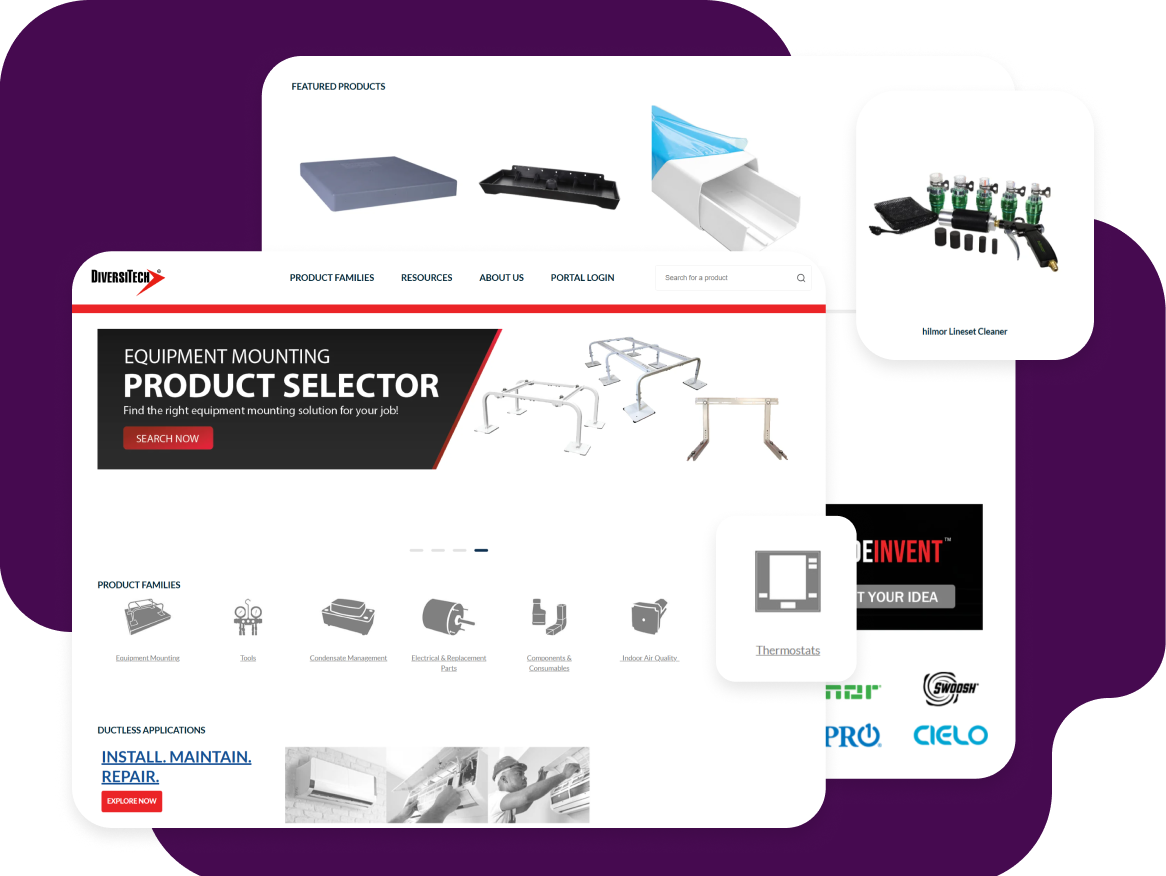
DiversiTech, North America’s largest manufacturer of HVAC components, grew through acquisition and ended up managing 12 legacy ERPs.
Rather than force a standalone AI tool onto that fragmented mess, the company deployed OroCommerce, a unified B2B commerce platform for manufacturers and distributors, as its single commercial layer.
Once that foundation was set, DiversiTech turned on native AI to automate incoming PDF purchase orders. The system now processes 700-line orders in seconds, delivering an immediate 20% improved efficiency boost to sales and support teams.
DiversiTech didn’t buy an algorithm. It fixed its architecture first, and the AI gains followed once the data had somewhere consistent to live, the surest way to turn AI into a durable advantage.
When your quoting workflows, corporate hierarchies, and product catalogs share a single unified data model, the intelligence layer doesn’t have to guess. It inherits your permissions, reads your live inventory, and executes complex B2B workflows instantly.
If your current software forces you to build custom workarounds just to support a basic AI use case, it’s time to stop evaluating algorithms and start fixing the foundation.
Start an ROI-Focused AI Investment Plan
- Pick one high-priority use case, ideally a Band 1 use case.
- Define a one-sentence hypothesis for what it should prove.
- Launch a time-boxed pilot with one success metric.
- Schedule a monthly scale-or-stop review.
Four steps won’t fix a fragmented architecture, but they will tell you, fast, whether AI ROI is achievable before you commit further budget.
Conclusion About AI ROI
Measuring AI ROI wrong isn’t a math problem. It’s a data problem wearing a math problem’s clothes.
The B2B companies proving AI success aren’t running smarter algorithms; they’re running unified commercial data that the algorithm can actually act on. Start with one use case, set a baseline, and build on an architecture that gives every AI investment a consistent place to land.
Your data is already there. So is the AI.
FAQs About AI ROI
What is AI ROI in B2B commerce?
AI ROI is the verified, attributable financial impact of an AI deployment, measured by a metric such as cost savings or revenue growth, excluding signals like dashboard activity. According to OroCommerce’s 2026 AI Benchmark survey, only 17% of B2B companies can currently prove it.
Why is measuring AI ROI so difficult?
Traditional ROI models assume deterministic software with a predictable lifecycle, and AI is neither. Displacement risk, probabilistic outputs, and ongoing data quality costs all break the formula. Most companies measure at a single point in time rather than continuously, which distorts the number.
How long does it take to see AI ROI?
Payback periods range from a few weeks for PO automation and customer self-service to 12 months or more for dynamic pricing and AI-assisted quoting. The timeline depends on how unified your data already is, not model sophistication.
What's the difference between hard ROI and soft ROI?
Hard ROI covers auditable numbers like hours saved, error reduction, and margin protected. Soft ROI covers real but intangible outcomes like customer satisfaction and better decision-making. Soft ROI typically moves first, months ahead of the hard numbers.
Why do most AI projects fail to show a positive return?
Most AI projects bleed money due to missing baselines, wrong use case selection, hidden total cost of ownership, poor deployment paths, legacy friction, and weak change management. Leaders in Oro’s survey consistently blamed fragmented data, not algorithms.
How can B2B companies improve AI ROI?
Unify data on one platform, set a pre-AI baseline for every metric, and fund AI investments against one KPI at a time.