
navigation

The short answer to how to use AI in e-commerce: fix your data architecture before you pick an algorithm. Put a commerce platform between your customers and your ERP so AI has one clean, connected source of truth, then roll out use cases one at a time, starting with the lowest-risk, highest-visibility win.
AI is an amplifier.
This is the single most important concept to understand before you invest in any of it. Attach an advanced algorithm to a 20-year-old, fragmented legacy system, and you don’t get an intelligent business. You get your existing operational chaos, amplified at machine speed.
Understanding how to use AI in e-commerce means addressing the infrastructure problem first, without ripping out your ERP. This guide is written for B2B e-commerce, IT, and operations leaders deciding where the AI budget actually pays off.
What This Guide Covers and How to Measure It
This guide is organized around a measurable operational result, not a vague goal like “adopt AI”: a higher touchless order rate, faster support resolution, and stronger search-driven conversion.
It walks through the architecture that makes those numbers possible, how to shortlist AI tools, which use cases to prioritize first, and how to govern the results once they’re live.
Ownership typically breaks down like this:
- Order processing: operations and IT
- Chat and search: customer experience
- Pricing: revenue operations
- Agentic and governance decisions: IT and architecture leadership
Fixing this architecture is exactly what a B2B commerce platform is built to do. OroCommerce sits as that intermediary layer between your ERP and your customers, giving you the flexible, enterprise-ready data AI needs without a multi-year replatform.
Book a demo to see it against your own catalog and account structure.
The Architecture Problem
The vast majority of enterprise AI projects fail. Converging data from Gartner, BCG, and MIT puts the failure rate between 80% and 95%. McKinsey’s 2025 State of AI survey found that while 88% of organizations now use AI, only 6% qualify as “AI high performers.”
The algorithm is not the point of failure. The architecture is.
Leaders treat AI as a silver bullet, expecting it to function in a disconnected environment. As analyst Heather Hershey noted on the B2B Commerce UnCut podcast, you cannot drop an LLM on top of five disconnected ERPs.
If the data is fragmented, the AI guesses, and in B2B, guessing is a liability, especially when it comes to customer data, past purchases, or inventory management.
The audit isn’t just about where data lives, either. It’s also about whether that historical data is labeled and clean enough to train or evaluate a model on.
Relational data
Retail AI looks at individual user behavior. B2B AI has to go further, understanding complex, multi-level account hierarchies: a branch-level buyer with a $10,000 spending limit who reports to a manager who approves capital expenditures.
That context is what lets AI deliver personalized shopping experiences tied to real customer needs and buying authority, the foundation of any meaningful ecommerce customer service strategy.
Commercial logic
AI can’t function if contract pricing rules are locked in an old ERP and inaccessible via API. It needs to see negotiated volume breaks and catalog restrictions in real time to execute dynamic pricing strategies based on market trends or generate an accurate quote.
Product data
Your catalog must be machine-readable. Centralizing product data in a PIM (product information management) system, rather than leaving specs and images siloed in PDFs, is what lets AI agents resolve queries and suggest compatible products.
If these three logic centers stay disconnected, AI can’t function, and it erases any competitive edge for ecommerce businesses.
| Architecture Layer | What It Requires | What Breaks Without It |
| Relational Data | Multi-level account hierarchies and buying authority | AI can’t tell who’s allowed to buy what |
| Commercial Logic | Real-time contract pricing and volume breaks | Wrong quotes, broken dynamic pricing |
| Product Data | A structured, PIM-centralized catalog | AI can’t match or recommend compatible products |
IDC's Agentic Commerce Playbook for B2B Leaders Who Want Clarity
Here’s What Most Companies Try
Most organizations default to one of two implementation models, and both carry heavy operational risk.
| Approach | The Pitch | The Risk |
| Rip and Replace | Replace the ERP with something AI-native | Three-year timelines; two-thirds of large tech programs miss budget, scope, or schedule |
| AI as an Add-On | Bolt standalone AI tools onto the existing stack | Works for one problem, but compounds technical debt as you add more tools |
The Big Bang: rip and replace
BCG confirmed more than two-thirds of large-scale tech programs miss their timeline, budget, or scope. Many companies try a shortcut instead: IDC reports that 21.4% plan to renew with their current ERP provider specifically because generative AI is coming in the next release.
An ERP is designed as the system of record for your ledger and inventory, not for the digital buying journey or personalized catalogs.
Running customer-facing AI on top of it leaves buyers with a rigid experience that fails to meet modern customer expectations and undermines customer satisfaction.
AI as an add-on
To avoid touching the ERP, companies buy standalone AI tools and tape them onto their existing stack. That works for one problem, but a tool running isolated AI algorithms that can’t reach the rest of your stack either fails outright or requires expensive custom work.
B2B commerce AI needs access to:
- Product catalog (PIM)
- Inventory management and pricing (ERP)
- Customer contracts and hierarchies (CRM)
- Order history (commerce platform)
Every new bolt-on tool means another custom integration, and the technical debt compounds until the system becomes unmanageable.
Learn how distributors tackle tech debt in B2B commerce in this free report
The AI Implementation Alternative: The Strangler Pattern
E-commerce AI needs two types of data:
- operational data from your ERP (inventory, pricing, logistics costs, and fulfillment)
- behavioral data from customer interactions during B2B online shopping (browsing history, quote requests, approval workflows).
ERP was never built to capture the second kind. Without it, AI can’t identify patterns or learn from real buyer friction.
The most pragmatic path forward is a recognized software engineering approach: the Strangler Pattern. Coined by Martin Fowler, it’s named after the fig tree that wraps around a host. You don’t tear down the legacy system. You place an intermediary layer in front of it.
The commerce platform layer
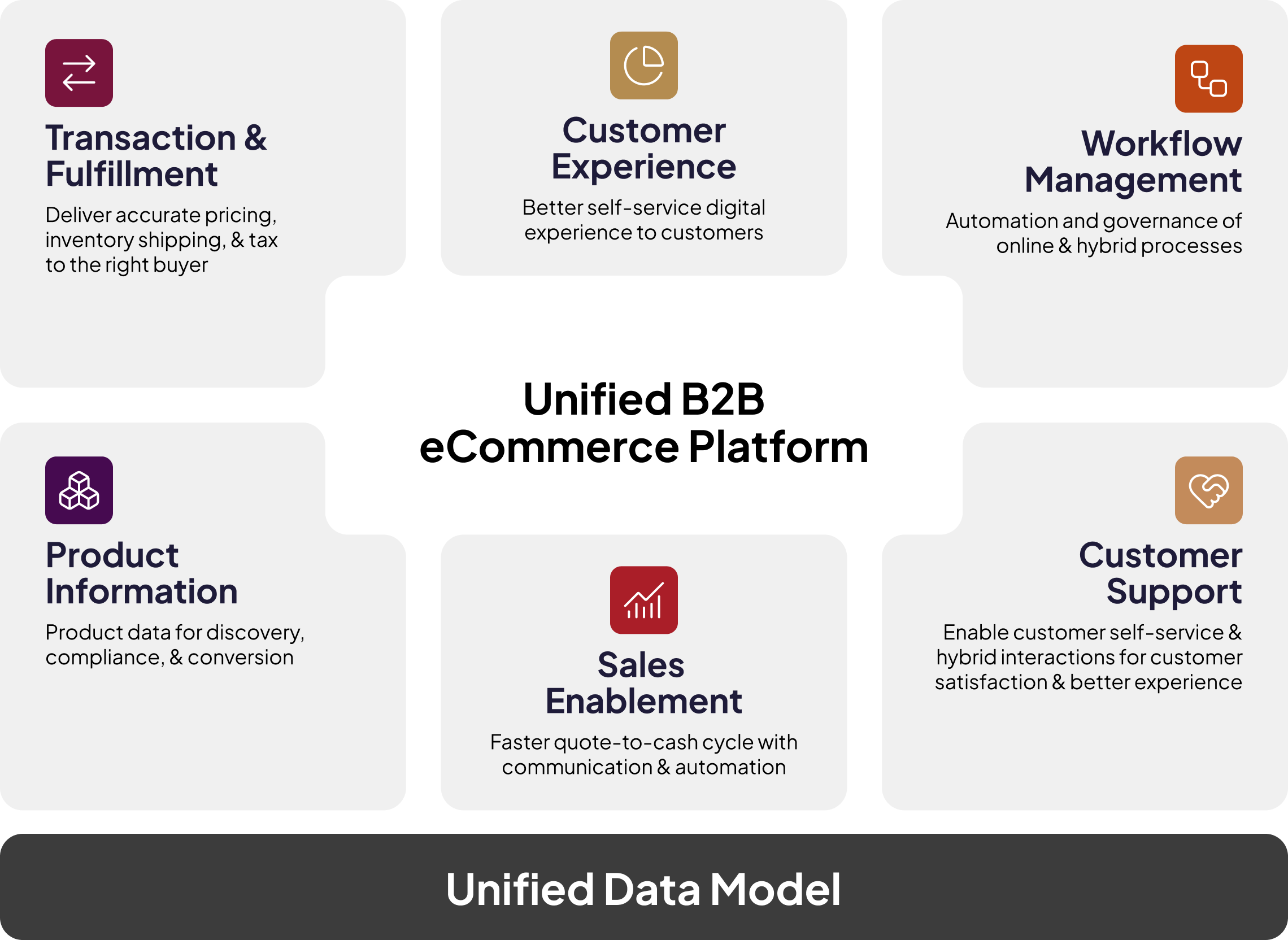
This layer is a unified digital commerce platform that sits between customers and your ERP, pulling operational data as real-time data without straining the legacy system. It creates the unified environment AI solutions need:
- Customer context (who they are, what they’ve bought, what they’re trying to do)
- Product context (specs, compatibility, availability)
- Commercial context (contract pricing, credit limits, approval rules)
- Behavioral patterns (where buyers get stuck, what they search for, which quotes convert)
The ERP stays the system of record for finance and fulfillment. You migrate the customer-facing logic, pricing calculations, quote generation, product discovery, into the commerce layer, one chunk at a time.
That’s what makes B2B e-commerce AI solutions able to execute in the first place, and lets you automate repetitive tasks without adding new risk.
Select AI Systems and AI-Powered Tools
Once the architecture is in place, choosing the right tool matters as much as the architecture itself:
- See what’s already running today, including any AI tools individual teams may have adopted informally, before evaluating anything new.
- Shortlist candidates by whether they can actually read your commerce-layer data (live pricing, contract terms, order history), not by feature checklists alone.
- Run a proof of concept with real data before committing to any AI models. A demo on clean sample data proves nothing about how a tool handles a live, fragmented B2B catalog.
- Budget for ongoing monitoring and governance from day one, not as an afterthought once something breaks.
Get this right, and the tool you pick becomes an extension of your architecture instead of another integration headache to manage later.
Choosing Your First AI Use Case
An ideal first use case checks five boxes:
- Low risk
- High visibility
- Measurable KPIs
- Clean existing sales data
- Augments a workflow rather than replacing it outright
Here’s how frequent use cases compare at a glance:
| Use Case | Risk Level | Primary KPI |
| Order Processing Automation | Low | Touchless order rate |
| AI-Powered Chat | Low | Support resolution time |
| Search and Product Discovery | Low | Search-driven conversion |
| Personalization and Recommendations | Medium | Average order value |
| Sales Enablement and Lead Prioritization | Medium | Pipeline growth |
| Product Content Enhancement | Low | Content production speed |
| Dynamic Pricing | High | Margin impact |
| Agentic Commerce | Not yet ready | N/A |
| Smart Logistics and Fulfillment | Medium | Stockout reduction |
| Fraud Detection and Risk Management | Medium | False positive rate |
1. Back-office automation: order processing

Orders arrive as PDFs, spreadsheets, and faxes, and sales reps spend hours rekeying them. AI can extract line items, validate SKUs, flag pricing errors, and draft orders for human review.
One OroCommerce client now processes 64-page PDFs with 716 line items automatically. This use case works because:
- You already have historical sales data and POs to train on
- The workflow is repetitive and high-volume
- Human review stays in the loop
The cost savings show up as less rekeying and faster turnaround.
2. Customer self-service: AI-powered chat
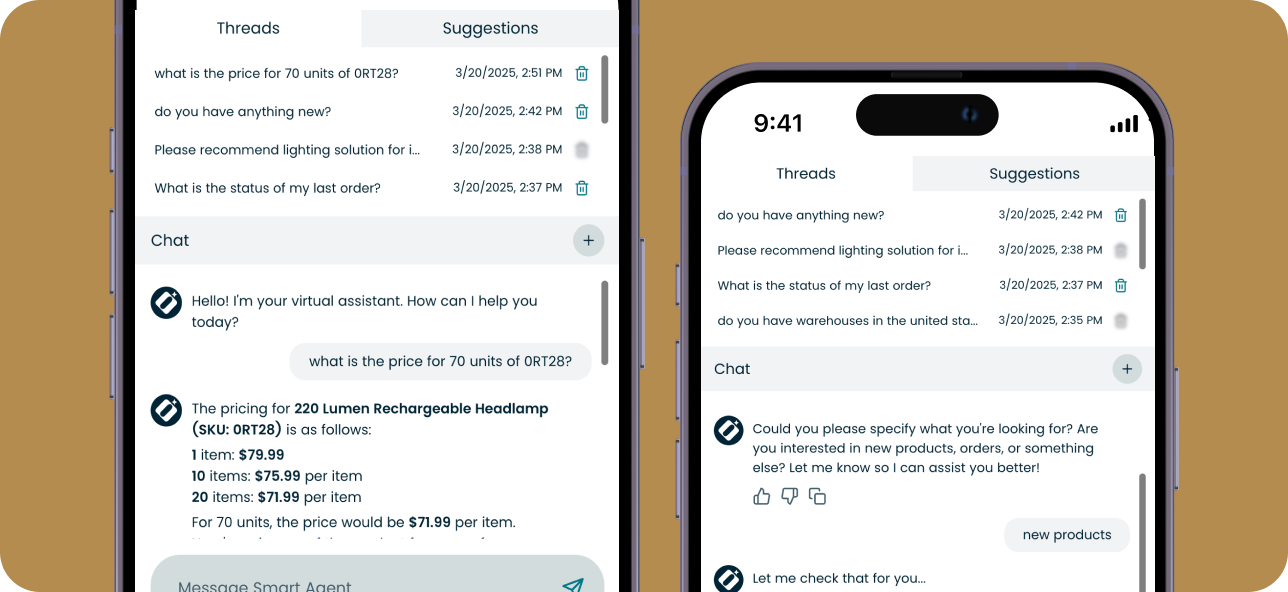
73% of B2B teams already use customer service chatbots, per OroCommerce’s 2026 survey.
A bad chatbot can’t see account data and forces customers to call anyway, driving up customer service inquiries instead of resolving them.
A good one, built on natural language processing, delivers real AI powered customer service, knowing contract terms, credit status, and order history well enough to answer “What’s my price for 100 units?” without escalating.
Before deploying, get two things right:
- Collect historical support transcripts to train the system on real customer language
- Define clear escalation rules for when it hands off to a human
That combination is what turns a chatbot into enhanced customer service instead of a frustration layer, building customer loyalty and enhanced customer satisfaction across the entire customer journey.
The ROI shows up in two places: support volume drops because AI handles routine tasks, and sales cycles get faster because buyers get answers at 8 p.m. instead of waiting for a rep.
3. Search and product discovery
Traditional keyword search fails in B2B because buyers search by application or compatibility, not your catalog structure. AI search using retrieval-augmented generation (RAG) can understand customer intent and match it to the product even without an exact SKU.
W.W. Grainger, a major MRO distributor, uses RAG-based search across 2.5 million products for exactly this reason. Some platforms are extending this with:
- Visual search, letting buyers upload a photo of a worn part to find its replacement
- Voice search for hands-free lookups on the warehouse floor
Better search directly drives customer engagement and higher conversion for ecommerce brands with large, complex catalogs.
4. Personalization and product recommendations
For B2B, this means:
- Recommending compatible parts
- Suggesting reorder quantities based on a specific account’s purchase history and contract terms
- Showing relevant cross-sell items during quoting instead of generic “customers also bought” widgets
It depends on the same unified account and product context from the Strangler Pattern: a recommendation engine that can’t see contract-specific pricing will suggest items the buyer can’t actually order at the price shown, which decreases customer trust fast.
5. Sales enablement and lead prioritization
McKinsey documented an industrial distributor that used AI-powered lead prioritization by extracting predictive analytics and actionable insights from unstructured data like construction permits.
The payoff showed up two ways:
- Over $1 billion in new pipeline opportunities, a 10% increase
- More than double the click-through rate in the first year, from personalized marketing campaigns tailored to specific customer segments
This use case works when:
- Your sales team is drowning in leads and struggling to prioritize
- You have rich CRM data to train on
- You can integrate external data sources (permits, industry news, financial filings)
The ROI shows up as higher win rates and faster deal cycles, not just more volume.
6. Product content enhancement
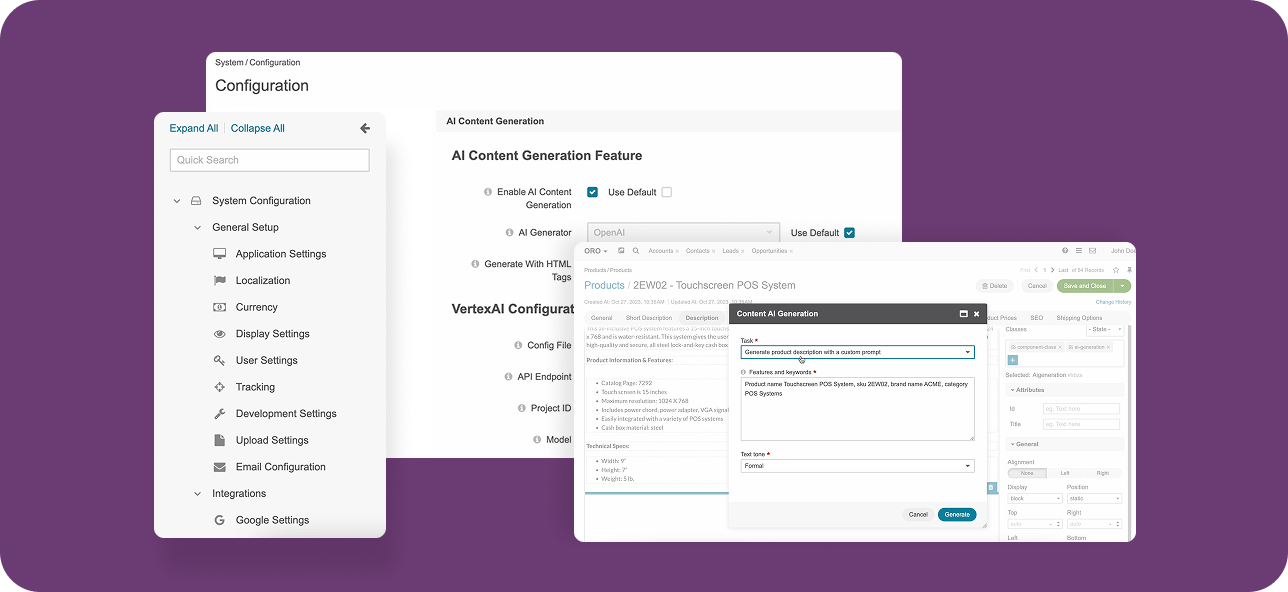
Generative AI helps in two ways:
- Producing detailed product descriptions and technical spec sheets at scale, with machine learning algorithms keeping that output consistent and searchable across massive catalogs
- Automating alt-text and metadata generation for product images, a quick, low-risk win
Anything generated should still get a human edit pass before it publishes, feeding the AI-powered shopping assistants that increasingly sit downstream.
7. Dynamic pricing
Artificial intelligence analyzes competitor pricing, demand signals, and customer purchase history to recommend optimal pricing in near-real time.
AI-driven dynamic pricing and broader dynamic pricing optimization work best for high-volume catalogs.
Because pricing is sensitive, test any model on a small, low-risk customer segment first and monitor revenue and margin impact daily before expanding account-wide.
8. Smart logistics and fulfillment optimization
This use case covers two connected applications:
- Demand forecasting: by analyzing customer demand signals, machine learning models can predict demand at the SKU level, informing warehouse operations and giving supply chain management teams an earlier warning than a manual reorder point
- Order routing: rules that account for inventory location and delivery priority
Both depend on the same clean, unified operational data this architecture establishes as the prerequisite for everything else. Get the data right, and these become lighter-touch additions.
9. Fraud detection, security, and risk management
B2B fraud looks different from generic consumer card fraud, since this audience’s risk exposure is different. Watch for:
- A sudden large order from a new account
- Repeated small test orders
- Credit-limit overrides
Set manual-review thresholds for high-risk orders instead of blocking automatically, and audit flagged decisions periodically to catch false positives.
Why It’s Too Early for Agentic Commerce in B2B
Agentic AI, systems that take action rather than just answer questions, isn’t ready for unsupervised B2B transactions:
- B2B runs on negotiated contract terms, tiered approvals, and pricing exceptions that consumer-style “agent completes a purchase autonomously” models were never built to navigate.
- The risk is asymmetric compared to consumer commerce: an agent that misjudges a recommendation is a minor inconvenience, but one that autonomously commits to pricing or credit terms creates real financial and legal exposure for both buyer and seller.
- The realistic near-term role is narrow and human-supervised, drafting a quote or flagging a reorder for approval rather than executing unsupervised, consistent with keeping human review in the loop.
Until contract logic and approval chains are as accessible to AI as they are to your sales team, agentic commerce stays a supervised assistant, not an autonomous buyer.
Measuring Success
Once you deploy your first use case, you have to prove to the board it worked. Many leaders measure the software instead of the business, tracking vanity metrics like “chatbot engagement rates” that show a tool was turned on, not that anything improved.
| Metric Category | Specific KPI | Target Benchmark (Post-AI) |
| Order Processing | Touchless Order Rate | 60-80% (Up from 10-20%) |
| Order Processing | Processing Time | < 1 minute (Down from 15+ mins) |
| Operational Efficiency | Labor Hours Saved | 25-40% reduction in admin tasks |
| Revenue / Growth | Search-Driven Conversion | 15-20% uplift |
| Revenue / Growth | Average Order Value (AOV) | 10-15% increase via smart upsells |
| Customer Experience | Time to Resolution (Support) | 50% decrease via Tier-1 automation |
Hitting these numbers at launch isn’t the finish line. Keep monitoring model performance and data drift over time, since a model that hit its benchmark on day one can quietly degrade as customer behavior shifts.
These gains come from analyzing customer data at every stage, improving customer satisfaction while cutting costs, so pair the table with direct customer feedback.
Governance, Privacy, and Ethical Controls
The same relational and commercial data that makes AI useful, like contract pricing, credit status and customer hierarchies, needs equally serious controls:
- Establish clear data governance and access rules for who, and which systems, can read that data.
- Build in a human-review checkpoint for any AI output that could affect a customer relationship or your company’s exposure, like a wrong price quote or an incorrectly approved credit override.
- Treat this as core infrastructure, not optional overhead. It’s what lets this Strangler Pattern architecture be trusted with sensitive commercial data.
Get governance right, and it stops being a constraint on your AI rollout and starts being the reason customers and stakeholders trust it.
The Future of AI in E-Commerce
As AI technology matures, you’re not just solving for today’s AI technologies; you’re building for whatever comes next.
Generative AI will get better at writing and generating images. Machine learning will get smarter about predictive inventory. All of it will still need the same thing: clean, unified data and a platform that can actually access it.
Which algorithm wins doesn’t matter. What matters is whether you built the foundation that lets you use it.
Roadmap: Pilot to Full-Scale Rollout
- Run a time-boxed pilot, roughly three months, on one narrow use case that meets the low-risk, high-visibility criteria above.
- Iterate on that pilot based on its KPI outcomes and user feedback before touching anything else.
- Scale the proven use case across additional channels or teams only once it’s confirmed working, rather than rolling out to the whole business at once.
Conclusion on How to Use AI in E-commerce
AI doesn’t create intelligence out of thin air. It reflects the environment you place it in. Companies struggling with AI implementation tried to solve an architecture problem with a software purchase.
Once you accept that architecture comes first, the path is clear: no three-year ERP replacement, no dozen bolted-together point solutions, just an orchestration layer that connects the systems you already have.
The architecture is the actual competitive advantage for any eCommerce business ready to move first.
FAQs on How to Use AI in E-commerce
What is the 30% rule in AI?
There’s no single official “30% rule.” The figure shows up loosely across AI adoption research, roughly 30% of decisions automated with human oversight, or 30% of work handled by AI at some companies, as a rough marker of where mature automation sits before full autonomy. In B2B, it’s a reasonable way to think about pacing: automate the routine share of a workflow and keep humans reviewing the rest.
How do I start with AI in e-commerce?
Fix your data architecture first. Put a commerce platform between your customers and your ERP, then pick one low-risk, high-visibility use case, like order processing automation, since it’s usually the safest starting point. Prove it with a measurable KPI you can report on in 3-6 months before expanding to anything else.
Which AI tool is best for e-commerce?
There isn’t one universal answer. The right choice depends on the use case: document extraction favors accuracy on structured data, search favors retrieval-augmented generation, and chat favors models tuned for grounded, account-aware responses. What matters more than the model is whether it has access to unified, accurate data.
Is AI e-commerce worth it?
Yes, when it’s implemented on top of the right foundation. Companies that fix their architecture first see measurable gains in order rates and support resolution time within two quarters. Companies that bolt AI onto fragmented systems tend to land in that 80-95% failure bracket instead.