
navigation

BigCommerce vs Salesforce Commerce Cloud is one of the most common comparisons mid-market commerce teams run when they’re scaling up or evaluating alternatives to their current stack.
BigCommerce is a fully hosted SaaS eCommerce platform with no transaction fees and multi-brand flexibility. Like any SaaS platform, merchants don’t have source code access.
What BigCommerce does offer is broad API coverage: if a native capability like checkout doesn’t meet your needs, you can connect alternative tools via API instead of being locked into what ships out of the box.
Salesforce Commerce Cloud is a different kind of product. It’s a managed SaaS solution natively integrated with the Salesforce ecosystem, designed for organizations already running Salesforce CRM, Sales Cloud, or Marketing Cloud.
This guide takes the buyer’s perspective: what these platforms actually deliver for B2B operations, where each falls short, and when manufacturers, distributors, and wholesalers should look beyond both to find the right eCommerce platform.
It also introduces OroCommerce as the purpose-built alternative for complex B2B operations.
BigCommerce vs Salesforce Commerce Cloud: Quick Overview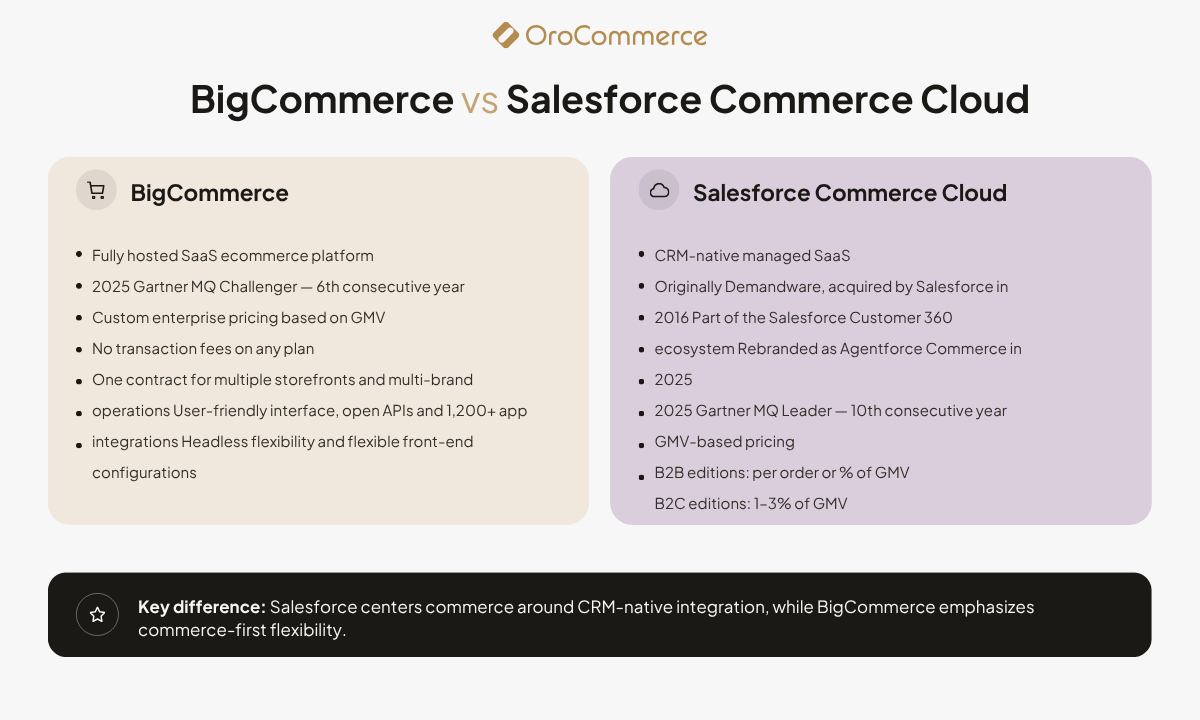
BigCommerce and Salesforce Commerce Cloud both serve enterprises, but they start from very different places.
BigCommerce: fully hosted SaaS, no transaction fees, multi-brand flexibility
BigCommerce is a fully hosted SaaS eCommerce platform, recognized as a Challenger in the 2025 Gartner Magic Quadrant for Digital Commerce for the sixth consecutive year. Here’s what that means for buyers:
- Enterprise pricing is custom, based on GMV, with no transaction fees on any plan
- One contract covers multiple storefronts and multi-brand operations
- BigCommerce offers a user-friendly interface, open APIs, and 1,200+ app integrations
- Merchants keep real control over their tech stacks through headless deployments and flexible front-end configurations, without requiring platform source code access
Salesforce Commerce Cloud: CRM-native managed SaaS in the Customer 360 suite
Salesforce Commerce Cloud began as Demandware, acquired by Salesforce in 2016. Today, it’s a managed SaaS solution natively integrated across the Salesforce ecosystem (Sales Cloud, Service Cloud, and Marketing Cloud), rebranded as Agentforce Commerce in 2025.
Salesforce has been recognized as a Gartner Magic Quadrant Leader for ten consecutive years. Pricing is GMV-based: B2B editions charge per order or as a percentage of GMV; B2C editions charge 1-3% of GMV.
The Salesforce Commerce Cloud vs BigCommerce comparison most often comes down to this: one is built around CRM-native commerce, the other around commerce-first flexibility.
Architecture and Deployment
The core architectural difference between these two platforms shapes every downstream decision: implementation timelines, development costs, team requirements, and vendor dependency.
BigCommerce: SaaS, headless-ready, no source code access
BigCommerce is a fully managed SaaS platform. Like any SaaS product, merchants don’t have source code access. What distinguishes BigCommerce architecturally is the breadth of its API coverage, claimed at 95% of native functionality.
That means if a native capability like checkout doesn’t work for your use case, there’s likely an API endpoint that lets you replace or extend it with a third-party tool.
BigCommerce’s architecture advantages include:
- Headless commerce as a first-class capability, supporting composable commerce architectures
- Scales online storefronts across brands without duplicating infrastructure
- A scalable architecture that handles traffic smoothly, adjusting to demand spikes automatically
- API-first design that lets the platform grow with the business without re-platforming at the next revenue threshold
Salesforce Commerce Cloud: fully managed, no source code access, separate B2B and B2C licenses
Salesforce Commerce Cloud is also a fully managed, multi-tenant SaaS platform with no source-code access. Like BigCommerce, it has an extensive set of APIs and supports composable use cases.
Unlike BigCommerce, it splits B2B Commerce and B2C Commerce into separate licensed products, each requiring a distinct contract.
The complexity Salesforce Commerce Cloud introduces at the licensing level extends into deployment:
- Implementing a Salesforce Commerce Cloud environment requires deep involvement from a certified Salesforce partner network
- Teams can’t operate the platform without deep Salesforce expertise
- Salesforce’s Composable Storefront lets teams build custom storefronts, but within the Salesforce framework
- Salesforce’s API investment is oriented toward connecting you deeper into its own ecosystem, not toward replacing Salesforce components with competing tools
What the architectural difference means for your team
Both platforms are fully managed SaaS. Neither gives you source code access, and neither is inherently more flexible at the infrastructure level. The real difference is where each platform’s API investment is pointed.
BigCommerce points outward: its APIs are designed to let your team centralize data, connect third-party tools, and swap out native components where needed.
Salesforce points inward: its APIs are built to pull you deeper into Sales Cloud, Service Cloud, and Marketing Cloud. That’s a strength if your business grows in the Salesforce ecosystem, and a real constraint if it doesn’t.
Architecture and deployment comparison
| Factor | BigCommerce Enterprise | Salesforce Commerce Cloud |
| Deployment model | Fully hosted, fully managed and multi-tenant | Fully hosted, fully managed and multi-tenant |
| Source code access | No | No |
| B2B and B2C on one license | Yes | No (separate licenses required) |
| Multi-brand support | Yes (one contract) | Fixed storefront count per contract; additional storefronts incur extra fees, compounded by GMV-based pricing on each |
| Headless / composable | Yes (claimed 95% API coverage) | Composable Storefront (React-based) |
| CRM integration | Third-party connectors | Native (Sales Cloud, Service Cloud) |
| AI capabilities | BigAI tools | Agentforce (launched Oct 2024) |
See enterprise B2B eСommerce platforms for a broader architectural comparison across the category.
BigCommerce vs Salesforce Commerce Cloud: B2B Capabilities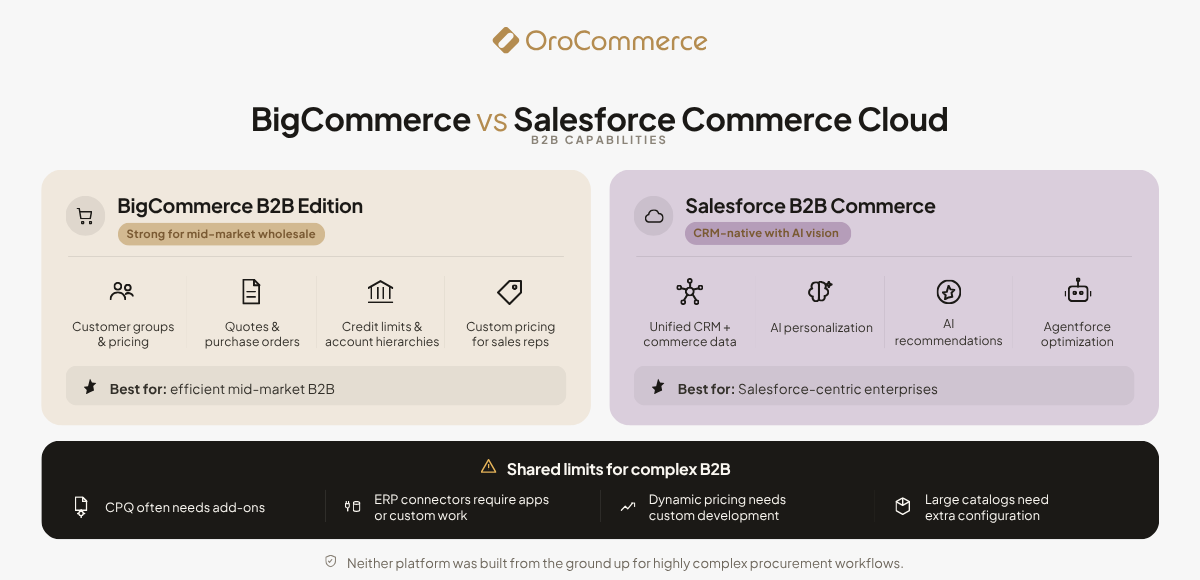
Both platforms have real B2B features. Neither was designed from the ground up for the procurement complexity that defines manufacturing, distribution, or wholesale operations.
BigCommerce B2B Edition: solid mid-market wholesale features
BigCommerce B2B Edition includes a solid set of features for mid-market wholesale operations:
- Customer groups and customer-specific pricing
- Quote management and purchase order support
- Credit limits and company account hierarchies
- Custom pricing tools that let sales reps configure account-specific rates without a developer
For mid-market wholesale sellers, that’s a strong foundation. If you’re managing product catalogs across multiple buyer segments, setting pricing rules by customer groups without writing custom code saves your team real time.
Salesforce B2B Commerce: CRM-native advantage with AI vision
Salesforce B2B Commerce’s primary strength is native integration with Salesforce CRM. Organizations running Sales Cloud gain unified customer data across commerce and CRM: order history, customer behavior signals, and account data all in one place.
Salesforce Commerce Cloud offers Einstein AI embedded across commerce workflows, enabling:
- AI-driven personalization based on purchase history and behavioral data
- AI-powered recommendations shown at key points in the buying journey
- Customer experience optimization through autonomous Agentforce agents, launched in 2024
For enterprises already running Salesforce, this is a true differentiator. For everyone else, it’s a compelling vision with a steep price tag.
Where both platforms hit their ceiling for complex B2B operations
For manufacturers, distributors, and wholesalers with genuine procurement complexity, both platforms share these limitations:
- Configure-price-quote (CPQ): BigCommerce offers limited quote management; Salesforce CPQ requires a separate license
- ERP integrations: Neither platform ships pre-built ERP connectors natively. Both require third-party apps or custom builds
- Dynamic pricing: Rule-based dynamic pricing tied to inventory levels and contractual terms requires custom development on both platforms
- Large catalogs: Very high-SKU environments with complex attribute structures require additional configuration on both platforms
BigCommerce vs Salesforce Commerce Cloud: Pricing and Total Cost of Ownership
Pricing is where these two platforms diverge most sharply.
BigCommerce Enterprise pricing: custom, no transaction fees
BigCommerce Enterprise uses a tiered subscription model based on GMV, typically starting at $1,000-$2,000+ per month. Key pricing points:
- No hidden fees tied to transaction volume
- Merchants can use any payment provider without incurring additional platform charges
- Contracts are negotiated rather than list-priced, with flexibility based on GMV and feature requirements
Salesforce Commerce Cloud pricing: GMV-based, negotiated, and costs beyond the platform
Salesforce Commerce Cloud operates on a tiered subscription model for both B2B and B2C. Both charge a percentage of GMV, typically in the 1-3% range, with exact rates negotiated rather than published. Rates aren’t publicly listed.
Implementation costs are widely reported at $300,000-$500,000+ for standard projects, with complex builds exceeding $1 million.
These figures exclude the Salesforce CRM license (Sales Cloud, Service Cloud, or Marketing Cloud) that most organizations that choose Salesforce Commerce Cloud will also need.
For enterprise clients evaluating these pricing models, the gap in total cost becomes clear when you factor in the full Salesforce ecosystem investment, not just the commerce license.
Total cost of ownership: what to model across three years
A three-year TCO model must include:
- License fees (platform and any adjacent Salesforce products)
- Implementation and systems integration costs
- Ongoing development and maintenance
- Third-party connector costs for ERP, CRM, and marketing tools
If you don’t already have a Salesforce foundation, the numbers favor BigCommerce.
Cost considerations at a glance
| Cost category | BigCommerce Enterprise | Salesforce Commerce Cloud |
| License model | Custom GMV-based; no transaction fees | GMV-based (1-3% of GMV; exact rates negotiated) |
| Typical starting range | $1,000-$2,000+/month | Custom; not publicly listed |
| B2B and B2C | One license | Separate licenses required |
| Implementation cost | Moderate | $300,000-$500,000+ (complex builds exceed $1M) |
| CRM cost | Third-party connector | Requires additional Salesforce CRM license |
| Upgrade management | Automatic (fully managed SaaS) | Automatic (fully managed SaaS) |
| Enterprise support | CSM and 24/7 priority support included in top-tier license; TAM and implementation PM available as flat-fee add-ons | Premier Support add-on at +30% of net license fee; cost scales automatically as GMV grows |
See best enterprise B2B eCommerce software for broader cost benchmarking across platforms.
Integrations and Ecosystem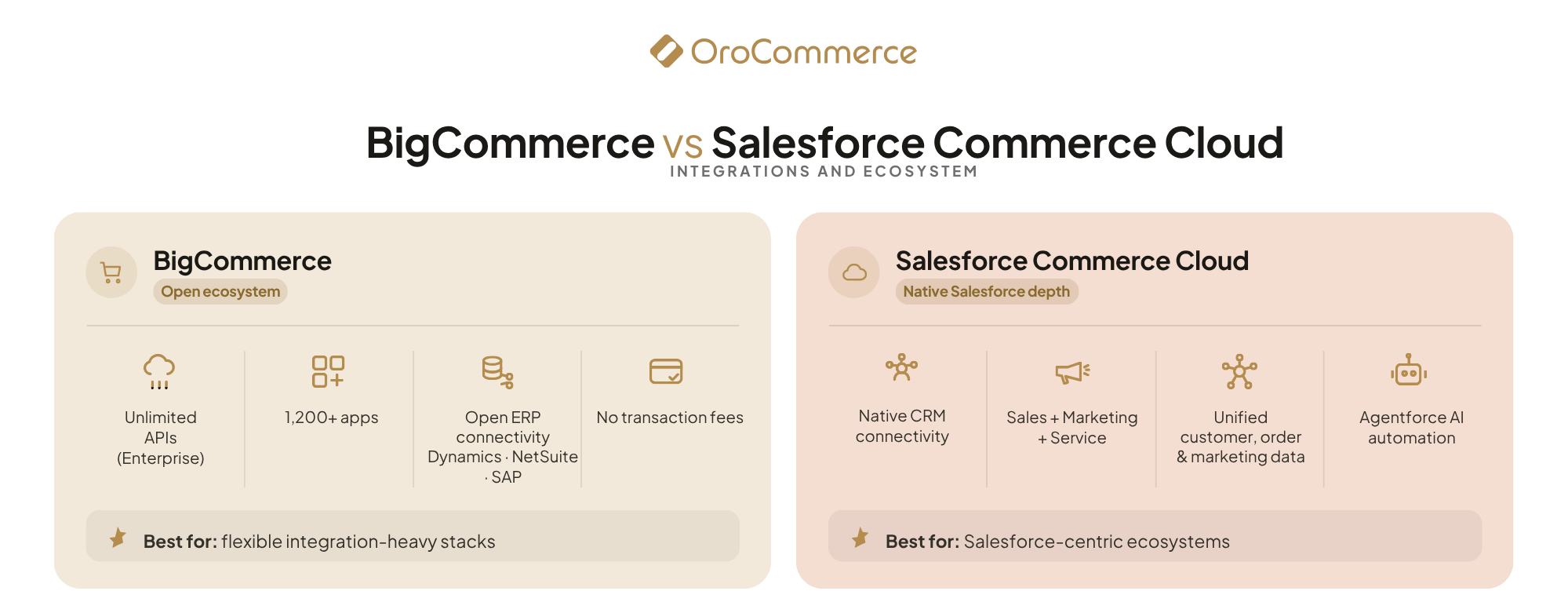
The BigCommerce vs Salesforce Commerce integrations story isn’t just about app count. It’s about where each platform’s native depth adds value to your operation.
BigCommerce: extensive API coverage, 1,200+ apps, no payment transaction fees
BigCommerce supports seamless integrations across its 1,200+ app marketplace. Notable integration capabilities include:
- Unlimited API calls on Enterprise plans, so integration-heavy architectures don’t generate unexpected overages
- Open API connectivity to ERP systems like Microsoft Dynamics, NetSuite, and SAP, without proprietary lock-in
- Third-party apps covering most common integration needs out of the box
- No transaction fees regardless of which payment provider is connected
Salesforce Commerce Cloud: native CRM advantage and Agentforce AI ecosystem
Salesforce Commerce Cloud’s integration advantage is concentrated in one area: deep integration across the Salesforce suite. Organizations running Sales Cloud, Marketing Cloud, and Service Cloud gain native connectivity.
Customer data, order data, and marketing data all flow between systems without custom integration work.
Salesforce Commerce Cloud offers Agentforce for AI-powered commerce automation that’s difficult to replicate on other platforms without equivalent investment.
For a direct alternative comparison, see Salesforce Commerce Cloud vs Shopify.
ERP integration: the question both platforms answer differently
eCommerce and ERP integrations aren’t optional for B2B operations. They’re the operational backbone. Neither platform ships native, pre-built ERP connectors:
- BigCommerce handles ERP sync through third-party apps and middleware. It’s flexible, but it requires build and maintenance work
- Salesforce Commerce Cloud requires custom integration projects through its certified partner network, adding to an already steep platform investment
If you need real-time inventory, pricing synchronization, and order workflow automation with your ERP, factor this build cost into the evaluation.
When BigCommerce Makes Sense and When It Doesn’t
BigCommerce is a strong fit for:
- Growing businesses managing multiple brands or storefronts under one contract without per-storefront fees
- Mid-market B2B sellers with moderate wholesale complexity: quote management, customer-specific pricing, and purchase orders
- Teams using third-party payment providers who need scalable solutions without transaction fee exposure
- Operations that want headless flexibility without Salesforce ecosystem dependencies
BigCommerce isn’t a strong fit for:
- Organizations already running Salesforce CRM, where unified data across commerce and CRM delivers real value
- Businesses that need complex CPQ or procurement workflow automation without custom builds
- Programs where the platform thrives only inside a full Salesforce product stack
See BigCommerce competitors and alternatives for a broader shortlist.
Salesforce Commerce Cloud: Strong Fits and Real Limitations
Salesforce Commerce Cloud is a strong fit for:
- Organizations already running Sales Cloud, Service Cloud, or Marketing Cloud, where native integration with Salesforce CRM delivers unified data across every customer touchpoint
- B2C and B2B/B2C hybrid operations where personalized experiences and AI-driven commerce are strategic priorities
- Large enterprises whose strategic goals include Agentforce autonomous AI deployment
- Enterprises with the implementation budget and Salesforce expertise to absorb a full deployment
Salesforce Commerce Cloud isn’t a strong fit for:
- Organizations without a Salesforce foundation. The integration advantage disappears, and the cost doesn’t
- Businesses where GMV-based pricing models become unsustainable at scale
- Pure B2B manufacturers and distributors who need native CPQ and pre-built ERP depth
- Buyers who need to manage multiple storefronts or brands under distinct pricing structures
- Buyers evaluating eCommerce solutions on standalone commerce capability rather than CRM-commerce unification
See Salesforce Commerce Cloud alternatives for further enterprise platform context.
Why B2B Manufacturers and Distributors Should Consider OroCommerce
Neither platform was built for the operational reality of manufacturers, distributors, and wholesalers. BigCommerce adapted a B2C-first SaaS model to serve B2B. Salesforce B2B Commerce was designed for account-based selling inside a CRM-first architecture.
Both ask complex B2B operations to build what should come standard.
OroCommerce, an open-source B2B ecommerce platform purpose-built for manufacturers, distributors, and wholesalers, takes a different approach.
Built for B2B from day one, not assembled from CRM-first or B2C-first roots
OroCommerce was engineered specifically for the buyer profile that both BigCommerce and Salesforce Commerce Cloud struggle to serve. It ships natively with:
- A built-in CRM (OroCRM), with no separate license required
- A configure-price-quote (CPQ) engine for complex deal structures
- Rule-based custom pricing with unlimited pricing tiers
- Corporate account hierarchies supporting multi-org structures
- Pre-built ERP baseline connectors with deep customization capabilities
- Procurement workflow automation, including multi-step approvals
- Embedded AI capabilities for product recommendations, smart search, seller copilots, and sales order automation
Unlike other platforms that layer B2B features onto a B2C foundation, all of this ships under one license.
Organizations evaluating a B2B eCommerce platform for manufacturers will find OroCommerce addresses the capability gaps both competing platforms leave open by design.
Sales reps working in complex B2B environments gain native tooling that replaces what would otherwise require custom builds or additional vendor contracts.
What ships natively vs. what you build or buy on BigCommerce and Salesforce
| B2B capability | BigCommerce Enterprise | Salesforce Commerce Cloud | OroCommerce |
| Corporate account hierarchies | Yes (B2B Edition) | Yes (B2B Commerce) | Native |
| Configure-price-quote (CPQ) | Limited quote management | Separate license required | Native |
| Rule-based pricing engine | Price lists per group | Account-based pricing | Native, unlimited |
| ERP integration capabilities | Third-party apps | Custom integrations required | Pre-built baseline connectors + deep customization capabilities |
| CRM | Third-party connectors | Native, licensed separately (Sales Cloud) | Native (OroCRM) |
| B2B and B2C on one license | Yes | No | Yes |
| Procurement workflow automation | Not native | Limited native | Native |
For wholesale-specific requirements, see the guide on the best B2B eCommerce platform for wholesale.
OroCommerce in practice: what enterprise B2B customers are seeing
OroCommerce has been recognized as a Visionary in the Gartner Magic Quadrant for Digital Commerce three years running: 2022, 2023, and 2024. It was also included in the 2025 report for the fifth consecutive year. The platform serves clients in over 100 countries.
Real-world deployments show the difference:
- DiversiTech consolidated CRM and commerce onto OroCommerce, replacing Salesforce, and runs three brand sites across North America and Europe from a single instance. AI-assisted order intake eliminated manual rekeying across nine regional ERPs, delivering a 20% productivity gain.
- Azelis, a €4.1B specialty chemicals distributor, manages 150 localized B2B portals across 200 markets from a single OroCommerce instance – with trade agreement logic controlling product visibility per account and new market portals deployable in as little as a week.
- PartsBase runs its $2B aviation parts marketplace on OroCommerce. PartStore revenue grew 130% year-over-year and new account onboarding dropped from days to five minutes.
Each of these implementations required capabilities (procurement automation, complex pricing hierarchies, deep ERP connectivity) that would have been custom builds on BigCommerce or additional licensed products on Salesforce Commerce Cloud.
As a unified commerce platform, OroCommerce consolidates what both competing platforms require you to assemble separately.
Explore the guide to the best B2B eCommerce platform to get a full market overview.
If your operation has outgrown what both platforms handle natively, get in touch to see how OroCommerce works in practice.
BigCommerce vs Salesforce Commerce Cloud: Final Verdict
BigCommerce wins on flexibility, multi-brand support, cost transparency, and lower total cost for organizations without an existing Salesforce investment. For businesses that need to build and scale eCommerce without platform lock-in, it’s the more practical choice.
Organizations already running Sales Cloud, Service Cloud, or Marketing Cloud will find the right platform is Salesforce Commerce Cloud. It delivers native CRM-commerce data unification and a credible AI roadmap through Agentforce. When the platform fits the organization’s existing architecture, the integration advantage is real.
For manufacturers, distributors, and wholesalers with complex B2B operations, both platforms leave too much on the custom-build list. OroCommerce closes that gap natively. If that matches your operation, it belongs on the shortlist.
Discover what a purpose-built B2B platform can unlock for your business
BigCommerce vs Salesforce Commerce Cloud: FAQs
What happened to BigCommerce?
In August 2025, BigCommerce’s parent company rebranded from BigCommerce Holdings to Commerce, Inc. (Nasdaq: CMRC). The BigCommerce product, pricing, and platform remained unchanged. The rebrand reflects the parent company’s broader strategy, which now includes BigCommerce, Feedonomics, and Makeswift under one umbrella. The ecommerce platform itself continues to operate as it did before the corporate name change.
What is Salesforce Commerce Cloud called now?
Salesforce Commerce Cloud was rebranded as Agentforce Commerce in 2025, reflecting Salesforce’s broader push toward autonomous AI agents. The platform remains the same managed SaaS commerce solution. Many buyers and partners continue to use the name Salesforce Commerce Cloud in everyday conversation, and both names are in active use.
Is BigCommerce a Big Cartel?
No. BigCommerce and Big Cartel are two separate, unrelated platforms. Big Cartel is a niche platform for independent artists and makers selling small-volume product lines, with plans starting around $9.99/month. BigCommerce is an enterprise-grade SaaS platform serving mid-market and large businesses. They share no ownership, technology, or business relationship.
Is BigCommerce now called Commerce?
The BigCommerce platform kept its name. What changed in August 2025 is that the parent company rebranded to Commerce, Inc. (Nasdaq: CMRC), the holding company for BigCommerce, Feedonomics, and Makeswift. In stock and investor contexts, “Commerce” refers to the parent company. The ecommerce platform you buy and configure is still called BigCommerce.
Which is better for B2B: BigCommerce or Salesforce Commerce Cloud?
BigCommerce B2B Edition suits mid-market wholesale operations with moderate complexity. Salesforce B2B Commerce works better for large enterprises already within the Salesforce ecosystem who need native CRM-commerce unification. Neither platform was purpose-built for manufacturers and distributors requiring native CPQ, procurement automation, and deep ERP connectivity. Those organizations should evaluate purpose-built B2B platforms alongside both.
How do implementation costs compare?
BigCommerce Enterprise implementations are moderate in cost, varying by project complexity. Salesforce Commerce Cloud implementations are widely reported at $300,000-$500,000+ for standard projects, with complex builds exceeding $1 million. Total cost must also include adjacent Salesforce licenses (Sales Cloud, Marketing Cloud, Service Cloud) that most Salesforce Commerce deployments require. For implementation context, see the unified commerce platform evaluation guide.