navigation

Today’s business buyers no longer accept slow quotes, offline pricing, or having to call a sales rep just to reorder. They expect the same speed and self-service they get as consumers, and the gap between what B2B buyers want and what most companies deliver is widening fast.
Launching a basic eCommerce store is no longer enough. Legacy tools, manual spreadsheets, and consumer-grade sites can’t handle complex pricing models, multi-account hierarchies, or reliable ERP and CRM systems sync.
The result: lost orders, frustrated customers, and sales teams drowning in avoidable work.
This guide helps wholesalers, manufacturers, and distributors choose the best B2B eCommerce platform built specifically for B2B complexity.
It covers the key features that separate purpose-built B2B solutions from bolt-on workarounds, compares the five leading platforms side by side, and gives you a practical framework for making a confident decision.
What Makes a B2B eCommerce Platform Different from B2C
A modern eCommerce platform is built specifically for business-to-business selling. It handles the account structures, pricing rules, and checkout workflows that consumer platforms were never designed to support.
The difference in essential features
| Dimension | B2C | B2B |
| Buyer structure | One individual | Company accounts with multiple buyers and roles |
| Pricing | Fixed list price | Contract-based, negotiated, account-specific |
| Checkout | Credit card, instant | PO numbers, net terms, approval workflows |
| Orders | One-time, small basket | Bulk, recurring, high-value |
| Self-service | Browse and buy | Quotes, reorders, invoice management |
What each buyer type needs
B2B isn’t a monolith. Wholesale operations require bulk ordering with quantity-break pricing built in. Manufacturers need configure-price-quote (CPQ) functionality and support for serialized, high-complexity SKUs.
Distributors managing multiple warehouses need real-time inventory visibility by location before they can commit to an order.
Businesses operating across complex B2B2X and reseller models add another layer: separate portals, distinct pricing tiers, and partner-specific catalogs that all need to work without manual intervention.
Why B2C-first platforms fall short
A B2C platform adapted for B2B creates a pile of workarounds: manual price overrides, quote-by-email because the system can’t handle complex pricing, and ERP data that syncs overnight instead of in real time.
Platforms like Adobe Commerce, which started as Magento B2C, require substantial customization to handle B2B requirements at scale, adding cost without helping you streamline operations.
Every workaround compounds the problem: more inconsistency, more support calls, more buyer frustration.
Key Features to Look for in the Best B2B eCommerce Platform
Knowing which capabilities are truly non-negotiable is where platform selection starts. The table below maps the six core feature areas to the business problem each one solves.
| Feature Area | What It Must Do |
| Pricing engine | Enforce customer-specific pricing, tiered pricing, and contract terms at checkout automatically |
| ERP/CRM integration | Sync real-time inventory, orders, and customer data with no overnight batch delays |
| Checkout and order management | Support PO numbers, net terms, tax exemptions, bulk ordering, and quick reorder |
| Catalog management | Handle large SKU counts without latency; enforce role-based catalog visibility per account |
| Architecture | API-first for omnichannel flexibility; headless when the use case justifies the complexity |
| AI tools and automation | Inherit commercial context natively instead of requiring middleware to connect external AI tools to your pricing and account data |
| Security and compliance | PCI DSS, SSO, RBAC, and audit logging as standard, not optional add-ons |
Check the full list of B2B eCommerce platform features before you start demos. The key benefits each platform claims should map directly to your operational gaps. Three areas matter most.
- Pricing engine and contract management: Customer-specific pricing negotiated offline must appear automatically on the eCommerce site: no manual overrides, no support calls. Pricing rules tied to distinct customer segments ensure the right buyer sees the right price every time.
- ERP and CRM integration: Enterprise resource planning and eCommerce can’t run as separate systems. Inventory management, open invoices, credit limits, and customer data must all share a single source of truth. The unified commerce architecture approach achieves this without fragile, custom-built middleware.
Headless and composable architecture: An API-first composable commerce platform, enabling businesses to deliver consistent experiences across multiple channels: web, mobile, dealer portals, and field apps, all from one backend. The real tradeoffs in headless B2B eCommerce depend on your team’s capacity and your own technology stack.
Best B2B eCommerce Platforms at a Glance
| Platform | G2 Rating | Best For | Top Feature | Starting Price |
| OroCommerce | 4.3/5 | Manufacturers, distributors, wholesalers | Native CPQ, RFQ, multi-org accounts, unified CRM | Custom |
| Shopify Plus | 4.4/5 | B2C brands adding wholesale | Ease of use, app marketplace | ~$2,300/mo |
| Salesforce Commerce Cloud | 4.3/5 | Enterprises on Salesforce CRM | CRM-native, Einstein AI | Custom |
| BigCommerce B2B Edition | 4.2/5 | Mid-market wholesalers | B2B buyer portal, net terms | ~$1,000/mo |
| SAP Commerce Cloud | 4.3/5 | Large SAP ERP enterprises | Deep SAP integration, marketplace capabilities | Custom |
The 5 Best B2B eCommerce Platforms Ranked
Each platform below is evaluated on the same criteria: B2B feature depth, integration readiness, pricing transparency, and fit for manufacturers, distributors, and wholesalers.
1. OroCommerce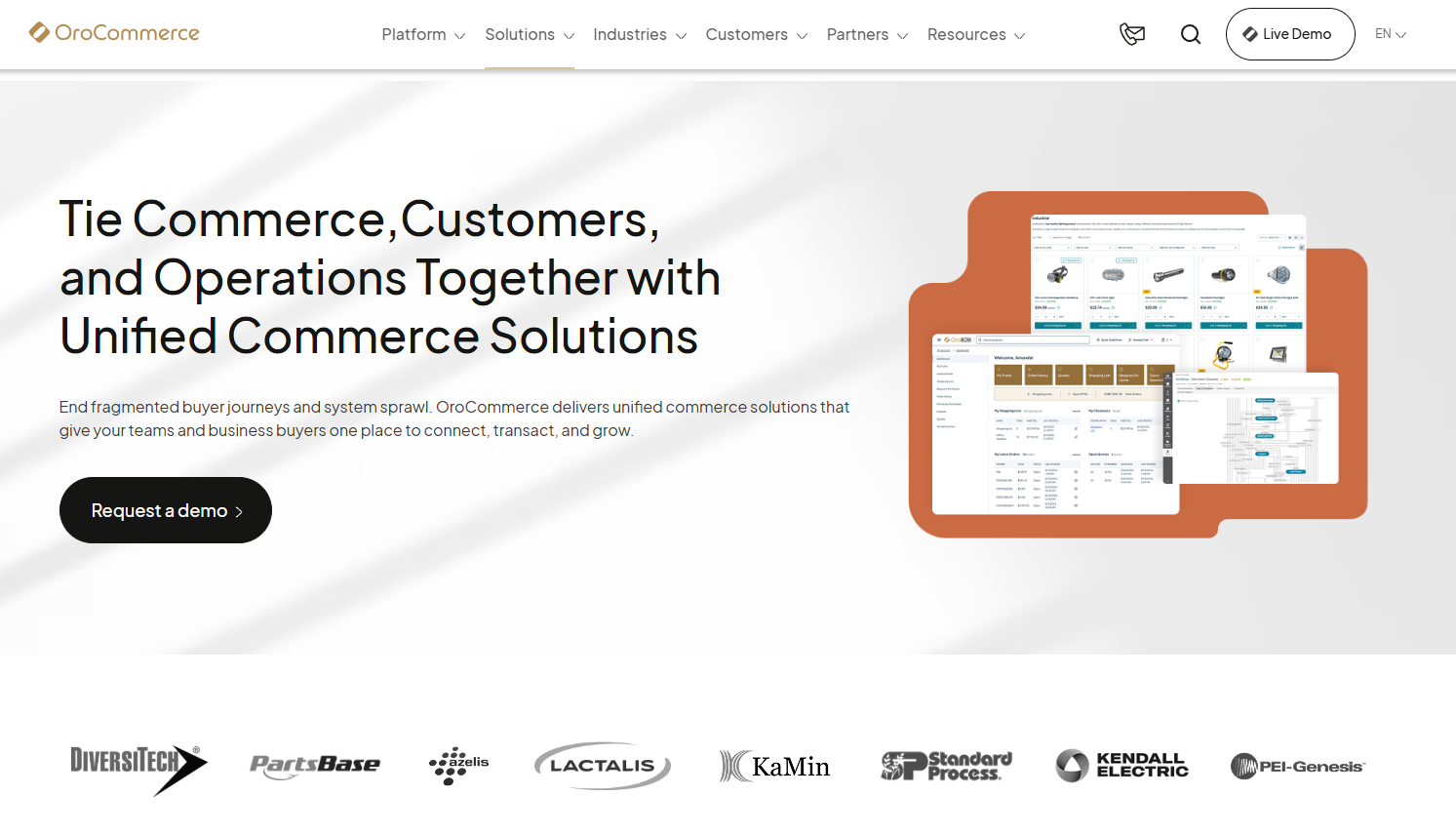
OroCommerce is a unified B2B eCommerce platform for manufacturers, distributors, and wholesalers. Built from the ground up for B2B complexity, it wasn’t adapted from retail. It’s an open-source platform available as both single-tenant SaaS and on-premises, serving clients in over 100 countries.
67% of new enterprise customers since 2024 are companies with $500M to $10B in revenue, with a 95% renewal rate. The platform supports 100+ portals, 8M+ SKUs, and 12+ ERPs in a single live instance, including SAP, Microsoft Dynamics, NetSuite, and Sage X3.
Best for
Mid-market and enterprise manufacturers, wholesale distributors, and industrial suppliers with complex pricing, multi-channel requirements, or ERP-heavy environments.
Key features
- Native RFQ and CPQ workflows with no third-party apps required
- Multi-org account hierarchies with granular buyer roles and approval chains
- Customer-specific catalogs and contract pricing enforced automatically at checkout
- Built-in CRM for unified customer relationship management and account management across all sales channels
- OroIQ orchestrator powering AI tools for orders, search, insights, and chat
- Low-code workflow automation for order routing, approvals, and notifications
- API-first architecture supporting headless, composable, and hybrid deployments
- Integrated OroPay supporting cards, ACH, and invoice-based payments with real-time ERP reconciliation
- Native marketplace capabilities for multi-vendor and reseller models
- SOC 2-compliant SaaS with no transaction fees and no API call limits
Pricing
Custom, based on deployment model and transaction volume. No per-transaction fees make it cost-effective for high-volume operations.
OroCommerce’s approach to unified commerce is worth exploring if your business spans complex sales models.
Get a demo today.
2. Shopify Plus
Shopify Plus is the enterprise tier of Shopify, the consumer ecommerce platform. It’s invested significantly in B2B capabilities, letting brands serve both DTC and wholesale business buyers from one admin without managing separate systems.
Shopify ships 100+ platform improvements every six months, and its AI assistant Sidekick can analyze SKU performance by territory and answer complex B2B questions.
Shopify Plus works well for brands adding wholesale. It falls short for manufacturers or distributors with complex pricing structures, multi-org account hierarchies, or high-SKU catalog requirements.
Learn more about Shopify Plus alternatives.
Best for
DTC brands adding a wholesale or B2B channel without building separate ecommerce websites.
Key features
- Company accounts with custom pricing and buyer permissions
- Net 30/60/90 payment terms built into checkout
- Sidekick AI for business insights and workflow automation
- Marketing tools and Shopify Flow for automated order workflows
- Hydrogen headless framework for custom frontend experiences
- Large app marketplace for extending platform capabilities
Pricing
From approximately $2,300/month. Third-party CPQ apps, complex B2B functionality, and deep ERP integration add cost and complexity.
3. Salesforce B2B Commerce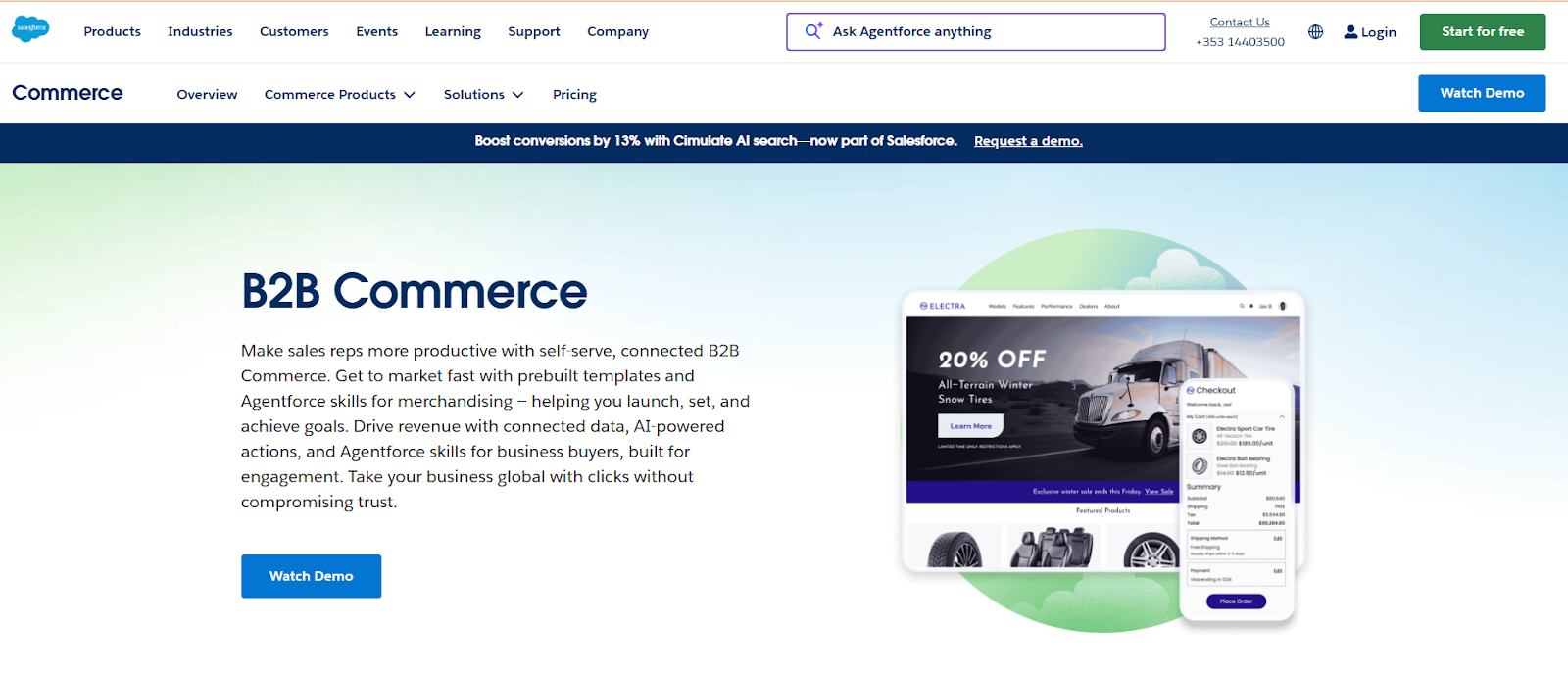
Salesforce Commerce Cloud is the B2B ecommerce solution within the Salesforce platform. It integrates natively with Salesforce CRM, Service Cloud, and Einstein AI, making it a strong option for enterprises that want customer data, commerce, and service operations in one place.
G2 reviewers consistently cite implementation complexity and steep learning curves. The platform delivers the most value for enterprises already running Salesforce Commerce Cloud across their business processes.
Best for
Large enterprises deeply invested in Salesforce that want ecommerce tightly coupled with customer relationship management and service operations.
Key features
- Native CRM integration with shared customer data across sales and commerce
- Einstein AI for personalization and product recommendations based on customer behavior
- Account-based pricing and catalog management for B2B customer groups
- Order management and case management via Salesforce Service Cloud
- Agentforce AI agents for guided selling and self-service capabilities
Pricing
Custom enterprise pricing. Implementation typically runs into six figures, making the total cost of ownership high. Organizations without an existing Salesforce stack might struggle to justify the investment.
4. BigCommerce B2B Edition
BigCommerce B2B Edition is a purpose-built B2B layer on top of BigCommerce’s SaaS platform, developed in partnership with Bundle B2B. It gives mid-market companies an accessible entry into digital commerce, with a user-friendly interface and a solid out-of-the-box feature set.
BigCommerce B2B Edition works well for simpler wholesale scenarios. Manufacturers with CPQ requirements, complex account hierarchies, or very large catalogs could find its platform capabilities insufficient at scale.
Learn more about BigCommerce competitors.
Best for
Mid-market wholesalers and distributors that want a practical B2B ecommerce solution without heavy implementation overhead.
Key features
- Company accounts with buyer roles, permissions, and customer accounts hierarchy
- B2B buyer portal with order history, invoicing, and order tracking
- Net terms and trade credit at checkout
- Custom pricing and customer-specific price lists per account
- Sales rep masquerading for assisted buying
- Multi-storefront support for managing multiple brands from one admin
Pricing
Enterprise plans with full B2B capabilities typically start in the $1,000-$2,000/month range, before implementation costs.
5. SAP Commerce Cloud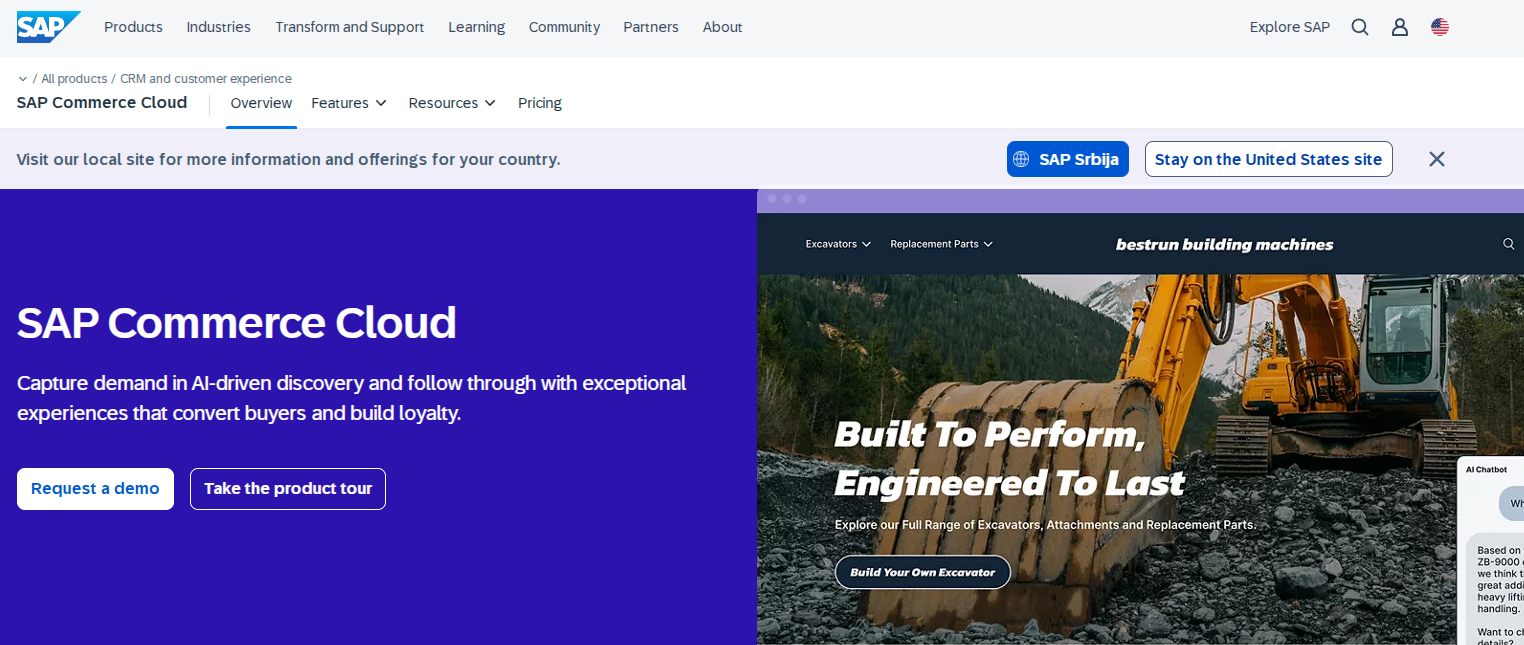
SAP Commerce Cloud is the enterprise digital commerce solution from SAP, designed for large organizations already running SAP ERP (S/4HANA or SAP ECC).
It’s built to enhance customer experiences across all touchpoints with consistent pricing, account information, and real-time availability. The platform supports B2B, B2C, and B2B2C from a single architecture.
Outside the SAP environment, the implementation complexity and cost are hard to justify. G2 reviewers highlight the steep learning curve and the need for dedicated technical resources.
Learn more about SAP Commerce Cloud competitors.
Best for
Large enterprises with deep SAP ERP investment that need digital commerce fully integrated with SAP finance, logistics, and customer master data.
Key features
- Native SAP ERP integration with real-time data sync and no fragile middleware
- Complex B2B pricing, including customer-specific pricing, volume discounts, and contract terms
- Org hierarchies with approval workflows, cost centers, and spending limits
- Self-service portals for order history, invoice management, and returns
- Multi-site and multi-language support for global operations
- Intelligent Selling Services for personalized customer experiences
- Punchout catalog support for integration with SAP Ariba, Coupa, and Jaggaer
Pricing
Custom enterprise pricing. SAP Commerce Cloud suits enterprises that can spread its implementation cost (typically 12 to 24 months) across significant transaction volume and an existing SAP environment.
Why OroCommerce Is the Best B2B eCommerce Platform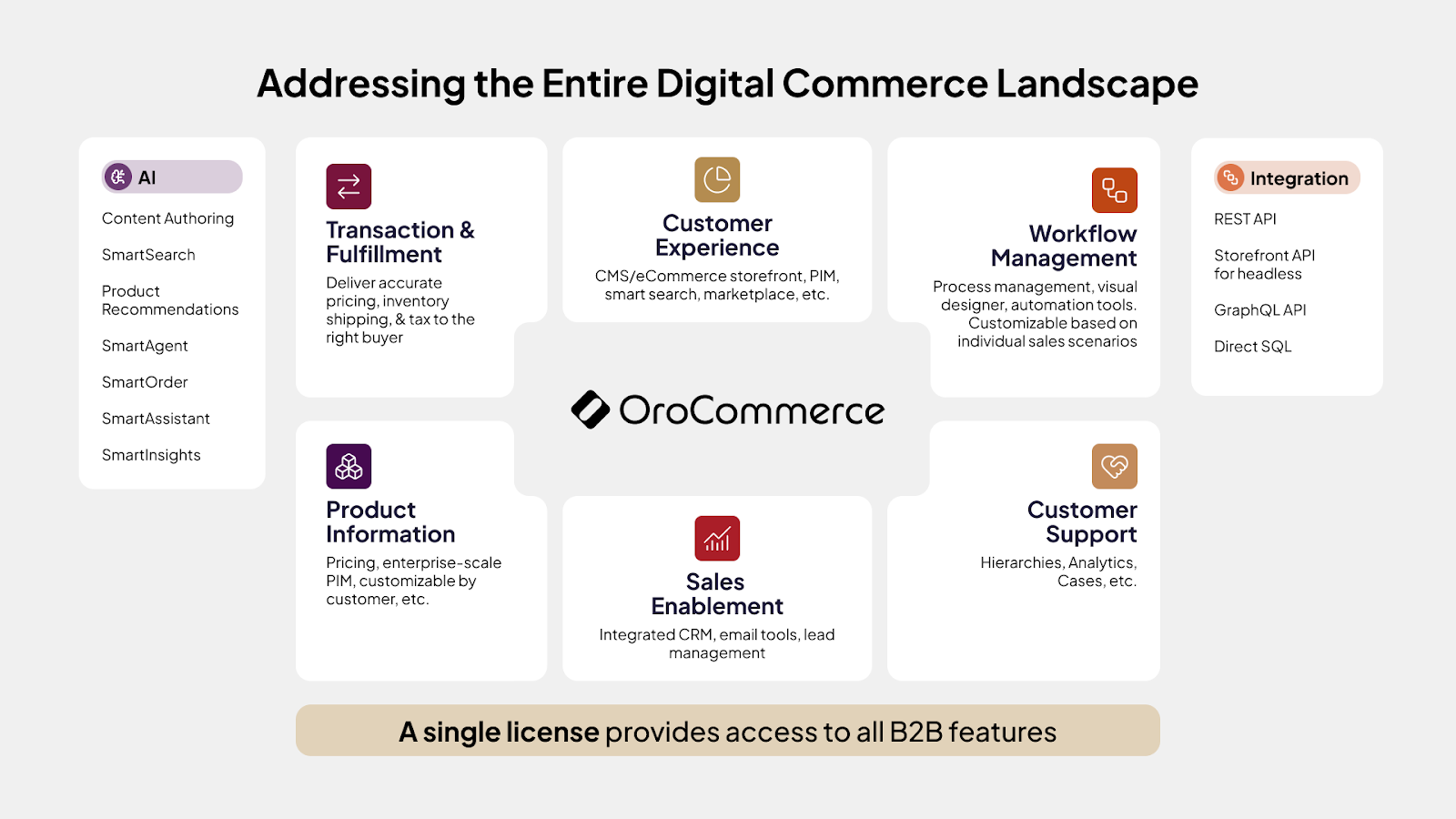
OroCommerce, a unified B2B eCommerce platform for manufacturers, distributors, and wholesalers, is the only platform in this comparison built natively for the full complexity of B2B commerce. It wasn’t retrofitted from consumer retail, and it doesn’t depend on a separate CRM.
Built B2B-first, not B2C-adapted
Most platforms on this list started elsewhere. Shopify Plus began in consumer retail. Salesforce Commerce Cloud is a CRM with commerce added on. SAP Commerce Cloud requires deep SAP investment to deliver value.
OroCommerce was built by the original creators of Magento, specifically for the workflows that manufacturers, distributors, and wholesalers run every day.
Native B2B features without add-ons
RFQ management, CPQ workflows, customer segmentation rules, multi-org hierarchies, and custom pricing are all core features: no plugins, no separate licensing, no CRM integration workarounds. The platform covers 70-80% of B2B eCommerce needs out of the box.
A single platform across the entire sales process
OroCommerce unifies eCommerce, CRM, PIM, invoicing, and payments in one system, eliminating the data fragmentation that plagues multi-tool implementations.
Sales teams, service reps, and buyers reference the same customer data, order history, and pricing in real time, whether they’re using the portal, the field sales app, or the admin backend.
No transaction fees, no lock-in
As an open-source platform with no per-transaction or per-API-call fees, OroCommerce keeps operational costs predictable, even at high order volumes. Businesses retain complete control over their commerce strategy without vendor-imposed constraints.
Proven enterprise traction
Companies including Gerdau S.A., Steelcase, and PartsBase (operating $2B+ networks) run on OroCommerce. These are large-scale, multi-brand implementations running billions in transaction volume.
See what strong distributor implementations look like in the distributor website examples on OroCommerce’s site.
See how OroCommerce handles your specific workflows
How to Evaluate B2B eCommerce Platforms: A Practical Checklist
Selecting the right eCommerce platform means mapping your requirements before you talk to any vendor. These steps reduce implementation risk and prevent platform regret.
- Define your use case first. Bulk ordering, CPQ, multi-storefront, and partner portals each demand different platform capabilities. Write these down before any vendor conversation.
- Map mandatory integrations. List every system that must connect: ERP, OMS, PIM, CRM and POS. Evaluate any integration listed as “via third-party connector” carefully for latency, data quality, and maintenance cost.
- Calculate the total cost of ownership. License cost is a small fraction of TCO. Include implementation services, integration development, internal staff time, training, and ongoing maintenance.
- Request reference customers in your industry. Ask each vendor for three references with comparable order volume, SKU count, and ERP environment. Generic reference calls don’t tell you what you need to know.
- Run a phased pilot with a real buyer segment. Launch with one product category or customer tier to surface integration gaps before full rollout.
Verify scalability and compliance. Confirm uptime SLAs, PCI compliance certification, SOC 2 Type II status, and disaster recovery procedures before signing.
Common Implementation Pitfalls and How to Avoid Them
Most B2B eCommerce implementations that miss deadlines or blow budgets fail for predictable reasons, not technical ones. Recognizing these patterns before you start is the best way to avoid them.
- Over-customization: Every requirement addressed through custom development adds to your long-term maintenance burden. When the platform upgrades, custom code breaks. Configuring within standard capabilities rather than building custom solutions for every edge case saves high costs over a three-to-five-year horizon.
- Poor product data quality: Missing attributes, inconsistent taxonomy, and duplicate SKUs undermine search and conversion from day one. Start data cleansing before implementation begins, not after launch exposes the problem.
- Late integration planning: Leaving ERP and CRM integration to the final project phase almost always results in scope creep and budget overruns. Run integration work in parallel with storefront configuration from day one.
- Skipping phased rollout: Launching everything at once means discovering critical UX problems after your entire buyer base has already experienced them. A phased approach protects your commercial relationships during the learning curve.
- Understaffing the project: A successful launch needs clear cross-functional ownership: a project lead with decision authority, IT for integrations, marketing for catalog and content, and sales for buyer onboarding and adoption.
The cost of avoiding these pitfalls is discipline. The cost of ignoring them is measured in months of delays and percentage points of budget overrun.
ROI and Business Impact: What to Measure
ROI from a B2B eCommerce investment is measurable, but only if you define KPIs before go-live. These metrics give leadership and operations teams a shared framework.
- Speed-to-revenue: Track time from contract to first buyer transaction and the rate at which phone and email orders shift to digital channels.
- Operational efficiency: Measure reduction in manual order entry hours, decrease in order error rates, and time saved on dispute resolution. Customer acquisition cost also tends to fall as self-service scales.
- Core commerce KPIs: Order cycle time, average order value, repeat purchase rate, and customer lifetime value show whether the platform is improving buyer behavior. Higher customer satisfaction correlates directly with repeat purchase rate.
- Customer loyalty indicators: Net Promoter Score for portal users, retention cohort analysis, and buyer satisfaction scores connect platform performance to long-term revenue. Platforms that genuinely enhance customer satisfaction, through faster reordering, accurate pricing, and self-service account management, show measurably better cohort retention.
- Total cost of ownership: A SaaS platform reduces infrastructure overhead but introduces per-transaction fees that compound at scale. Compare TCO across deployment models before you sign, or face cost surprises in year two.
These metrics are the clearest indicators of long-term business success, and they build the case for continued platform investment and expansion into new digital channels.
Conclusion: The Best eCommerce Platform for Your B2B Operations
The right platform for B2B is the one built for how business buyers actually operate. Don’t settle for a consumer platform extended through workarounds.
Prioritize platforms that handle net terms, contract pricing, and multi-org account management as core capabilities, not optional modules.
Avoid tools that require heavy custom development to meet standard B2B requirements. Align your platform choice with your integration readiness, buyer expectations, and long-term commerce strategy.
For manufacturers, distributors, and wholesalers operating at scale, OroCommerce is the right choice.
It’s a unified B2B eCommerce platform built to support complex business operations at scale, without vendor lock-in or bolt-on compromises.
See how OroCommerce handles your specific setup.
FAQs About the Best B2B eCommerce Platform
How much does a B2B eCommerce platform cost?
BigCommerce B2B Edition starts at around $1,000-$2,000/month. Shopify Plus starts at approximately $2,300/month. Enterprise platforms: OroCommerce, Salesforce Commerce Cloud, and SAP Commerce Cloud use custom pricing.
How is B2B eCommerce different from B2C?
B2B buyers operate within company accounts with defined roles, spending limits, and purchasing approval chains. They buy under negotiated contract terms, not list prices, and require PO-based checkout, net terms, and multi-level approval workflows.
B2C eCommerce was designed for individual consumers making single-session, single-card transactions.
Can Shopify Plus handle B2B eCommerce?
Shopify Plus works for brands adding a wholesale channel alongside an existing DTC store. It lacks native CPQ, deep RFQ workflows, and the multi-org structures that manufacturers and distributors with complex operations need.
Teams with straightforward wholesale needs may find it adequate; those with complex pricing or integration requirements typically outgrow it.