navigation

Retail shopping carts break under the weight of wholesale operations. When your buyers log in, they aren’t browsing. They expect to see their negotiated rates, contracted product lists, and net terms instantly.
If your development team has to buy third-party apps just to handle a basic purchase order workflow, you haven’t deployed the best B2B ecommerce platform for wholesale. You just bought a consumer tool that requires constant patching.
This article compares five of the best ecommerce platforms: OroCommerce, Adobe Commerce, Sana Commerce, ElasticPath, and BigCommerce B2B Edition, evaluated on pricing flexibility, self-service capability, ERP integration, account management, and total cost of ownership.
What to Look for in a B2B eCommerce Platform for Wholesale
Seven capabilities separate the best eCommerce platform for wholesale from a retail tool with B2B add-ons. Every platform on your shortlist should meet all seven natively, without requiring third-party apps or custom development to fill gaps that should not exist.
- Account-specific pricing and custom catalogs. Wholesale buyers expect to log in and immediately see their negotiated pricing, contracted products, and payment terms. Platforms that cannot support customer-specific catalogs across different customer groups at scale create operational problems as the buyer count grows.
- Bulk ordering tools. High-volume wholesale buyers need CSV order upload, quick order forms, minimum order quantities, volume discounts, and one-click reorder from purchase history. These directly affect order speed and repeat purchase rates.
- Net payment terms and flexible payment options. Net 30, net 60, credit lines, purchase orders, and ACH transfers are standard in wholesale. A B2B eCommerce platform limited to credit card checkout is not built for wholesale buyers.
- Self-service buyer portal. Business users should manage their account, view invoices, track shipments, and reorder without contacting the sales team. A capable self-service portal reduces the cost of serving existing accounts and drives repeat purchases.
- ERP integration depth. Your commerce platform needs to match how your IT team manages server load. Look for software that handles heavy background syncs while firing live calls for critical inventory and contract pricing at checkout.
- Customer segmentation and approval workflows. Gated catalogs, login-based visibility, and account-level permissions ensure buyers see only what is relevant to their account. Corporate wholesale accounts also need multi-buyer structures with defined spending limits and approval routing as core capabilities, not expensive customizations.
Total cost of ownership over three to five years. Licensing, ERP integration, customization, and per-transaction fees all contribute to real cost. A thorough total cost of ownership analysis for eCommerce belongs in every platform evaluation.
Best B2B eCommerce Platforms for Wholesale at a Glance
| Platform | Best For | Top B2B Feature | Pricing Model |
| OroCommerce | Mid-market to enterprise wholesale with complex pricing and ERP sync requirements | Native price list engine with customer-specific, tiered, and contract pricing; one master catalog as the source of truth and unlimited rule-based web catalogs for personalized experiences. | GMV-based; single license, no transaction fees |
| Adobe Commerce | Large enterprises with extensive dev resources and Adobe stack investment | Company accounts, shared catalogs, requisition lists | PaaS; high TCO |
| Sana Commerce | SAP and Microsoft Dynamics users wanting ERP-native B2B commerce | Live ERP data sync with no separate integration layer | Custom; multiple editions |
| ElasticPath | Composable commerce teams needing headless flexibility for complex B2B use cases | API-first, headless commerce capabilities with deep customization | Custom enterprise pricing, higher TCO |
| BigCommerce B2B Edition | Growing wholesale businesses wanting SaaS simplicity with strong B2B features | Buyer portal, company accounts, and custom pricing on a SaaS foundation | Custom; software as a service model |
5 Best B2B eCommerce Platforms for Wholesale in 2026
The following platforms each address core wholesale eCommerce requirements, but with different architectures, integration approaches, and total cost profiles:
- OroCommerce: a B2B-first platform for wholesalers, distributors, and manufacturers with complex sales workflows.
- Adobe Commerce: enterprise-grade customization on the Magento B2C foundation
- Sana Commerce: ERP-native commerce for SAP and Microsoft Dynamics users
- ElasticPath: composable, API-first platform for headless wholesale builds
- BigCommerce B2B Edition: SaaS wholesale platform with solid out-of-the-box B2B tools
Here is what each platform delivers for wholesale operations.
1. OroCommerce: Best B2B eCommerce platform for wholesale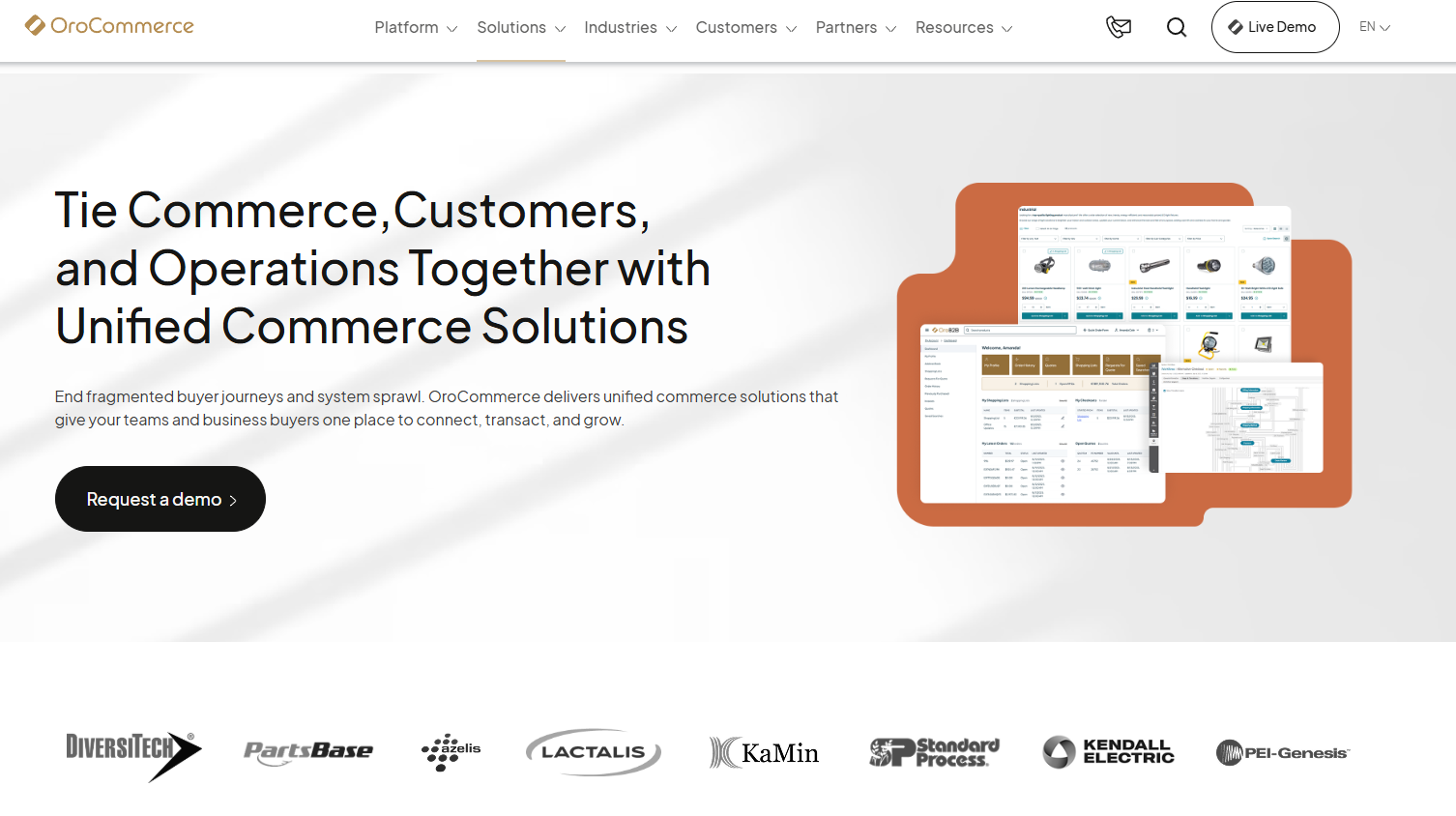
OroCommerce is a unified B2B eСommerce platform built specifically for manufacturers, distributors, and wholesale operations.
Unlike platforms that add B2B features to a retail-first foundation, OroCommerce ships complex pricing, multi-buyer account management, complex catalogs, and deep ERP connectivity as native capabilities under a single license.
The platform consolidates eСommerce, CRM, CPQ, PIM, and AI into a unified data model, delivering enterprise-grade reliability as single-tenant SaaS, in a private cloud, or on-premises.
Best for
Mid-market to large wholesale distributors, manufacturers, and supply chain partners with complex customer-specific pricing, multi-account management, high-volume catalogs, and deep ERP integration requirements.
Key features
- Price list engine: Supports customer-specific pricing, tiered pricing, volume discounts, contract pricing, and location-aware pricing synced with ERP data in real time.
- Bulk ordering: CSV upload, quick order forms, MOQs, and one-click reorder from full order history cover the core needs of high-volume wholesale buyers.
- Payment flexibility: Net payment terms, purchase order support, credit management, native embedded payments with OroPay or flexible payment gateway integrations built into the platform.
- Account hierarchies: Corporate accounts with granular buyer roles, spending limits, and approval workflows are native capabilities, not extensions.
- Rule-based catalogs: A single master catalog feeds unlimited web catalogs, with rules driving personalized product experiences for every buyer segment, channel, or storefront.
- Built-in CRM: A 360-degree view of every wholesale account, interaction, and order supports long-term customer relationships across the full sales cycle.
- OroIQ AI: Intelligent reorder suggestions and automated back-office tasks reduce manual work for the sales team.
- ERP connectors: Native integrations for SAP, Microsoft Dynamics, NetSuite, and Oracle require no middleware.
- Built-in PIM: Manages complex product catalogs, large SKU sets, and customer-specific catalogs from one place.
- Self-service portal: Personalized catalogs, full order history, invoice management, and shipment tracking give buyers complete control.
- Multi-organization support: Manage multiple brands or regional storefronts from a single backend.
Pricing
Online GMV-based tiered pricing. A single license covers all core modules (eCommerce, CRM, CPQ, PIM, and AI) with no per-site fees and no transaction fees. Use the B2B eCommerce ROI calculator to model expected return against current manual order processing costs.
Bring your hardest wholesale workflows to the table and see how we handle them.
2. Adobe Commerce: Best for large enterprises with Adobe Stack investment
Adobe Commerce, formerly Magento Commerce, is a widely deployed enterprise eCommerce platform with deep integration across Adobe Experience Cloud. Its B2B module includes company accounts, shared catalogs, requisition lists, purchase order support, and customer group pricing as native capabilities.
Adobe Commerce suits wholesale enterprises already invested in the Adobe ecosystem, particularly those using Adobe Experience Manager, Marketo Engage, or Adobe Analytics for customer experience management.
Outside of that stack, its total cost of ownership is difficult to justify against more focused wholesale alternatives.
Learn more about Adobe Commerce competitors.
Best for
Large wholesale enterprises with significant internal development resources, complex product catalogs, and existing investment in Adobe Experience Cloud tools.
Key features
- Company accounts: Shared catalogs, requisition lists, and purchase order workflows are included in the B2B module for managing different customer segments.
- Customer group pricing: Volume discounts and account-level price books are configurable at scale across different customer groups.
- Inventory management: Multi-source inventory with warehouse and shipping rule support handles complex fulfillment scenarios.
- Headless commerce: GraphQL API enables custom front-end builds for teams with composable requirements.
- Adobe integrations: Native connectors for Adobe Experience Manager, Marketo Engage, and Adobe Analytics support the full Adobe stack.
- Multi-site management: Manage multiple brands or regional ecommerce stores from a single installation.
Pricing
PaaS model; high TCO. Licensing, customization, developer resources, and ongoing maintenance make Adobe Commerce one of the most expensive wholesale eCommerce options in this comparison to operate at scale.
3. Sana Commerce: Best for SAP and Microsoft Dynamics users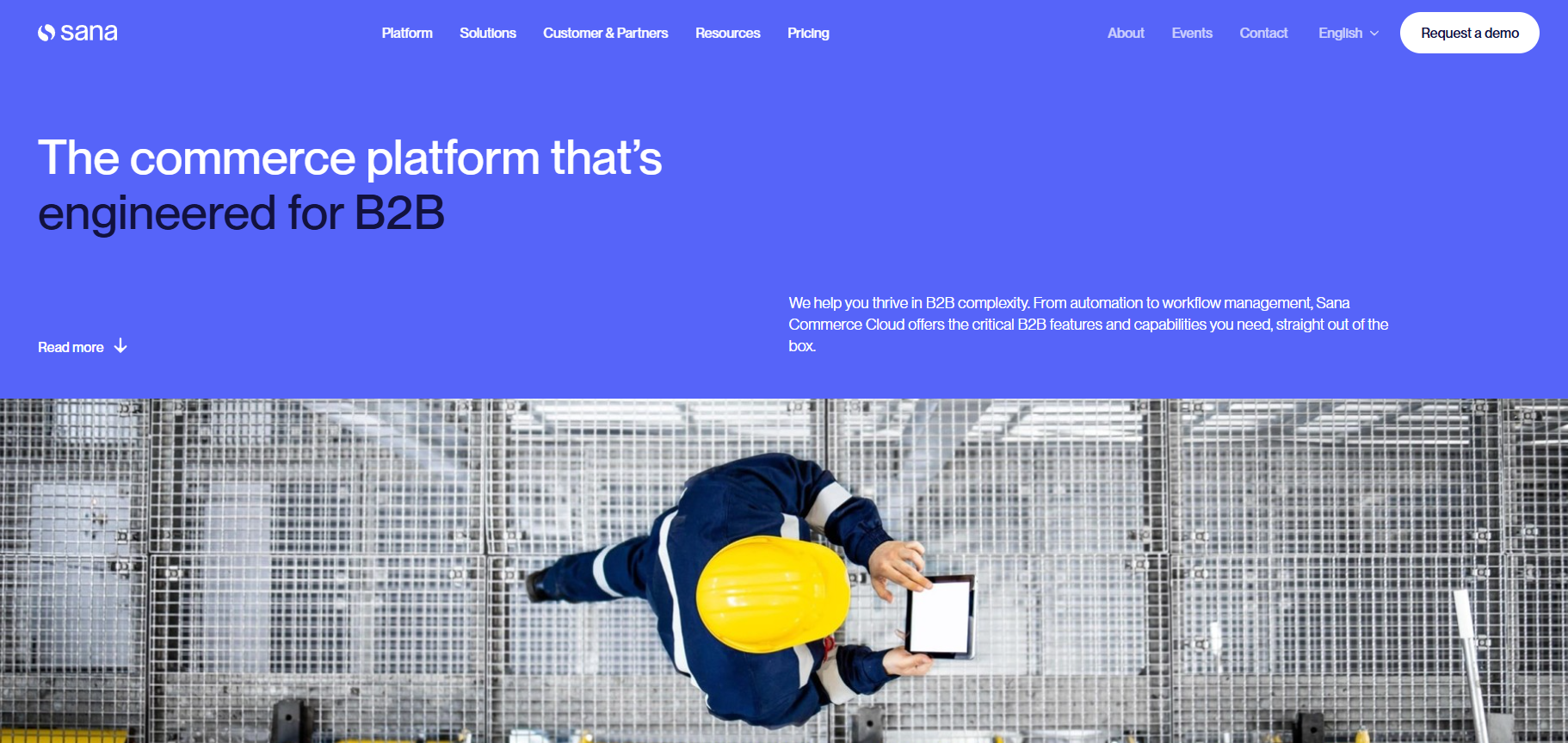
Sana Commerce is an ERP-native B2B eCommerce platform built to run directly on top of SAP or Microsoft Dynamics. Rather than maintaining a separate sync layer, Sana Commerce reads pricing, inventory, customer terms, and order data live from the ERP, so the storefront and the ERP are always in agreement.
For wholesale distributors already on SAP or Microsoft Dynamics, this architecture eliminates an entire category of integration problems. Buyers see the same data the back office sees, orders are correct the first time, and fulfillment runs without manual correction.
Sana Commerce also supports punchout catalog integration for buyers using procurement systems such as Coupa or Ariba.
Best for
Wholesale businesses running SAP or Microsoft Dynamics that want a B2B web store without managing a separate integration layer. Not cost-effective for businesses on other ERP systems.
Key features
- ERP-native integration: Pricing, inventory, customer terms, and order data reflect SAP or Microsoft Dynamics records in real time with no sync delay.
- Customer-specific data: Customer-specific pricing, credit limits, and net payment terms pull directly from ERP master data.
- Self-service portal: Order history, invoice access, shipment tracking, and order management are available without sales team involvement.
- ERP-driven catalog: Product catalog built from ERP master data keeps specifications and availability consistent across all accounts.
- Reorder tools: Quick reorder from full order history and saved order lists serve repeat wholesale buyers efficiently.
- Procurement connectivity: Punchout catalog support for buyers using procurement systems such as Coupa or Ariba.
- International support: Multi-language and multi-currency capabilities cover cross-border wholesale operations.
Pricing
Custom pricing across multiple editions (Essential, Pro, Advanced).
4. ElasticPath: Best for composable, headless wholesale commerce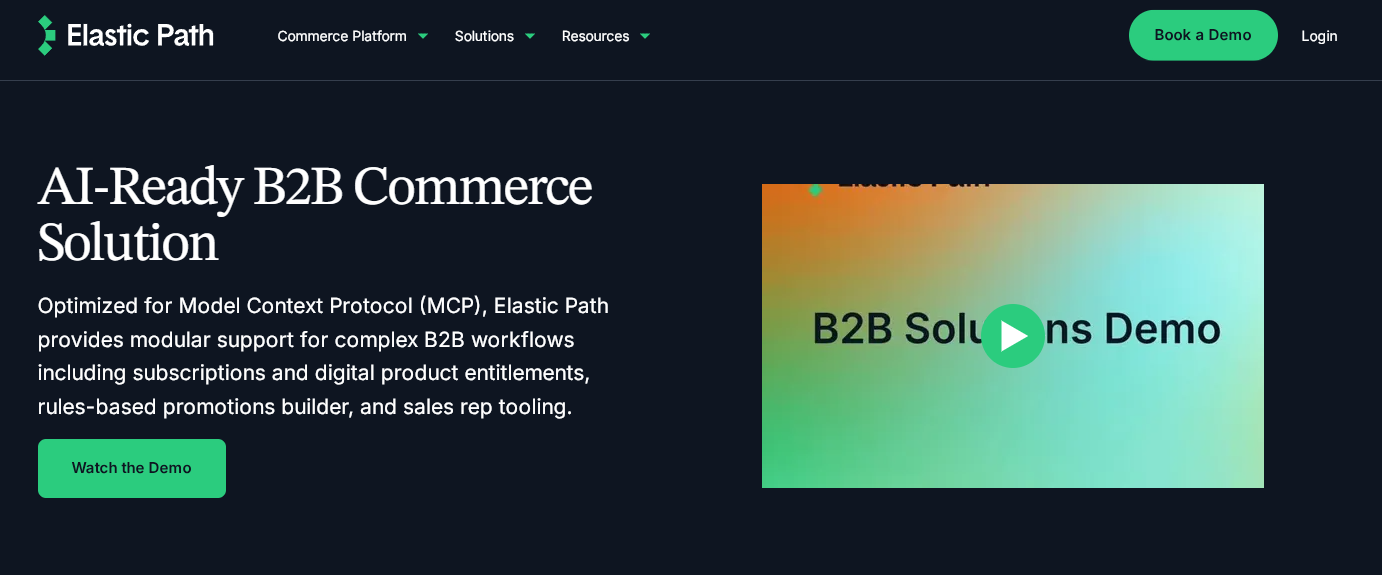
ElasticPath is an API-first, composable commerce platform for wholesale businesses that need highly customized eCommerce experiences.
It assembles services for product management, pricing, payments, and customer data, giving development teams complete control over how the platform integrates with existing systems.
For wholesale operations with complex technical requirements or a large existing tech stack, ElasticPath offers headless commerce capabilities.
The trade-off is implementation cost: significant technical investment is needed to assemble and maintain the platform.
Best for
Wholesale businesses with strong engineering teams that need deep customization, headless commerce capabilities, and complex existing systems integration at the API level.
Key features
- Headless architecture: API-first design enables fully custom front-end builds and flexible storefront experiences without platform constraints.
- Personalized pricing: Customer-specific pricing rules and price-book management via an open API support sophisticated pricing models.
- Account management: Account hierarchies and customer segments with API-level access control mirror complex wholesale structures.
- Integration capabilities: Open API connects to ERP and CRM systems across the existing tech stack without proprietary middleware.
- Multi-store support: Manage multiple brands or sales channels with separate configurations from one platform.
- Composable architecture: Individual commerce components can be replaced or upgraded without rebuilding the entire platform.
Pricing
Custom enterprise pricing based on gross merchandise value. The total cost includes the ElasticPath license and every third-party service in the stack: payments, search, PIM, and marketing tools. Model total stack cost, not just platform licensing.
5. BigCommerce B2B Edition: Best SaaS option for growing wholesale businesses
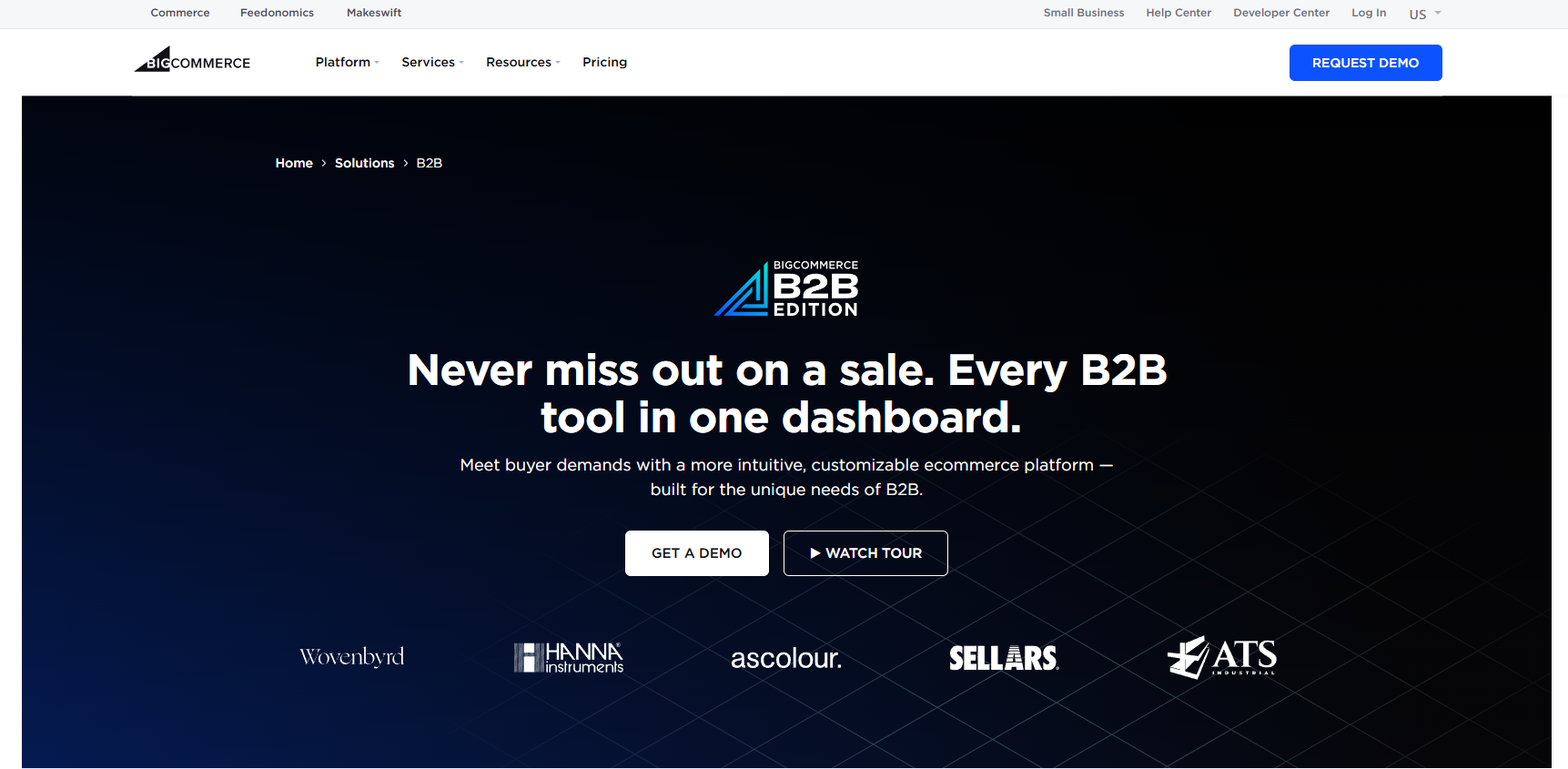
BigCommerce B2B Edition is a software-as-a-service wholesale eCommerce platform that delivers solid B2B features on a managed SaaS foundation.
It includes a dedicated buyer portal, company account management, customer-specific pricing, and quote management. The SaaS architecture handles hosting, security, and updates, reducing internal operational burden.
Wholesale businesses with highly complex pricing structures or deep ERP integration requirements may find native capabilities limiting and needing supplementation with third-party apps. For small to lower mid-market operations focused on growth without infrastructure overhead, BigCommerce B2B Edition is a capable option.
Best for
Growing mid-market wholesale businesses that want a capable SaaS B2B eCommerce platform with manageable total cost and strong out-of-the-box B2B tools.
Key features
- Buyer portal: Company account management, order history, and invoice access give wholesale buyers a self-service experience without sales team intervention.
- Customer-specific pricing: Custom catalogs and personalized pricing are configurable by customer groups and different customer segments.
- Quote management: Negotiated pricing workflows let sales reps and buyers agree on terms before order placement.
- Bulk ordering: Quick order tools and CSV upload support high-volume wholesale purchases efficiently.
- Headless commerce: Storefront API enables custom front-end builds for teams with composable requirements.
- SaaS economics: No transaction fees on enterprise plans; predictable ongoing costs with a managed infrastructure model.
Pricing
Custom pricing based on gross merchandise value. No transaction fees on enterprise tiers. Factor in third-party app subscription costs if core wholesale features require supplementation.
Why OroCommerce Is the Best B2B eCommerce Platform for Wholesale
Every platform on this list handles wholesale ecommerce at some level. OroCommerce handles the full depth of wholesale complexity natively, so you aren’t forced to patch feature gaps with third-party apps.
Sales reps and customers work in one system
Wholesale buyers frequently rely on a sales rep to verify complex part compatibility over the phone. In most platforms, if a rep builds that order in the ERP, the customer never sees it in their portal.
OroCommerce unites the storefront and CRM natively. Take PartsBase, a $2 billion aviation network. They used OroCommerce’s native workflow engine to fully automate buyer onboarding and self-serve quoting. PartsBase cut their high-touch onboarding cycle from several days to just five minutes.
Natively supporting complex pricing and catalogs
Throw 5 million SKUs and 10,000 customer-specific price books at a standard online store and watch the page load times crash. Consumer platforms rely on third-party lookup apps to handle this scale. OroCommerce processes it natively. Aftermarket equipment distributor TruPar, for example, relies on OroCommerce to serve real-time pricing and availability across an 8-million SKU catalog.
The system also inherently understands complex B2B units of measure, allowing a buyer to easily toggle between purchasing eaches, cases, or pallets based on their specific contract rates.
Multiple brands on one platform
Mid-market wholesalers often grow through acquisition. When you buy a regional distributor or launch a new division, standing up a totally new server instance is a massive waste of IT budget.
Oro’s Multi-Org structure lets you run independent brands and entirely different regional tax rules from one central backend.
HVAC supplier DiversiTech inherited 12 different ERP systems after an aggressive M&A spree. Instead of maintaining separate infrastructure, they deployed OroCommerce. Today, they run three distinct wholesale storefronts from a single unified backend.
Consolidating your infrastructure to manage all global entities under a single pane of glass creates undeniable operational efficiency. See exactly how this structural advantage holds up against patched-together tech stacks in this enterprise B2B ecommerce platform comparison.
See what happens when your commerce platform natively understands B2B.
How Wholesale Businesses Can Use eCommerce to Reduce Manual Order Processing
Manual order processing (phone calls, faxed purchase orders, and spreadsheet-based pricing updates) is the primary source of errors, delays, and sales team burnout for most wholesale businesses.
When pricing lives in a spreadsheet, and orders arrive by email, every transaction requires human translation between systems, leaving sales reps doing administration rather than growing accounts.
A purpose-built wholesale eCommerce platform addresses this systematically across every stage of the order cycle:
- Eliminate the manual order bottleneck. A self-service portal lets wholesale customers browse their personalized catalog, check real-time inventory management data, and place bulk orders without sales team involvement, reducing errors and accelerating fulfillment.
- Automate repeat ordering. Saved order lists, restocking reminders, and AI-driven replenishment suggestions eliminate the cycle of chasing repeat business manually, reducing buyer behavior friction on routine purchases.
- Free the sales team for growth work. When routine transactions are handled by a sales order automation tool, sales reps shift focus to customer relationships, upselling, and new account development on the wholesale marketplace, a core pillar of any B2B sales enablement strategy.
- Streamline operations end-to-end. Platforms that unify order management, pricing, and customer data in one system help wholesale businesses streamline operations, cut administrative overhead, and improve customer satisfaction across every account.
Before committing to any platform, insist on seeing live account-specific pricing, bulk reorder from purchase history, CSV order upload, and ERP sync in action. See the 8 B2B ecommerce capabilities to see live before you replatform.
Conclusion: On the Best B2B eCommerce Platform for Wholesale
Each platform covered here addresses wholesale eCommerce, but with meaningfully different strengths. Consider Salesforce Commerce Cloud or SAP Commerce Cloud if your business is already deeply embedded in those ecosystems, but for most wholesale operations, purpose-built platforms outperform suite-attached modules in terms of flexibility and total cost.
Here is how the five platforms in this comparison break down:
- OroCommerce is the strongest purpose-built option for wholesale businesses needing native complex pricing, multi-account management, built-in CRM, and deep ERP integration without assembling third-party tools.
- Adobe Commerce suits large enterprises with substantial development resources and existing Adobe stack investment, though the total cost of ownership is high.
- Sana Commerce is the right choice for wholesale distributors running SAP or Microsoft Dynamics who want ERP-native commerce without a separate integration layer.
- ElasticPath suits wholesale operations with strong engineering teams needing maximum composable flexibility and headless commerce capabilities.
- BigCommerce B2B Edition is a capable SaaS option for small to low mid-market wholesale businesses that want solid B2B tools without infrastructure complexity.
Before shortlisting, audit your actual requirements: pricing complexity, volume of manually processed purchase orders per week, and depth of ERP integration needed.
Choosing the right platform starts with honest answers to those questions. Consulting an enterprise B2B eCommerce guide can help frame evaluation criteria for your business model.
For wholesale businesses with complex pricing, high order volume, and serious ERP integration requirements, OroCommerce’s unified architecture consistently offers the strongest fit and the most predictable total cost of ownership for eCommerce over a three-to-five-year horizon.
See how OroCommerce handles your wholesale pricing, account management, and ERP integration requirements live
FAQs About B2B eCommerce Platforms for Wholesale
What makes a B2B eCommerce platform suitable for wholesale businesses?
A B2B eCommerce platform suits wholesale when it natively supports customer-specific pricing, net payment terms, bulk ordering tools, account hierarchies with approval workflows, and real-time ERP integration. Platforms requiring third-party apps for these core capabilities are not purpose-built for wholesale and carry significantly higher total cost at scale.
Which B2B eCommerce platform handles bulk ordering and net payment terms best?
OroCommerce handles both most comprehensively as native capabilities. It supports CSV order upload, quick order forms, minimum order quantities, and reorder from full purchase history, alongside built-in net payment term management, purchase order support, and credit line administration, with no additional extensions required.
Does OroCommerce support wholesale pricing and account-specific catalogs?
Yes. OroCommerce includes a flexible price list engine supporting customer-specific pricing, tiered pricing, volume discounts, and contract pricing. Each buyer account can be assigned a personalized catalog showing only their contracted products at their negotiated rates, with pricing synced from the ERP in real time.
How does ERP integration improve wholesale eCommerce operations?
Deep ERP integration eliminates manual reconciliation between the storefront and the back office. When pricing, inventory, and customer data sync in real time, orders are fulfilled faster, inventory accuracy improves, and sales teams stop spending time correcting discrepancies. OroCommerce’s native ERP connectors for SAP, Microsoft Dynamics, NetSuite, and Oracle require no middleware.
Can wholesale businesses manage multiple buyer accounts from one platform?
Yes. Purpose-built wholesale ecommerce platforms support multi-buyer corporate accounts with account hierarchies, role-based permissions, spending limits, and approval workflows. OroCommerce includes these as native capabilities, allowing businesses to mirror the actual structure of their corporate customer accounts, with multiple buyers, different permission levels, and automated approval routing, from a single backend.