
navigation

Expanding a digital channel into international markets surfaces all the small but consequential differences that shape how companies buy: language, data standards, approval paths, regional rules, and the expectations buyers bring from their own environments. When those details drift out of sync with what a target market needs, even the strongest online store struggles to gain traction.
This piece takes a practical look at where B2B eCommerce localization breaks down and the adjustments that help teams adapt for new markets without creating a maze of one-off solutions.
What “Localization” Means in B2B
For B2C, localization usually means translating the eCommerce website, adjusting prices, and calling it a day.
In B2B, your target audience is dealing with:
- contract pricing and credit limits,
- regulatory documents,
- and buying processes that involve several people, not one “online shopper.”
That changes everything.
When you localize a B2B e commerce site, you’re adapting:
- how account structures work in each target region,
- which products and units appear in each local market,
- how taxes, shipping, and online transactions behave,
- and how your teams handle localized customer support.
Language still matters. Buyers are more likely to trust you if the online store speaks their native language and uses familiar terms. But if the payment methods, shipping costs, and approvals don’t fit local norms, translation won’t save you.
So, instead of thinking “translate the eCommerce store,” think: “How would a fully competent local distributor run this online store for their own customers?”
That’s your eCommerce localization benchmark.
Where B2B Localization Efforts Usually Fall Apart
Most teams don’t need a manifesto on localization in B2B eCommerce. They need a clear sense of what’s broken and what to fix in what order.
1. Buyers Can’t Reliably Buy in That Region
This is the most basic failure mode, and it shows up quickly once international customers start using the site.
You see things like:
- the interface half-translated into the target language,
- prices stuck in the wrong currency for that target region,
- unclear taxes, duties, and shipping costs,
- missing or unfamiliar payment methods,
- delivery options that don’t reflect how carriers operate in that local market.
In this state, your so-called localized online store is just a catalog. Buyers might browse, but they’ll place the order through email or phone.
This is the first layer to fix because nothing else matters if people can’t confidently complete online transactions. It’s also where platform and integration gaps surface: ERP feeds that don’t support multiple currencies, tax engines that aren’t wired in, shipping integrations that don’t understand cross-border. If those are wrong, no amount of localized content will save the experience.
2. Buyers Can’t Tell What They’re Buying
Once people can technically place an order, the next failure is clarity.
In each local market, ask yourself: would a competent local buyer feel confident pressing “Submit order” based on what they see?
Common signs they wouldn’t:
- category names and product descriptions left in English while everything else is “localized”,
- units, pack sizes, or specs that don’t match local preferences or standards,
- critical docs (safety sheets, manuals, certificates) missing or not available as multilingual content,
- a user interface that uses terms nobody in that region would actually say.
The issue here has little to do with wording and everything to do with how the data and structure are set up.
If Italian technicians are copying SKUs into WhatsApp to double-check details, your content localization has failed. At that point, translation memory, structured attributes, and a catalog or PIM that can serve different data per target market do more for customer engagement than another banner campaign ever will.
This is the second thing to tackle. Once core content is precise in the right target language, you can trust that orders placed through the site are at least based on the right information.
3. The Flow Ignores How That Market Buys
The last failure is more subtle and very common: the customer journey you’ve put online doesn’t resemble how that region buys from you offline.
Examples:
- markets where buyers expect quote-first flows and your site only offers instant checkout,
- regions where delegated purchasing and approvals are the norm, but your account model only knows “one user, one card,”
- industries where compliance checks, export controls, or environmental declarations are required steps, but those checks live in someone’s inbox instead of in the flow.
In these cases, buyers understand the products, and technically they can pay. They just don’t trust the process. So they revert to whatever mix of reps, email, and spreadsheets already works.
This is where platform capabilities really decide your future. If your system can’t adapt workflows, account structures, and permissions per region, you’re not localizing. You’re asking each market to contort itself around whatever the default flow happens to be.
Fixing this doesn’t start with more translation. It starts with mapping real local processes, then using a workflow engine and access controls to make the eCommerce platform behave like a competent local channel instead of a generic global template.
Check the comparison guide to understand which B2B eCommerce platforms adapt best to new markets.
How Your Platform Decides if Localization Helps or Hurts
Once you know where localization is failing – buying, understanding, or flow – the next question is whether your stack can support the fix or keeps fighting you.
This is where architecture matters more than word choices.
A lot of localization challenges show up the same way: a target market in one region quietly drifts back to email and spreadsheets while you’re trying to drive online transactions. That’s usually a sign the platform still treats international markets as one global blob: one currency model, one tax model, one checkout pattern.
A platform that takes eCommerce localization in B2B seriously lets you describe “France” and “US” as different commercial setups on the same spine:
- Price lists tied to local currencies with room for regional discounts and contract pricing.
- Tax and invoice rules that follow local laws instead of one global template.
- Checkout that can plug in local payment methods, carriers, and duty calculation without cloning the eCommerce site for each region.
OroCommerce leans into that model. The pricing engine supports customer-specific and region-specific price lists; globalization features allow per-site configuration of catalog, pricing, language, and content; APIs and connectors tie into ERP, tax, payments, and shipping. That’s what turns a localized frontend into a working channel across different markets, not just a translated brochure.
If your current stack forces “one currency, one tax pattern, one checkout,” you’ll keep patching eCommerce localization on top of a core that was never built for global markets.
When Buyers Don’t Fully Trust What They’re Seeing
If every country maintains its own half-synced set of products, attributes, and documents, divergence is guaranteed – and your target audience in each region starts to doubt what they see.
A platform that supports localization at the data layer gives you:
- One master catalog that can be sliced by target market: which SKUs are visible, which attributes show, which documents attach.
- Support for localized content and multilingual support, so specs, safety sheets, and manuals follow the product into each local market.
- Controls for units of measure and pack sizes per region, so a “case” means the right thing to international shoppers wherever they’re shopping online.
OroCommerce is built around that idea: multi-org and multi-website catalogs, customer-specific visibility, advanced units of measure, and a central asset library for PDFs and media. You define the truth once, then decide what each B2B eCommerce store exposes to its local audiences.
If your tools can’t do that, you end up with translation spreadsheets, ad-hoc PIM hacks, and a lot of guessing about which product record is “the good one” in each country. That’s where content localization strategy quietly turns into a data clean-up project no one really owns.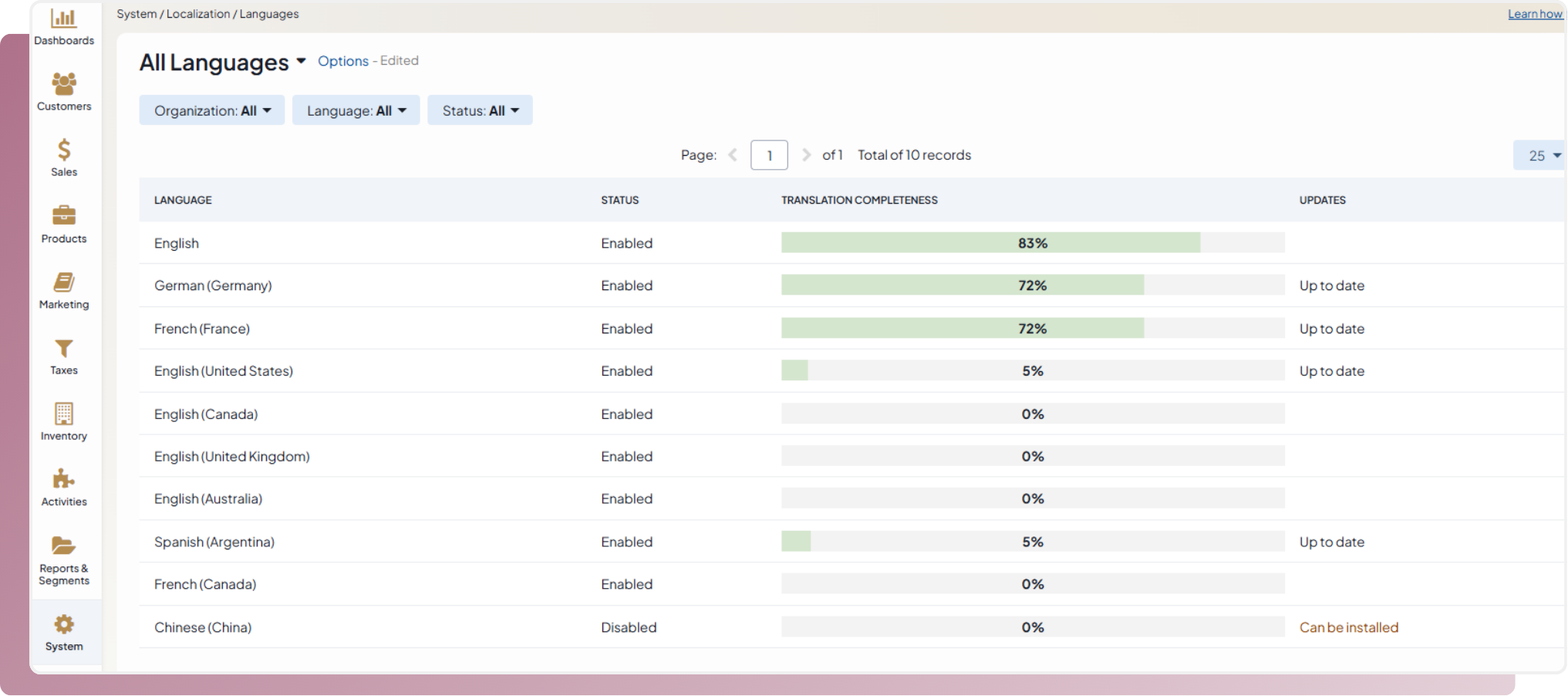
When the Flow Doesn’t Match How That Market Buys
The last piece is behavior. You can get currencies and product descriptions right and still lose a region because the process on the site doesn’t resemble how that market buys from you today.
Fixing that depends on two muscles in the platform:
- Account structures that can model buying groups, dealers, branches, and their roles.
- A workflow system that lets you vary quotes, approvals, and order handling by site or segment.
In a mature e Commerce business, that’s where you encode cultural preferences and local buying habits into the system instead of leaving them in someone’s inbox.
OroCommerce ships with a granular ACL model and a configurable workflow engine. Roles and permissions can be scoped from global down to user level, so local teams can manage “their” country or brand without stepping on others. Workflows for orders, quotes, onboarding, and more can differ per site or per customer segment.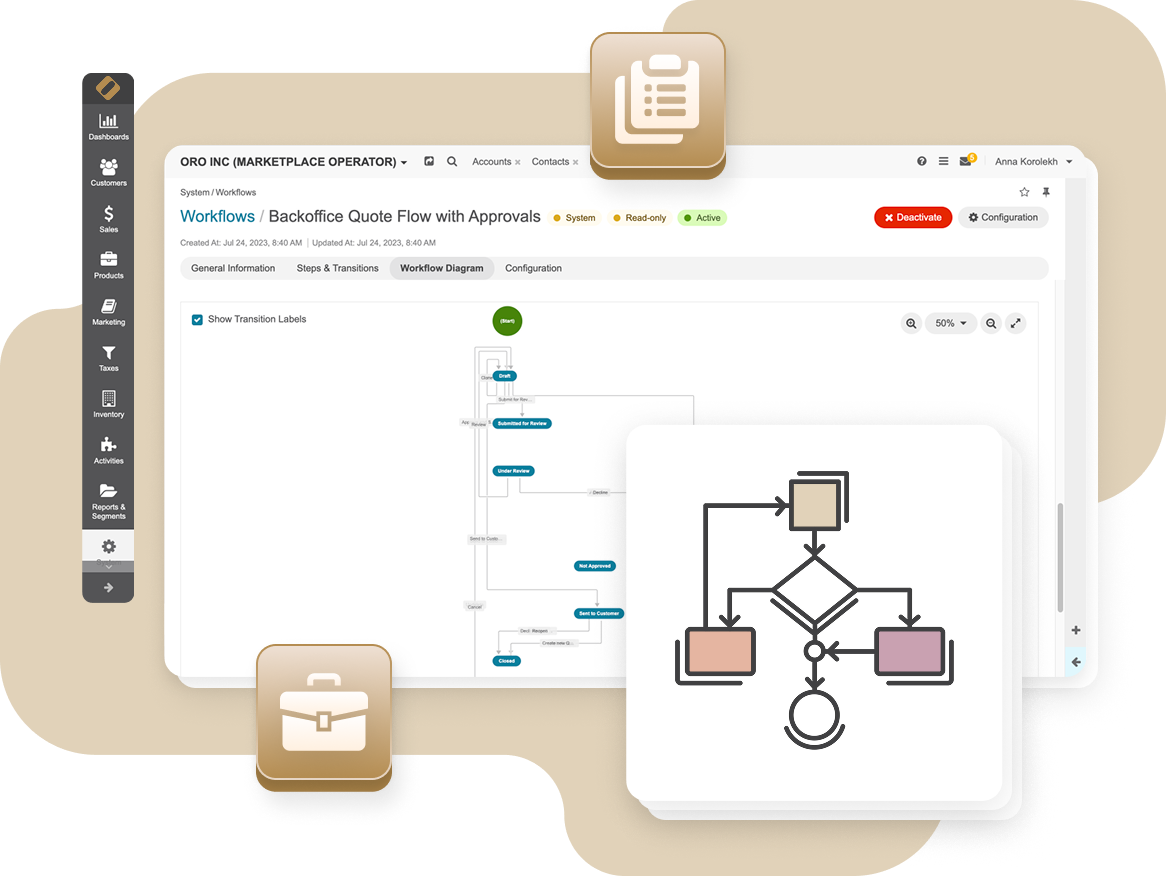 That lets you run quote-first flows for one market, straightforward checkout for another, and heavier approvals for sensitive product lines, all on one backbone.
That’s how companies like Lactalis can run a multi-brand portal across a dozen international markets with different processes on one instance, and how Dunlop can open country-specific eCommerce websites that still share the same back office and integrations.
If your platform only supports one universal flow in the name of simplicity, you’re not localizing processes. You’re training every market to work around the tool.
Lactalis: Localization Strategy Across Twelve Countries
To see how these dynamics play out in practice, consider Lactalis. They run a multi-brand B2B portal for twelve international markets on a single eCommerce platform. Their eCommerce localization strategy wasn’t “translate everything and hope.” They started from the target audience in each country and worked backwards.
Each online store runs in the local language, uses pricing rules for that target market, and exposes only the products that make sense in that region. French B2B buyers see navigation, filters, and product descriptions that match how they talk about dairy in their native language. US buyers see different pack sizes and different payment methods, tuned to their habits as online shoppers.
Underneath, the commercial core stays shared: one catalog, one pricing model, one set of integrations. The localization strategy lives in how each site is configured for its market, not in a pile of separate projects. For the business, it means they can move into new markets without rethinking the entire localization process every time.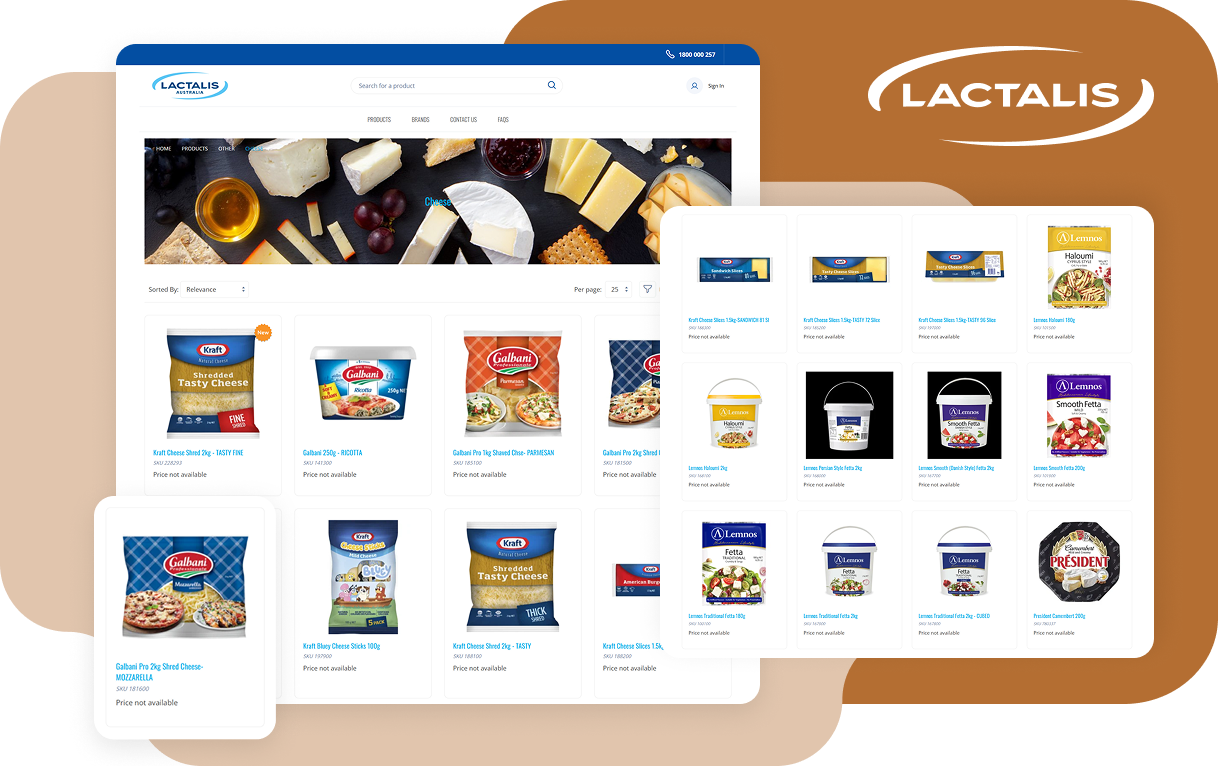
Azelis: Many Local Audiences, One Platform
Azelis works across more than 50 countries and serves international customers whose expectations vary by region. Each market needs a portal shaped around its own regulatory requirements, terminology, and daily workflows – something a single global template can’t provide.
To handle that scope, Azelis runs 100+ portals on one OroCommerce instance. Each portal is configured for a specific region or customer group and supports multiple languages so buyers can work in whichever format fits their operations. Local teams manage navigation, documentation, and localized content, while all portals draw from the same commercial core.
This lets the company reach potential customers in new regions without recreating systems or restructuring data. Markets can publish information in different languages, surface the right documents, and tune the experience for what buyers expect to find, whether they arrive through regional distributors or local search engines.
It’s a practical model for companies with many specialized markets: shape the experience locally, keep the foundation global, and expand without creating a new system for every audience you serve.
Bringing B2B Localization Back to Operational Reality
Localization works when the digital channel earns its place in the market. If buyers move through the site without questioning pricing, terminology, or workflow, the channel becomes part of how that region operates. Everything else is decoration.
For B2B companies expanding across regions, the harder work is keeping scale and variation under one roof. OroCommerce is structured for that reality. It supports regional sites that share the same operational backbone, which is why organizations like Lactalis and Azelis can adapt for each market without fragmenting their systems.
If the goal is a multi-site model that stays stable as new regions come online, OroCommerce gives teams the foundation to do it without rebuilding their approach each time.