
navigation

Most Adobe Commerce vs Shopify comparison articles end with “it depends on your needs” and leave you exactly where you started. This guide makes specific calls.
Adobe Commerce and Shopify are the two most commonly evaluated eCommerce platform options for mid-market and enterprise buyers.
One is built for deep technical control and code-level customization; the other is built for speed, simplicity, and operational ease. Which of those qualities matters more for your operation is the entire decision.
This article compares both platforms across architecture, B2B capabilities, pricing structures, and total cost of ownership. It then makes a clear case for when each is right, and when neither is.
For manufacturers, distributors, and wholesalers with complex B2B operations, there is a third option: OroCommerce, a unified B2B eCommerce platform that may better fit your needs.
We’ll explain why.
Adobe Commerce vs Shopify: Quick Overview
Gartner, the enterprise technology research and advisory firm, recognized both Adobe Commerce and Shopify as Magic Quadrant Leaders in 2025. Adobe has held that position for nine consecutive years, while Shopify entered for the third consecutive year and was positioned highest for Ability to Execute in 2025.
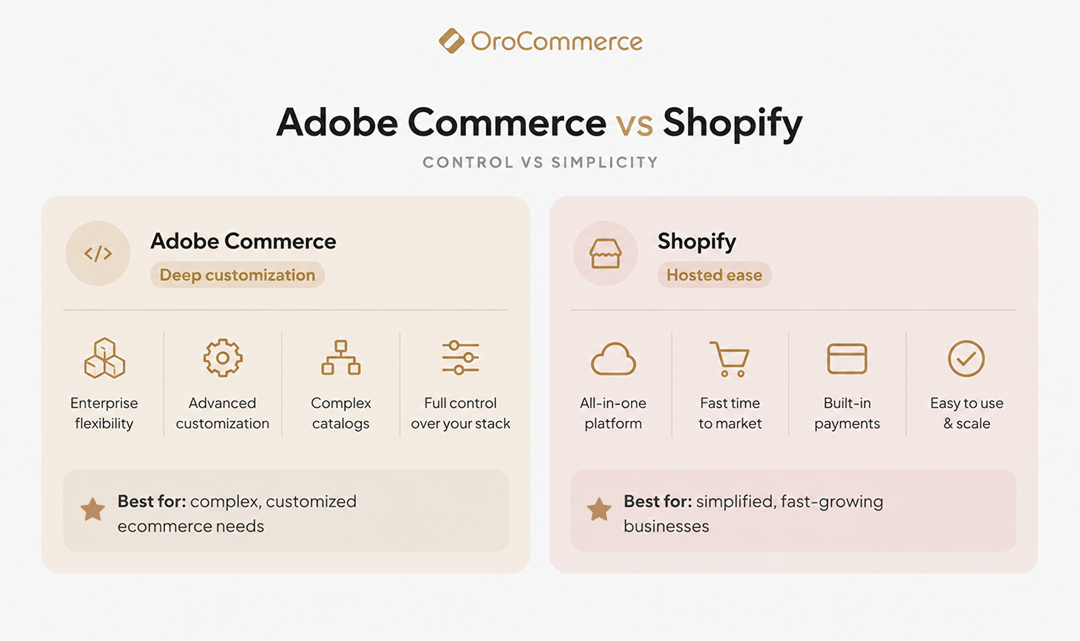
The two platforms take opposite approaches to running an eCommerce store.
Adobe Commerce is an open source platform with deep customization and full source code access on its PaaS deployment. Shopify is a fully hosted SaaS product built for operational simplicity and rapid setup.
Adobe Commerce: deep customization, developer-dependent
Adobe Commerce, formerly known as Magento, gives enterprise businesses full code-level control over their eCommerce environment. It requires a development team to manage deployments, upgrades, and integrations.
It’s a good choice for organizations that need that depth of control.
Shopify: fast, hosted, and built for ease of use
Shopify is a fully hosted platform that handles infrastructure automatically. Store owners never manage a server.
Shopify Plus is the enterprise version of Shopify. Its native B2B capabilities have expanded substantially since 2023, when Shopify replaced its legacy Wholesale Channel app with a fully integrated B2B module.
By April 2026, Shopify extended foundational B2B features, company profiles, custom catalogs, payment terms, and volume pricing to all paid plans, with advanced features remaining Plus-only.
Architecture and Deployment
The biggest practical difference between them is infrastructure ownership. Shopify handles everything. Adobe Commerce puts varying degrees of responsibility on the merchant, depending on the deployment path you choose.
Shopify: fully hosted, zero infrastructure management
Shopify manages web hosting, SSL certificates, PCI compliance, and version upgrades automatically. You don’t need coding knowledge to run the platform day to day.
It’s the go-to choice for any team launching an online store without a dedicated technical department. Shopify Plus B2B builds typically run eight to 14 weeks.
Adobe Commerce: deployment paths and their trade-offs
Adobe Commerce runs on three paths, each with a different trade-off between control and overhead.
Magento Open Source is a self-hosted open-source solution with no license fee. The merchant handles all infrastructure, security, and upgrades, and needs a strong dev team to do it.
The PaaS option uses a Git-based workflow on AWS or Azure and requires the merchant or a partner to manage all code deployments and Adobe Commerce upgrades. It offers full source code access and no feature ceiling, but demands ongoing DevOps expertise.
Adobe Commerce Cloud SaaS (ACCS), launched in June 2025, is fully managed by Adobe and significantly reduces that maintenance burden. The trade-off is source code access: customization happens via APIs only, since Adobe owns the core code.
What does the architectural difference mean in practice?
Your technical expertise determines which path is realistic. Businesses without in-house developers will find PaaS difficult to maintain in the long term.
Shopify scales without technical staff. Adobe Commerce PaaS has no feature ceiling, but only if you have the team to manage it.
| Factor | Shopify / Shopify Plus | Adobe Commerce PaaS | Adobe Commerce ACCS | Magento Open Source |
| Deployment model | Fully hosted SaaS | PaaS, Git-based on AWS/Azure | Fully managed SaaS | Self-hosted open source |
| License fee | Monthly subscription | Custom-licensed (~$22k–$200k+/yr) | Custom-licensed | $0 (free) |
| Source code access | No | Full | Limited (APIs only) | Full |
| Infrastructure management | Shopify handles all | Merchant or partner | Adobe managed | Merchant |
| Time to launch | Weeks (8-14 for Plus B2B) | Months (16-28 typical) | Faster than PaaS (~12–20 weeks) | 4–8 months typical |
| Upgrade management | Automatic | Merchant managed | Adobe managed | Merchant managed |
| Customization depth | App-layer, limited | Deep, full code access | Moderate (APIs) | Deep, full code |
For broader context on where both platforms sit in the wider market, see enterprise B2B eCommerce platforms.
Adobe Commerce vs Shopify: B2B Capabilities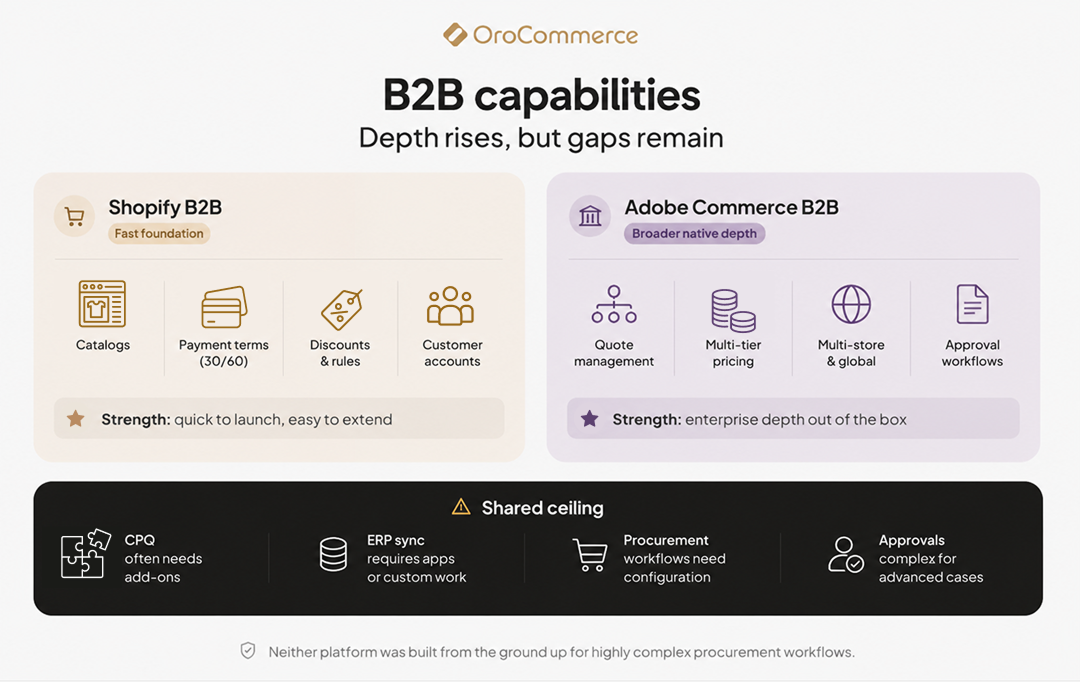
Both platforms have meaningful B2B features. The real question is where the ceiling lands, and for operations with serious complexity, that ceiling arrives faster than most evaluation teams expect.
Shopify B2B: what’s now on all plans and what remains Plus-only
As of April 2026, Shopify extended foundational B2B key features to all paid plans. Company profiles, up to three custom catalogs, payment terms including Net 30 and Net 60, volume discounts, and quantity rules are now available on core plans.
Shopify Plus adds unlimited catalogs, partial payments, deposits, and direct catalog-to-location assignment. Advanced features like checkout customization and a dedicated B2B checkout come standard at the Plus tier, including draft order approval, partial payment flows, and deposit requirements.
This feature set works well for companies in the earlier stages of B2B digitization: wholesale brands, simpler distributors, or manufacturers with a contained buyer base and standard payment terms.
Shopify offers native integration with Apple Pay and Shopify Payments, covering most standard payment gateways without extra configuration.
It also connects with social media platforms (Instagram, Facebook, TikTok, Google) for omnichannel selling and supports digital product distribution via Shopify Digital Downloads or third-party apps.
Adobe Commerce B2B module: broader capability, higher complexity
Adobe Commerce Magento B2B module ships with company hierarchies, shared catalogs, custom pricing per group, and multilingual support. It also includes requisition lists, quick order forms, quote management, and credit limits.
Unlike Shopify, it handles multi-tier pricing across large numbers of customer groups natively. Adobe Commerce offers multiple store management within a single instance, making it well-suited for businesses with regional operations or multiple brand lines.
Setting up an Adobe Commerce store requires more technical investment than a comparable Shopify setup, but the payoff is deeper control over customer data and international selling capabilities.
Adobe Commerce Cloud SaaS (ACCS) reduces infrastructure overhead for teams that want SaaS deployment without giving up enterprise-grade customization.
The B2B ceiling that both platforms share
Both Shopify and Adobe Commerce hit the same wall when B2B complexity gets serious. Neither ships a native CPQ (Configure, Price, Quote) engine. Neither includes pre-built ERP connectors for SAP, Oracle, Microsoft Dynamics, or NetSuite.
Both require third-party apps, third-party services, or custom development to achieve real-time ERP sync. That gap means additional costs and ongoing maintenance as your operation scales.
The shared gaps include:
- Native CPQ and complex quoting workflows
- Pre-built ERP integrations with real-time inventory management sync
- Procurement automation beyond basic purchase orders
- Complex multi-level approval workflows for large buyer accounts
- Multi-org management from a single instance
Adobe Commerce vs Shopify: Pricing and Total Cost of Ownership
Pricing is where both platforms surprise buyers. License fees are visible; implementation costs and app spend are not.
Shopify Plus pricing: monthly fee, transaction costs, and app spend
Shopify pricing for Plus starts at $2,300 per month on a three-year term, or $2,500 per month on a one-year term. A variable platform fee of 0.35% of GMV kicks in once monthly sales exceed approximately $800,000.
Transaction fees drop to 0% if you use Shopify Payments; external payment gateways carry additional fees. Shopify’s total cost of ownership expands once you factor in the apps required to fill B2B gaps in catalog management, ERP sync, and customer portals.
Adobe Commerce pricing: GMV tiers and implementation reality
Adobe Commerce charges a GMV-tiered annual license. PaaS adds hosting costs on top; ACCS bundles hosting into the fee.
There’s no free version of Adobe Commerce beyond the Magento Open Source Community Edition. Domain name registration and infrastructure on PaaS are separate costs.
Adobe Commerce B2B builds typically run 16 to 28 weeks, putting implementation spend well above the license in year one.
Total cost of ownership: what to ask before you sign anything
The license is the smallest part of the real number. Before signing, request itemized estimates covering implementation, customization options, third-party services, ongoing development, and app or extension spend.
Built-in POS system requirements, if applicable, add another cost layer for Adobe. The true Adobe Commerce vs Shopify comparison is a three-year TCO calculation, not a monthly fee comparison.
| Cost category | Shopify Plus | Adobe Commerce PaaS | Adobe Commerce ACCS |
| Base license | $2,300/month (3-yr) or $2,500/month (1-yr); variable fee above ~$800K monthly GMV | GMV-tiered annual fee (~$22K–$200K+/yr) | GMV-tiered SaaS fee (includes hosting) |
| Hosting | Included | Separate cost | Included |
| Transaction fees | 0% with Shopify Payments; 0.5–2% with external gateways | Not applicable (your payment processor) | Not applicable (your payment processor) |
| Implementation time | 8-14 weeks (B2B) | 16-28 weeks (B2B) | Faster than PaaS (~12–20 weeks) |
| Upgrade management | Automatic | Merchant-managed (ongoing dev cost) | Adobe managed |
| App/extension costs | Shopify App Store | Magento Marketplace | Adobe marketplace |
| POS system | Included free | Third-party integrations required (+cost) | Third-party integrations required (+cost) |
Integrations and App Marketplaces
Both platforms offer large app markets and strong third-party connectivity. How much integration work lands on your team depends on the systems you need to connect.
Shopify: the largest app market in eCommerce
Shopify has over 17,000 apps in its App Store, the largest app market in eCommerce by volume. You can install apps to cover shipping, returns, ERP sync, loyalty, and customer experience without writing code.
Complex B2B setups often chain multiple apps together rather than finding one end-to-end solution. Shopify also makes it straightforward to customize your store using Shopify themes, with hundreds of free and paid options available.
Adobe Commerce: Magento Marketplace and Adobe Experience Cloud
Adobe Commerce connects with Adobe Experience Cloud, giving marketing and commerce teams access to advanced analytics, AI tools, personalization, and digital marketing capabilities in one suite.
The Magento Marketplace provides thousands of extensions for enterprise-scale customization. For organizations already running Adobe products, that native connectivity adds real value.
ERP integration: where both platforms put the work back on you
ERP integration is where platform differences become clear. Shopify requires custom development or third-party iPaaS connectors (like Celigo, MuleSoft, Boomi) for real-time ERP sync with SAP, Oracle, Microsoft Dynamics, or NetSuite.
Adobe Commerce offers prebuilt connectors via Adobe Exchange for Microsoft Dynamics 365 ERP and SAP S4/HANA ERP, reducing initial setup time.
However, large businesses with complex requirements, such as multi-tier pricing across dozens of customer groups, real-time inventory across multiple warehouses, and custom approval workflows, often end up with multi-month custom builds regardless of platform choice.
When Shopify Makes Sense and When It Doesn’t
Speed and ease of use are where Shopify sets itself apart. It’s the right platform for the right buyer, and knowing which type you are saves weeks of evaluation time.
Shopify’s documented positioning makes its Ideal Customer Profile explicit: companies under $200 million in revenue.
Shopify acknowledges it shouldn’t chase B2B-first businesses with deep ERP integration needs or extensive third-party systems like punchout and procurement connectors. That’s a useful filter before you start any evaluation.
Shopify is a strong fit for:
- B2B operations with simpler requirements, up to a few thousand buyer companies, and standard payment terms
- Small businesses and medium-sized businesses entering online selling for the first time
- Teams without technical staff who need a fully managed, hosted solution
- D2C or hybrid B2B/B2C brands that don’t require complex procurement workflows
- Programs where speed to launch is the dominant constraint, and selling products quickly is the goal
Shopify is not a strong fit for:
- B2B-first manufacturers and distributors with deep ERP integration requirements
- Operations that rely on punchout catalogs or procurement system connectivity
- Complex company hierarchies with parent accounts, subsidiaries, and divisions
- Multi-tier pricing logic across hundreds of customer groups
- Custom approval workflows tied to procurement systems
Standard Shopify plans and Shopify Plus now cover a wider range of B2B needs than they did two years ago. But the ceiling is real, and Shopify has effectively drawn it itself.
For what exists beyond Shopify, see Shopify Plus alternatives.
When Adobe Commerce Makes Sense and When It Doesn’t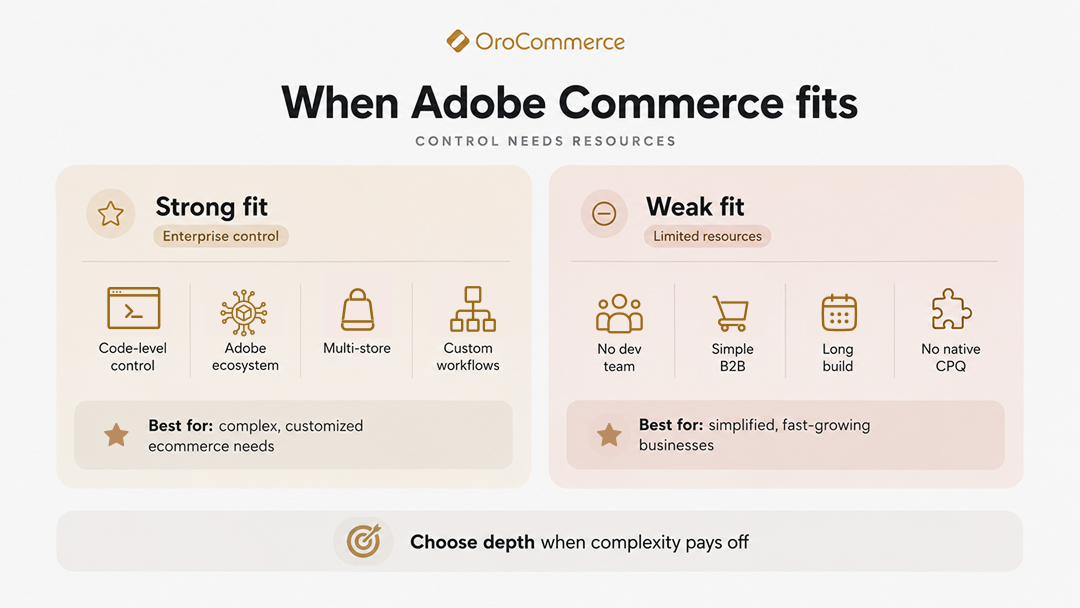
Customization depth, technical control, and tight Adobe Experience Cloud integration are where Adobe Commerce excels. It suits organizations that have the in-house resources to use it correctly.
Choose Adobe Commerce when:
- Your development team manages PaaS deployments and can handle version upgrades
- Your operation runs B2B and B2C on one platform and needs code-level control over both
- You need a commerce experience tied tightly to Adobe Experience Cloud marketing tools
- Your catalog complexity and custom workflows justify a 16 to 28 week build cycle
- You need multiple stores and regions across international markets from one codebase
Adobe Commerce may not be the right call when:
- You don’t have a dedicated development team or budget for ongoing technical support
- Your B2B requirements are straightforward and don’t justify PaaS complexity
- You need native CPQ, which, like Shopify’s app gaps, Adobe’s extension market still doesn’t solve natively
- Your budget can’t support implementation timelines of six months or more
For a full view of what competes with Adobe and how those platforms compare, see Adobe Commerce competitors.
Why B2B Manufacturers and Distributors Should Consider OroCommerce
Most comparison articles skip this part. If you’re a manufacturer, distributor, or wholesaler evaluating Shopify vs Adobe Commerce, both platforms will ask you to build what should come standard.
OroCommerce, a unified B2B ecommerce platform, was designed from day one for exactly that complexity. It ships the hard stuff natively, as a single purpose-built product with no custom build overhead.
Built for B2B from day one, not adapted from B2C
Shopify and Adobe Commerce were each designed primarily for B2C use cases and extended into B2B over time. OroCommerce started with B2B requirements: corporate account structures, rule-based pricing engines, procurement workflow automation, and built-in CRM integration.
These aren’t extensions or apps you source separately. They ship with every OroCommerce license.
What ships natively vs. what you build or buy on Shopify and Adobe
The technical detail matters when you’re scoping a three-year implementation. OroCommerce includes native CPQ, a built-in CRM system, a rule-based pricing engine, pre-built ERP connectors, full corporate account hierarchies, and procurement workflow automation under one license.
That one-license model is especially relevant for the businesses OroCommerce is built for: mid- to large manufacturers, distributors, and wholesalers operating across multiple legal entities, divisions, brands, or regions.
These are organizations managing separate buyer catalogs per business unit, different pricing structures across subsidiaries, and sales teams serving distinct customer segments under one company umbrella.
On Shopify or Adobe Commerce, supporting that structure means layering apps, custom builds, and workarounds onto a platform that wasn’t designed for it. On OroCommerce, it’s the baseline.
On either platform, those same capabilities require third-party apps, marketplace extensions, or custom development, adding cost and maintenance as your business grows.
| B2B capability | Shopify Plus | Adobe Commerce | OroCommerce |
| Corporate account hierarchies | Company profiles (flat; hierarchy requires Plus or custom build) | B2B module (hierarchies supported) | Native (full hierarchy) |
| Configure-price-quote (CPQ) | Not native on any plan | Third-party extension | Native |
| Rule-based pricing engine | Price lists per company | Limited, extensions required | Native |
| Pre-built ERP connectors | Third-party apps | Extensions or custom | Native |
| CRM | Not included | Not included | Native (OroCommerce’s CRM) |
| B2B and B2C on one license | Yes (Plus) | Yes | Yes |
| Procurement workflow automation | Not native | Extensions required | Native |
OroCommerce in practice: what enterprise B2B customers are seeing
Customers, including DiversiTech, Lactalis, and Braskem, use OroCommerce to handle exactly the complexity that Shopify and Adobe ask you to build.
According to Gartner, OroCommerce was recognized as a Visionary in its Magic Quadrant for Digital Commerce for three consecutive years (2022, 2023, 2024). It’s included in the 2025 report for the fifth consecutive year.
For manufacturers specifically, the B2B eCommerce platform for manufacturers guide covers what that looks like operationally.
For wholesale operations, the best B2B eCommerce platform for wholesale covers wholesale-specific requirements. To benchmark options across the full field, the best enterprise B2B eCommerce software is worth reviewing before any vendor call.
See how OroCommerce handles complex B2B requirements natively
Adobe Commerce vs Shopify Comparison: Final Verdict
Shopify wins on simplicity, speed, and operational ease. Adobe Commerce wins on customization depth and technical control. For most eCommerce businesses, one of those two is exactly the right choice.
For manufacturers, distributors, and wholesalers dealing with genuine B2B complexity, both platforms ask you to build or buy what should come standard.
OroCommerce ships that complexity natively, without the custom build overhead of every serious Adobe implementation, and without the ceiling that limits Shopify Plus B2B deployments.
For context on the best B2B ecommerce platform options for your situation, that guide covers the full market.
Ready to see what a purpose-built B2B commerce platform looks like?
FAQs on Adobe Commerce vs Shopify Comparison
Is Adobe Commerce better than Shopify?
Neither platform is universally better. Adobe Commerce suits businesses that need deep customization, full code control, and Adobe Experience Cloud integration.
Shopify suits teams that prioritize fast setup and operational simplicity without managing infrastructure. The right choice depends on your technical resources, business model, and B2B complexity.
What is the difference between Adobe Commerce and Shopify?
Adobe Commerce is an open-source-rooted platform with deep customization and developer-dependent management across three deployment options. Shopify is a fully hosted SaaS platform requiring no infrastructure management.
Adobe suits businesses needing code-level control; Shopify suits those prioritizing speed and simplicity. For complex B2B operations, both have capability gaps that purpose-built platforms like OroCommerce address natively.
Is Shopify good for B2B?
Shopify Plus has meaningful native B2B features, including company accounts, price lists, payment terms, and quote requests. As of April 2026, foundational B2B features are also available on standard paid plans.
For businesses with complex company hierarchies, multi-tier pricing, or deep ERP integration needs, the native B2B ceiling becomes limiting, and custom builds or third-party apps are required.
Who are the main competitors of Adobe Commerce?
Main competitors include Shopify Plus, commercetools, Salesforce Commerce Cloud, SAP Commerce Cloud, and OroCommerce, a unified B2B ecommerce platform for manufacturers and distributors. For B2B-specific operations, OroCommerce is the strongest purpose-built alternative.
For B2C or hybrid operations, Shopify Plus is the most common choice when merchants prioritize ease of use over deep customization.