
navigation

AI is an amplifier.
This is the single most important concept to understand before you invest. If you attach an advanced algorithm to a 20-year-old, fragmented legacy system, you don’t get an intelligent business. You get your existing operational chaos, amplified at machine speed.
This guide shows how to use AI in eCommerce by addressing the infrastructure problem first without ripping out your ERP.
The Architecture Problem
The vast majority of enterprise AI projects fail. Converging data from Gartner, BCG, and MIT puts the failure rate between 80% and 95%. McKinsey’s 2025 State of AI survey found that while 88% of organizations now use AI, only 6% qualify as “AI high performers.”
The algorithm is not the point of failure. The architecture is.
Leaders treat AI as a silver bullet, expecting it to function in a disconnected environment. As analyst Heather Hershey noted in the B2B Commerce UnCut podcast, “You cannot drop an LLM on top of five disconnected ERPs.” If the data is fragmented, the AI guesses. In B2B, guessing is a liability, especially when it comes to customer data or inventory management.
Before choosing an implementation path, you must audit your infrastructure. An AI trained on incomplete or contradictory historical data will confidently produce flawed output.
For B2B commerce, this architectural audit must focus on three specific areas where retail strategies break.
1. Relational Data
Retail AI looks at individual user behavior. B2B AI must understand complex, multi-level account hierarchies. It needs to know that a specific user is a branch-level buyer with a $10,000 spending limit, reporting to a regional manager who must approve all capital expenditures.
This relational context is critical for understanding customer behavior and delivering personalized shopping experiences that reflect actual buying authority and contract terms.
2. Commercial Logic
An AI can’t function if your contract pricing rules are hardcoded into an old ERP and inaccessible via API. It must be able to see a customer’s negotiated volume breaks and custom catalog restrictions in real-time. If it can’t, it also can’t execute dynamic pricing strategies based on market trends or even generate an accurate quote.
3. Product Data
Your catalog must be machine-readable. An AI cannot recommend a compatible part if the product attributes, product images, and technical specifications exist only in a siloed PDF. The data must be structured and accessible, enabling AI to resolve complex queries and suggest products based on compatibility, application, or customer needs.
If these three logic centers live in disconnected systems, the AI can’t function, much less streamline processes. This is the fragmentation that kills deployments and erases any potential competitive edge.
IDC's Agentic Commerce Playbook for B2B Leaders Who Want Clarity
Here’s What Most Companies Try
The immediate question is how to fix the fragmentation. Most organizations default to one of two implementation models. Both carry massive operational risk.
The Big Bang: Rip and Replace
The logic seems sound. Your ERP is the source of fragmentation, so replace it with something modern that supports AI natively.
The execution is brutal. BCG confirmed that more than two-thirds of large-scale tech programs are not delivered on time, within budget, or to defined scope. Three-year timelines are common. Business operations freeze while IT rebuilds the foundation.
Many companies attempt a shortcut by simply waiting for their existing ERP vendor to release an AI update. IDC reports that 21.4% of companies plan to renew with their current ERP provider specifically because generative AI is included in the next release.
Upgrading your ERP is necessary for back-office efficiency. It doesn’t, however, solve the problem for your customer-facing workflows.
An ERP is designed to be the system of record for your ledger and physical inventory. It’s not designed to manage the digital buying journey, semantic search, or personalized catalogs. Relying on an ERP to run customer-facing AI leaves your buyers with a rigid, disconnected experience that fails to meet modern consumer expectations and undermines customer satisfaction.
AI as an Add-On
To avoid touching the ERP, companies swing in the opposite direction. They buy standalone AI tools and attempt to tape them to the outside of their existing architecture.
This works when you’re solving one problem. It breaks when bolt-on becomes your strategy for multiple use cases.
B2B commerce AI needs access to:
- Product catalog (PIM)
- Inventory management and pricing (ERP)
- Customer contracts and hierarchies (CRM)
- Order history (commerce platform)
A bolt-on tool running isolated AI algorithms that can’t pull data to access all of this either fails or requires expensive custom integration. You repeat that custom integration for every new tool you add. The technical debt compounds until the system becomes unmanageable.
If rip-and-replace takes too long and bolt-on creates integration chaos, what’s left?
Stop trying to make one system do everything.
Learn how distributors tackle tech debt in B2B commerce in this free report
The AI Implementation Alternative: The Strangler Pattern
The problem both paths miss: eCommerce AI needs two types of data.
- Operational data that lives in ERP, including inventory management, pricing, logistics costs, and fulfillment.
- Behavioral data that comes from customer interactions during B2B online shopping: searches, comparisons, abandoned configurations, quote requests, approval workflows. ERP was never designed to capture this.
Without operational data, B2B eCommerce AI solutions can’t execute (wrong price, wrong stock level). Without behavioral data, it can’t learn (no patterns to recognize, no friction to identify).
The most pragmatic path forward is a recognized software engineering approach: the Strangler Pattern.
Coined by Martin Fowler, the pattern is named after the strangler fig tree, which wraps itself around a host. In enterprise IT, you don’t tear down the legacy system. You place an intermediary layer in front of it.
The Commerce Platform Layer
In B2B commerce, this intermediary layer can be a unified digital commerce platform that sits between customers and your ERP. It handles customer-facing work, enabling businesses to pull operational data from ERP in near real time without straining the legacy system.
As commerce analyst Heather Hershey noted, the strangler pattern lets you tackle modernization incrementally: “You can buy one of these apps that acts as an intermediary layer, creating a source of truth the AI can leverage.”
A B2B eCommerce platform creates the unified environment AI solutions need:
- Customer context (who they are, what they’ve bought, what they’re trying to do)
- Product context (specs, compatibility, availability)
- Commercial context (contract pricing, credit limits, approval rules)
- Behavioral patterns (where buyers get stuck, what they search for, which quotes convert)
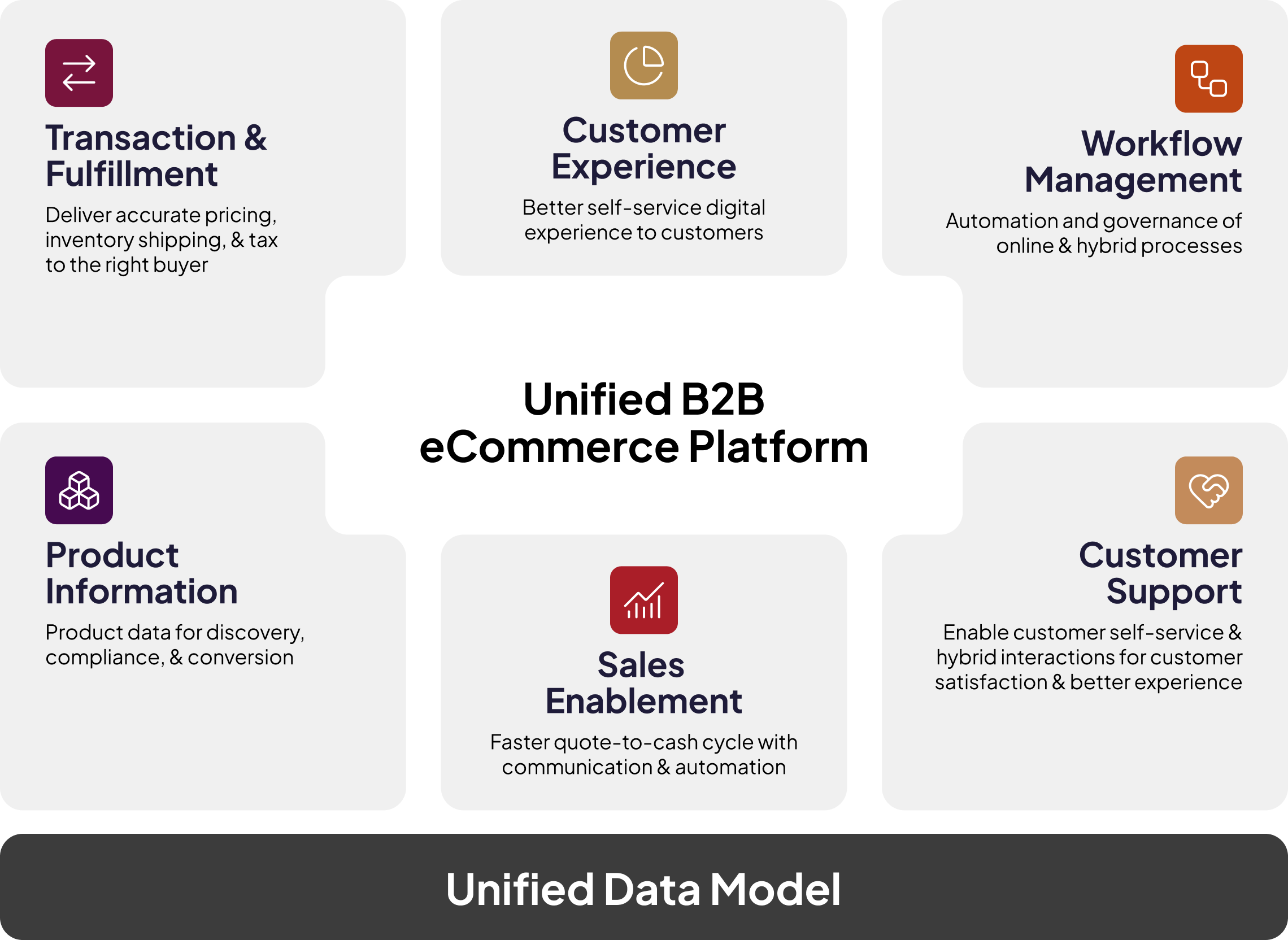
The ERP continues to act as the absolute system of record for finance and fulfillment.
But you migrate the dynamic, customer-facing business logic out of the ERP and into the commerce layer. Functionality like customer-specific pricing calculations, quote generation, and product discovery are moved one chunk at a time.
The commerce platform absorbs these responsibilities and orchestrates the data. It becomes the clean, unified brain of the operation.
This creates the exact structured environment that AI tools and AI agents require to function accurately.
Once that architecture is in place, you face a critical operational decision: where do you point the algorithm first?
Choosing Your First AI Use Case
The consensus among enterprise IT leaders is that an ideal use case must meet specific criteria:
- Low operational risk (if it breaks, the business keeps running)
- High visibility (executives and teams see the impact)
- Measurable KPIs (you can prove ROI in 3-6 months)
- Clean existing data (you’re not waiting months to normalize inputs)
- Workflow augmentation (helping people work faster, preserving the human touch)
Here’s where B2B companies are seeing returns:
Back-Office Automation: Order Processing
The highest-impact, lowest-risk starting point.
Orders arrive as PDFs, spreadsheets, emails, and faxes. Sales reps spend hours rekeying data into the ERP. Instead, AI can read these documents, extract line items, validate SKUs against inventory, flag pricing errors, and create draft orders for human review.
One OroCommerce client now processes 64-page PDFs with 716 line items automatically.
This use case works because:
- The data already exists (you have historical sales data and POs to train on)
- The workflow is repetitive and high-volume
- Human review stays in the loop
- The benefit is immediate (less rekeying, faster turnaround)
Customer Self-Service: AI Powered Chat
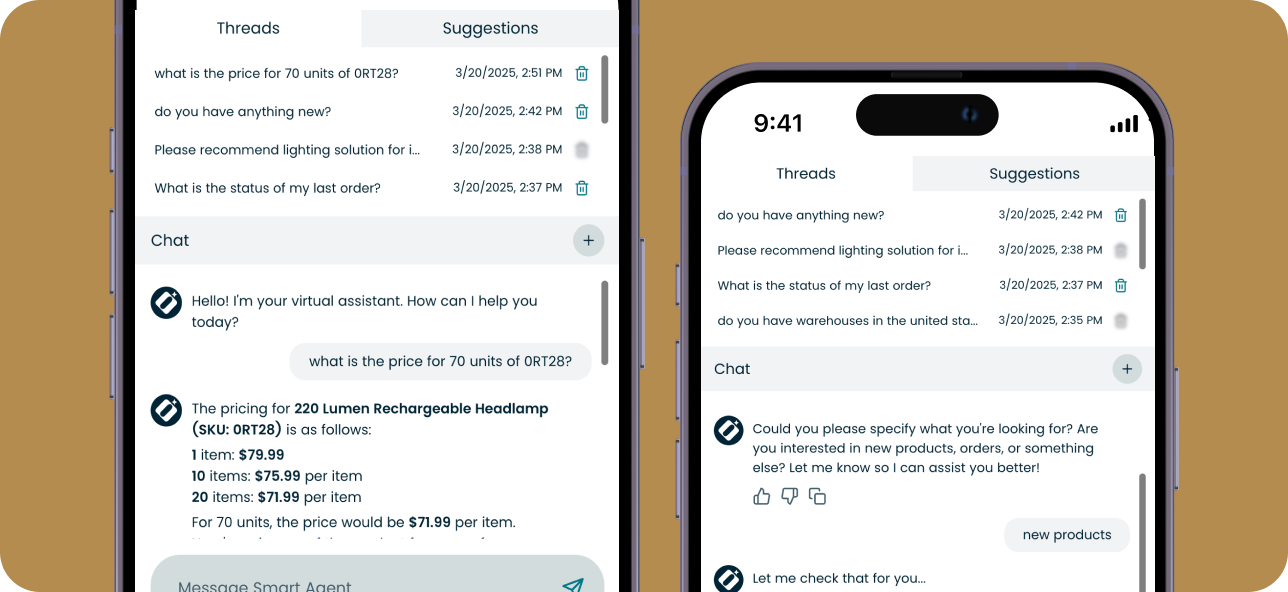 73% of B2B teams already use AI chatbots for customer service, according to OroCommerce’s 2026 survey. The question is whether they’re deployed well.
Bad implementation: a chatbot that can’t access account-specific data, so it gives generic answers and forces customers to call anyway.
Good implementation: a chat interface powered by natural language processing that knows the customer’s contract terms, credit status, order history, and current inventory. It answers “What’s my price for 100 units?” or “When will my order ship?” without escalating to a human.
This approach helps enhance customer service while building customer loyalty through faster, more accurate responses, driving increased customer satisfaction across the entire customer journey.
The ROI shows up in two places:
- Reduced support volume (routine questions get answered instantly)
- Faster sales cycles (buyers get answers at 8 p.m. instead of waiting for a rep)
The risk is low because customers still have the option to escalate. AI handles routine tasks. Humans handle everything else.
Search and Product Discovery
Traditional keyword search fails in B2B because buyers don’t search the way you organized your catalog. They search by application (“pump for saltwater”), by compatibility (“fits 2019 F-150”), or by vague need.
AI search uses semantic understanding and retrieval-augmented generation (RAG) to match customer intent to product, returning relevant results even when the buyer doesn’t know the SKU or exact terminology.
W.W. Grainger, a major MRO distributor, implemented RAG-based AI search across 2.5 million products to handle the fact that different buyer personas search in fundamentally different ways. A facilities manager searches differently than a purchasing agent, and AI can bridge that gap.
The benefits are higher conversion, fewer dead-end searches, and less dependency on sales reps to “translate” buyer needs into SKUs. Better search directly impacts customer satisfaction and drives customer engagement for eCommerce brands.
Sales Enablement and Lead Prioritization
McKinsey documented an industrial materials distributor that used AI-powered lead prioritization to identify over $1 billion in new opportunities – a 10% pipeline increase.
The system scored existing opportunities and identified new ones by extracting actionable insights from unstructured public data like construction permits.
The AI also personalized outreach at scale for marketing campaigns tailored to a specific target audience, more than doubling click-through rates in the first fiscal year.
This use case works when:
- Your sales team is drowning in leads and struggling to prioritize
- You have rich CRM data to train on
- You can integrate external data sources (permits, industry news, financial filings)
The ROI shows up as higher win rates and faster deal cycles, not just more volume.
Product Content Enhancement
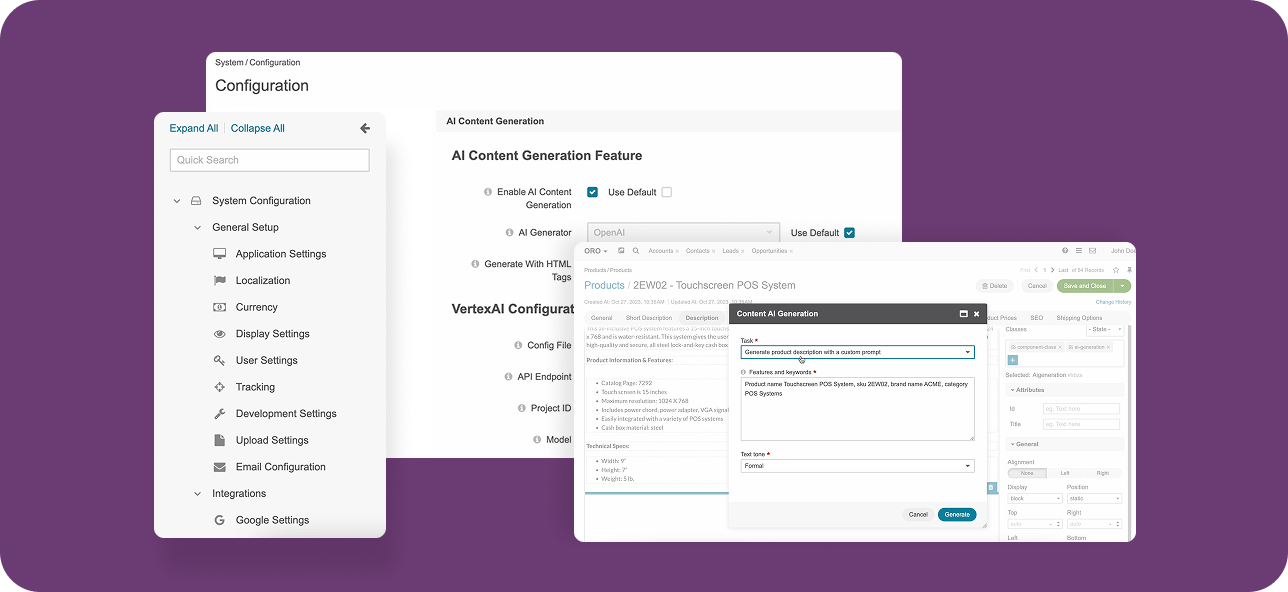 Generative AI is transforming how B2B companies create and maintain compelling product descriptions at scale. Instead of manually writing thousands of technical spec sheets, AI can generate detailed, accurate product descriptions that incorporate technical specifications, application guidance, and compatibility information.
This is particularly valuable for distributors managing massive catalogs where content creation has traditionally been a bottleneck. AI can analyze vast amounts of technical data and produce consistent, searchable descriptions that improve discoverability and help buyers make informed decisions.
Dynamic Pricing
Dynamic pricing strategies deliver the highest profit impact, but they require data maturity and tight ERP integration.
Artificial intelligence analyzes competitor pricing, demand signals, inventory levels, and customer purchase history to recommend optimal pricing in near-real time. This works best for high-volume catalogs in a fast-paced digital marketplace where manual repricing is impossible.
The challenge: pricing is sensitive. A pricing error can cost margin or negatively impact customer sentiment. You need clean data, strong governance, and confidence in the model before going live.
Start here only if your data is solid and you’ve proven AI works elsewhere in the business.
Measuring Success
If you successfully implement the Strangler Pattern and deploy your first use case, you have to prove to the board that it worked.
This is where many leaders make a crucial mistake. They measure the software instead of the business.
Tracking “chatbot engagement rates” or “number of AI searches performed” are vanity metrics.
They tell you that a tool was turned on, but they don’t prove that the business improved.
True success means the architecture is finally doing the heavy lifting. You measure that by tracking the drop in administrative drag and the protection of your margins.
| Metric Category | Specific KPI | Target Benchmark (Post-AI) |
| Order Processing | Touchless Order Rate | 60 – 80% (Up from 10-20%) |
| Order Processing | Processing Time | < 1 minute (Down from 15+ mins) |
| Operational Efficiency | Labor Hours Saved | 25 – 40% reduction in admin tasks |
| Revenue / Growth | Search-Driven Conversion | 15 – 20% uplift |
| Revenue / Growth | Average Order Value (AOV) | 10 – 15% increase via smart upsells |
| Customer Experience | Time to Resolution (Support) | 50% decrease via Tier-1 automation |
These metrics demonstrate real business impact: improving customer satisfaction, reducing operational costs, and driving customer engagement.
The Future of AI in eCommerce
Here’s the good news about building the right infrastructure: you’re not just solving for today’s AI technologies.
Generative AI will get better at writing product descriptions and generating images. Machine learning will get smarter about predictive inventory. New AI tools will emerge that do things we’re not even thinking about yet.
And all of them will need the same thing: clean, unified customer data and a platform that can actually access it.
The companies building eCommerce infrastructure now are positioning themselves for whatever comes next. When a breakthrough AI capability drops, they can adopt it in weeks or months.
Which algorithm wins doesn’t matter. What matters is did you build the foundation that lets you use it?
Building the Foundation for B2B AI
AI doesn’t create intelligence out of thin air. It reflects the environment you place it in.
The companies struggling with AI implementation tried to solve an architecture problem with a software purchase. They expected an algorithm to bridge gaps between ERP, CRM, and PIM that humans can barely navigate.
Here’s the good news: once you accept that architecture comes first, the path becomes clear.
You don’t need a three-year ERP replacement. You don’t need to bolt a dozen point solutions together and hope they sync. You build an orchestration layer – a commerce platform that handles B2B complexity natively and connects the systems you already have.
The algorithm is just the final piece of the puzzle. The architecture is the actual competitive advantage.
Frequently Asked Questions About AI in eCommerce
How can I use AI for eCommerce?
Start with order processing automation or AI-powered search. Most B2B companies see the fastest ROI by using AI to eliminate manual data entry from PDF orders or by deploying chatbots that enhance customer service with instant answers to routine questions. Don’t try to implement AI everywhere at once – pick one workflow that’s repetitive and high-volume.
What is the best AI for eCommerce?
There isn’t one. B2B needs AI technologies that handle complex pricing and account hierarchies. Generative AI works well for search and support. Machine learning models are better for predictive analytics and demand forecasting. The platform matters more than the algorithm. AI only works if it can access your customer data and systems.
Is AI eCommerce worth it?
Yes, but only if your data infrastructure supports it. If your customer data is fragmented, AI implementation just amplifies the mess. Fix the foundation first.
What are the risks of using AI tools in eCommerce?
The biggest potential risks are data privacy violations and overreliance on flawed predictive models. If your AI has access to sensitive customer data, you need strict governance around who sees what and how long it’s stored.
The other risk is trusting AI outputs without human review. Start with low-stakes use cases and keep humans in the loop for decisions that impact customer experience or margins.