navigation

Selling wholesale in FMCG looks different than it did five years ago. Buyers expect a digital ordering experience, and this playbook exists to help FMCG brands, manufacturers, and distributors build one that actually works.
Inside, you’ll find a full FMCG B2B eCommerce strategy: how to pick a platform, design the buyer experience, price and promote effectively, run operations behind the scenes, and roll all of it out in phases.
The guide covers B2B, B2C, and B2B2C together, because most companies now need a single business model that serves every channel at once, not three separate systems bolted together.
Margins in this category are thin, and demand moves fast, so a wrong platform choice costs more here than it would somewhere slower-moving. Market conditions shift quickly in a changing business environment, and the brands still running wholesale by phone and spreadsheet are losing ground to the ones who moved first.
OroCommerce was built for exactly this kind of complexity, and you’ll see it come up throughout this playbook wherever a specific FMCG requirement calls for it.
Executive Summary for FMCG Businesses
For stakeholders who only have time for one section, here’s the short version.
- Why it matters: digital platforms give FMCG businesses faster ordering, fewer manual errors, and real-time visibility into pricing and stock. These gains in operational efficiency directly affect margin in a low-margin category.
- What to measure: track digital order share, average order value, and the reduction in manual, self-service versus rep-assisted processing as your core success metrics.
- What it takes: a phased rollout starting with one pilot market, buy-in from sales, IT, and operations from day one, and a multi-quarter timeline before scaling company-wide. Brands that skip the pilot and go company-wide at once are the ones who end up rolling it back.
Why FMCG Brands Embrace B2B eCommerce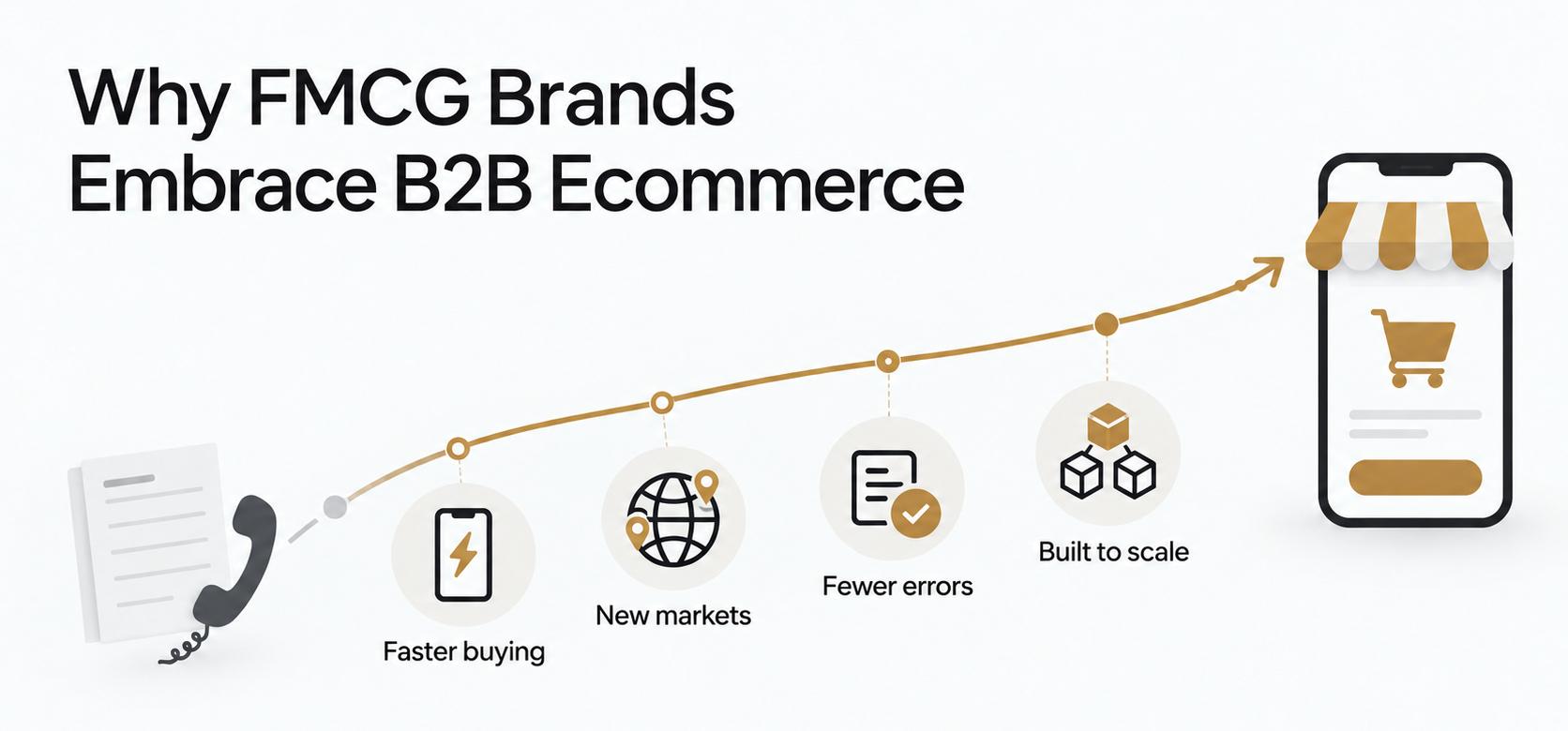
The shift toward digital wholesale ordering isn’t happening because it’s trendy. It’s happening because the alternative is increasingly uncompetitive.
- Buyer expectations have shifted. Retail and wholesale business buyers now expect the same speed and convenience they get as consumers on their own mobile devices. A phone call or fax-based order form feels like friction they no longer tolerate: 45% B2B buyers say current online experiences don’t meet expectations, pointing to the need for ERP-connected portals and live data.
- The opportunity is largest outside mature regions. Rising mobile penetration and digital payment adoption mean FMCG industry players can enter new markets faster through a digital storefront than through a traditional field sales build-out. According to Allied Market Research, the global FMCG B2B e-commerce market is projected to grow from $520.8 billion in 2021 to $1,220.5 billion by 2031, a 9% compound annual growth rate.
- Short-term goals are operational. They focus on reducing manual order-taking and cutting the pricing errors that come from spreadsheets and phone orders.
- Long-term goals are strategic. They involve expanding into additional channels and geographies without rebuilding the tech stack every time the FMCG sector shifts. Done well, this builds a lasting competitive edge.
Before shortlisting a vendor, understand what a modern platform actually needs to do. See this rundown of essential B2B eCommerce platform features for a fuller list.
Business Models for FMCG B2B and DTC Channels
Few FMCG brands run a single channel. Most need to support direct wholesale, marketplace listings, and a growing direct-to-consumer arm, often all from the same catalog.
- Reseller and distributor commission structures need definition before launch, not after the first disputed invoice, to avoid manual reconciliation later.
- Subscription and replenishment offerings turn one-time wholesale orders into recurring revenue. They also reduce the sales effort required to retain existing customers.
- Blending B2B and DTC means product and pricing data for corporate buyers and consumers alike need to live in one place. Two disconnected systems will quietly drift out of sync and stop reflecting real customer needs.
This is where the difference between a true unified commerce vs traditional ecommerce vendor becomes obvious. Bolting a B2C storefront onto a B2B system, or the reverse, tends to break down exactly where FMCG brands need it to hold up: at scale, across accounts with very different needs.
Which model fits your channel strategy
| Model | Best fit | Key requirement |
|---|---|---|
| Direct-to-retailer | Brands with strong existing customer relationships and enough market reach to service independent retailers and retail chains without an intermediary | Account-level pricing and order history |
| Marketplace | Brands entering unfamiliar categories or regions, provided they can lean on an established network of retailers and suppliers already active there | A vetted local partner network and clean onboarding |
| Subscription/replenishment | Brands with predictable, repeat-purchase SKUs | Automated recurring order logic |
Platform Selection Criteria for FMCG Brands and Businesses
Generic eCommerce software wasn’t built for FMCG’s specific mechanics. Evaluate any FMCG eCommerce platform against requirements that a standard shopping-cart tool hasn’t thought about.
| Criteria | Why it matters for FMCG |
|---|---|
| Native B2B functionality | Bolted-on modules retrofitted from a B2C product tend to break under real wholesale volume and complexity |
| Deep integration with ERP and PIM | Keeps pricing, stock levels, and product data accurate without manual syncing between systems |
| Customer-specific pricing and rebate support | Reflects the negotiated trade terms that define most FMCG wholesale relationships |
| Multi-warehouse inventory management | Gives real stock visibility across every distribution point, not just a single default warehouse |
| Realistic three-year cost projections | Accounts for implementation, integration, and scaling, not just the year-one subscription line |
For a broader view of what “enterprise-grade” actually requires, this guide to enterprise B2B eCommerce platforms is a useful companion to this checklist.
Why OroCommerce Is Built for FMCG B2B eCommerce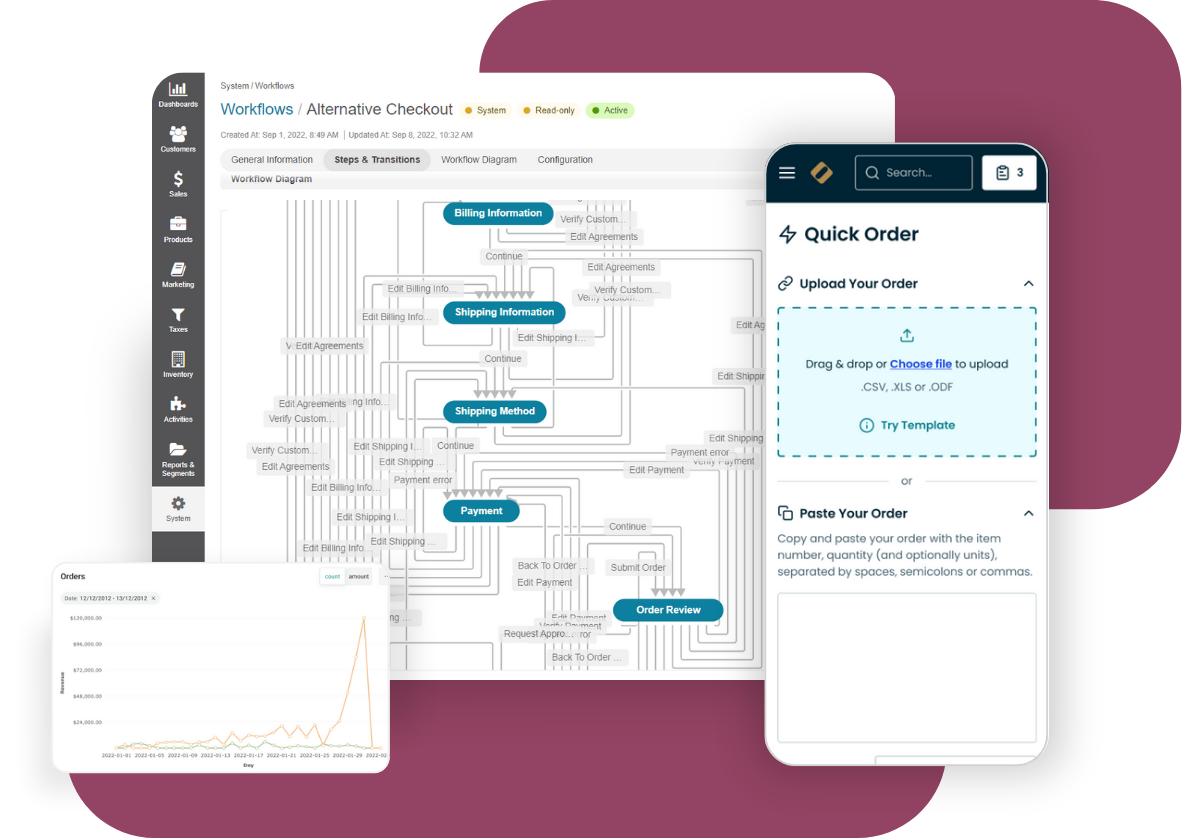
Most of the criteria above exist because generic platforms fall short for FMCG. Oro Inc. built OroCommerce around that gap instead of retrofitting it.
- Scalability for high SKU counts, multi-site operations, and seasonal demand surges that would strain platforms designed for simpler catalogs.
- B2B features built for the category, including layered customer hierarchies, contract pricing, bulk ordering, and multi-organization account management for FMCG companies operating at global scale.
- Configurable, low-code workflows that adapt to approval chains, compliance documentation, and promo cycles instead of forcing FMCG processes to conform to the software.
- Built-in CRM alongside eCommerce, so sales and marketing manage every account and every round of negotiated pricing, from a single account view, on desktop or mobile.
- Support for B2B, B2C, and B2B2C from one dashboard, including multiple decoupled storefronts and personalized portals. This matters for any FMCG manufacturer running the kind of blended channel strategy described earlier.
The proof point here is Lactalis. The dairy group rolled OroCommerce out across 12 markets, giving each region room to adapt catalogs and workflows while keeping one shared platform.
Within two years, Lactalis onboarded 15,000 customers, grew digital orders by 230%, and reduced manual admin by 44%.
If your current setup can’t do what’s described above, see the platform directly instead of taking it on faith. When you’re ready, book a demo to see it against your own catalog and account structure.
Customer Experience Design for B2B Buyers in FMCG
For FMCG buyers, speed matters because many purchases are repeat orders, often placed across multiple locations or accounts. The experience should help procurement professionals and retail customers get through routine buying quickly.
- Make repeat purchasing faster. Saved lists, past orders, and quick reorder tools help buyers submit orders without rebuilding the same basket every time.
- Show the right products and terms. Account-specific catalogs, pack sizes, pricing, and stock availability help buyers make decisions faster and reduce ordering mistakes.
- Support account-level control. Buyers managing several stores or locations should be able to manage orders, permissions, and purchasing activity from one account.
Behind that experience, unified commerce architecture helps keep pricing, inventory, and order data connected, so teams can streamline operations as digital order volume grows.
Buyers who can submit orders in a few clicks, and manage orders without calling a rep, are the ones most likely to keep shifting spend to your digital channel.
Pricing, Promotions, and Average Order Value Strategy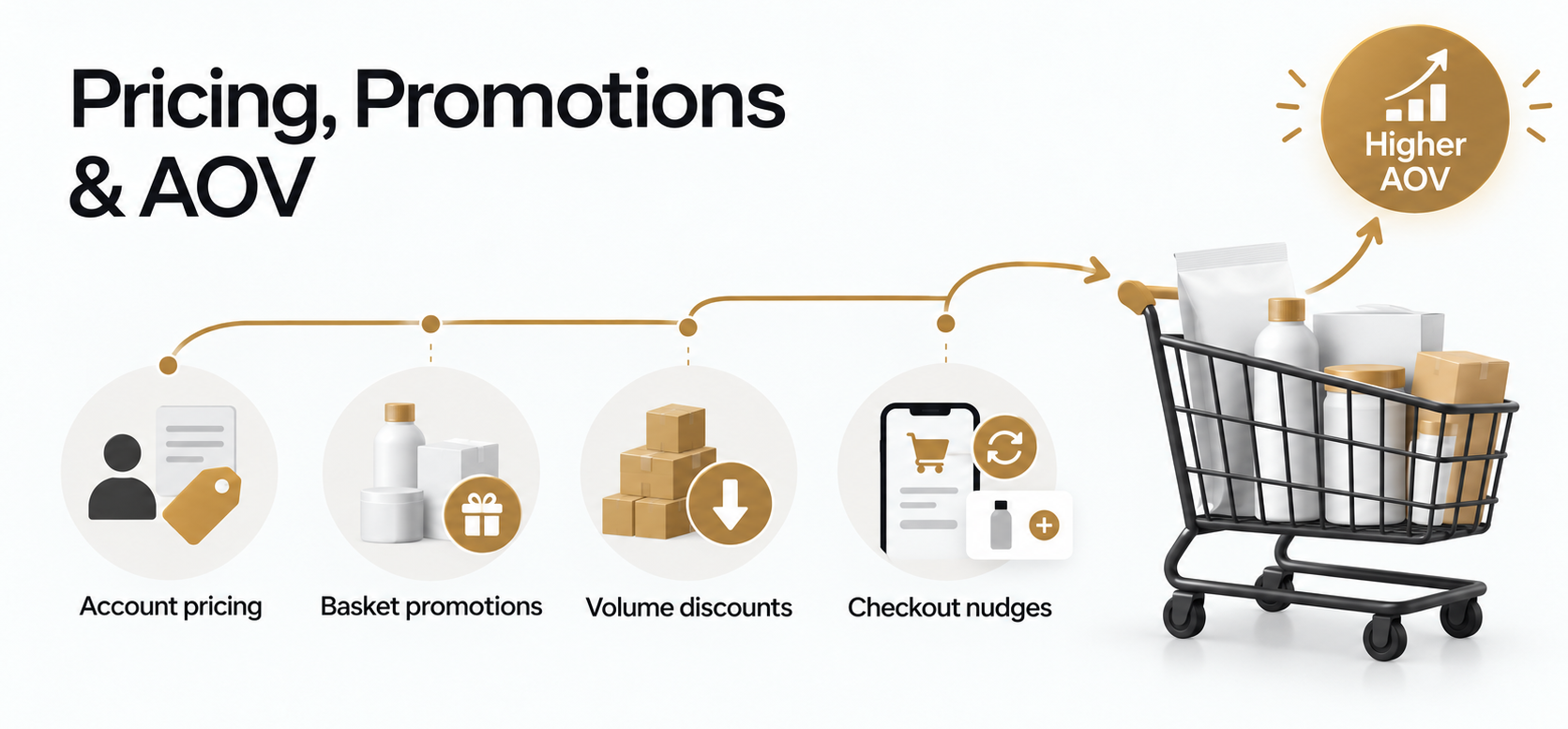
Pricing and promotions are where FMCG margins are won or lost. Getting the mechanics right online matters as much as getting them right in a contract negotiation.
- Account-specific price lists tied to contractual terms agreed during negotiation, applied automatically rather than manually re-keyed at order time.
- Promotions designed to lift the whole basket, not just move a single SKU. Bundle and threshold-based offers built around trade promotions calendars perform better than blanket discounts.
- Volume discounts and tiered rebates applied automatically at checkout so buyers see transparent pricing instead of discovering the real number on an invoice later.
- Checkout nudges, like bundle suggestions and reorder prompts, tested specifically for their effect on average order value across accounts, not just rolled out and left alone.
Operations: Integration, Supply Chain, and Fulfillment
The backend work is what makes the buyer-facing experience trustworthy. FMCG buyers notice immediately when stock or pricing data is wrong, and they don’t give many second chances.
- Data flows mapped clearly between the eCommerce platform and ERP, so nothing depends on someone remembering to run a manual export.
- Real-time inventory visibility defined per warehouse rather than only at the SKU level, since FMCG supply chains routinely split stock across multiple facilities.
- SLAs for order processing and delivery with clear ownership when they’re missed. Ambiguity here is where fulfillment problems turn into churned accounts.
Supply chain disruptions are close to inevitable at some point in any given year. The brands that recover fastest are the ones whose eCommerce and supply chain systems were designed to talk to each other from the start.
This guide on pairing B2B eCommerce with supply chain management goes deeper into how that integration should be structured.
Mobile, Sales Force Enablement, and Field Apps for FMCG B2B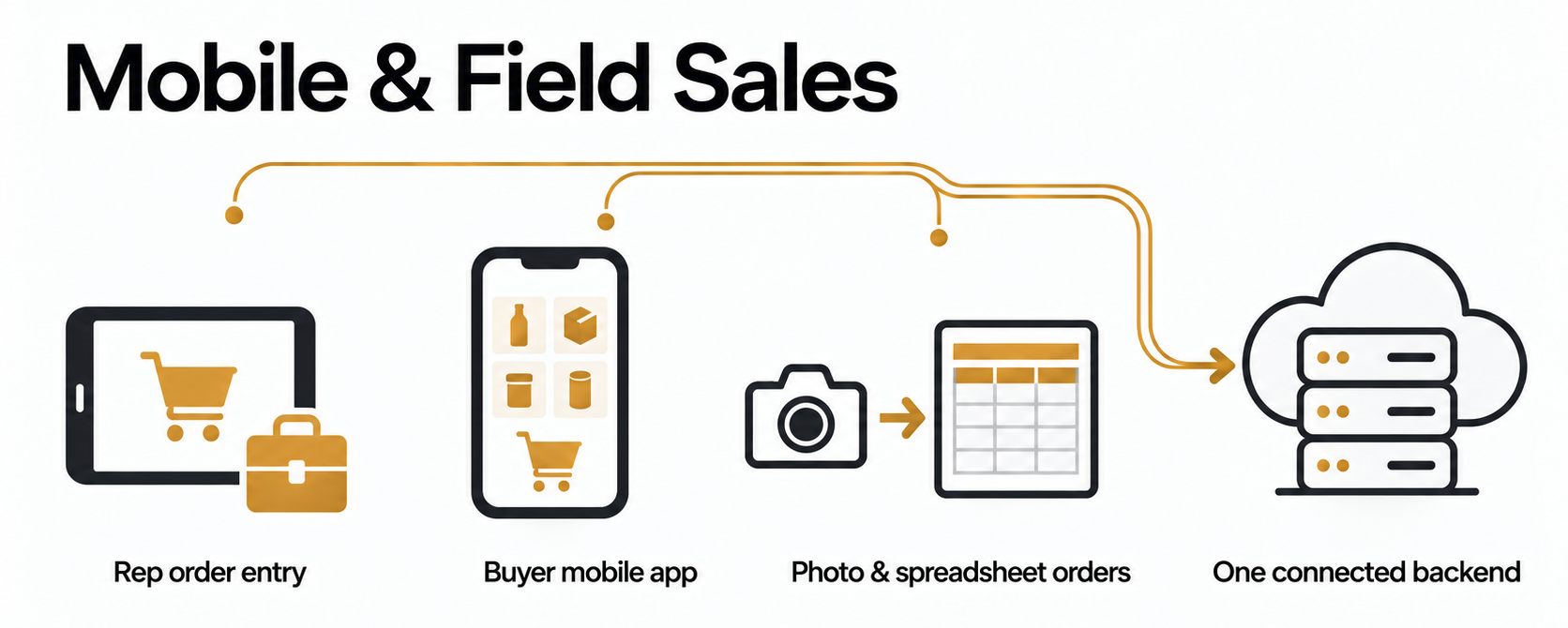
FMCG selling still happens in the field as much as it happens online. Mobile tools need to support reps as much as they support buyers.
- Mobile order-entry tools for sales reps visiting retail and wholesale accounts, including at trade events where a rep needs to place an order on the spot rather than follow up days later.
- A buyer-facing app for retailers who’d rather order from mobile apps on a phone than log into a desktop self-service portal.
- Photo and spreadsheet ordering options that meet buyers who aren’t ready for full self-service partway, instead of forcing an all-or-nothing switch.
For a closer look at how field sales and digital ordering can share the same backend, this walkthrough of the OroCommerce mobile field sales app covers assisted selling in more detail.
Emerging Markets Playbook for FMCG Brands
Expanding into a new region adds localization requirements that a single-market rollout never had to solve for.
- Localized catalogs and vernacular content per region, not machine-translated storefronts that read as an afterthought to a local buyer.
- Alternate payment methods and credit options that match how buyers in Asia Pacific or the Middle East actually prefer to pay. Assuming card-based payment workflows from a mature market rarely translates.
- Partnerships with local logistics infrastructure and fintech providers to fill the gaps a software platform alone can’t solve. Last-mile delivery and local credit assessment are the two that come up most often.
For the fuller framework, this resource on cross-border eCommerce solutions covers the regulatory and logistical side in more depth than fits here.
KPIs and ROI: Tracking Average Order Value and Platform Performance
None of the above matters if you can’t prove it’s working. Track these against a pre-launch baseline, not in isolation.
| KPI | What it shows | Cadence |
|---|---|---|
| Average order value | Whether pricing, bundling, and checkout nudges are actually lifting basket size | Weekly and monthly |
| Digital order share vs. total FMCG sales | Real channel shift in market share, rather than assumed adoption | Monthly |
| Payback period and three-year ROI | Return against the cost figures established during platform selection | Quarterly |
These three numbers separate a platform investment that’s genuinely paying off from one that just looks busy on a dashboard. Increasingly, they’re informed by real-time insights from artificial intelligence-driven demand forecasting rather than manual spreadsheet modeling.
Implementation Plan and Phased Rollout
A phased sequence beats a big-bang launch almost every time in FMCG, where the operational cost of getting it wrong on day one is high.
- Assemble a cross-functional launch team spanning sales, IT, and operations before any vendor conversation gets serious.
- Define MVP scope for a single pilot market rather than trying to launch everywhere at once.
- Run the pilot with a representative distributor cohort, not just the easiest accounts to please.
- Scale ERP integrations gradually rather than connecting every system simultaneously.
- Onboard top customers with dedicated training so early adoption data is actually meaningful.
- Continuously optimize based on buyer feedback rather than treating launch day as the finish line.
Automating the repetitive parts of this rollout early pays off later. See these B2B eСommerce workflow automation ideas for where to start.
Checklist and Next Steps for FMCG Businesses
- Shortlist vendors against the FMCG-specific criteria covered earlier in this playbook, not a generic ecommerce checklist that ignores category requirements.
- Prepare an RFP that includes concrete performance targets, average order value and digital order share goals, not just a feature list with boxes to check.
- Schedule vendor demos built around real FMCG use cases, such as multi-warehouse inventory or contract pricing scenarios, rather than a generic product tour.
- Map your current data flows between ERP, PIM, and any existing storefront before the first vendor call, so integration gaps surface early instead of mid-implementation.
- Bring a sales rep, a procurement stakeholder, and someone from operations into every shortlist evaluation. A platform that only satisfies IT rarely survives contact with the field.
- Set a realistic pilot timeline and success threshold in writing before signing, so “the rollout is working” is a measurable claim rather than a feeling six months in.
- Revisit the shortlist criteria annually as your channel mix, SKU count, or regional footprint changes, rather than assuming the platform decision only needs to be made once.
Treat this checklist as the filter that keeps the rest of the playbook honest. If a vendor or a plan can’t survive it, it isn’t ready for your business.
Conclusion About FMCG B2B Ecommerce
FMCG B2B eСommerce succeeds when pricing, catalogs, mobile enablement, and operations are unified rather than patched together from separate tools that don’t talk to each other.
OroCommerce was built specifically for that requirement set: layered pricing, multi-warehouse visibility, CRM, and multi-channel support in one platform, not five.
See how OroCommerce supports high-volume B2B ordering, account-specific pricing, and multi-market operations.
FAQs About FMCG B2B Ecommerce
What is FMCG B2B ecommerce?
FMCG B2B ecommerce is the use of digital platforms to manage wholesale ordering between fast-moving consumer goods manufacturers or distributors and their business customers, such as retailers, resellers, and distributors. It replaces manual processes like phone and fax orders with self-service catalogs, account-specific pricing, and real-time stock visibility.
Why is the FMCG sector investing in digital commerce platforms now?
Buyers increasingly expect the same speed and convenience in wholesale ordering that they get as consumers, and manual order-taking creates pricing errors and delays that digital tools eliminate. Digital commerce also lets brands enter new regions faster than building out a traditional field sales presence would allow.
How does e-commerce improve supply chain visibility for FMCG companies?
A connected ecommerce platform syncs inventory data directly with the ERP and warehouse systems, so stock levels shown to buyers reflect what’s actually available at each location. This reduces overselling, speeds up fulfillment, and gives operations teams earlier warning when a SKU is running low.
Can ecommerce help FMCG businesses achieve unified commerce across regions and brands?
Yes, provided the platform supports multiple storefronts, currencies, and account hierarchies from a single backend rather than running separate systems per region. This lets a company maintain consistent product data and pricing logic globally while still adapting the buyer experience to local market needs.
What are the top 10 B2B ecommerce platforms?
The B2B ecommerce space is led by a mix of enterprise-grade and mid-market platforms, each suited to different catalog sizes, industries, and integration needs:
- OroCommerce
- Salesforce B2B Commerce Cloud
- Adobe Commerce for B2B
- SAP Commerce Cloud (formerly Hybris)
- Shopify Plus
- BigCommerce B2B Edition
- Commercetools
- Spryker
- Intershop
- Unilog
The right fit depends less on brand recognition and more on whether the platform natively handles account hierarchies, contract pricing, and multi-warehouse inventory out of the box, rather than through costly customization.
What are the top 5 FMCG companies?
By global revenue, the FMCG companies most commonly cited as industry leaders are Nestlé, Procter & Gamble, PepsiCo, Unilever, and the Coca-Cola Company. Exact rankings shift depending on whether the measure is total revenue, category breadth, or brand count, but these five consistently appear at the top of most industry lists.
What is B2B in eCommerce?
B2B in eCommerce refers to online transactions between two businesses rather than between a business and an individual consumer. For example, a manufacturer selling wholesale to a distributor or retailer through a digital storefront. It typically involves larger order volumes, negotiated pricing, and longer sales cycles than consumer-facing ecommerce.
What are the 7 types of e-commerce?
The seven commonly recognized e-commerce models are B2C (business-to-consumer), B2B (business-to-business), B2B2C (business-to-business-to-consumer), B2G (business-to-government), C2B (consumer-to-business), C2C (consumer-to-consumer), and D2C (direct-to-consumer). FMCG brands frequently operate across several of these models at once. That’s why unifying B2B, B2C, and B2B2C on a single platform matters so much for this industry.